Brad R. Torgersen
@BradRTorgersen • 13,189 subscribers
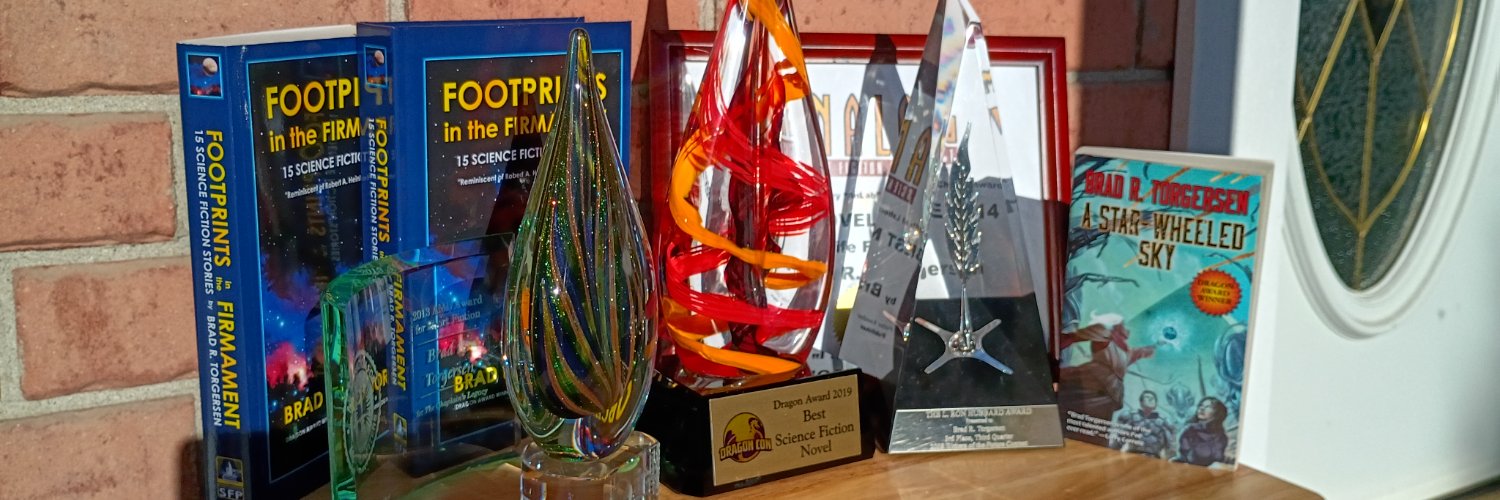
Full-time Army POG. CW4. Sci-fi writing. Has won some awards.
Videos

The problem is not that they put 7 of 9 in that fantastic spandex suit. The problem is that they left her in it for the duration. The suit was explained (in the story) as being a kind of 24th-century medical skin-sleeve. Worn to help her heal from the fact most of her Borg components had been surgically deleted. But after two or three episodes? 7 of 9 should have been in a regular ship's duty uniform, just like the Maquis before her. And for the same reason. The fact they kept Jeri in the spandex made the eye candy gimmick too obvious. And this diminished both the character and the series IMHO.
Brad R. Torgersen1,753,680 次观看 • 8 个月前

(TL;DR warning again) 41 years ago this month my local UHF channel began airing a kids cartoon unlike anything I'd ever seen before. Half-hour installments. Amazing animation which seemed a cut above most early 80s American childrens TV to that point. And the scripting was of a decidedly more adult nature than either Voltron or G.I. Joe. It only took one episode to suck me in. Because of the airplanes turning into robots, of course. It was the era of Optimus Prime duking it out with Megatron. Every American boy in 1985 adored both Transformers and GoBots. But these giant swing-wing "veritechs" were piloted by men. Against enormous aliens who were decidedly different from any I'd seen in any science fiction TV show before. And one episode's plot bled into another. These weren't capsule stories. The entire thing was one big story. Which I avidly tuned in to before school day after day. The war against the Zentraedi segued to the war against the Robotech Masters, which segued to the war with the Invid. I had no idea at the time I was seeing an Americanized kitbash of three distinct Japanese shows. It was all just extraordinary to me, and I never noticed the seams which had been papered over by American writers. There aren't many sci-fi franchises which have had an impact on me like ROBOTECH. Not even STAR WARS. The only sci-fi show which has a larger presence in my mental landscape is STAR TREK. And I not only owned the entirety of ROBOTECH on VHS—grainy TV tapes at first, then store-bought official copies after—I played the Palladium role-playing game with my H.S. friends. The remastered DVD sets which emerged 20 years ago never sat right with me because the sound effects got re-done. And it wasn't until I was on deployment trying to watch ripped .mp4 of the remasters that I realized just how badly those re-done sound effects jagged on my ear. I still remembered *all* the broadcast effects as they had been. And I wanted them back. Amazon briefly had rights to and streamed an "original broadcast" edition of ROBOTECH which kept the old effects. But this was license short-lived. And I ended up buying a *second* set of DVDs in the vain hope of getting a broadcast-true edition in hard media. Except, that set also ended up being the remastered sound effects. What to do? I kept hearing about "legacy" copies from turn of the century. After VHS, but before the remasters. This week I finally located a full 14-disc set of the "legacy" DVDs which supposedly are closest to broadcast. After ripping them to .mkv it seems true. I finally have digital hard media of the actual ROBOTECH I remember from my youth. 🤓
Brad R. Torgersen65,095 次观看 • 3 个月前

File under, "Things modern Hollywood seems to have forgotten how to do." Tell the story without dialogue. This combined scene is not even three minutes long, but it says so much about Max's post-civilizational reality. The hard desperation for necessities. To Max, a fork-full of dog chow has become a welcome feast. Enough for the Gyrocaptain to also attempt a go, except his fingers almost get bitten off. And so he waits for the dog to lose interest. Then scrapes a mouthful off the bottom of the can with his filthy fingers. And finishes by dabbing daintily at his lips with a kerchief. Not the act of a slovenly man. There's suddenly more to him than we the audience were initially given to believe. This is such great exposition. And nobody says a single word. We are shown the plight of post-apocalyptic humanity not with action, nor spectacle, but silence.
Brad R. Torgersen49,987 次观看 • 2 个月前

The Cold War gifted us with a lot of spy movies outside James Bond. One of my favorites was a kitbash: spy flick, fighter jock flick, and Vietnam vet malaise flick. FIREFOX was based on a 1977 technothriller which predated THE HUNT FOR RED OCTOBER by 7 years. As others have noted, this was a different role for Clint Eastwood (who also produced and directed) because Mitchell Gant wasn't just an implacable, sandpapery tough guy. He was struggling with mental and emotional scars left from the Vietnam war, at the same time he struggled with justifying the sacrifice of all his Russian accomplices for the sake of stealing a super-jet. Gant: "Don't you resent those men in London ordering you to die?" Baronovich: "Mister Gant, you are an American. You are a free man. I'm not. There is the difference. So, if I resent the men in London ordering me to die, then it is a small thing compared to my resentment of the KGB." Freddie Jones. Nigel Hawthorne. Kenneth Colley. It's a very good ensemble of character actors all of whom turn in very good performances. The tension (for Gant) begins the moment he leaves the Moscow hotel, and never lets up. And all of that before we even get to the air combat portion, which is rather substantial once Gant gets the MiG-31 into the air. The plot is alt-history now, of course. And nobody in the early 1980s guessed that the Soviet Union would be gone ten years later. Back when this movie was made the Russian menace loomed larger than ever, thanks to the nuclear nightmare that still haunted many imaginations. Again, such a good spy movie, that's much more than a spy movie. And this scene in particular always stops me in my tracks. It says so much, without a line of dialogue. It's as if Gant's passing into a stable, and witnessing the blackest of Hell's own stallions. Sleek. Powerful. Unmatched prowess. Just waiting for a rider. And behind it? Its twin. A perfect foreshadowing. I never read the original book, nor its sequel. But I did read the 1987 threequel Winter Hawk. which again successfully blended spy stories, war technology, and the suffocating presence of the Communist state through which Gant must once again travel in order to stop a Soviet superweapon.
Brad R. Torgersen81,411 次观看 • 5 个月前

Why I have loved STAR TREK since I was 13 years old. This is your TL;DR warning. I didn't fall for TOS, even though I'd seen it a lot in UHF re-runs. I didn't even fall for Wrath of Khan, though I saw it first-run in the theater in 1982—and it's still widely regarded as the best Trek movie for very good reasons. I fell for The Search For Spock. And not because of the contrived way they undid the tragic beauty of the second film's ending. But for the notion of Starfleet as presented on film. Something about the gliding return to Spacedock. Rand standing there shaking her head at the repaired damage to the hull. Kirk, Scotty, and Sulu remarking on the Excelsior. And then (of course) Kirk's ballsy decision to choose loyalty above duty. The theft of the Enterprise. That scene in particular. I never don't get chills with that scene. It still moves me in ways I cannot sufficiently put to words. Anyway, right movie, right moment in my life. I re-watched it endlessly on VHS, then backed up and re-watched Khan and also The Motion Picture. And fell for them in different ways, for different reasons. Have seen all three countless times. Love the original crew mated to 1980s quality film special effects. Love the NCC-1701 refit. And consider it peak Enterprise after all these years. And I went back and rented almost all of TOS from Blockbuster when they had it in VHS. Appreciated the true standout episodes like "The Doomsday Machine" and "Balance of Terror." All of this was hugely impactful on my adolescence. Leaving a mark that's lasted all the way to now. Some people seem to love the idea of the UFP. Especially people on the Leftward side of American politics. Who insist that it's a Socialist utopia. I found it attractive when I was young, for most of the same reasons the Lefties do, but as I got older I realized it was just wishcasting. Especially those TNG scripts with all the snobby, "Your primitive planet is not ready for us evolved and superior Feddies, dear prole!" episodes. Side note: part of what makes Quark great is Quark is the perfect foil taking the air out of the Federation's tires during DS9's run. Some very good writing (and on-the-nose reflection) in those scripts. But Starfleet itself? Remained a wonderful representation of a space navy. I have never not been enamored with it. Yes, some folks consider it too goody-two-shoes for their taste. I can see why. But Starfleet—and especially the TOS crew at motion picture scale—made me want to *BE* on the Enterprise. They could make me a fobbit POG who never does a single away mission and I wouldn't care. Just being aboard. Being part of that. That's what ignited my 13 year old brain. And kept me going into successive films, and also TNG, and then DS9, and then VOY. The fascination with Starfleet never left me. And while 23+ years of IRL military service has shown me all the mistakes and misguided notions—especially that moronic "Starfleet is not a military!" stuff certain script people tried desperately to shoe-horn into the plots—I've never lost my admiration for the idea: a fleet of ships, crewed with the finest the galaxy has to offer, exploring and patrolling the far reaches of interstellar space. Armed for war, they nevertheless go in peace. To seek out and catalogue new solar systems, new planets, new species, new civilizations, Boldly Go, and so forth. What a wonderful idea. It doesn't get old. Not to me. And maybe that's why I get so damned unhappy with Nu Trek Product™? It cheapens the characters, their service, even the very conceit. Turns it into a gimmick, a parody, or just downright vandalizes Starfleet. I don't hold with that. I refuse it, in fact. And I remember. I remember what it was like to be young, and feel the magic. Ever since Captain Styles pressed the button on his arm rest and said, "Kirk, you do this you'll never sit in the captain's chair again." And Kirk, unblinking, orders, "Warp speed." 🖖
Brad R. Torgersen92,424 次观看 • 6 个月前

I've said it before: even 50 years on, this remains one of the best arguments ever made for prepping. For getting out of the cities. For making a life as close to the land as can be managed, or at least, for having a plan to get back to the land when the crash inevitably comes.
Brad R. Torgersen82,615 次观看 • 9 个月前


TOS re-watch day 26: "Devil in the Dark" is absolutely a Top 5 episode for me, from the original series. There are only a handful of other TOS episodes I've re-watched as often as this one, and it remains excellent all these years later. Everything that makes TOS fire on all cylinders is present in this episode: a genuinely alien mystery, the big three cast each getting opportunities to flex his acting chops, an engineering dilemma for Scotty to solve, good guest stars who inhabit their roles nicely, and a practical worldbuilding problem which drives the drama: beyond dealing with a mere monster inhabiting the shadows, Kirk and his crew have to get the mining colony back into operation for the sake of many other Federation colonies who all rely on the miners' product. The questionable physics of a silicon-based deep-dish pizza creature moving through basalt the way we move through air, takes a back seat to the human problem of confronting a murderous entity which only reveals its true nature at the very end. When the miners have to also face their nature. Each of the species reacting against the other, until Spock (with the mind meld) can broker an understanding. I mentioned in my last review that this was a far better example of Nimoy being unleashed from his stone-faced stoicism, than was true in, "This Side of Paradise." Considering the fact Nimoy is having to convincingly and heavily emote—while clutching at throbbing bladders of spray-painted foam—really shows his range. Meanwhile, the irascible DeForest Kelley gets in several Bones-ian lines such as, "I'm a doctor, not a bricklayer!" while barking orders to a junior officer on the ship, and questioning Spock's theses, at the same time simultaneously giving us clues to the mystery through cool-headed forensic talk. And this specific scene—where Shatner discovers the main clutch of Horta eggs—he's staring up into the ceiling of a sound stage. But has to make the audience think he's just seen the most astounding sight imaginable, which suddenly makes him realize just what it is the Horta's been killing for in the first place. Ken Lynch is terrific as Chief Vanderberg, and had an extensive credits history through film and television. A very comfortably familiar face who absolutely sells himself as the production-minded miners' boss. Miner Schmitter (Bill Elliott) likewise had a healthy list of credits, and was important in his brief but key portrayal of a working blue-collar man facing annihilation at the hands of the monster. Security Chief Giotto (John Duke, aka: Barry Russo) would later appear as Commodore Wesley in TOS episode, "The Ultimate Computer." And like Elliott and Lynch, had quite a run of credits. Unlike some other TOS outings, there really isn't much to complain about with this one. The scripting is tight, the plot advances smoothly, the anticipation (as well as horror) is real, and the solution at the end proves quite satisfying. And once again we have clear, undeniable proof that the Federation is not a moneyless utopia, much to the chagrin of Marxist Trekkies. Kirk remarks that Vanderberg and his men are going to be embarrassingly rich once the hatched Horta get going. Likewise, the other colonies depending on Janus VI for rare ores (like the fictional Pergium) are clearly *paying* for the stuff. And any delay in mining or shipping poses a big enough threat to the function of those colonies that Starfleet Command detours the Enterprise to investigate and solve the issue. Thus the economy surrounding the mining is integral to the plot, and inseparable from the worldbuilding. I love this episode. Start to finish. Again, Top 5 for TOS in my book.
Brad R. Torgersen22,282 次观看 • 3 个月前

This little montage of glamour shots from Star Trek III demonstrates why the "swoopy fighter plane" space sequences of so much later Trek feel so wrong to me. Nothing that big is gonna swerve, dodge, or barrel like an interceptor. We're talking about craft larger than the largest modern supercarrier. And space stations the size of a small moon. *Nothing* is going to be moving quickly, nor easily. The motion should be ponderous. Gliding. Majestic. Suggesting immense physical mass, in additional to physical size. All without ever saying a word to the audience. It's implied through pure visuals. Breathtaking.
Brad R. Torgersen65,484 次观看 • 1 年前


A brief pause in the Trekpoasting to announce that it's February. Which means it's time again for me to re-watch one of the great movies (IMHO) of the 1980s, featuring one of the greatest openings of the same decade. This is two minutes of very effective, very clever movie-making. Silence is essential to the first 45 seconds. You learn a lot just from what you see: the era, the character, and the genre are all suggested with visual clues. Then, when the first bandit bangs through that shack door—sixguns blazing—we're plunged directly into the teeth of the story. The music cue is magical. Rolling, ominous piano. Followed by lone horn, then trumpet. Signaling exactly what this movie will be. Perfectly complimenting the scenery. I admire this opening every bit as much as the opening to The Road Warrior, which is also on my list of amazing movie openings for the 1980s.
Brad R. Torgersen29,378 次观看 • 6 个月前

TOS re-watch day 27: "Errand of Mercy" gives us the debut of the Klingons, as well as John Colicos playing Commander Kor. A total of 27 years would elapse between Kor's first appearance, and his second. But Colicos' initial portrayal would do much to define who and what the Klingons would be throughout successive films and television series. The setup itself isn't a strong one: seemingly superpowerful beings masquerading as medieval pacifists—whose world lies at the fulcrum of the Klingon Empire's interstellar melee with the Federation—decide to settle the war before it's truly begun. No real reason given for why such Q-ish people would pretend to be mortal, nor for why they would care to solve the Federation's conflict with the Klingons. Except a constant assertion that they find violence abhorrent. So much so I find both Kor's and Kirk's irritation with the Organian's entirely reasonable. Especially since they refuse to explain themselves, while also telling the Klingons and Starfleet they don't understand. But that doesn't much matter. The real joy of the episode is Colicos' devilish Kor. Who sees in Kirk a worthy opponent against which to test his skill as a warrior, thus making the (assumed) victory so much sweeter. Nearly all Klingon portrayals afterward would tie back to this focal point of culture: the Klingon people are conquerors, and a Klingon untested against a worthy foe is not a Klingon. The aesthetic of TOS Klingons is ersatz-Mongolian, of course. With not much beyond the sash surviving to TNG and Michael Dorn's portrayal of Worf. The look and feel of the Klingons during the Shatner-era movies is rather different, and more long-lived. But still, the Klingons of Kor's introduction are a martial species. Who see the galaxy as a thing to be taken by blood, versus negotiation. The conclusion of this story doesn't sit well with me, only because almost everything that comes after puts the lie to the idea that the Organians have somehow imposed a galaxy-wide halt to Klingons vs. Federation conflict. But I think it stands in the upper third of outings for TOS. Purely on the strength of Colicos' performance, and the vitality the Klingons provide.
Brad R. Torgersen17,514 次观看 • 3 个月前

27 years ago PBS aired this retrospective on the Apollo program. I've recaptured it in three parts and am putting it here, so as to preserve the interviews with the astronauts and NASA staff especially. Many of whom are dead now. Hear them in their own words. (part 1 of 3)
Brad R. Torgersen19,767 次观看 • 3 个月前

1:57
Sensitive content
This media may contain sensitive content.
TOS re-watch day 30: "Operation—Annihilate!" is one I well remember from my childhood. Those jellyfish parasite aliens were not only repulsive, what they did to Spock and the other victims really disturbed me. It was the first time I can remember seeing any TV wherein the alien menace didn't just horribly harm the heroes, it used them for its own malicious purposes. As a science fiction conceit it's rather grotesquely interesting. A hive lifeform which isn't sentient at the granular level, but as a collective it can take over whole populations which it then uses to spread itself to other worlds. Any attempt by the infected to disobey the instincts of the hive is met with agonizing pain, therefore the infected don't dare disobey. Truly an awful concept for a monster. The story's solution recalled to mind the demise of the Vorvon from 1980's Buck Rogers. In that the fleeing Denevan has to pilot his ship into the sun to be free of the hive parasite controlling him. Just as Buck and Wilma have to pilot into a star to kill the Vorvon and end its possessive hold on Col. Deering. Back to Trek: the death of Sam Kirk is an interesting plot point in that this is the only time Kirk's older brother gets any mention or screen time. And his nephew Peter is only ever seen unconscious, so we never know what happened to him as an orphaned teenager. It might have been a nice cameo in one of the Shatner movies if Peter Kirk had made an appearance. Even if just for a line or two of dialogue. Spock's Vulcan inner eyelid also never gets additional mention in any future episodes, though I have often thought that it might explain why Spock seems blinded following his exposure to the Enterprise's dilithium core in the climax of the second film. Enough for Spock to only be able to follow the sound of Kirk's voice through the comm system, not perceive the transparent barrier separating them in Main Engineering. Again, my memory of seeing this one when I was a kid was that it terrified me significantly. Those little buzzing splats of space snot were not something my adolescent self brushed off easily. They hung around in the back of my imagination. (shudder)
Brad R. Torgersen14,697 次观看 • 2 个月前

I'm plucking this Bridget Phetasy clip out for special emphasis. Because this explains how I felt, and still feel. The problem is not that vaccines are all evil. They're not. I trust vaccination as a proven medical technology. The problem is that authorities were threatening people with losing their jobs or even going to jail, unless they got the Coof Vax. Seldom did these authorities ever say, "We highly advise people to . . ." No. It was mandates and threats almost immediately. And when months passed and the claims being made were revealed as false, the people giving the mandates and making the threats doubled down. I am willing to risk someone from the margin, like RFK Jr., reforming national healthcare offices. Because I absolutely do not trust nor believe the people who've run those offices for the past ten years are at all interested in my well-being. I saw them happily get people in the military discharged without recourse, for saying, "I don't trust this vax, and I don't think I should be forced to get it." Doing nothing to fix the authoritarianism, is not an option. RFK Jr. might prove to be a nutbag, but the status quo had gotten so bad, the sane choice *is* to risk the nutbag. Versus the proven maliciousness of the Faucists. (yes, I spelled that deliberately.)
Brad R. Torgersen50,890 次观看 • 1 年前

TOS re-watch day 29: "The City On the Edge of Forever" often rates as Star Trek's finest hour, at least for the original series. And often rates Top 10 for Star Trek in its entirety. Few other Trek episodes have received as much critical and popular praise. And I am certainly among those Trek fans who agree that it's one of TOS's most moving and evocative stories. But I stop short of awarding it my personal status of most favorite. That probably falls to either, "Devil in the Dark," or "The Doomsday Machine." The latter having been written by a contemporary of Harlan Ellison, who wrote this episode. In each instance Trek was striving to bring actual, competent science fiction authors to the lore. And with "The City On the Edge of Forever" the franchise has a true winner. The time travel stakes are familiar to most of us, now. We who came of age with movies like The Terminator, which was also based loosely (so the legal settlement goes) on a Harlan Ellison story. But in 1967 this wasn't so. And the idea that meddling with the past might dramatically alter the present was something new to a lot of television viewers. Could the life or death of even one person have such a drastic effect on the course of history? How badly would things be derailed by intentional or accidental alteration? McCoy's overdose-induced paranoia and madness is mostly a plot contrivance to arrange the circumstances. As is the Guardian itself. An inexplicable relic of a long-dead civilization which apparently mastered not just space, but also time, and incorporated this mastery into a living, thinking device capable of bridging both. That conceit alone is heady. But what the story does with it is better yet. And Joan Collins is a stunning performer, as Edith Keeler. The woman idealistically seeing toward so much, but through whom the trajectory of the 20th century will be altered terribly if she's allowed to live. It's a very good moral question: if you permit Edith to die, or cause her death, is that somehow better than letting her survive? But in so doing altering events so that a more terrible chain of reality ripples forward in time? Can Kirk live with himself when it's all over? Can Spock? Or Bones? The expressions all three men wear when they re-emerge from the Guardian's open portal, tell precisely the toll their journey has taken. Episodes like this are 100% the reason why Star Trek gained such a broad audience in syndication. For every stinker like "The Alternative Factor" doing Star Trek at its worst, there's a genuine gem like "The City On the Edge of Forever" doing Star Trek at its best. IIRC they re-visited the Guardian in at least one of the old Pocketbooks Star Trek novels. Though, I can't remember ever owning a copy. Such a planet featuring such a device would (given the wider lore of TNG and DS9) almost certainly have become one of the Federation's most tightly-held secrets. The Department of Temporal Investigations specifically would be maniacal in desiring control over the Guardian. Defended and protected at practically any cost. Or even destroyed (if possible) so as to prevent the Guardian from being used or abused by anyone; be they Starfleet, or someone from an adversarial nation.
Brad R. Torgersen12,713 次观看 • 2 个月前

没有更多内容可加载