
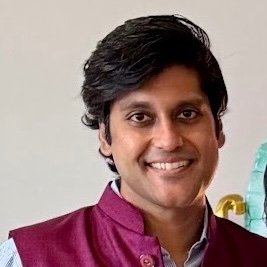
Gaurab Chakrabarti
@Gaurab • 40,935 subscribers
CEO @Solugen | MD/PhD building the modern chemical industry | Making molecules that power humanity | Takes on manufacturing, energy, molecules, and biology
Videos

We spent $15,000 on billboards targeting one person: the guy controlling all the chemical spend at a saltwater disposal company in Texas. We mapped his commute and bought every billboard between his house and the oil field. When we finally called, he said "I see your billboards everywhere." That landed us our first oil field contract. At the time our entire operation was a $10,000 reactor built from PVC pipes from Home Depot, turning corn sugar into industrial chemicals. People keep trying to throw it away. It still works. That leaking reactor started a multibillion-dollar company. Y Combinator visited our plant in Houston. The original PVC reactor is still on the floor next to the Bioforge.
Gaurab Chakrabarti932,141 görüntüleme • 5 ay önce

Our first reactor? Sean Hunt and I built it from Home Depot parts in three weeks. Rented a lab behind Dallas Love Field, had to rip out the ceiling panels to fit it. That machine started a multibillion-dollar company. People keep trying to throw it away. It still works. A year earlier I was 26, doing my MD/PhD, studying how pancreatic cancer hides from the immune system using chemistry. The mechanism? Cancer cells were producing hydrogen peroxide to blind immune cells. But the enzyme doing it? It was more efficient than anything in industrial chemistry. Cancer was outperforming a $6 trillion industry. A few months later, I was at a poker game in med school. Got seated next to Sean, an MIT chemical engineering PhD. He was studying hydrogen peroxide production at massive industrial scales. I told him his approach was techno-economically insane. Traditional chemical engineering: heat, pressure, heterogeneous catalysis. The whole industry operates at 20% yield and considers that acceptable. I'd just watched cancer cells hit 90%+. I was a cancer biologist. He was a chemical engineer. What if we married our two worlds? Six months later we pitched enzyme-based chemical production at MIT's 100K. We lost, taking second place for $10,000. I thought: "Either this works or I go be a doctor." So we drove Sean's Subaru to Home Depot and bought the biggest PVC pipe that we could find. They cut it so it would fit in the trunk. Three weeks later we had a leaking prototype, held together with zip ties, producing chemicals at 4x the industry average yield. That prototype made us the peroxide kings of Dallas. Two float spa owners saw our MIT pitch and shared it in their Facebook group. Suddenly we were supplying an entire niche we didn't know existed. We spent the next months driving around Houston, hand-delivering product. Made $10,000 a month from that PVC reactor. We had profitably miniaturized the chemicals industry. Same thing Nucor did for steel: decentralized production. That was 2016. Today: - Bioforges in Houston, Texas - Shipped 150M lbs of chemicals last year - DoD contracts for critical chemical precursors - Shipping container reactors deploying internationally - DOE Loan Programs Office funding (same program that backed Tesla) - Almost $1 billion raised from Founders Fund, Blackrock, Temasek, GIC, Baillie Gifford People have no idea how huge the chemical industry is. One of our customers: An 80-person water treatment company in rural America, quietly doing $250M annual revenue, with $150M spent just on chemicals. And there are thousands more like them. This is why it's a $6T market. And the supply chains are fragile. America has zero domestic TNT production until 2028. We import dozens of critical chemicals needed for semiconductor manufacturing. COVID and tariffs made it obvious: We don't make the chemicals we need to make the things we need. Much is learned in the making of things. You can read all the papers, draft business plans, theorize. But you don't know if it works until you're tearing out ceiling panels to fit a reactor and hand-delivering product to float spas at 6 AM. The gap between theoretically possible and actually manufacturable is where companies live or die. I keep finding that the hardest problems in one industry have already been solved in another, or by nature. Cancer biology solved industrial chemistry for us. Nucor proved the business model. Materials science is what unlocks Kardashev. Energy abundance needs materials breakthroughs. Defense needs domestic supply chains. AI scaling needs physical infrastructure. Physical bottlenecks determine whether we can actually build the future we're betting on. It all comes back to atoms. Here I share what I learn: the cross-industry connections, the weird market dynamics, the supply chain vulnerabilities nobody's talking about, and the (sometimes) boring technology that makes it happen. If you're building in the world of atoms, I want to hear from you. You can just do things.
Gaurab Chakrabarti173,036 görüntüleme • 6 ay önce

Automate everything except plumbing, and every plumber gets paid like LeBron. Short of super AGI, the humans doing physical work become the bottleneck. travis kalanick is right. But there's a layer beneath the plumber. Atoms runs driverless haul trucks in a Texas quarry. More than two million tons of limestone in eight months. Those trucks are moving atoms that already exist. So is the plumber. I build chemical plants. Software automated language and math because both are symbolic. A reaction has an equation too. That equation doesn't change when you scale it up, but everything else does. People tuned the pressure, the oxygen, and the flow by hand over decades. My plants run engineered enzymes into a metal catalyst. A model can write that synthesis. For now, you can only learn how the enzyme shears under the pump by... pumping it. That's part of why one wafer still takes 100+ chemicals and the US can't make 60% of them in the volumes the fabs need. If the plumber is the last mile of the physical world, the molecule is the last inch. The final thing to automate are the reactions that make the pipe in the plumber's hand possible.
Gaurab Chakrabarti16,130 görüntüleme • 21 gün önce

SpaceX mastered full-flow staged combustion - the most challenging engine cycle ever flown. Every propellant drop runs through turbopumps before reaching the combustion chamber. The catch? Parts face 600 bar pressures and extreme temperatures. This demanded a new approach...
Gaurab Chakrabarti183,695 görüntüleme • 1 yıl önce

We built a chemical plant next to a church. Permitted in under a month:
Gaurab Chakrabarti19,205 görüntüleme • 8 ay önce
Daha fazla içerik yok.