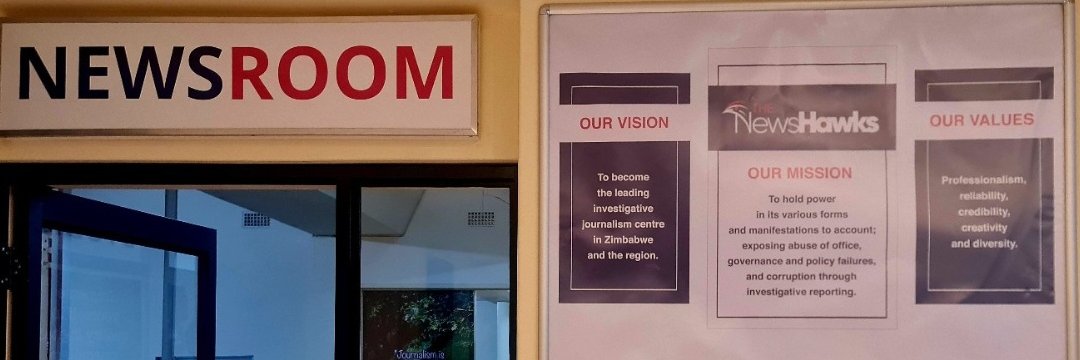

TheNewsHawks
@NewsHawksLive • 136,132 subscribers
Zimbabwe's leading digital investigative reporting, breaking news & analysis platform. Independent. Factual. Impartial. Fearless. https://t.co/fl36ibjgGe
Shorts


Videos

🔴The convoy of three cars which have been menacingly following retired Air Force of Zimbabwe Air Vice-Marshal Henry Muchena and his wife for close to a week now, includes a silver Honda vessel AGC 6549; white Mercedes Benz AES 6579 and white Toyota Hilux AFC 9059. It suspected that these are state security agents brazenly running an overt and ominous surveillance operation to harass and intimidate Muchena - while also sending a warning to other former army commanders - for his bold resistance and attacks on the recent far-reaching constitutional amendments extending President Emmerson Mnangagwa’s tenure by two more years from 2028 to 2030.
TheNewsHawks126,192 просмотров • 10 дней назад

Despite that the Karoi-Binga Road is a strategic 343-kilometre transport corridor in Zimbabwe that significantly shortens the travel distance between Harare and Victoria Falls by more than 200 kilometres, it remains hardly navigable for ordinary travellers. Yet it creates a direct, efficient link between Mashonaland West and Matabeleland North provinces, cutting down travel time and transit costs. The route has huge economic value as it unlocks access to major tourism destinations, including Binga, Matusadonha National Park, Bumi Hills, and Hwange National Park, while connecting Kariba and Victoria Falls. However, the Karoi-Binga Road is rugged and in a dilapidated state, only navigable and passable by high-clearance 4x4 vehicles. The road features rough gravel, rocky sections, and deep sand rather than being entirely closed or permanently non-navigable.
TheNewsHawks16,262 просмотров • 2 дней назад

🔵If white people were to leave Africa for good, particularly South Africa, black people will starve, according to the world's richest man Elon Musk's father Errol. Is this a racist and patronising stereotype or simply a realistic economic assessment, or both?
TheNewsHawks235,924 просмотров • 1 месяц назад

United Kingdom triple-murder fugitive Ndodana Mkhanyisi Tshuma has pleaded guilty in the Johannesburg Magistrate's Court to charges of unlawful possession of a firearm and ammunition, as well as violating South Africa's Immigration Act. The 45-year-old British citizen of Zimbabwean descent pleaded guilty to all four counts regarding an unlicensed 9mm handgun and ammunition found when he was arrested in Kensington, Johannesburg on July 10 for allegedly killing his wife Zandile Nothabo Khumalo (42) and her daughters Natalie (15) and Nala (5). He apparently killed them on July 3 and fled the UK the following day, July 4, to South Africa via Dubai, arriving July 5. There bodies were discovered on July 6. The three were buried on August 4 in Luveve Cemetery, Bulawayo. Tshuma also admitted to contravening immigration laws by residing in South Africa, while being a wanted fugitive. The guilty plea followed a Section 105A agreement negotiated between the state and the defence. Prior to the agreement, the state noted it intended to use the local firearm charges to expedite his processing or fine him to clear the path for fast-tracked legal proceedings. According to the National Prosecuting Authority (NPA), Tshuma entered South Africa legally via OR Tambo International Airport on July 5. However, once UK authorities activated an Interpol red notice and arrest warrant, his legal status changed under the Immigration Act to a "prohibited and undesirable person". Tshuma is a wanted fugitive in the UK for allegedly murdering of his wife and their two daughters. Their bodies were discovered at their home in Great Denham, Bedfordshire, after Tshuma fled via London's Heathrow Airport. The victims were repatriated and buried in Bulawayo after a month of investigations, autopsies and paperwork. Police say they died from "blunt force trauma", meaning Tshuma used a blunt object to kill them. The South African firearm conviction and his broader UK extradition case are being handled as separate legal tracks, with the NPA confirming that the necessary UK extradition documents are finalised. During Tshuma's last court appearance before today, on the roll for further investigation and progression of the local firearm case alongside the provisional UK extradition proceedings, the deceased’s families - the Khumalos and Magonyas - expressed faith in the judicial system, but deep frustration that the wheels of justice are turning slowly for them.
TheNewsHawks16,520 просмотров • 5 дней назад

After President Emmerson Mnangagwa unexpectedly aborted his trip to Bulawayo to open officially open the ongoing Mining Engineering and Transport Expo (Mine Entra) exhibition, Vice-President Constantino Chiwenga is now set to perform the duty amid speculation why his boss decided last minute not to attend. Mnangagwa was expected to open the event on a day when there is a stayaway planned by civil society organisations and the opposition. Running under the theme, “Unearth, Transform, Prosper: Anchoring Economic Transformation Through Mining Value Chains”, the expo showcases mining companies, their activities and contributions to the economy.
TheNewsHawks106,163 просмотров • 1 месяц назад

Spooky characters, suspected to be state security agents, following retired Air Force of Zimbabwe Air Vice-Marshal Henry Muchena and his wife are back on their trail today after a few days reprieve in the aftermath of media exposure of their menacing activities. They are currently parked outside Muchena's family home in Glen Lorne, Harare. A convoy of three cars have been following them everywhere in the city for the past week in an ominous shdowing operation typical of the Central Intelligence Organisation (CIO)'s brazen "in-your-face" surveillance methods. Multiple videos by journalists show the suspected state security agents relentlessly trailing Muchena and his wife, while also besieging his Gen Lorne home. The surveillance operation started soon after his public opposition to Constitutional Amendment Act No. 3, which extends President Emmerson Mnangagwa’s term in office by two more years. Muchena is acting as the public face for a group of disgruntled retired senior military generals, ex-combatants, and senior civil servants opposing the changes. In March 2026, Muchena issued a statement and submitted a scathing parliamentary petition demanding a national referendum, arguing altering the constitution to extend power to a "select few" betrays the original ideals of Zimbabwe's liberation struggle. In May, Muchena and a group of eight retired military generals met Mnangagwa over two days to discuss the isssue. Mnangagwa dismissed the army ex-commanders, telling them, "Whoever wins, let them win," before the suspected state security entities began actively hounding Muchena's family. In one confrontation, his bravely wife approached the trailing vehicles, but the occupants covered their faces and refused to roll down their car windows or engage, even after local police were called to intervene so far unsuccessfully.
TheNewsHawks25,759 просмотров • 10 дней назад

#KaribaFerryDisasterIndepthAnalysis The Kariba Ferry Disaster: What the State Knew & What It Did By Dr Phillan Zamchiya Dear Reader, Government records, historical reports, survivor testimonies, media reports and official statements establish an uncomfortable pre-disaster history. Mbuya Nehanda, KF551, was a government passenger ferry operated by Zimbabwe’s Rural Infrastructure Development Agency (RIDA), providing public water transport on Lake Kariba. Five years before the tragedy, the Office of the President and Cabinet had acknowledged persistent breakdowns in the ageing ferry fleet on Lake Kariba and announced plans for refurbishment. The state had also documented the dependence of isolated lakeshore communities on government water transport. On 11 August 2026, evidence points to a safety warning advising boats not to sail because of dangerous waves. Mbuya Nehanda had a stated passenger capacity of 90, excluding crew, and required adequate life jackets. Yet that fateful afternoon on 11 August 2026 it sailed from Kariba for Chalala in Nyaminyami Rural District, carrying adults, children, infants and substantial cargo. It sank near Long Island. At least 80 people are confirmed dead, with the toll likely to rise, and 77 have been rescued. Before proceeding, my deepest condolences go to the bereaved families and survivors. I hope a national resolution of the following seven puzzles will help establish the truth, secure accountability and bring some measure of closure. First, what happened after the state identified serious problems with its own ferry fleet? Five years before Mbuya Nehanda sank, government had identified persistent breakdowns in the Lake Kariba fleet and announced plans to modernise it. In November 2021, Dr Martin Rushwaya, then Deputy Chief Secretary in the Office of the President and Cabinet, toured Nehanda, Chaminuka and Nyaminyami fleet. The state-owned Herald reported “constant breakdowns and high operating costs”, assessments of refurbishment needs, and new engines for Chaminuka costing about US$40 000. The unanswered question is what followed for the 41-year-old Mbuya Nehanda. Was it refurbished? Who received the contracts, for how much, and what work was actually completed? The inquiry must follow that documentary trail from the 2021 government diagnosis and promised refurbishment to the vessel that sailed on 11 August 2026. Second, was this simply an unpredictable weather event? Evidence suggests warning signs existed before Mbuya Nehanda started the journey. Weather undoubtedly matters. But weather explains the waves, not necessarily the decision to sail. Survivor Itai Marumisa told journalists that strong winds known in local lexicon as ‘Binga wave’ were already whipping across the lake, water was entering the boat and a battery and inverter were swept overboard. Passengers asked the captain not to sail and, according to Tatenda Sianjeme, repeatedly urged him after departure to turn back or shelter at an island. ZimLive reported that Brenda Javis said the Lake Captain had warned boats not to sail because of dangerous waves. Earlier disaster-risk work by Zimbabwe Red Cross Society identified strong winds and waves as recurring Lake Kariba dangers and established community warning mechanisms. However, the state subsequently attributed the disaster to an unexpected strengthening of the South Indian Ocean anticyclone, while President Mnangagwa described conditions as “rough and choppy.” It seems visible warnings were ignored. Third, how many people were actually aboard? The numbers expose a serious failure of passenger accounting. On 11 August, police spokesperson Paul Nyathi initially reported exactly 90 passengers and five crew. However, police later confirmed that 90 was Mbuya Nehanda’s official passenger capacity, excluding five crew. One crew member said they 153, now the number of casualties and survivors show they were more than that.
TheNewsHawks47,618 просмотров • 27 дней назад


South African tourist adventurer George van Deventer of Trans Africa Self-Drive & Tours explains the Masaisai sculpture - also known as the Kariba Wave - a landmark stone artwork located at the Kariba Heights Viewpoint in Zimbabwe; what it represents and means. Created by Kariba-born sculptor Ronika Tandi, the monumental piece was officially unveiled on August 24, 2018, and overlooks Lake Kariba, the largest man-made water reservoir in the world by volume.
TheNewsHawks44,640 просмотров • 27 дней назад

#SoldiersInvadeFarmEvictFarmers A group of soldiers have invaded, attacked and evicted farmers at the disputed Ingleborough Farm in Mazowe, Mashonaland Central province, in brazen violation of courts orders, including one recently issued by High Court Justice Neville Wamambo interdicting them from interfering in its operations. The troops came and booted out the farmers, including the mother and family Wonder Mukaira, a prominent indigenous farmer on the land which has been a battleground between civilian land owners and the military. In a renewed defiance of court orders and trampling upon the rule of law, senior military commanders invaded the farm despite being interdicted from interfering with the police and court sheriff implementing a lawful ruling to evict occupants loyal to them or their proxies. Wamambo on July 24 issued an interdict against Zimbabwe Defence Forces (ZDF) and Zimbabwe National Army (ZNA) commanders, Lieutenant-Colonel Ncube, Lieutenant-Colonel Malamba and another senior commander Chirwanemhuka, barring them from interfering with police and the sheriff enforcing execution of a court order under case number RHCH4996/22. This order was issued to evict the unlawful occupants backed by the soldiers. However, on April 9, 2026, armed soldiers blocked the High Court sheriff from enforcing the order to evict their proxies. This forced one of the farmers, Tryness Kabiti, to return to court seeking an order to interdict the soldiers from their continued interference and, specifically, to allow police and the sheriff to enforce the eviction order. Wamambo's July 24 court interdict reads: INTERIM RELIEF GRANTED Pending determination of this matter, the Applicant is granted the following relief - 1. The 1st, 2nd and 3rd respondents (soldiers - Ncube, Malamba and Chirwanemhuka)be and are hereby each ordered interdicted from interfering with the 5th and 6th (police and sheriff) respondent’s execution of the court order under case number RHCH4996/22, being the eviction of the 1st to the 6th defendants in that matter from the Remaining extent of Ingleborough Farm situated in the Mazowe District of Mashonaland Central Province measuring 100ha in extent. 2. The 1st, 2nd and 3rd respondents jointly and severally the one paying the others to be absolved refund the applicant the costs of the botched 9 April 2026 execution within seven days of the grant of this order. 3. The 1st to the 3rd respondents pays the cost of this application on the legal practitioner and client scale. But the soldiers - again - defied this court order as they freshly invaded the farm, which they did in April when they blocked police and the sheriff from executing an eviction order. The applicant, Kabiti, is operating under immense pressure from the aggressive soldiers. The respondents were Ncube, Malamba, Chirwanemhuka, another senior ZNA commander who is unnamed in court papers, a Zimbabwe Republic Police officer in charge of Marlborough Police Station and the Sheriff (Bindura). These military officers are still serving under the ZDF and ZNA. The case has been raging for many years. Tensions escalated on April 9, when armed soldiers blocked the High Court sheriff from executing a lawful eviction order against occupants on the land, who are their proxies. This led to the farm owners - Kabiti and Mukaira - to go back to court to seek relief. The saga revolves around a long-standing conflict between resettled indigenous farmers, including Kabiti and Mukaira, and ZDF soldiers. Indigenous farmers were originally allocated portions of the farm under the land reform programme around 2013. The state later reallocated portions or all of the property to the military for "institutional use", prompting years of court battles over offer letters and the farm. Military officers intervened during the April eviction bid, detaining the sheriff briefly and reinstating displaced settlers. Now they have evicted local farmers, breaking the law with impunity.
TheNewsHawks46,274 просмотров • 1 месяц назад

Botswana's President Duma Boko, who took office on November 1, 2024, captured singing a Xhosa religious song with fluent rendition. Boko reportedly has South African Xhosa origins and heritage. Xhosa-speaking people and communities are found in South Africa, Lesotho, Botswana, Namibia and Zimbabwe. With a population of about 9.6 million, Xhosas are the second largest ethnic group in South Africa after Zulu-speaking people who are about 15 million. They are mainly found in Eastern Cape, Western Cape, KwaZulu-Natal and Gauteng provinces. Born in 1969 in the Mahalapye area of Botswana, Boko, who is Tswana by nationality, is associated with Xhosa-speaking communities locally and in the region. The Botswana President attended Madiba Senior Secondary School, which carries a name similar to the late former South African president Nelson Mandela's Xhosa clan identity. This highlights Botswana's diverse, multi-ethnic, and multicultural background. Zimbabwe's has a small Xhosa population of at least 200 000 people, intertwined with Ndebeles, mainly found in Mbembesi and Ntabazinduna areas near Bulawayo. Xhosa is one of Zimbabwe’s 16 official languages, half of them found in South Africa; namely Ndebele (a Zulu dialect), Sotho, Venda, Tswana, Shangani, Xhosa, sign language and English.
TheNewsHawks234,784 просмотров • 6 месяцев назад

#ChivayoInStateHouseMeetingScandal #BarredFromSeeingNigerianBillionaire Prominent and flamboyant ex-convict tenderpreneur Wicknell Chivayo gatecrashed State House in Harare yesterday in a desperate bid to attend the meeting between President Emmerson Mnangagwa and Nigerian billionaire Aliko Dangote to sign a US$1 billion investment deal, but was barred from the event. The incident left Mnangagwa's security and protocol teams fretting, and those attending the event bewildered. Chivayo had lied to his hangers-on that he was going to meet Dangote to sign a mega deal and officials were waiting for him at State House. His social media hacks started posting false stories about the issue, with the narrative that he had an appointment with Mnangagwa and Dangote. Chivayo used that false claim to worm his way into State House to try to gatecrash the meeting for a photo opportunity as there was no business deal between him and Dangote. Before that, Chivayo had begged state officials and organisers to attend the event, but was rebuffed. Apart from Mnangagwa and Dangote, the meeting was attended by cabinet ministers, government officials and business executives. Chivayo, who has expressed public ambitions to be a billionaire and always hobnobs with Presidents in Africa and rich people whenever he gets a chance, stormed State House - uninvited - and tried to gatecrash the meeting, but was stopped dead in his tracks by Mnangagwa's aides, including his son Sean, who is part of the close security unit, and turned away. "It was drama; a spectacle. Chivayo was not invited to the meeting. He had spent some time trying to convince the President's protocol and security teams that he should be allowed to attend the Dangote meeting. He begged them for days, but all in vain. He badly wanted to see Dangote and pitch his quick-buck schemes, but, as usual, he had also seen a big photo opportunity for himself. So he contrived to deceive or scam his hangers-on and state officials. All he wanted was to get a photo with Dangote to enhance his status and in the process scam people that he is signing deals with the richest man in Africa, wealthiest black person in the world. Chivayo likes Dangote, but for his own interests. Yes, he truly admires him, but the difference is that one is a genuine businessman, while the other is a tenderpreneur. Their business models, values and ambitions are so different, and not aligned at all. One is building generational wealth, while the other one is looking for tenders, fame and flamboyance for temporary gratification," a senior government official who attended the meeting told The NewsHawks. "Chivayo's plan this time failed. He had plotted this after failing to get invited to the meeting. Under false pretences, he then negotiated his way at the gate into State House, which is a security breach I'm told, and tried to force his way into the meeting, but he was stopped. He was told it was not possible to attend because he was not invited. His attempt to name-drop the President was promptly and curtly rejected. He was told to go away, so he was embarrassed and humiliated." Journalists covering the event say they saw Chivayo walking towards State House offices after parking his car. "I saw him walking from his car coming to State House offices where we were, carrying a brown envelope and thought he had been invited last minute, but it soon became clear he was trying to gatecrash the meeting. This reminds me of the way he manoeuvred to take a photo with Kenyan President William Ruto at Trade Fair in Bulawayo last year. Out of that deft move, he has now become Ruto's friend and has got business opportunities in Kenya. That is his business model - infleunce-peddling; hence he has met many Presidents in the region, among them those from Uganda, Tanzania, Zambia, Mozambique, Nigeria and Malawi, among others. But this time it failed. It was really embarrassing. After the drama, he walked away with his tail between his legs."
TheNewsHawks297,116 просмотров • 10 месяцев назад

Zimbabwean-born author Sukoluhle "Sue" Nyathi is living a dream after a South African super-novella, The Polygamist, produced by Gugu Zuma-Ncube is dominating the screens locally and elsewhere. The Polygamist is based on the explosive 2012 debut novel by Nyathi who studied finance and investment at National University of Science & Technology in Bulawayo, Zimbabwe's second-largest city. It was produced by Zuma-Ncube, a South African producer, actress and daughter of former president Jacob Zuma and his ex-wife Nkosazana Dlamini-Zuma, a retired long-serving minister. Zuma-Ncube is daughter-in-law to Zimbabwean politician Welshman Ncube, a professor of law. She is married to Wesley Bongani Ncube. The Polygamist was directed by prominent Nigerian-born South African actor and writer best known for his role as Khaya Motene in the SABC 1 soapie Generations. Originally self-published in 2012 after being rejected by multiple publishers, the book became a massive cultural phenomenon following its June 2026 global adaptation into a 22-episode Netflix supernovela. The explosive story explores the deep complexities, secrets, and emotional wreckage of undercover polygamy in modern society. African societies have a long history of polygamy which still exists, although it is now mainly underground. Polygamy, specifically polygyny, where one man has multiple wives, is practiced by roughly 2% of the global population. It is highly localised, with the highest concentration occurring in the "polygamy belt" of West and Central Africa, alongside select parts of the Middle East and South Asia. It is also prevalent in Southern Africa, where Eswatini King Mswati III is the most prominent and leading polygamist with 16 wives, although some of them have died, quit or were divorced. According to biblical and historical accounts, King Solomon of ancient Israel had 700 wives and 300 concubines. The second Shah of Qajar Iran (1797–1834) is documented to have had more than 1 000 spouses. A controversial Islamic cleric from Bida, Nigeria, gained international attention in 2008 for having 86 wives. By the time of his passing in 2017, he reportedly had around 130 wives and 203 children. Within days of its release, the hit drama, The Polygamist, soared to the No.3 spot on Netflix worldwide, holding the No. 1 position in South Africa, Nigeria, Kenya, and several other countries across Africa, Europe, and the Caribbean. Premiered on June 12, 2026, the series explores themes of wealth, deception, and family dynamics, sparking viral debates across the continent and internationally. The dramatic film follows a wealthy businessman named Jonas Gomora (played by S'dumo Mtshali) and his public image as a family man when he was living as a closet polygamist. When he dies, Gomora's carefully hidden life of polygamy unravels, revealing a web of secret marriages, mistresses, and infidelity. The drama — which features other prominent stars like Gugu Gumede— centres on his social media influencer wife uncovering the deception. It is trending because the show has viewers and critics passionately debating the blurred lines between traditional polygamy and mere infidelity. It has sparked huge debate on polygamy, infidelity, patriarchy, domestic violence and absent fathers. Traditional polygamy requires consent and transparency, whereas the show's protagonist normalises deception and infidelity as part of his complicated life. The film has also caused a spike in reading the original source material - the book - across South Africa and Zimbabwe, among other countries. The Polygamist has South Africans from all walks of life talking and debating in animated and emotional ways. In this Newzroom Afrika interview, Arabile Gumede speaks to Nyathi, and Zuma-Ncube, the women who made it happen.
TheNewsHawks86,170 просмотров • 2 месяцев назад

🔴Another South African Marvel Manganyi explains why local employers prefer Zimbabweans and other foreigners for certain jobs or in particular sectors. He says it's a lie told by denialists or the uninformed that foreigners are preferred to South African due to cheap labour. He says work ethic, resilience and great determination to do the job without behaving like a cry baby or weakling is the real explanation for that trend. Many employers in certain sectors say they prefer foreigners because they work harder and hardly have excuses for non-performance or demand fat salaries and benefits without commensurate productivity and output to ensure company profitability.
TheNewsHawks94,159 просмотров • 3 месяцев назад

President Hakainde Hichilema of Zambia - where the ANC and its military wing uMkhonto weSizwe, together with their closest ally, Zapu and Zipra from Zimbabwe, were based during the liberation struggle - says xenophobic and violent anti-immigrant protests against black African migrants is wrong and must be stopped. Hichilema was echoing the same grave concerns expressed by many other African leaders, ordinary Africans and the world over the xenophobic, Afrophobic and ethnophobic attacks on foreigners by vigilante groups like tMarch and March led by Jacinta Zinhle Ngobese-Zuma who is rabidly anti-black immigrants. Her organisation was even promoting tribal prejudice and hate songs, especially against the Shangani people. As a result, the world is saying to South Africa, every country has sovereign authority to enforce its laws and deal with illegal migration, but no one has a right to treat other people - Africans in this case - in an inhuman, violent and cruel manner. South Africa, people across the continent say, must address the issue of illegal immigrants through its own constitution and the law, not vigilantism, lawlessness and barbarism. Ordinary South Africans blame immigrants for unemployment, crime, drugs, social service delivery failures, and social decay, among many other things. Vigilante groups have been taking the law into their own hands and going to clinics and schools to harass and block immigrants from accessing public services. They have been going around asking people for their IDs or passports - apartheid-style - claiming to be "cleaning up" the country, which is all unlawful. Further, they also have been invading small-to-medium enterprises, purporting to be flushing out foreigners, harassing owners and closing some of them, to justify extortion and looting at times. These ugly scenes have angered large parts of Africa and the world, while damaging the country's reputation. However, the majority of South Africans - who understand how the economy and the world work - do not support vigilante groups, xenophobia and violence. Most South Africans are not xenophobic, but have concerns about illegal immigration and its impact on their country and society. African leaders agree that illegal immigration must be addressed, but condemn the xenophobic and Afrophobic hostility and violence by anti-immigrant groups and extremists. Hichilema reminded South Africa how his country and many others sacrificed so much helping black South Africans to be free. Countries in the region supported, sheltered, fed, trained, funded and protected South African freedom fighters at a huge human life and financial cost at the height of the anti-apartheid struggle. Over one million people died and billions were lost in the region during apartheid South Africa's campaign of destabilisation which destroyed infrastructure, utilities and stopped development in other countries. Frontline States and other African countries helped South Africa to gain freedom through political, diplomatic, material, financial and logistical support. Vigilante group leaders, who thrive on propaganda, false narratives and exaggerated statistics, either ignore or don't know all that. So, Africans say South Africa does not owe these countries and their people anything, but it should never forget their sacrifices - the human life, financial and logistical costs on its behalf - when dealing with illegal immigrants and relating to blacks. In other words, they are saying South Africa must deal with illegal immigration without forgetting where it comes from, especially the black people whose history and destiny is tied to the rest of other Africans across the continent.
TheNewsHawks32,625 просмотров • 1 месяц назад


For some South Africans marching amd marching has now become almost like a daily, permanent occupation. This is a march led by Nkosikhona Phakel'umthakathi Ndabandaba going on now at KwaCeza, in Ulundi, Zululand District, KwaZulu-Natal province. The xenophobic and Afrophobic marches by vigilante groups are mainly targeted at black African immigrants - occasionally Pakistanis and Bangladeshis - in South Africa, largely Nigerians, Ghanaians, Malawians, Somalis, Mozambicans, Basotho and Zimbabweans, among others.
TheNewsHawks44,903 просмотров • 1 месяц назад

#MotivationalAndInspiringStories #EverySundayWeWillDeliverThem Dr Kudakwashe Mutenda, a Zimbabwean businessman, global corporate executive, and author educated in Japan who has travelled to 100 countries and worked in seven, says unless a country produces something it will not prosper. Unless Zimbabwe starts producing something of value and stop importing almost everything, "we are going nowhere". In general country does not need to produce everything it consumes to prosper, but it must produce something of value —whether goods or specialised services — to trade with others and grow economically. Importing things and becoming a wholesale for other countries is the fastest route to poverty and dependence. In a recent inspirational presentation at CDC Assembly about his life journey and global business sucess stories, Mutemba, known as the founder and managing director of Mwana Group, a local manufacturing and automotive solutions enterprise, says innovation, production and development are mutually reinforcing. Countries must be innovative, produce and trade in order to develop. He says due to deindustrialisation and lack of production; relying on imports, Zimbabwe is going backwards. In 2019, Mutenda transitioned from a highly lucrative international corporate career to establish Mwana Group in Zimbabwe. The company manufactures commercial vehicle components; a modern single car has about 30 000 parts — most notably automotive filters under the Mwana Filters brand — and provides maintenance services. Before returning to Zimbabwe, he worked for Daimler AG in Germany and Mitsubishi in Japan during his high-profile career with global automotive giants. He spent years managing operations across seven countries, including serving as the regional sales manager for Daimler Middle East & Levant in Dubai and heading Mercedes-Benz commercial customer services across 42 African nations from Nairobi. Coming from a humble background in Mufakose, Harare, he won scholarships to attend Prince Edward School and later study engineering in Japan. He became fluent in Japanese and completed his undergraduate, master's, and doctorate degrees entirely in the Japanese language. He earned two master's degrees from Sophia University, famously completing a two-year programme in just 13 months. In March 2026, he published his 488-page autobiography titled "My Life: Overcoming – Kukunda". The memoir serves as an inspirational blueprint for African entrepreneurship, detailing his journey from walking barefoot to primary school to succeeding in global boardrooms and overcoming early learning difficulties.
TheNewsHawks35,899 просмотров • 1 месяц назад

#NothaboAndDaughtersMurderCase The bodies of Nothabo Zandile Khumalo and her daughters Natalie and Nala murdered a month ago allegedly by her husband Ndodana Mkhanyisi Tshuma failed to arrive in Zimbabwe today - again - after missing a connecting flight in Addis Ababa to Bulawayo from London. They were initially scheduled to arrive in their home town of Bulawayo yesterday afternoon for burial on Monday or Tuesday. The Ethiopian Airlines flight that was carrying the bodies failed to land at Bole International Airport yesterday due to bad weather and had to divert to neighbouring Djibouti. By the time it arrived in Ethiopia from Djibouti, the connecting flight to Bulawayo from Bole International Airport had left. Ethiopian Airlines flies from Addis Ababa to Bulawayo via Ndola in Zambia, taking about six hours and 35 minutes. The route goes from Bole International Airport to Simon Mwansa Kapwepwe International Airport in Zambia. The continuation flight from Ndola to Joshua Mqabuko Nkomo International Airport in Bulawayo takes one hour and 40 minutes.
TheNewsHawks35,644 просмотров • 1 месяц назад
