
TechInnovation
@TechInnovationz • 7,802 subscribers
Tech enthusiast | Diving into quantum, AI, & space $IONQ ….| Insights on future-shaping companies🚀 | Follow me!
Shorts


Videos

$IONQ has a name for its 256-qubit system. Golden Flower. Cameron Chehreh, VP of Engineering and CTO for Public Sector at IonQ, reports the first one is being built. The architecture shift is in the same answer. Ions trapped in a photonic semiconductor QPU, away from the old design, with better than anticipated results on the design side and on the algorithms. He credits John Gamble and his team. Then the moment he calls the inflection. Physicists working alongside engineers, and engineering asking how to reach production scale. The commitment holds. Roadmap to 10,000 qubits on the date already published, and a cryptographically relevant machine before 2030. The Post-Quantum World, Protiviti, September 2. #IonQ #Quantum
TechInnovation61,497 Aufrufe • vor 23 Tagen

$IONQ Investor Day: five releases in one morning → Guidance. Full-year 2026 revenue now expected at $450 million to $460 million, against $280 to $290 million on 5 August. SkyWater is consolidated from 31 July, the day the acquisition closed, with intercompany revenue between the two eliminated. Inder Singh, CFO and COO, calls it the first combined guidance as a unified organization. → Superion 256. Sixth-generation platform, first ions trapped in prototype systems. The 256-qubit QPUs were fabricated at SkyWater after six tapeouts in the first half of 2026, with 12x more wafer lots in six months than at the previous foundry. Electronic Qubit Control on the chip, a standard server rack, less power than a rack of GPUs. Orders open, deliveries in 2027, first system pre-sold in Q1. Superion 10K is underway with CMOS on the chip, and Chris Ballance, President of Quantum Computing, puts full fault tolerance in a 2027 lab and commercial reality in 2028. → ECDLP blueprint. IonQ published an end-to-end resource estimate for Shor’s algorithm on secp256k1, the curve behind Bitcoin: 19,397 physical qubits, 1,457 logical, 25.7 days per attempt, on Walking Cat with qLDPC codes. The circuits themselves are withheld. Advance copies went to U.S. government and industry partners before publication. ML-DSA and SLH-DSA are unaffected. → SkyWater Quantum Solutions. A merchant offering for quantum process development, integration and manufacturing, led by Mihir Bhaskar as senior vice president and general manager. He was SVP of Research and Development at IonQ and co-founded Lightsynq before that. Two platforms, SC250 superconducting and SP90 silicon nitride photonics, plus Nexus Photonics heterogeneous integration. A development program with Qolab, co-founded by John Martinis, 2025 Nobel laureate in physics, starts on SC250. → Congruity360. An $8.18 million agreement: Clavis QKD pairs and Solteris appliances, both ID Quantique hardware, for clients in finance, healthcare and insurance, legal services, manufacturing, defense and higher education. Jordan Shapiro, President of Quantum Platform, ties it to the June 2026 executive order that moves federal post-quantum deadlines to 2030 and extends them to contractors. Webcast at 12:30 PM ET from the New York Stock Exchange. The first cryo-CMOS test chips for the 10K are on show there today. #IonQ #QuantumComputing #SkyWater
TechInnovation38,623 Aufrufe • vor 17 Tagen

$IONQ published a playable model of its 10,000-qubit chip A Superion 10K built out of 256-qubit unit cells, running live in a browser. Click one tile and you are inside a Superion 256 QPU, the platform IonQ launched on September 8. That tile holds Logical Qubits, a Magic Factory, a Cat Factory, a Bell Factory and a Global Reservoir. You pick the error-correcting code it runs on, Steane or BB5, and watch the cost change. Below the demo, under "Demonstrated path to megaquop FTQC", five papers: → Complete blueprint, arXiv 2604.19481 → Electronic qubit control, arXiv 2407.07694 → Breakeven qLDPC, arXiv 2606.06455 → Real-time decoding, arXiv 2608.25027 → >99.99% two-qubit gate fidelity, arXiv 2510.17286 Jeff Henshaw of IonQ posted it, Alex Buser built it. Chad Sakac, SVP Field Engineering, says the working real-time decoder and compiler already exist, and that the 10K is "in active design in parallel to the 256 system". The logical qubits stay put. Cat states walk across the chip to whatever operation needs one. That is the whole idea, and now you can watch it happen. #IonQ #WalkingCat
TechInnovation25,325 Aufrufe • vor 11 Tagen

$IONQ de Masi on CNBC: guidance beaten and raised five years running Niccolo de Masi, Chairman and CEO, with Morgan Brennan on the floor of the NYSE yesterday. His whole argument fits in one of his lines. Every investment since he took the job has moved the roadmap to the left. Oxford Ionics, about $1.1 billion in June, put the ion trap and its lasers on a chip. SkyWater, closed under two months ago, scales it and manufactures it, after the better part of a decade running quantum work for a wide share of the ecosystem, including customers that cannot be named. The result is a machine that gets more powerful without getting much more expensive, and upgradeable in place, swap the chip, recalibrate, same hardware. The 10,000-qubit system is likely running in the lab next year. More customers buy more than one product, more of them abroad, and IonQ already sells clocks, photonic interconnects and networking to other quantum companies. Chips join the list. The same logic lands on security. Q-Day now sits inside a CISO's planning horizon. Invest in 2026 and 2027, he says, and the worst case is being early and ready. His frame, borrowed from Sundar Pichai. Quantum is about five years behind AI on GPUs. If this is 2021 for GPU AI, look at the next five quarters. #IonQ #Quantum
TechInnovation13,873 Aufrufe • vor 16 Tagen

$IONQ wants a chip back from the fab in three weeks, from six months. Mihir Bhaskar, Senior Vice President of R&D at IonQ, gives the reason for SkyWater in one number. Once the physics on the roadmap was de-risked, progress came down to one delay, the time between a chip design and the tested part back in the lab. Five to six months, the normal cycle for anyone who has worked with a foundry. The target with SkyWater is three weeks. He names what the fab is for. Speed of turnaround over volume, specialised packaging, and combining the new materials quantum chips need onto one part. Three sites, Minnesota, Austin, and an advanced packaging facility in Florida. The deal had not closed when he spoke. It closed on 31 July. Optica Quantum Industry Summit, Glasgow, 16 June. Video out this week. #IonQ #Quantum
TechInnovation13,362 Aufrufe • vor 20 Tagen


$IONQ "The world still massively underestimates just how disruptive it's going to be." Chris Ballance IonQ President of Quantum Computing laid out the whole picture with Kearney's Brent Smolinski. Start to finish: What it is → Quantum computers run on quantum physics, not classical logic - for Ballance, the most powerful form of computing the laws of physics allow. They solve in minutes what a classical machine couldn't crack in the lifetime of the universe. Where we are → "The end of the beginning." Real systems exist, you can buy one from IonQ today, and the field is speed-running the computing revolution. The race now: who scales the best platform the fastest. The value comes in three eras → - Early: problems classical can't touch - chemistry & drug discovery (with AstraZeneca), crash-analysis simulation (with Ansys). - Middle: familiar work, but faster, better or far less energy - AI fine-tuning, most likely hybrid: a GPU farm and a quantum computer side by side, more than the sum of their parts. - Late: unknown. The killer applications are never the ones you expect. Quantum advantage → Not a benchmark stunt - a better solution per dollar invested in quantum than classical. Hard to spot, but already real for certain early problems. The economics → His sharpest line: compute is now just a markup on electricity. With a fixed budget, the question is classical or quantum - and some of the first quantum wins won't be faster, just orders of magnitude cheaper. The architectures → Superconducting (IBM, Google): first-mover lead and standard chip fabs - but chips chilled to a thousandth of a degree above absolute zero, huge energy-hungry refrigeration, and a quantum chip "three orders of magnitude harder" than Intel's toughest. It loses coherence fast, too: many redundant qubits, far bigger machines. Trapped ions (IonQ): individual atoms - and an atom is "guaranteed perfect across the universe." No fab variation, far lower error rates, no exotic cooling. The atoms are run by an ordinary classical chip, so IonQ rides the trillion-dollar semiconductor industry instead of inventing a quantum chip. (Oxford Ionics' Electronic Qubit Control, SkyWater foundry) Why it's green → A future million-qubit machine is about a dozen racks drawing minuscule power - orders of magnitude less than a large AI data center. Classical can still gain 10–100×, but not the orders of magnitude quantum unlocks. His call: within ~10 years, some 100-megawatt NVIDIA clusters could sit vacant. Quick-fire → - Most over-hyped: changing biology. - Most underestimated risk: integrating into real customer workflows. - First to adopt: finance ) portfolio analysis & fraud prevention. - Most exciting: the speed of change over the next 24 months. The personal why → What gets him out of bed: reinventing how we think about computation and the belief that the world still underestimates how disruptive this will be. For leaders → Quantum computing is here now. Adopting any new tech takes 2-3 years, so the moment to start isn't next year it's now, so you're ready when the hardware lands. Full conversation below ↓ $IONQ #IonQ #Quantum
TechInnovation26,310 Aufrufe • vor 3 Monaten

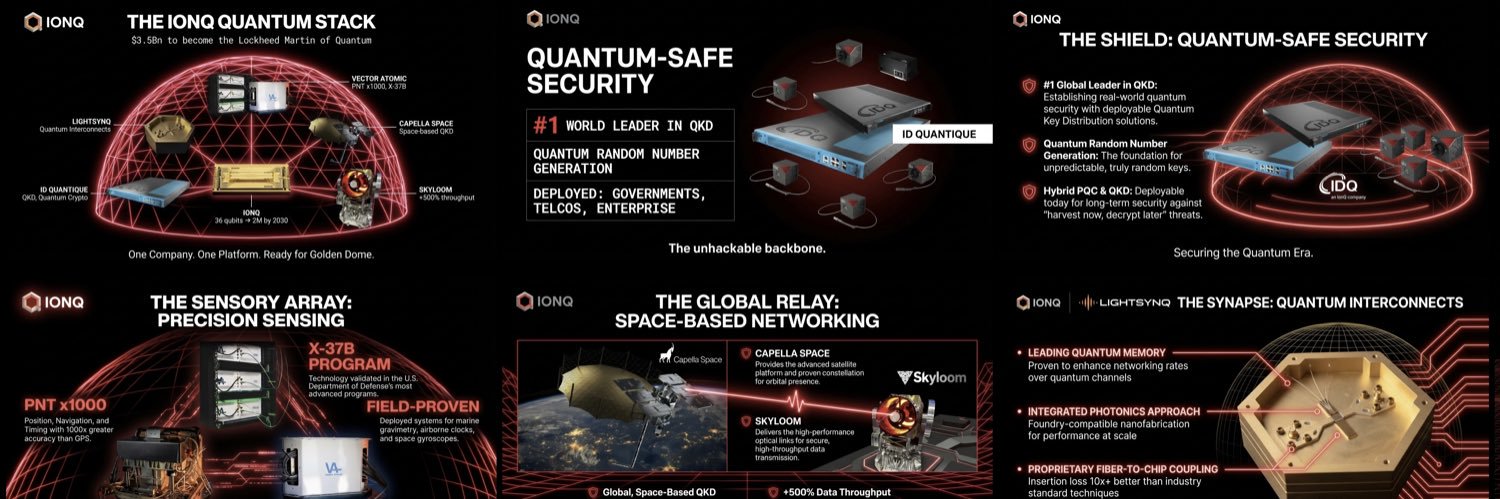
$IONQ The U.S. National Science Foundation just launched Project Triad: "the first-ever system where quantum sensing, networking and computing work together in concert," built to turn quantum into real-world applications across safety, healthcare, energy and defense. Now look at the elements. Sensing, computing, networking, the exact three domains NSF wants to unite. IonQ Federal's Rick Muller laid out all three at World Quantum Day, months earlier: Sensing: PNT clocks roughly 1000× more accurate than GPS (Vector Atomic), plus space (Capella) and optical comms (Skyloom). Networking: a contract in DARPA's Heterogeneous Architectures for Quantum (HARQ) program, plus QKD and entanglement distribution. Computing: nearing fault-tolerant operation in DARPA's Quantum Benchmarking Initiative (QBI), verified by DARPA. So it's not one program. IonQ is stacking two DARPA programs (HARQ and QBI) on top of the Vector Atomic, Capella and Skyloom acquisitions. His words: "IonQ can provide an engine to drive federal quantum integration that no other companies can." Now put the two diagrams side by side. NSF's illustration of an "integrated quantum system" and IonQ's timing architecture are the same picture: networked satellites, ground stations, sensors and a quantum computer, tied together by quantum links. NSF hasn't named a company. But it's building a national program around the architecture IonQ already has, down to the diagram. Sound familiar? 🔗 #IonQ #Quantum #ProjectTriad
TechInnovation17,144 Aufrufe • vor 2 Monaten

$IONQ The CEO’s Niccolo de Masi day-after-earnings tour: 🎙️ CNBC this morning: “Quantum is coming sooner than people think.” 🔔 NYSE 🏛 Live this afternoon Backed by IonQ Q1 numbers: $64.7M revenue · +755% YoY · beat midpoint by 30% · FY guide raised to $260-270M The print speaks. The CEO amplifies. Watch.👇📹 $IONQ #Quantum
TechInnovation18,672 Aufrufe • vor 4 Monaten

$IonQ Quantum computing is officially out of the lab and driving real enterprise results! IonQ CEO Niccolo de Masi dropped massive updates on "Squawk on the Street" regarding recent acquisitions and new contracts. It’s clear: IonQ is at a "strategic and financial inflection point." Here are the key takeaways: 1/ Massive Financial Scaling IonQ is the first public quantum company to hit 9-figure revenue (tripling last year!), guiding toward a quarter-billion dollars this year " It's not a science experiment when we have... nine figures of revenue flowing in," says de Masi. The ultimate proof? 60% of their revenue is now commercial. 2/ Four Major 'World Quantum Day' Announcements IonQ just released industry-leading benchmarks focusing on the "cost to solution and time to solution". They also secured 3 massive contract wins: ✅ AFRL (Air Force Research Lab) IonQ constructs first networked quantum systems among remote quantum processing units. ✅ University of Maryland (UMD). ✅ DARPA for advanced quantum memory. 3/ Building the Future "Quantum Data Center " IonQ's tech stack goes far beyond base computing to include networking, security, and sensing. De Masi notes their tech is in all warfighting domains, "from submarines to up in the heavens in space". Why the heavy DARPA & AFRL investments? Because "they see the future for quantum data centers". The Bottom Line: Both government and commercial clients are realizing that working with the quantum ecosystem early gives them a massive competitive advantage. Full scoop 👇📹 #IonQ #QuantumComputing #DeepTech #DARPA #TechNews
TechInnovation14,532 Aufrufe • vor 5 Monaten

$IonQ Following up on my recent post, why exactly did IonQ buy Lightsynq? The future of quantum computing isn't about building one massive, complex machine. It's about linking smaller, reliable machines together. Here is a short, simple video explaining how Lightsynq uses advanced fiber optics to connect these computers and build the quantum "data centers" of tomorrow. Watch it here 👇📹 $IonQ #QuantumComputing #TechInnovation
TechInnovation13,827 Aufrufe • vor 5 Monaten

$IonQ Tennessee just allocated $20M to accelerate quantum computing - 🧵 Governor Bill Lee’s FY27 budget includes funding specifically designed to attract federal and private investment in quantum, targeting advanced manufacturing, life sciences, and logistics sectors. Why this matters: State-level quantum funding signals a shift from pure research to economic deployment. Tennessee isn’t funding university labs - they’re building infrastructure to attract quantum companies and create high-wage jobs. Tennessee already has Oak Ridge National Laboratory, one of the world’s premier quantum research facilities. Adding $20M in state support creates a complete ecosystem: research capability, government backing, workforce development, and commercial deployment pathways. The timing is perfect: Quantum companies with deployable systems can now tap into state partnerships, regional contracts, and workforce programs. This creates real commercialization opportunities beyond federal research grants. For context, IonQ already works with Oak Ridge and has the commercial systems ready to deploy. But this funding isn’t just about one company - it’s about Tennessee positioning itself as THE quantum hub in the Southeast, competing with Colorado, Maryland, and California. What to watch: When states start competing for quantum companies with actual budget allocations, it validates that quantum computing is becoming an economic sector, not just a science project. Expect more states to follow Tennessee’s lead in 2026. The quantum industry is transitioning from “interesting research” to “strategic economic investment” at the state government level. That’s a meaningful milestone. 🎯 #QuantumComputing #Tennessee #Innovation #IONQ #EconomicPolicy #TechIndustry
TechInnovation15,775 Aufrufe • vor 7 Monaten
Keine weiteren Inhalte verfügbar