
Vedveer Arya वेदवीर आर्यः 🇮🇳
@VedveerArya3 • 9,754 subscribers
Chronologist, Historian, Author, Sanskrit Scholar & Civil Servant. Rebuilding the chronology of Indian civilisation.https://t.co/HlIb40H12n
Videos

A planetary conjunction described as a fundamental astronomical epoch in the Surya Siddhanta, in which the Sun, Moon, Mercury, Venus, Mars, Jupiter, and Saturn occupy a longitudinal span of less than 30°, represents one of the rarest configurations observable with the naked eye. Numerical simulations using modern ephemeris-based astronomical software with ΔT correction indicate that such a configuration occurred on 22 February 6778 BCE (astronomical year −6778), coincident with a New Moon and with the Sun located in Aries. अस्मिन् कृतयुगस्यान्ते सर्वे मध्यगताः ग्रहाः I विना तु पातमन्दोच्चान् मेषादौ तुल्यतामिताः II मकरादौ शशाङ्कोच्चं तत्पातस्तु तुलादिगः I Surya Siddhanta (Chapter 1, Verse 57-58): Notably, only one such alignment occurred following the Last Glacial Maximum (~18,000 BCE). The reconstructed configuration therefore constitutes a credible candidate for an exceptionally rare planetary alignment in deep antiquity, with potential implications for archaeoastronomy, historical chronology, and the reconstruction of early Indian astronomical traditions.
Vedveer Arya वेदवीर आर्यः 🇮🇳54,068 views • 5 months ago

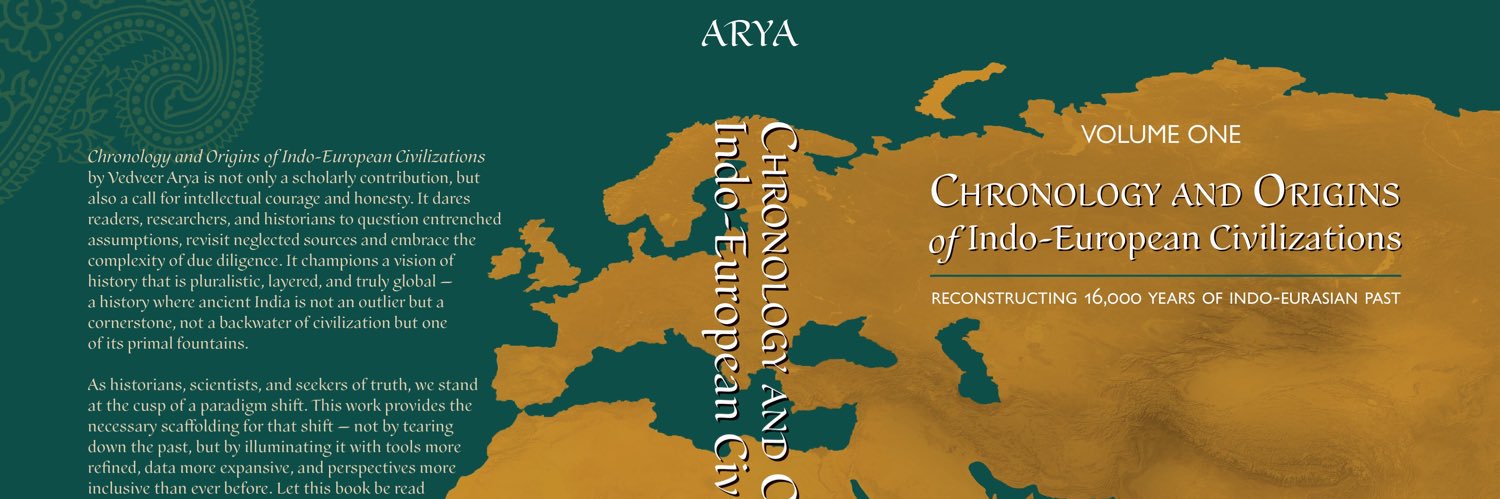
Vedveer Arya re-evaluates the chronological foundation of global history, contending that conventional world timelines are misaligned by over six centuries and also obscure the true origins of Indo-European civilizations. Rooted in traditional records and reinforced by archaeo-astronomy, archaeology, epigraphy, linguistics, and archaeogenetics, this work in two volumes reconstructs a coherent, evidence-based global chronology. The method correlates diverse data: planetary alignments, eclipse records, dynastic lists from India, Egypt, Sumeria, and Assyria, and genetic dispersals. It validates the traditional date of the start of the Gupta dynasty of India in 334 BCE while shifting the timelines and lifetimes of Buddha, Jesus, the Achaemenids, and Alexander the Great, thus resolving anomalies and revealing 661 missing years lost in history. The implications of this shift are profound. When the anchor points of chronology are corrected, the origins of Indo-European civilizations — linguistic, cultural, and genetic — extend far dee per into antiquity, reaching as far back as the transformative monsoon cycles in India and South Asia after the Last Glacial Maximum. The Sapta Sindhu region of northwestern India is not a peripheral recipient of an influx of people from outside but a cradle of civilization from which migration carried agriculture, astronomy, and language westward into Persia, Anatolia, Mesopotamia, and Europe between 13500 and 6000 BCE. There is a tendency to dismiss the tales of ancient literary traditions as “myths.” On the contrary, Vedveer Arya treats them as repositories of historical memories to be decoded with the aid of astronomy, linguistics, and genetics. The Rigveda, Puranas, Avesta, Greek epics, and king lists are not curiosities on the fringe of scholarship but invaluable treasures revealing our vast human past. By combining empirical rigour with a willingness to challenge entrenched orthodoxies, this work offers a panoramic and integrated account of Eurasian chronology. It is an invitation — and a challenge — to unlearn, to look again, and to consider that our shared past may be older, richer, and more interconnected than we have been led to believe. ............................................ Buy Chronology and Origins of Indo-European Civilizations(in Two Volumes) Book Online at Low Prices in India | Chronology and Origins of Indo-European Civilizations(in Two Volumes) Reviews & Ratings -
Vedveer Arya वेदवीर आर्यः 🇮🇳43,978 views • 6 months ago

The astronomical lunisolar calendar has been used by Indians since the Vedic era. Reconstructing the Indian calendar starting from the early Vedic era to till date based on archaeoastronomical evidence is the key to establishing the chronological continuity of Indian civilization. This documentary establishes that Mayasura wrote Surya Siddhanta on 22 Feb 6778 BCE which ushered the epoch of the Siddhanta astronomy calendar. Thus: - Pre-Siddhanta Calendar; 13500 BCE to 6777 BCE - Siddhanta Calendar: 6777 BCE to till
Vedveer Arya वेदवीर आर्यः 🇮🇳112,906 views • 3 years ago

No more content to load