

Arjun Khemani
@arjunkhemani • 34,385 subscribers
Freedom and immortality
Shorts


Videos

“Moderation is a propaganda word for censorship.” — Elon Musk
Arjun Khemani17,845,902 Aufrufe • vor 2 Jahren

.Elon Musk (worth $250B) answers why he’s still working: I think it's a good question you asked, because it goes to, like, at a foundational level, what is my philosophy, and why does it lead to this conclusion? So the reason is that when I was a teenager, I had, like, an existential crisis to try to figure out what's the meaning of life. There doesn't seem to be any meaning. For me, at least the religious texts, and I read all of them that I could get my hands on did not seem convincing. Then I started reading the philosophers. Be careful of reading German philosophers as a teenager. It's definitely not going to help with your depression. So reading Schopenhauer, Nietzsche, as an adult, it's much more manageable. But as a kid, you're like, “Whoa.” So then I was like, “Man, I'm just struggling to find meaning in life here.” And then I read Hitchhiker's Guide to the Galaxy. And basically what Douglas Adams was saying is that we don't really know what the right questions are to ask. The question is not, “What's the meaning of life?” In The Hitchiker's Guide to the Galaxy, Earth it turns out is a big computer, and its goal is to answer the question, “What's the meaning of life?” And Earth comes up with the answer “42”. This is where the 42 number comes from. And 420 is just ten times 42. In that book, which is really sort of a book about, it's an existential philosophy book disguised as humor. They come to the conclusion that, no, the real problem is trying to formulate the question. And to really have the right question, you need a much bigger computer than Earth. And so maybe one way, I think, of characterizing this would be to say, “The universe is the answer. What is the question? Or what are the questions?” The more we can expand the scope and scale of consciousness, the better we can understand what questions to ask about the answer that is the universe. The more we can expand consciousness, become a multi-planet species, ultimately a multistellar species… we have a chance of figuring out what the hell is going on. And so this is why I think we should have more humans and both biological and digital consciousness. And why we should become a multi-planet species and a multistellar species is so that we can understand the nature of the universe. And then in order for that to occur, then we have to make sure that things are good on Earth. We don't want Earth to disappear, so sustainable energy is important.
Arjun Khemani15,601,294 Aufrufe • vor 2 Jahren

Peter Thiel: I went to the World Economic Forum in Davos the last time in 2013, and of course, they have the same ideas as the mob. And in some ways, it is a mob. And people are there only in their capacity as representatives of corporations or of governments or of NGOs. And it really hit me: There are simply no individuals. There are no individuals in the room. There’s nobody there who’s representing themselves. And it’s this notion of the future I reject. A picture of the future where the future will be a world where there are no individuals. There are no people with ideas of their own. There’s nobody to say, this is wrong. This doesn’t make sense. And I’m going to think differently. I’m going to think for myself.
Arjun Khemani16,097,136 Aufrufe • vor 2 Jahren


“It is meaningfully different to be a Zcash user today than literally six weeks ago.” Dev Ojha (Dev) joins me to discuss Zcash’s security and UX improvements since Ironwood went live: - A quantum-recoverable, formally verified shielded pool - Proving optimizations - Onboarding links from Vizor - Zcash Wallet - Ledger integration for shielded ZEC
Arjun Khemani200,510 Aufrufe • vor 1 Monat

.Keith Rabois on the most important lesson he learned from Peter Thiel: You can’t hire anybody over 30. “Peter might not say it exactly the same way today, but basically, what he was trying to say is this: by the time you’re 30, everyone on the planet knows how to assess you pretty accurately. There are enough data points on your resume—back then, it was your resume, and today, it’s your LinkedIn profile—so that everybody can come to a consensus view about your abilities. But if you come to a consensus view about everybody’s abilities, guess what? Google is going to spend a lot of money on that person. Or OpenAI is going to spend a lot of money on that person. Or Meta is going to spend a lot of money on that person. And, when you’re a startup, you can’t outspend large companies that are very profitable or have infinite money like OpenAI. You need to be much more disciplined, much more frugal, and you may not even want to hire these people. The people who are motivated by that much compensation may not even be the right builders. I took that advice with me literally from November 2000, and I’ve been trying to apply it for 24 years now.”
Arjun Khemani3,782,849 Aufrufe • vor 2 Jahren

.Naval: “The opportunities have never been more equal than now. Elon Musk and Jeff Bezos have the same iPhone you do. They don’t have some better version of an iPhone. They’re eating food that might be marginally better than yours, but it’s basically the same. You might even have a better diet than them. You probably have more time to go to the gym than them. They’re not immortal, and they’re not going to be—most likely, not at this time scale. So you have more youth than them. You have a lot of advantages over them. The wealth gaps are actually much smaller than people think. A lot of that is due to mass production, which comes from specialization, labor, and capitalism. But it’s very easy to overlook that and agitate—because that gets you higher in the status hierarchy with other monkeys. It makes you look like you’re fighting for noble causes and gives you status, which is really what people are craving these days. They’re craving status, not money or wealth. And status is a zero-sum game. So it’s kind of an evil game to play because there have to be losers for every winner. And the only way to win is by crushing somebody else down.”
Arjun Khemani343,937 Aufrufe • vor 2 Monaten

.Naval: There was a story that I read about Elon Musk that really affected me, which was when he was talking to Bill Gates, and Bill Gates had just taken out some huge short on Tesla. It was like a billion dollar short or something. And, Elon was like, “Why would you do that? Why would you short Tesla?” And Bill goes, “Well, you know, I talked to my financial advisors and I looked at the math and there’s no way it’s overvalued. And so I’m going to make money on the short.” And Elon goes, “What do you care about making money? I thought you were into electric cars and climate change and saving the world. What are you doing trying to save a few bucks and betting against Tesla?”. And he just walked away in disgust. And I think he never talked to Bill Gates after that. And that’s when I realized, like, Elon’s a purist. He means what he says. The money is a tool for him to get what he’s trying to do. And so I take him at face value, which is the crazy thing, because a lot of people who set these audacious goals to inspire people, you kind of know they don’t really mean it. Elon, I take at face value. So I really do think he intends to get to Mars. I don’t think he’s joking about that. And I think he means to get there within a defined window of time. And I don’t think it’s just like an inspirational, faraway goal. I think he’s very, very concretely going to do whatever it takes. Because Elon doesn’t want to go down in history as the electric car guy or even the guy who saved America guy. He wants to go down as a guy who got humanity to the stars. Again, I’ll give him more credit than that. I don’t even think he wants to go down as the “I got humanity to the stars” guy. He’s just like, “I want to get to the stars, and so I have to make it happen in this lifetime. The only way that I get to experience the science fiction world in my head is if I get to the stars.” And so that’s so inspirational. I think that drives everything. So I think the government was just a thing that got in his way.
Arjun Khemani2,736,739 Aufrufe • vor 1 Jahr


.Naval: “I’m always struck by the Elon Musk story where he did PayPal… And he said something along the lines of: ‘I made $200 million from the sale of PayPal. I put $100 million into SpaceX, $80 million into Tesla, $20 million into Solar City, and I had to borrow money for rent.’ This guy is a perennial risk taker. He’s always willing to start over. He doesn’t have any pride about being seen as successful or being seen as a failure. He’s willing to put it all on the line. Even now, his new startup is the USA. He’s basically trying to fix it like he would fix one of his startups. It’s a willingness to look like a fool and a willingness to start over. A lot of people just don’t have that. They become successful or rich or famous, and that’s it, they’re stuck. They don’t want to go back to zero. And creating anything great requires zero to one. And that means you go back to zero. And that’s really painful and hard to do.”
Arjun Khemani1,152,126 Aufrufe • vor 1 Jahr
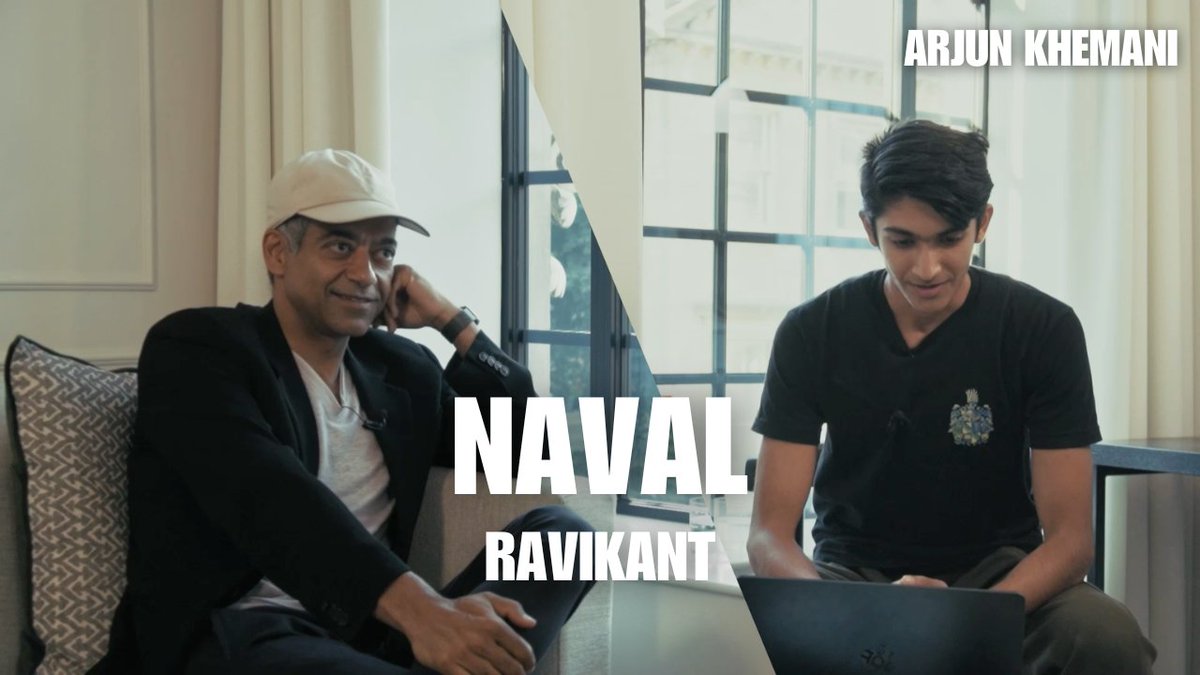
My conversation with Naval. Enjoy! (0:00) - The Theory of Everything (4:48) - How do you know what’s true? (7:51) - Groups search for consensus, individuals search for truth (13:07) - We have never run out of a single resource (15:25) - Are we destroying the Earth? (17:48) - Marxism denies wealth creation (21:28) - Regulation kills innovation (27:05) - Degrowth and the fall of Western universities (33:31) - Why the West is best (35:47) - Federalism (38:10) - Everyone wants to live forever (41:44) - Humans are universal explainers (43:25) - Collectivism vs. individualism (50:44) - You cannot explain the universe without explaining humans (55:02) - How David Deutsch’s ideas have changed Naval’s life (1:02:31) - The scientific method isn’t possible (1:05:07) - The low-hanging fruit theory is a bad explanation (1:08:19) - The biggest threats to Western civilization
Arjun Khemani1,496,181 Aufrufe • vor 1 Jahr


VanEck CEO Jan van Eck on CNBC: “There’s something else going on within the Bitcoin community that non-crypto people need to know about. And that is: ultimately, VanEck has been around before Bitcoin. We will walk away from Bitcoin if we think the thesis is fundamentally broken. We don’t right now, but you always have to look at the underlying technology and the crypto. What the Bitcoin community has been asking itself is: Is there enough encryption in Bitcoin, because quantum computing is coming? And secondly: Is there enough privacy in Bitcoin? And so a lot of Bitcoin OGs or maxis have been looking at Zcash. Zcash is a token. It’s sort of related to Bitcoin with a lot more privacy. The kind of garbage that we got about Bitcoin four years ago was: ‘It’s used for all bad illicit behavior.’ But now everyone kind of realizes that when you move money around on the Bitcoin blockchain, you can see it. You can see it move from one wallet to another. And a lot of people are looking for more privacy.”
Arjun Khemani595,779 Aufrufe • vor 11 Monaten

My conversation with Michael Levin, a biologist at Tufts University whose research explores bioelectricity, regeneration, morphogenesis, and how cells collectively process information to build and repair bodies. Timestamps: 0:00 - Causes and downstream effects of aging 3:31 - Bioelectric patterns and memory in regeneration 9:30 - Cracking the bioelectric code 12:10 - The boredom theory of aging 23:11 - The germline is ageless 25:45 - Bioelectricity and epigenetic reprogramming 27:15 - What experiment could falsify Mike’s ideas? 29:13 - The role of aging clocks and biological age 31:06 - Top-down control in biological systems 39:09 - Consciousness and its implications 48:25 - Changing human goals and preferences 51:30 - The future of medicine
Arjun Khemani50,602 Aufrufe • vor 28 Tagen

Naval on the presidential debate: It's obviously a disaster for the Democrats. They've got 40 days to find a replacement for him, which is going to be really difficult. 40-day limit is because of the Ohio ballot rules. To get on the ballot, I think you have till August 4th. In any case, because of Biden being the incumbent, they have to convince him to step down, which I don't think actually will be that hard. But then they have the harder job of convincing Harris to step down alongside him, because if she doesn't voluntarily step aside, she's going to get beaten up by Trump. She loses very badly to him in the polls. And then they have to replace the entire Biden-Harris ticket with probably, I would guess, Whitmer and somebody else. This is where it gets really tricky. Maybe Hillary makes a comeback. I don't think they can quite run Newsom. He's not ready, and California's record is terrible, and he would lose all the swing states. So I think the Democrats are in a very difficult position. And my question about who's been in charge all along, it's been semi-obvious that it hasn't been Joe. So I think it's just a good moment to reflect upon how the bureaucracy in this country, and frankly in the entire West, is highly entrenched and is on autopilot. Imagine if you were an investor in a company or a board member and you walk into your board meeting and you realize the CEO hasn't shown up to work for two years, and really just the VPs have been running amok and doing whatever they wanted. You'd know at that point that anything run by committee is incredibly inefficient and wasteful and almost kleptocratic. So you would expect the company to have essentially been looted the entire time.
Arjun Khemani1,172,561 Aufrufe • vor 2 Jahren


.Naval: First of all, I don't think of myself. I just want to be clear on that. And that's not a rule. It's just a habit I've kind of developed because I found that thinking about yourself is a source of all unhappiness and misery. Self obsession is the root of all unhappiness. What did Buddha do? Conquer the self. What does that mean? Means that he saw through the illusion of the separate self. Did Buddha think about himself? Not for an instant. Anyone that you think of as an enlightened being does not think about themselves for an instant. The happiest people in life when people are at their best is because they love something more than they love themselves. They love their children, they love God, they love their mission, what have you. And all misery comes from rumination, from sitting around, being depressed, going in circles in your own head about me, me, me, me, me. Me is a disease. And you need a concept of a me to be effective and to keep track of things. You have a memory, you have certain predilections, you have personality patterns. But the more you self obsess, the less happy you're going to be. I guarantee you that.
Arjun Khemani903,351 Aufrufe • vor 2 Jahren

My conversation with Sean Bowe (Sean Bowe) and Dev (Dev) on the architecture of freedom. 0:00 - Why Dev’s working on Zcash 12:24 - AI is surveillance’s ultimate weapon 13:33 - Encrypted money must scale 15:49 - Compliant “privacy” is an oxymoron 19:25 - PIR for scaling Zcash 36:35 - How Tachyon and PIR work hand in hand 43:47 - Quantum recoverability 47:18 - Is quantum the last cryptography problem? 51:41 - Easier coinholder voting process 1:03:15 - Zcash roadmap 1:17:34 - What Zcash looks like at scale
Arjun Khemani259,273 Aufrufe • vor 6 Monaten

Peter Thiel: Maybe you should think of wokeness as hyper Christianity.
Arjun Khemani911,000 Aufrufe • vor 2 Jahren