

Bri Teresi
@briteresi • 1,101,298 subscribers
Model | Golf Influencer ⛳️ | Crypto & Liberty Advocate | 🎙️ Host of Free The Money
Shorts








Videos

Why Tokenization Could Be the Most Important Economic Innovation of Our Lifetime | Bruce Fenton Bruce Fenton is a longtime Bitcoin advocate since 2012, securities professional, and one of the early pioneers of tokenized securities. He is the founder and CEO of Chainstone Labs and founder of Atlantic Financial. Alongside Overstock founder Patrick Byrne, Bruce was involved in some of the earliest efforts to bring securities and financial-market infrastructure onto blockchain rails. In 2018, he tokenized equity in his own company, Chainstone Labs, on the Ravencoin blockchain—years before tokenization became one of Wall Street’s biggest narratives. In this episode, Bruce breaks down naked short selling, the plumbing behind traditional securities markets, and why he believes much of the problem is ultimately a ledger problem. We dive into questions such as: Who actually owns the stocks sitting in your brokerage account? How can shares be lent and rehypothecated? What role do brokers, clearing firms, DTCC, and Cede & Co. play in determining who owns what? And could blockchain replace an opaque system of claims and intermediaries with a transparent ledger showing exactly where an asset is and who owns it? We unpack what “tokenized stocks” actually means—and the important distinction between a token that simply gives you exposure to a stock’s price and a security issued natively onchain, where the token itself represents the actual share and the ownership rights that come with it. Bruce discusses how tokenization could allow smaller businesses to tokenize ownership and have their stock traded globally without needing to be listed on a traditional exchange like the NYSE, as well as what a future without KYC could look like. Finally, we get into Wall Street’s embrace of tokenization, the SEC’s evolving approach to tokenized securities, and one of the biggest questions surrounding the future of this technology: who ultimately controls these new financial rails? Remember to subscribe and hit the bell “🔔” icon to get notifications 0:00 Bruce Fenton & Patrick Byrne: Pioneers of Tokenized Securities 3:36 Naked Short Selling Explained 6:28 Who Actually Owns the Stocks in Your Brokerage Account? 12:00 Tokenization Solves Wall Street’s “Ledger Problem” 15:48 What Are You Actually Buying With Robinhood’s Tokenized Stocks? 16:48 Real Tokenized Stocks: When the Token IS the Share 21:46 Tokenization Could Open U.S. Markets to the Entire World 22:52 Why Companies May No Longer Need the NYSE 26:29 Could Tokenized Markets Exist Without KYC? 29:31 Bruce Tokenized Equity on Ravencoin in 2018 30:53 Will Blockchain Make Clearing Houses & DTCC Obsolete? 33:17 Could Tokenization Have Prevented the GameStop Crisis? 38:19 Wall Street Is Embracing Tokenization — Who Gets the Power? 40:20 The SEC’s New Tokenized Securities “Innovation Exemption” 42:57 Why Robinhood’s Tokenized Stocks Don’t Qualify 47:01 Could Everything Eventually Be Tokenized? 51:02 The Dystopian Side of Tokenization: Surveillance & Asset Seizure
Bri Teresi181,844 görüntüleme • 22 gün önce

Anvil: The Future of Collateral and The Evolution of BNPL In this episode of Free The Money, I'm joined by Maximillian Schwartz, CEO of Anvil Research Labs, to discuss how Anvil 🛠️ is building the universal collateral layer and rethinking how financial promises are secured and enforced. Buy Now, Pay Later (BNPL) is on track to become a nearly trillion-dollar industry built largely on unsecured debt, with J.P. Morgan projecting the market to grow from $560 billion in 2025 to $912 billion by 2030. Federal Reserve survey data found that 26% of BNPL users made at least one late payment in 2025, while 11% incurred an overdraft or insufficient-funds fee because of a BNPL payment. The underlying problem? Our credit system still relies heavily on trust, credit scores, and collateral that can be difficult to value, transfer, or liquidate. Meanwhile, younger generations are accumulating wealth differently. With an estimated 560 million-plus crypto owners worldwide, an enormous pool of digital wealth remains largely disconnected from traditional credit markets. This wealth could serve as collateral but often sits outside conventional underwriting. Rather than relying solely on promises and third-party enforcement, Anvil uses smart contracts to place provable holds on digital assets, allowing them to secure financial obligations on-chain. Crypto offers unique advantages as collateral: markets operate 24/7, assets can be valued and liquidated rapidly, and financial commitments enforced through code. We explore how Anvil's digital letters of credit LOCS could bridge DeFi and traditional financial services, allowing users to secure future payments without necessarily paying upfront or selling their investments. Assets can retain exposure to potential price appreciation, while supported yield-bearing collateral can continue generating returns. Max also breaks down Anvil's newly launched enterprise SDK and the $5 million ANVL token purchase led by Peter Thiel's Founders Fund, including why major investors are seeking a voice in the governance of this emerging financial infrastructure. Want financial privacy? Check out my favorite privacy coin Zano You can buy Zano seamlessly on MEXC using a VPN, or browse the full list of exchanges where Zano is available here: You can also find educational content, tutorials, and interviews on the official Zano YouTube Channel: 0:0 Max Schwartz, CEO of Anvil Research Labs 1:00 What's Broken About Credit Today? 3:35 Buy Now, Pay Later & the Phantom Debt Problem 7:07 Collateral, Rehypothecation & the Risks of Trust-Based Lending 8:36 Illiquid vs. Liquid Collateral: The Car Loan Problem 13:27 Why Crypto Is the Perfect Collateral: 24/7 Markets & Smart Contracts 14:27 Gen Z, Digital Assets & the Broken Credit Score System 17:10 Bridging DeFi & Traditional Finance 20:28 Zano 22:15 What Is Anvil? The Universal Collateral Layer 23:28 Traditional vs. Digital Letters of Credit 27:16 Real-World Use Cases & the Cost of Paying Early 34:30 Code vs. Law: Can Smart Contracts Replace Traditional Legal Systems? 37:06 Crypto Volatility, Overcollateralization & Liquidations 41:05 Anvil's SDK: Making Blockchain Adoption Seamless 48:42 Peter Thiel's Founders Fund & the $5M ANVL Token Purchase
Bri Teresi50,568 görüntüleme • 8 gün önce
CoreWeave's bonds are now trading at distressed levels. When I interviewed Nobody Special on Free The Money, he warned about CoreWeave’s relationship with Nvidia, circular financing, and the growing risks in the AI infrastructure boom. He specifically named CoreWeave as a company to watch for signs of trouble. Now the market is flashing warning signs. Is the AI bubble beginning to crack?
Bri Teresi25,521 görüntüleme • 6 gün önce
Digital Letters of Credit (LOCs) are a game changer for the crypto economy. Max "M" Schwartz Anvil 🛠️
Bri Teresi31,297 görüntüleme • 8 gün önce

Why Flexa Co-Founder Tyler Spalding Is Bullish on Zano 👀| Free the Money Ep. 40 Tyler Spalding is President of the Acronym Foundation and the former Co-Founder & CEO of Flexa, a digital payments network. He has been mining and building in crypto since 2011 and has more than 20 years of experience across technology, payments and aerospace, including engineering work with the U.S. Air Force and NASA programs. His work in crypto and Web3 has spanned a number of projects, including Anvil 🛠️ and SPENDERS CLUB, with a longstanding focus on payments and bringing digital assets into real-world use. In this episode, Tyler shares his perspective on what it will actually take for digital assets to become usable money and why privacy is essential for adoption at scale. For the first time publicly, Tyler discusses his longtime support for Zano, what he believes the project has gotten right, and why its approach to privacy and security has positioned it ahead of the curve in preparing for emerging AI threats. We also discuss stablecoins, private digital dollars, Zano’s Hard Fork 6, cross-chain interoperability & Zcash. Tyler makes the case for Proof of Stake over Proof of Work, including the security risks he sees in PoW networks, and we explore the bigger challenge of moving crypto from something people simply hold to something they can privately and securely spend in the real world. Remember to subscribe and hit the bell “🔔” icon to get notifications. Want financial privacy? Check out my favorite privacy coin Zano You can buy Zano seamlessly on MEXC using a VPN, or browse the full list of exchanges where Zano is available here: You can also find educational content, tutorials, and interviews on the official Zano YouTube Channel: 0:0 Background 2:46 Why Bitcoin Changed Everything for Tyler in 2011 5:48 Stablecoins & Digital Dollars: “Money Is Really Equal to Debt” 10:55 Discovering Zano: Why Tyler Became an Early Supporter 14:12 Why Privacy Is 100% Vital for Crypto Mass Adoption 19:53 Zano Confidential Assets: Bringing Privacy to Bitcoin & Crypto 24:38 Spending Private Zcash in the Real World With Flexa 27:49 Zano Hard Fork 6: Gateway Addresses & Cross-Chain Integration 31:19 Zcash vs. Zano 32:35 Freedom Dollar: The Private Stablecoin Built on Zano 35:56 AI Hacks: The Growing Security Threat to Crypto 39:15 How Proof of Work Vulnerable to a 51% Attack 45:50 Why Proof of Stake Could Be the Future of Crypto 46:34 Digital Spenders Club: Making Crypto Spendable in the Real World 51:38 No KYC: Paying Merchants Directly With Crypto 52:39 Tyler Spalding’s Must-Read Books on Money 54:19 Economic Finality
Bri Teresi157,277 görüntüleme • 1 ay önce

XRP, Tokenization & the Next Crypto Boom | The Bearable Bull The Bearable Bull is back to talk XRP, tokenization and the next crypto boom—from Evernorth’s Nasdaq listing and Brazil bringing securities infrastructure onto the XRP Ledger to DTCC’s tokenization push and AI threats. Remember to subscribe and hit the bell “🔔” icon to get notifications 0:00 Intro 3:52 Why XRP Is Heating Up Again 6:18 DTCC & the Shift to Tokenized Markets 9:12 Crypto Doesn’t Need the CLARITY Act 10:20 Tokenized Securities on the XRP Ledger 15:15 Evernorth’s Nasdaq Listing 22:08 Brazil Is Bringing Securities On-Chain 24:33 Digital Euro, CBDCs & the AI Era 32:41 SEC Innovation Exemption & U.S. Crypto Regulation 36:54 Quant & the Rise of Utility-Based Crypto 38:48 AI Hacks, Crypto Security & Proof of Stake 40:49 The Next Crypto Bull Run
Bri Teresi49,043 görüntüleme • 15 gün önce

Brave Just Revealed the Future of the Internet | Roadmap 4.0 Explained | Free the Money Ep. 35 Luke Mulks 🦁⟁◎⟁ is Vice President of Business Operations at Brave, the company behind the privacy-first Brave browser with more than 121 million monthly active users. After leaving the ad tech industry in 2016, he joined Brave to help build a better internet and later co-authored the Basic Attention Token (BAT) (BAT) white paper. In this episode, we break down Brave's newly released Roadmap 4.0, including: • How Brave plans to rebuild the economic layer of the web • Why the traditional advertising model is breaking down in the age of AI • Brave's vision for stablecoins, BAT buybacks, and a new "web of value" • X402, Machine Payments, and why AI agents need native internet payments • Why Brave Search API has seen explosive growth as developers build the next generation of AI applications • The Creator Contribution Protocol and Brave's vision for paying creators in the AI era • The new unified Brave Wallet, Brave Pay, and bringing self-custody to everyday payments • Why private digital cash is essential for preserving freedom in a cashless world • How mass surveillance creates permanent profiles that can be abused by governments, criminals, or foreign adversaries Remember to subscribe and hit the bell "🔔" icon to get notifications. Check out my favorite privacy coin, Zano and follow Zano for updates. You can buy Zano seamlessly on MEXC using a VPN, or browse the full list of exchanges where Zano is available here: You can also find educational content, tutorials, and interviews on the official Zano YouTube Channel: 0:00 Luke Mulks on Why He Left Ad Tech to Help Build Brave 2:27 Why 121 Million People Are Choosing Brave 3:45 Brave Roadmap 4.0: Rebuilding the Economic Layer of the Web 5:25 Why Programmatic Advertising Is Dying & What Replaces It 8:23 BAT, Stablecoins & the "Web of Value": How Users Could Earn From Everyday Activity 10:42 Cash Is Disappearing. What Replaces Financial Freedom? 11:41 Why Private Digital Cash Is Essential for a Free Society: ZANO 13:29 X402 & Machine Payments 15:05 The Convergence of AI, Crypto & Autonomous Payments 16:41 Why Stablecoins Could Become the Internet's Default Payment Rail 18:22 Will Brave Launch Its Own Stablecoin? How BAT Buybacks Could Work? 22:12 Brave's Creator Contribution Protocol: Paying Creators in the AI Era 25:29 Can AI Protect Creators? The Future of Copyright, Attribution & Royalties 28:12 Inside the New Unified Brave Wallet: Self-Custody Meets Everyday Payments 31:23 How Crypto Cards Actually Work at Checkout 35:59 What Does Privacy-Preserving Commerce Actually Mean? 38:03 The Phia Browser Extension Controversy & the Growing Browser Trust Problem 39:47 Could X and Brave Work Together? 43:01 Waymo Locked Kids Inside a Driverless Car 44:51 Flock: How Third Parties Built Your Digital Profile
Bri Teresi263,191 görüntüleme • 3 ay önce
What if you could invest $100 in your favorite local restaurant as easily as you can buy a meme coin? Bruce Fenton’s vision for tokenization goes far beyond Wall Street. Small businesses. Real estate. Global ownership. Borderless markets. He believes this could be one of the most important economic innovations of our lifetime—including the internet.
Bri Teresi60,576 görüntüleme • 22 gün önce


Japan Could Trigger the Next Financial Crisis | Dr. Jim Willie | Free the Money Ep. 37 Dr. Jim Willie returns to Free the Money warning that the next several months could be critical for the economy. At the center of the conversation is Japan and the yen carry trade, particularly the recent joint U.S.–Japan intervention to support the yen. Jim argues that the bigger concern is what a disorderly carry trade unwind could mean for U.S. Treasuries, interest rates and the broader financial system. Key Points: •Jim says persistent high oil and diesel prices could significantly worsen economic conditions. Diesel is his key “litmus test” because of its impact on transportation, businesses and consumers. •The Fed faces a difficult tradeoff. Jim argues that high energy costs are creating “cost inflation” while the economy weakens, potentially forcing the Fed to cut rates despite continued inflation. •Jim believes the Yen carry trade is much larger than commonly acknowledged, potentially $5–7 trillion or more—with significant exposure across Wall Street, Japan and Europe. •An unwind could put pressure on U.S. Treasuries. Investors exiting yen funded trades may have to sell Treasuries and buy yen to repay their debt. Jim believes higher Japanese rates could accelerate that process and interprets the joint currency intervention as an effort to contain the risk. •Intervention may only buy time. Jim describes currency intervention as a “Band-Aid,” noting that previous attempts to strengthen the yen provided only temporary relief. •Higher U.S. rates could deepen economic weakness. Jim expects elevated Treasury yields to mean higher mortgage costs, more foreclosures and further housing weakness, predicting home prices could fall another 15–20%. •Jim sees a Middle East peace agreement as one possible pressure-release valve. He believes there is strong incentive for the Trump administration to move toward a broader agreement involving Iran, Gulf Arab states and Israel, potentially connected to an expansion of the Abraham Accords. •The bigger question is confidence in the dollar-based system. Jim describes the yen, euro and pound as essentially “dollars with a different jacket on” and believes Treasury-market instability could accelerate the move away from using U.S. government debt in international settlement. Remember to subscribe and hit the bell “🔔” icon to get notifications Sign up for Dr. Jim Willie’s Newsletter: Want financial privacy? Check out my favorite privacy coin Zano You can buy Zano seamlessly on MEXC using a VPN, or browse the full list of exchanges where Zano is available here: You can also find educational content, tutorials, and interviews on the official Zano YouTube Channel:
Bri Teresi155,326 görüntüleme • 2 ay önce

How NEAR Intents are Solving Crypto's Biggest Problems | Free the Money Ep. 36 Alex Shevchenko is the Co-founder and CEO of Aurora Labs and Defuse Labs, the team behind NEAR Intents, the universal liquidity protocol for on-chain markets and tokenized assets. With a PhD in Applied Physics, Alex Shevchenko 🇺🇦 has been building blockchain infrastructure since 2015 and helped launch Rainbow Bridge, Aurora, and NEAR Intents. Today, NEAR Intents’ infrastructure handles the majority of cross-chain trading volume outside same-asset transfers. •Why blockchain fragmentation is crypto's biggest obstacle to mainstream adoption •How NEAR Intents creates a universal liquidity layer across blockchains •What a fully agentic economy actually looks like and why AI agents will need their own financial infrastructure •Why open AI models are catching up to Big Tech and why personal AI could become the future •Why nearly $16 trillion in real-world assets (RWAs) could be tokenized by 2030 and why interoperability will be critical •How NEAR's ~$79 million in daily volume generates an average of ~$158,000 in daily $NEAR buybacks •Near's Confidential Intents: private cross-chain trading using a private shard and trusted execution environments (TEEs) •Why the CLARITY Act could accelerate institutional adoption and bring new capital into crypto •Why $470 billion worth of Bitcoin is exposed to quantum attacks and how NEAR Protocol is preparing with post-quantum cryptography Remember to subscribe and hit the bell "🔔" icon to get notifications. Check out my favorite privacy coin, Zano and follow Zano for updates. You can buy Zano seamlessly on MEXC using a VPN, or browse the full list of exchanges where Zano is available here: You can also find educational content, tutorials, and interviews on the official Zano YouTube Channel: 0:00 Alex's Journey from Applied Physics 2:25 The Origin Story Behind NEAR Intents & Cross-Chain Infrastructure 4:14 Blockchain Fragmentation: Liquidity, Markets & Why Crypto Still Feels Broken 8:59 How NEAR Intents Work Under the Hood (Chain Signatures, Settlement & Self-Custody) 12:52 Building the Financial Backbone of the Agentic Economy (MPP, AI & NEAR's Vision) 16:58 When Will the Agentic Economy Arrive? Alex's Prediction 18:16 Distillation & Open vs Closed AI Models 24:32 NEAR AI: Private Inference & Running AI Without Giving Up Your Data 25:31 $80M Daily Volume, $NEAR Buybacks & Tokenomics 29:41 Why RWAs Need NEAR Intents 33:37 The Agentic Economy Explained: Cross-Agent Interactions 37:17 AI Will Disrupt Subscription Models: The Case for Agentic Micropayments 40:00 Why Privacy Matters: Zano 42:02 Confidential Intents Explained 47:53 Why the CLARITY Act Could Unlock Institutional Capital for Crypto 51:29 Quantum Computing Threats & How NEAR Is Preparing with Post-Quantum Cryptography NEAR Protocol NEAR AI NEAR Mobile | Wallet & DEX
Bri Teresi180,296 görüntüleme • 2 ay önce

Flock Safety: Is America Building a “Pre-Crime” Surveillance State? | Free the Money Ep. 39 Are we moving toward a “pre-crime” surveillance state where authorities can track your movements, build a profile of your behavior, and potentially decide you’re suspicious before you’ve even committed a crime? Jason Bassler, co-founder of the Free Thought Project, joins me to expose Flock and the rapidly expanding surveillance infrastructure being built across America. We break down how Flock’s automated license plate readers (ALPRs) can track far more than just a license plate, creating a “digital fingerprint” of your vehicle and logging your daily movements. Jason also discusses documented cases of police abusing ALPRs, innocent people being wrongfully stopped or held at gunpoint, and Flock data being accessed beyond local police. He says ICE, the ATF, FBI, and DHS have accessed Flock data that cities never approved. Key points we cover: -Flock Safety’s nationwide network of ALPR cameras and its expanding drone technology -Why ALPRs account for less than 1% of crime clearance in many departments—meaning roughly 99% of the surveillance collected is on innocent people -Motorola Signal Trace technology that can detect wireless signals from phones, Bluetooth devices, AirPods, and wearables -The growing push for age verification and digital ID across the internet -Why taxpayers could be spending roughly $360 million per year on Flock cameras -The Fourth Amendment questions surrounding mass location tracking -Why financial privacy and private digital money matter in an increasingly surveilled world -How communities are fighting back through FOIA requests, city councils, and projects like DeFlock Remember to subscribe and hit the bell “🔔” icon to get notifications. Want financial privacy? Check out my favorite privacy coin Zano You can buy Zano seamlessly on MEXC using a VPN, or browse the full list of exchanges where Zano is available here: You can also find educational content, tutorials, and interviews on the official Zano YouTube Channel: 0:00 Jason Bassler’s Background: The Free Thought Project & Deplatforming 5:29 Flock Safety: Surveillance Infrastructure Disguised as Public Safety 7:04 How Flock ALPR Cameras Track Your Vehicle’s “Digital Fingerprint” 8:28 Flock’s New Alpha Drone: The Next Level of Mass Surveillance 10:22 Is Flock Unconstitutional? The Fourth Amendment Legal Gray Area 13:23 Private Businesses Are Using Flock Cameras Too 15:51 Flock vs. Your Phone: The Critical Difference 16:55 Zano 21:09 Police Abusing Flock: Stalking Exes & Innocent People Held at Gunpoint 22:40 Who Has Access to this Flock Data? Police, Federal Agencies & More 25:33 The Massive Data Breach & Foreign Adversary Risk 28:34 Flock’s Shocking Crime Stats: 99% of Surveillance Is on Innocent People 34:00 Beyond License Plates: Motorola Signal Trace Tracks Your Electronics 37:21 Age Verification & Digital ID: The Push to Identify Everyone Online 40:21 DeFlock: Mapping America’s Flock Surveillance Network 45:07 Taxpayers Are Spending $360 Million a Year to Be Surveilled 46:19 Why Private Money Is Essential for a Free Society 52:05 How to Fight Back: FOIA Requests, City Councils & Taking Action
Bri Teresi111,186 görüntüleme • 1 ay önce

Targeted for Spreading Bitcoin? The Ian Freeman Story I sat down with the lovely and beautiful Bonnie Freeman Mrs. ₿onnie Freeman, wife of Ian Freeman Ian Freeman, a longtime libertarian activist and host of Free Talk Live. Ian was one of the very first voices to introduce Bitcoin to a radio audience. Free Talk Live began discussing Bitcoin all the way back in 2010, and Ian's mission was to get Bitcoin into more people's hands. He sold Bitcoin directly to customers, operated Bitcoin vending machines, and went into local businesses helping onboard them to Bitcoin—giving them tablets and helping them set up point-of-sale systems. He used his time to actually help people use Bitcoin. He was also fiercely outspoken against the government and became a major advocate for Bitcoin, financial privacy, and individual freedom. On March 16, 2021, their home was violently raided by federal agents. Bonnie takes us inside that morning, describing armed agents, armored vehicles, a drone, and a flashbang used during the raid. We break down what Ian was actually accused and convicted of and how the government and media painted him out to be a fraudster. Prosecutors claimed Ian's operation processed more than $10 million connected to romance scams and internet fraud, said his business “catered to fraudsters,” and publicly called him an “internet fraudster.” But the romance-scam allegations are much more nuanced than the headlines. Ian was not convicted of committing the underlying romance fraud. Investigators never produced communications showing Ian and the actual romance scammers agreeing to defraud victims. Ian also had his own customer-screening procedures. He asked customers why they were buying Bitcoin and tried to identify potential scams. According to his defense, some victims actually concealed the true purpose of their transactions because Ian may have stopped them if they admitted they were sending the money to an online romantic interest. Ian also had a business incentive to prevent customers from being scammed because his reputation depended on satisfied customers. So we examine one of the biggest questions surrounding his conspiracy conviction: How can you establish that Ian knowingly joined a conspiracy if you haven't demonstrated an agreement between Ian and the people actually committing the scams? Testimony from scam victims was also presented to the jury, and Ian's defense argues that it emotionally tied him to the scammers even though he wasn't the person committing the underlying romance fraud. Ian ultimately received an eight-year federal prison sentence. And at the center of our conversation is a much bigger question: Was this simply the prosecution of financial crimes the government believed he committed, or did his influence on Bitcoin adoption and his outspoken opposition to government power put a target on his back? And was this really an attempt to silence an influential Bitcoin advocate and send a message to an industry that threatened the traditional financial system? Bonnie shares why she believes Ian's name was smeared, what prison has taken from their lives, and why she believes his case belongs in the broader conversation about the war on crypto. Please consider signing and sharing the petition to help bring more attention to Ian’s case: Remember to subscribe and hit the bell “🔔” icon to get notifications Want financial privacy? Check out my favorite privacy coin Zano You can buy Zano seamlessly on MEXC using a VPN, or browse the full list of exchanges where Zano is available here: You can also find educational content, tutorials, and interviews on the official Zano YouTube Channel: 0:00 Who Is Ian Freeman? | Free Talk Live & Early Bitcoin 3:12 Discovering Bitcoin LIVE on Free Talk Live 5:16 Shire Free Church & Ian Freeman’s Bitcoin Mission 10:24 How Ian Tried to Prevent Bitcoin Scams 14:21 What Is Zano? | Private Cryptocurrency 18:22 What Was LocalBitcoins? | Peer-to-Peer Bitcoin 23:46 No Evidence Ian Communicated With Scammers 27:24 Did Scam Victim Testimony Influence the Jury? 31:18 March 16, 2021: The Federal Raid on Ian Freeman 36:00 IRS Calls Ian Freeman an “Internet Fraudster” 38:32 Was Ian Targeted for His Bitcoin Advocacy? 43:56 Bitcoin vs. Cash: What Do Scammers Actually Use? 47:05 Does KYC Destroy Bitcoin’s Original Promise?
Bri Teresi51,366 görüntüleme • 28 gün önce

YOU’RE INVESTED IN THE AI BUBBLE… Whether You Know It or Not | Jack Gamble | Free the Money Ep. 41 I sit down with Nobody Special host of Nobody Special Finance to break down what he believes to be the “biggest misallocation of capital in history,” following the biggest monetary expansion in history. Jack explains the circular financing behind the AI boom and why he believes OpenAI and Anthropic’s massive spending is supporting the entire bubble, despite both companies losing tens of billions of dollars. We also discuss NVIDIA, CoreWeave, private credit increasingly financing the AI data-center buildout, and the debt being sold to people’s Pensions, 401Ks and IRAs. Jack refers to this as “one giant crowded trade that everybody is in, whether they realize it or not.” We get into the parallels with 2008, attempts to turn future GPU compute revenue into asset-backed securities, problems Jack sees developing in private equity and life insurance, and the warning signs surrounding a potential OpenAI IPO. Finally, Jack argues that “the real economy is doing very poorly, even though speculative asset bubbles are inflating more and more,” and explains how the enormous borrowing needs of the AI buildout are beginning to compete with the U.S. government for capital, putting upward pressure on interest rates. Remember to subscribe and hit the bell “🔔” icon to get notifications. Want financial privacy? Check out my favorite privacy coin Zano You can buy Zano seamlessly on MEXC using a VPN, or browse the full list of exchanges where Zano is available here: You can also find educational content, tutorials, and interviews on the official Zano YouTube Channel: Subscribe to Nobody Special Finance on Youtube: 0:00 Intro: Jack Gamble / Nobody Special Finance 2:19 NVIDIA’s Record Revenue & Accounting Red Flags 5:12 Circular Financing, Round-Tripping & CoreWeave 9:15 The Structure of the AI Bubble — NVIDIA, Hyperscalers, OpenAI & Anthropic 11:28 NVIDIA’s $500B AI Financing Push & Private Credit 13:28 S&P 500 Concentration Risk — How Exposed Are Investors to AI? 16:13 South Korea’s Bubble — the KOSPI, Samsung, & SK Hynix 18:42 Are OpenAI & Anthropic “Too Big to Fail”? 21:25 OpenAI Executive Exodus & IPO Warning Signs 23:48 Zano 25:36 AI vs. 2008 — Turning GPUs Into Asset-Backed Securities 27:38 Private Credit, Life Insurance & Retirement Money 30:19 Apollo, Athene & the Growing Web of Financial Risk 33:49 Is the U.S. Economy Actually Growing? AI Data Centers & GDP 35:55 AI Bubble Is Competing With the U.S. Government for Debt Issuance 37:28 Treasury Intervention, the Yen Carry Trade & Rising Rates 39:07 Treasury Buybacks & the Yield Curve 40:34 Gold, Silver, Bitcoin & the Return of the Debasement Trade 41:32 What Could Trigger the AI Bubble to Burst? 46:15 Book Recommendations
Bri Teresi65,870 görüntüleme • 1 ay önce
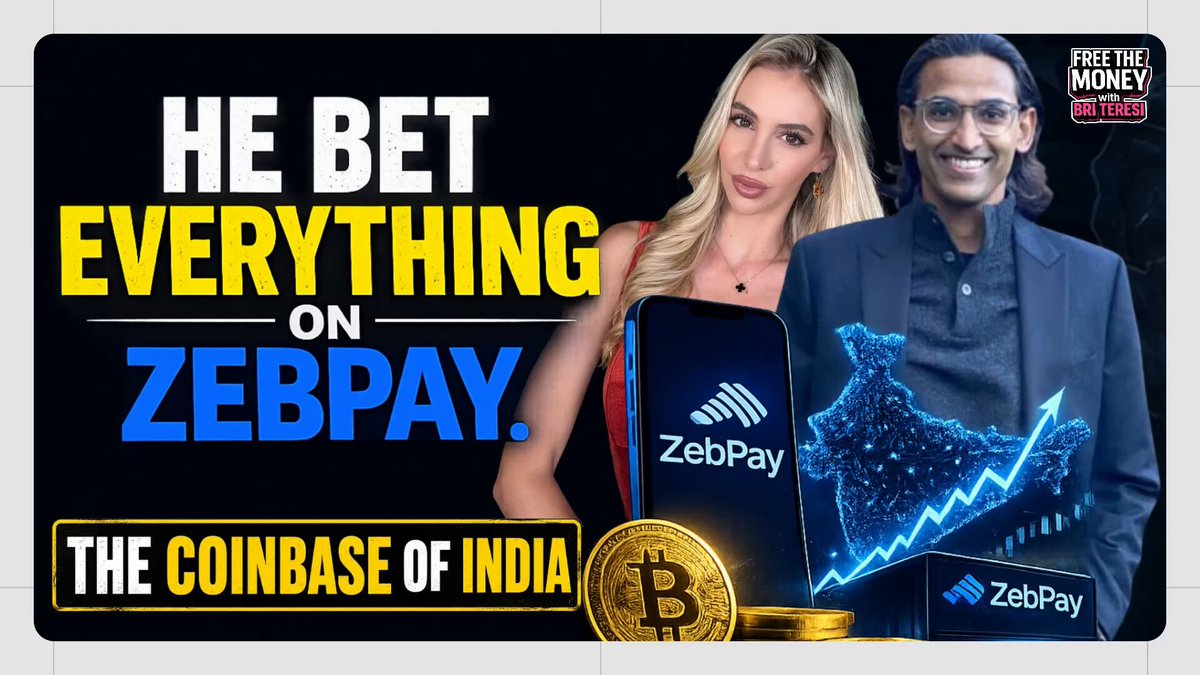
He Bet Everything on ZebPay: Inside the Coinbase of India | Free the Money Ep. 34 Rahul Pagidipati is the CEO of ZebPay, one of India's largest cryptocurrency exchanges. He's been investing in digital assets since 2011. Beyond crypto, Rahul (ZebPay) Pagidipati is a successful serial entrepreneur and investor. He co-founded Freedom Health, which grew into the largest private health insurance company in the United States with $1.8 billion in annual revenue before being acquired by Anthem in 2018. Today, Rahul is also the Managing Partner of Ayon Capital and a Board Member at Brave Software, the company behind the privacy-focused Brave browser. Through Ayon Capital, he has led investments in multiple unicorn healthcare companies, including Oscar Health, RxAdvance, and Rise. In this episode, we discuss: •Why Rahul made an all-in bet on ZebPay during India's crypto crackdown •How ZebPay survived when many believed crypto in India was finished •The lessons behind building and scaling a multi-billion-dollar healthcare company •Why long-term conviction beats short-term speculation •Brave's mission to restore privacy and give users control over their data •Why Rahul believes privacy will become one of the defining issues of the AI era •Why he thinks the Basic Attention Token (BAT) (BAT) is one of the most overlooked opportunities in crypto •How Brave's roadmap could bring BAT into everyday payments through agentic commerce •His long-term outlook on Bitcoin, Ethereum, and the future of digital assets Remember to subscribe and hit the bell "🔔" icon to get notifications. Check out my favorite privacy coin, Zano and follow Zano for updates. You can buy Zano seamlessly on MEXC using a VPN, or browse the full list of exchanges where Zano is available here: You can also find educational content, tutorials, and interviews on the official Zano YouTube Channel: 0:00 Intro 3:16 Building a $2 Billion Healthcare Company as a Family 6:53 How Rahul Discovered Bitcoin in 2011 12:10 How India's Crypto Crackdown Created the ZebPay Opportunity 14:07 Why India Has 100+ Million Crypto Holders 15:49 The Story Behind Buying India's Largest Bitcoin Exchange 19:26 Rahul's Advice for Young Entrepreneurs 21:25 Buying Bitcoin, Ethereum & BAT Every Single Day 26:13 Why Privacy Coins Like Zano Matter 30:04 Why Basic Attention Token (BAT) Is Massively Undervalued 33:34 Brave Browser: Fighting Big Tech with Privacy 40:03 How AI Is Quietly Shaping Our Opinions 44:08 AI Agents, BAT & the Future of Digital Commerce 49:23 Rahul's Favorite Books on Bitcoin & Entrepreneurship
Bri Teresi127,019 görüntüleme • 3 ay önce

Is America losing the next generation to socialism? | Patrick Bet David | Free the Money Ep. 38 Patrick Bet-David, founder of Valuetainment, PHP Agency, Minnect and host of the PBD Podcast joins Free The Money for a powerful conversation about the rise of socialism in America, the fight for the next generation and whether the American Dream is slipping out of reach.Why are young Americans increasingly drawn to socialism? And are Republicans offering them a compelling enough alternative?? From a radical proposal that could change the financial future of Americans under 30 to his bold prediction for the 2028 election, Patrick lays out where he believes America is headed and what needs to happen before it's too late. But this conversation goes far beyond politics. Patrick candidly opens up about his relationship with God, how faith remains at the center of his life, and why the bigger his vision becomes, the more he realizes he cannot accomplish it alone. He shares the philosophy that has guided him for years: “Pray like it's up to God, but work like it's up to you.” Patrick reveals the experiences that created his relentless drive, from being $49,000 in debt to building a business eventually sold for $250 million, he lays out his four stages that transformed his relationship with money. Patrick gets personal about marriage and fatherhood and the legacy he ultimately hopes to leave behind. Remember to subscribe and hit the bell “🔔” icon to get notifications. Want financial privacy? Check out my favorite privacy coin Zano You can buy Zano seamlessly on MEXC using a VPN, or browse the full list of exchanges where Zano is available here: You can also find educational content, tutorials, and interviews on the official Zano YouTube Channel: 0:0 Intro 1:52 The Four Phases of Wealth: Survival, Status, Freedom & Purpose 5:15 God’s Role In PBD’s Life 11:13 PBD’s Formula for Success: Outwork, Out-Improve, Out-Strategize & Outlast 12:38 The Content Strategy That Helped PBD Build a Massive Audience 16:18 Why Outlasting Everyone Is the Hardest Part of Success 19:51 Zano 21:46 Inside PBD’s Controversial “Thinking Room” 25:53 Why Young Americans Are Turning to Socialism 29:22 PBD’s Solution: How Do We Win the Next Generation Back? 32:47 The Decision PBD Made at 25 That Changed His Life 35:38 The Wealth Tax: Are We Punishing Success? 39:04 Should You Get Married & Start a Family Earlier? 43:01 Raises Successful Kids 44:49 The Legacy PBD Wants to Leave: “A Leader Amongst Leaders” 46:14 The Books That Changed PBD’s Life
Bri Teresi81,180 görüntüleme • 2 ay önce

Could Amazon be the only thing standing between Monero and a 51% attack? 👀 Flexa Co-Founder Tyler Spalding argues that PoW is “incredibly vulnerable” stating that if AWS allowed crypto mining, enough hash power could be rented to 51% attack Monero “within one click.” He goes even further, arguing that nearly every PoW consensus including Bitcoin and potentially Zcash is “100% vulnerable.” But with PoS? Tyler says he’s not aware of a PoS protocol ever being successfully 51% attacked. “History is telling me that Proof of Stake is the way to go in every single way.” And he says Zano is “so far ahead” as it moves toward becoming a fully Proof-of-Stake privacy network..one of the reasons he’s so bullish on the tech.
Bri Teresi63,809 görüntüleme • 1 ay önce

0:22
Sensitive content
This media may contain sensitive content.

"The Flock issue is a mirror into what's been happening on the internet for over a decade."- LukΞ Mulks 🦁⟁◎⟁ The same third-party data collection that's been building detailed profiles of us online is now becoming visible in the physical world through systems like Flock Safety. When you combine license plate readers, location data, audio and years of online tracking, you end up with an incredibly detailed surveillance profile. As Luke points out, once that data exists, it can be misused, whether by governments, bad actors, or anyone else who gains access to it. The Fourth Amendment exists to protect against unreasonable government surveillance and overreach, making this more than just a technology issue—it's a civil liberties issue. He also raises another concern that's often overlooked: the security of these systems themselves. If we're worried about foreign adversaries, why are we collecting and storing massive amounts of sensitive location and behavioral data on third-party servers in the first place? If those systems are vulnerable, that data doesn't just become a privacy risk, it can become a national security risk.
Bri Teresi102,642 görüntüleme • 3 ay önce