
Chamath Palihapitiya
@chamath • 2,467,163 subscribers
Social Capital 8090 God is in the details.
Videos

We raised a $135M Series A! 8090’s Series A was led by Salesforce Ventures and joined by WNDR, Craft Ventures, The Production Board, and LAUNCH. We also had the support of a group of esteemed angels including Nikesh Arora, Cliff Robbins, Adam D’Angelo, Shyam Ravindran, Abhi Arun, and Thomas Laffont. We’re grateful for their support. It validates 8090’s mission and traction so far, but mostly it accelerates the work ahead. The capital will go to two places. The first is hiring more people, because the demand we have is accelerating rapidly. The second is investing in the compute and infrastructure needed to keep delivering our solutions at high quality and reliability. 8090 works with the biggest, hardest, most demanding customers in the most regulated industries: healthcare, insurance, life sciences, aerospace, energy, manufacturing, financial services, and the United States government. We help them win by using our AI-enabled Software Factory to design and build entire new systems, refactor old ones, and find and accelerate their edge. Our view is that as Software Factory is used more and more to do mission-critical work inside industries with the least tolerance for error and the most oversight, it will be used to bring transparency, consistency and control to work everywhere. And as we expand the potential of the biggest organizations, we are also building a playbook and a series of network effects into Software Factory that will be valuable to everyone, from SMBs to solo founders. With much gratitude, back to work… PS - A note on why I am doing this as CEO, rather than from the board. This is one of those rare moments when the technological ground is moving so ferociously underneath all of us that the decisions made in the next few years will set the stage for the next twenty. AI can be the grand equalizer. It is the thing that can give everybody a shot, and I would like to help it achieve that potential. Since I left Facebook, I was waiting for a moment like this to return to a full-time operating role. I was a demanding manager back then, but I felt I had no choice given how powerful and undeniable what we were building was. I am convinced that what we are building now is even more important, so there was no decision to make except to be all in.
Chamath Palihapitiya1,119,915 Aufrufe • vor 3 Monaten

Bissell is a 150 year old American family owned business based in Grand Rapids, Michigan. It’s a multi billion dollar manufacturing business who has revenue streams around the world and has to compete against tough competition from China everywhere so productivity, speed, and eliminating waste are critical to their competitiveness. 8090 worked with Bissell to identify a roadmap of potential projects to improve productivity and revenues or reduce costs. Our first program with them has added a lot of learning to our playbook in manufacturing while delivering measurable time and cost savings for them. Hear more from Bissell’s CFO, Matt Kruer here:
Chamath Palihapitiya190,707 Aufrufe • vor 2 Monaten

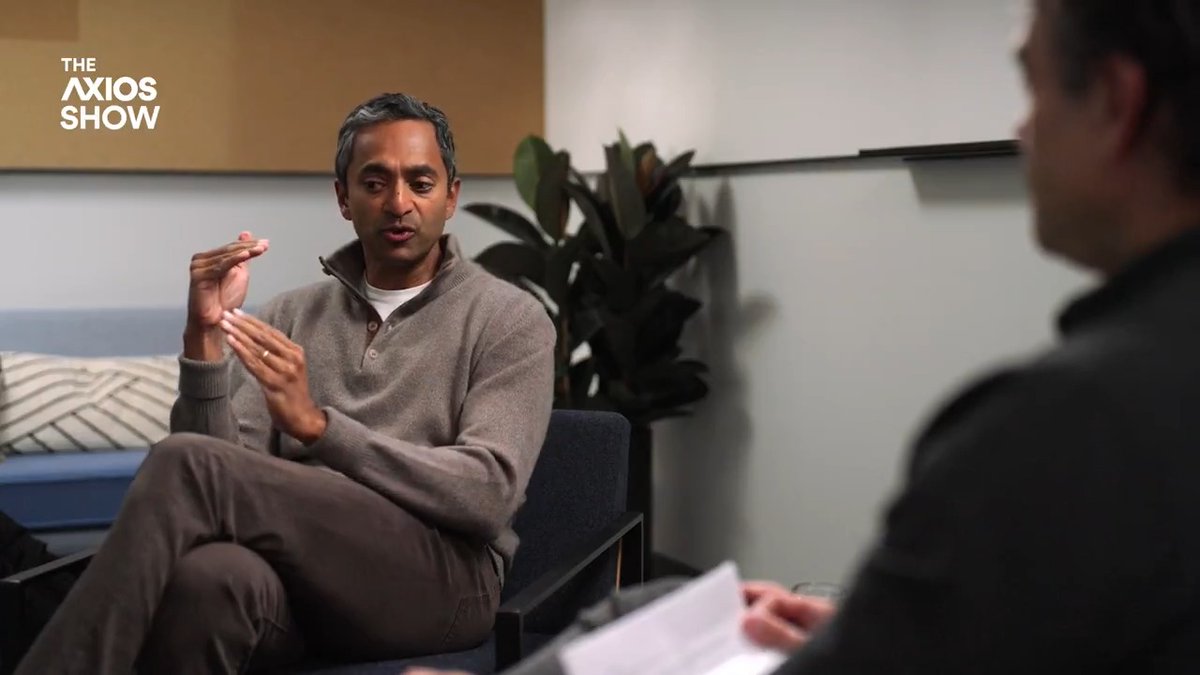


It doesn’t matter how fast your code is generated if the requirements are unclear. Shit in == shit out. That’s why we designed Software Factory as a discipline, not as a convenience tool. Our agents scrutinize your requirements and designs so that when you pass that context to a coding agent, it delivers as expected. Try it here:
Chamath Palihapitiya305,609 Aufrufe • vor 8 Monaten

The honor of my working life thus far had been the team I recruited and led at Meta - three of them who are still there and have risen to become COO, CMO, CXO. That is until now. This is the best team I’ve ever recruited. Based. Cracked. Humble. Wicked smart. Honorable. Much of the team start as interns and then graduate into an MTS after several arduous terms auditioning. But some, like Sai, we snipe from outside because his specific expertise is rare and hard to find. All are equals. All are excellent. Please consider working with us if you like what you hear.
Chamath Palihapitiya140,989 Aufrufe • vor 4 Monaten


Most documentation rots because it’s expensive to maintain and easy to ignore. Software Factory is documentation-first so teams can describe systems in English and let agents compile that intent into code. It detects drift on every code push and keeps documentation synchronized with reality. Context stays alive. Agents keep building. Try it here:
Chamath Palihapitiya197,716 Aufrufe • vor 8 Monaten


Software leverage doesn’t come from faster typing. It comes from stronger coordination. Software Factory is a multiplayer platform: shared requirements, blueprints, and work orders flow to coding agents via MCP. Alignment first. Then parallel execution. Try it:
Chamath Palihapitiya142,969 Aufrufe • vor 8 Monaten


On Friday, I hosted a Space with Jonathan Ross, the founder and CEO of GroqInc - a company I invested in that is building custom chips for AI inference. Jonathan, a former high-school dropout, entered the chip industry while working on ad optimization at Google’s New York office. Jonathan overheard the speech recognition team complaining that they couldn't get enough compute. These were the early days of AI, and machine learning wasn’t really a thing yet. So he asked for some budget from Google and started putting together a chip-based machine learning accelerator for them. During the day, Jonathan would work in the normal ads part of the business, and at night, he would work with the accelerator team. After winning approval from Google, Jonathan and his team built a new chip called the Tensor Processing Unit, and began deploying it across Google’s data centers within a year. The TPU was a huge success within Google, eventually underpinning more than 50% of all of Google’s compute power. When the other hyper-scalers learned of this success, they tried to hire Jonathan to build custom chips for them too. During this process, it became increasingly clear to Jonathan that a gap would emerge between companies that had access to next-gen compute and companies that didn’t. So he founded Groq and set out to build a chip that would be available to everyone. I led Groq’s founding investment in 2016, and since then, Jonathan and his team have developed several types of AI hardware including the Language Processing Unit (LPU), a new type of silicon that is hyper-efficient at running inference for LLMs. In our conversation on Friday, we discussed the founding story of Groq, what you need for great AI hardware, large language models, and some of the implications for the key players in AI. It’s one of the most interesting conversations I’ve had on AI with a lot of learnings. You can listen to our conversation below:
Chamath Palihapitiya326,856 Aufrufe • vor 2 Jahren


Great chatting with students at The Wharton School. We talked about growing up in an immigrant family, the early days at FB, building Social Capital, the biggest economic drivers of the next decade, and what the next generation of tech investing can look like...
Chamath Palihapitiya294,738 Aufrufe • vor 3 Jahren

My take on the energy discussion with China and the U.S grid problem:
Chamath Palihapitiya60,339 Aufrufe • vor 10 Monaten
Keine weiteren Inhalte verfügbar