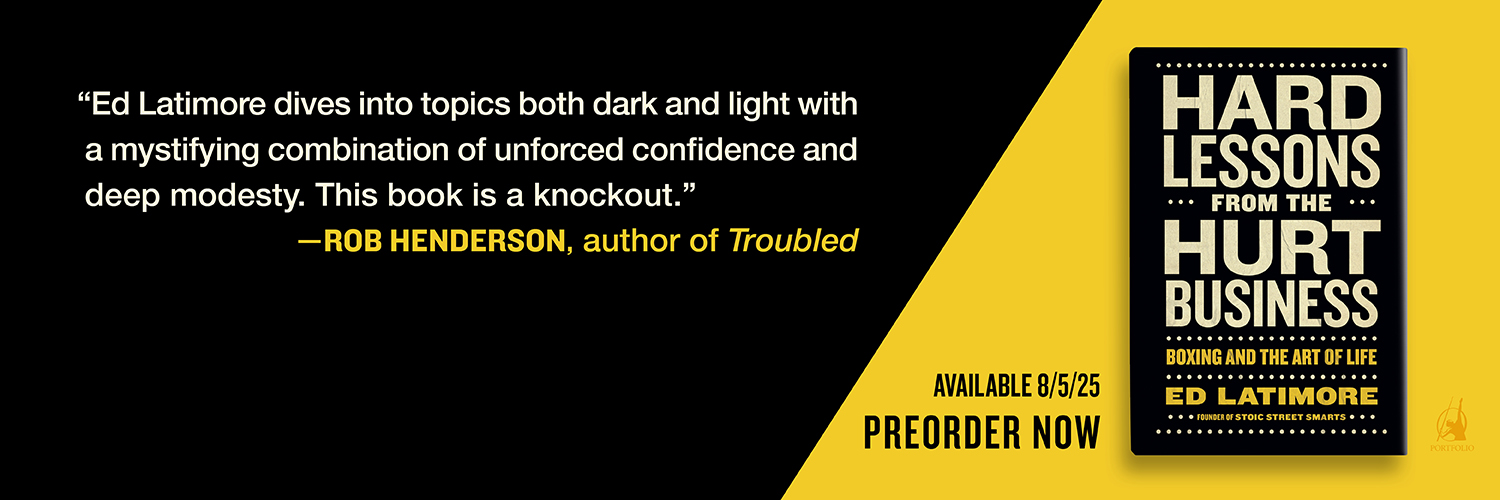
Ed Latimore's banner
Ed Latimore's profile picture

Ed Latimore

@EdLatimore211,492 subscribers

Hwy boxer (14-1-1) | Keynote Speaker | Author of Hard Lessons From The Hurt Business: Boxing and The Art of Life | Sponsored by @rebelhealth_

Shorts

11 or 12 years ago, I was walking through a Best Buy parking lot and a dude passed by me with his girl dressed with all the goodies hanging out. Dude looked at me and said, “What the fuck you lookin' at?” Now, the dude was like 5’7” and skinny. I am not a small man. If someone his size talks to me like that out of the blue, I have to assume he knows something about the balance of forces in this equation that I don’t. I’m not interested in defending my pride to find out because, as Marcelus Wallace once said in Pulp Fiction, “Fuck pride.”

Sensitive content

11 or 12 years ago, I was walking through a Best Buy parking lot and a dude passed by me with his girl dressed with all the goodies hanging out. Dude looked at me and said, “What the fuck you lookin' at?” Now, the dude was like 5’7” and skinny. I am not a small man. If someone his size talks to me like that out of the blue, I have to assume he knows something about the balance of forces in this equation that I don’t. I’m not interested in defending my pride to find out because, as Marcelus Wallace once said in Pulp Fiction, “Fuck pride.”

96,116 просмотров

Whenever my son starts whining about something, I pick him up and do squats until he chills out. A win for both of us.

Whenever my son starts whining about something, I pick him up and do squats until he chills out. A win for both of us.

58,076 просмотров

It's not that you don't want to rotate the hips. There is rotation, but you have to be able to quickly decelerate that rotation and then transfer the momentum to your core for rotation. You want to stabilize the hips so your core can swing and make full use of concentration and ecentric strength. But the core can't be tense until the moment you strike. Otherwise, energy is lost. Or, to put it in physics terms, you want to maximize impulse by decreasing the time the force is applied to stop the momentum of your rotation. In my hiatus, I had figured that part out. That punching is effectively the same motion and muscle recruitment pattern as a golf swing, baseball swing, quarterback pass, or even bowling. What had always troubled me was understanding how to synchronize my feet with these movements. That's where Tom Yankello Boxing and his brilliant training comes into play. My development had always been limited by not understanding the mechanics of a rotational movement across the traverse plane of motion. Once I got that, I figured it out, I could way more easily absorb and understand boxing. I can actually learn how to fight.

It's not that you don't want to rotate the hips. There is rotation, but you have to be able to quickly decelerate that rotation and then transfer the momentum to your core for rotation. You want to stabilize the hips so your core can swing and make full use of concentration and ecentric strength. But the core can't be tense until the moment you strike. Otherwise, energy is lost. Or, to put it in physics terms, you want to maximize impulse by decreasing the time the force is applied to stop the momentum of your rotation. In my hiatus, I had figured that part out. That punching is effectively the same motion and muscle recruitment pattern as a golf swing, baseball swing, quarterback pass, or even bowling. What had always troubled me was understanding how to synchronize my feet with these movements. That's where Tom Yankello Boxing and his brilliant training comes into play. My development had always been limited by not understanding the mechanics of a rotational movement across the traverse plane of motion. Once I got that, I figured it out, I could way more easily absorb and understand boxing. I can actually learn how to fight.

35,834 просмотров

I'm not the writer who's gonna tell you I don't wanna sell a bunch of copies of my book. With that said, the feedback I'm getting from the early readers lets me know that I told one hell of an engaging story—and that really matters. It's a story that seems normal to me because I lived it, but people seem engrossed and are blazing through it. That's a good sign... There are 6 days left before the official launch. Make sure to pre-order if you want to receive the pre-order bonuses, including an invitation to a Q&A call where you can ask me anything... Fighting, writing, crackheads, where the bodies are hidden...you name it! More information at the link below

I'm not the writer who's gonna tell you I don't wanna sell a bunch of copies of my book. With that said, the feedback I'm getting from the early readers lets me know that I told one hell of an engaging story—and that really matters. It's a story that seems normal to me because I lived it, but people seem engrossed and are blazing through it. That's a good sign... There are 6 days left before the official launch. Make sure to pre-order if you want to receive the pre-order bonuses, including an invitation to a Q&A call where you can ask me anything... Fighting, writing, crackheads, where the bodies are hidden...you name it! More information at the link below

25,487 просмотров

Almost every punch should involve a small step. The only real exception is when you're using your lead hand to throw a shot directly in front of you at close range—like when your opponent is trapped on the ropes or tied up in a clinch and can’t retreat. The "how" of stepping is beyond the scope of this caption, but the "why" isn't. You step to generate momentum for your punch and to stay balanced whether you land the shot or miss. Steps also let you adjust to the flow of the fight. Your opponent won’t stand still—you have to punch while moving. But it’s important these are small, controlled steps. Large steps break your stance, compromise your balance, and leave you vulnerable. Plus, when you take large steps, your feet spend more time off the ground, which reduces your ability to transfer force through your legs and hips into the punch. From a physics perspective, small steps help you apply force efficiently. Remember: force equals the change in momentum divided by the time over which that change happens (that’s the impulse-momentum relationship: F = Δp / Δt). The faster you can apply that force (meaning the smaller the Δt), the greater the force you generate. Even fractions of a second matter—double the time it takes to apply your punch’s momentum, and you cut the force dramatically. That’s why staying grounded and taking small, sharp steps maximizes your punching power.

Almost every punch should involve a small step. The only real exception is when you're using your lead hand to throw a shot directly in front of you at close range—like when your opponent is trapped on the ropes or tied up in a clinch and can’t retreat. The "how" of stepping is beyond the scope of this caption, but the "why" isn't. You step to generate momentum for your punch and to stay balanced whether you land the shot or miss. Steps also let you adjust to the flow of the fight. Your opponent won’t stand still—you have to punch while moving. But it’s important these are small, controlled steps. Large steps break your stance, compromise your balance, and leave you vulnerable. Plus, when you take large steps, your feet spend more time off the ground, which reduces your ability to transfer force through your legs and hips into the punch. From a physics perspective, small steps help you apply force efficiently. Remember: force equals the change in momentum divided by the time over which that change happens (that’s the impulse-momentum relationship: F = Δp / Δt). The faster you can apply that force (meaning the smaller the Δt), the greater the force you generate. Even fractions of a second matter—double the time it takes to apply your punch’s momentum, and you cut the force dramatically. That’s why staying grounded and taking small, sharp steps maximizes your punching power.

16,474 просмотров

Videos

Больше нет контента для загрузки