

Chris Powers
@fortworthchris • 222,640 subscribers
Long
Videos

There is only one city in the United States that doesn't grow north - Minneapolis-St. Paul, restricted by geography. Every other city in the country grows north. That's the framework Rex Glendenning has been using for 40 years to position himself in front of growth. People in Celina laughed at him 30 years ago for buying dirt in the boondocks. He plowed every dollar after taxes and overhead back into 40 and 50-acre tracts anyway. In this clip from this week's episode - the rule of thumb Rex says should be on the first page of every real estate book.
Chris Powers894,029 просмотров • 4 месяцев назад

Today I sat down with Jordan Levi, the Kosher Cowboy - a Jewish kid from the Chicago suburbs who became the largest cattle feeder in America. Jordan runs Five Rivers Cattle Feeding with a capacity of nearly a million head. He started as a runner on the Chicago Board of Trade at 13 and found his way to cattle through a hedge fund that sent him to a feedlot in Amarillo. He showed up in Gucci loafers and never left the industry. We go deep on how he trades the curve instead of making binary bets, why the cattle supply is the tightest since the 1950s, and what it takes to manage risk on nearly a million animals across 13 feedlots. I hope you enjoy this episode as much as I did. 02:16 - The Belted Galloway 03:51 - The Kosher Cowboy 08:05 - Pulling value of the futures forward 11:43 - Learning Cattle trading 16:48 - Daily average gain in cattle 18:20 - Jordan’s Eureka moment in the cattle industry 21:08 - What does trading in animals actually look like? 27:05 - How Jordan defines his ROI in trading cattle 31:17 - The Cattle curve 33:37 - The state of the cattle market 42:10 - Buying the largest cattle feeder in the world 46:09 - Grass vs. grain fed cattle 49:15 - Predictions for the cattle supply over the next 10 years 50:54 - The international market 53:17 - Trading frequencies and macro thesis 01:00:27 - USA beef vs. international beef 01:05:21 - The cattle supply chain 01:07:32 - The future of auction yards and ranchers 01:09:40 - AI in AgTech 01:12:52 - The biggest problem facing the industry 01:14:42 - Livestock as a commodity that dies and how that impacts trading theory 01:20:51 - Is there a market for new entrants into cattle? 01:21:41 - Beef prices and the impact of a closed border on the industry 01:24:39 - Jordan’s biggest ideas for the industry 01:26:49 - Philanthropic efforts 01:31:24 - a day in the life of Jordan 01:26:42 - Risk management in cattle 01:41:17 - Does what you do show a leading indicator to the broader health of the American economy?
Chris Powers822,631 просмотров • 6 месяцев назад

The way someone uses AI tells you a lot about them. "Mark Cuban (Mark Cuban) has a quote I wish were mine. Some people use AI so they can learn everything, and some use AI so they don't have to learn anything." Chris Koerner (Chris Koerner) is firmly in the first camp. And he says he can spot the people who aren't. "At my church I hear talks now and I can tell. That's Opus 4.7. And I think that's a shame." His own rule is simple. AI shouldn't save you time. It should make the work better. "If I have three hours to build a lesson, I'm still going to spend three hours. I'll use AI the whole time, and it'll be far better. I could be done in three minutes. But I don't." In this clip, Chris Koerner on using AI to raise your standard instead of lowering it.
Chris Powers250,147 просмотров • 3 месяцев назад

I read Jim Cantrell (Jim Cantrell), Co-founder & CEO of Phantom Space, something he had said before: that executives at very big corporations once wanted him to help destroy Elon Musk. "They signed a contract willing to pay me a lot of money." "Their question was, 'Why is he doing this?'" "My answer was, 'He doesn't care about you. He cares about Mars.'" "Their next question was, 'Well, we've decided we have to destroy him before he gets too big to harm us.'" Jim goes on to tell them they are approaching this all wrong and the correct path is to "be more like Elon". What did that mean? "Well, you know, just go do stuff."
Chris Powers88,267 просмотров • 1 месяц назад

I don’t think I’ve ever had someone on the podcast who genuinely loves what they do for a living as much as StripMallGuy loves strip malls. In today’s episode, we talk about 20+ years of experience investing in strip malls across the country. I must say, I’m intrigued. Don Tepman runs a real estate fund that focuses on buying neighborhood strip centers throughout the United States and also runs the 'StripMallGuy' account on X and LinkedIn. Don started his career in 2002 and led his first strip center purchase in 2006. He has completed 40 purchases and raised over $150M in LP capital. We discuss: - Don’s career and mentors - What makes a successful strip mall acquisition - Building StripMallGuy and the future of the brand 2:30 - Don’s upbringing and career background 6:28 - The dynamics of suburban retail 10:22 - Don’s mentor & learnings 19:31 - Restaurants in strip centers 24:50 - Tenant mixes 28:42 - TI 34:12 - Where do folks waste money on exteriors? 35:54 - Drive-thrus 37:11 - Don’s hold period strategy 41:09 - Why do you stick to smaller deals? 44:12 - What is your approach to entering a new market? 52:10 - Why does Price per foot matter so much? 52:53 - Leasing 59:00 - Taxes and insurance 59:54 - StripMallGuy 1:08:21 - Working a deal through the system 1:12:23 - Thoughts on the market 1:18:04 - Luxury retail 1:19:39 - Meeting Charlie Munger 1:27:08 - Plans for SMG in the future
Chris Powers1,232,219 просмотров • 2 лет назад

At SpaceX, engineers are treated like elite athletes, and held to that standard. Ben Nowack (Ben Nowack ☀️🌎🪞) joined as a college freshman and absorbed it fast. He still quotes the way President Gwynne Shotwell framed it: “SpaceX engineers are the Navy SEALs of engineering, the professional athletes of the field.” Ben doesn't think that bar is unique to rockets. In this clip, the standard he carried out of SpaceX and into Reflect Orbital, and why he believes any company can run that way.
Chris Powers149,421 просмотров • 3 месяцев назад

Today I sit down with Nat Eliason - founder, writer, and now launching Alpha School, a new entrepreneur high school in New York City. Tuition is $150K a year. The promise: every student hits a million dollars in gross profit by graduation, or the family gets their tuition refunded. The first class is around 20 freshmen. The day is split between AI-driven academics in the morning and business building the rest of the day. This is also the Nat who in his spare time built Felix - an AI agent he gave a Stripe account, an email, and an X handle, then told to launch a business overnight. Felix has done $60+K in sales since. Nat has not touched the code. I hope you enjoy this episode as much as I did. 05:55 What Alpha Does Differently From Conventional Schools 11:48 Playing the Fake Game of School 21:46 How Nat Masters New Domains 32:18 Open Claw Deep Dive 43:50 Building the Alpha Entrepreneurship Program 51:43 Freshman Year Structure at Alpha School 1:00:23 How Students Can Pitch for Equity or Debt Funding 1:04:08 Why Establish a New York Location for Year One 1:11:15 Nat’s 10-Year Vision 1:15:11 AI as a Force Multiplier for Teenage Founders 1:16:15 How Alpha Students Quickly Reverse-Engineered a Workaround After Open Claw Went Down 1:24:13 Teen-Parent Conflict as a Symptom of Infantilization
Chris Powers223,789 просмотров • 5 месяцев назад

After 35 years of falling rates and rising allocations, Michael Levy of Crow Holdings thinks the tailwinds that carried real estate are spent. "The '20s could be a lost decade in real estate. We had 35 years of declining interest rates, and 35 years of allocations institutionally going from 2% to 12%. Those are very powerful forces." He doesn't see either one coming back. "Do I think that allocation's going up from here? No. I think it's moving into infrastructure." He points to a whole generation of owners who bought near the top and are now stuck. "There's a lot of people who bought a lot of stuff... that had business plans to monetize it, and it's gonna sit for a decade. There's a lot of investors who invested and thought they'd be getting distributions back, and they're not getting distributions back." In this clip, why he still believes the turn, whenever it comes, will be worth the wait.
Chris Powers93,821 просмотров • 2 месяцев назад

Tomorrow's episode is with Adam Blake (adamblake), Founder of Mavria and former DOGE team lead at the Department of Energy. Adam built a commercial solar company to 2,000 projects, sold a software company to Vista Equity, and in early 2025 got on a plane to Washington. Two executive orders ended up assigning work to his team. One of those orders created a nuclear reactor pilot program at the Department of Energy. I asked him how it actually worked. "So this order called out this crazy ambitious goal of let's get three new reactors turned critical by July 4th, 2026. So this was a goal at the time, by the way, that everybody thought was impossible." "This executive order was also unique in the sense that it assigned implementation to the DOGE team at the DOE, which was me. So that allowed my team to really try and remove barriers and drive this as fast as we possibly could." "This is American entrepreneurship and capitalism at its best. You had these incredible entrepreneurs that were given a clear road. They organized private sector capital. This is not government picking winners or losers." In this clip, Adam explains what the DOE can do that the Nuclear Regulatory Commission can't, and why he says these guys crushed it.
Chris Powers23,697 просмотров • 15 дней назад

When Ben Nowack (Ben Nowack ☀️🌎🪞) was an engineer on SpaceX's Dragon 2, he was sure it would ship later than Boeing's Starliner. Everything was late, broken, changing by the day. "I was like, there's no way this works." It turned out SpaceX was about five years ahead. Dragon 2 now flies astronauts - some of whom Ben has since met. In this clip, the one thing he'd leave behind from SpaceX, and the lesson he kept: you need a very high pain tolerance to get hard things done.
Chris Powers134,490 просмотров • 3 месяцев назад

Today I sit down with Adam Blake (adamblake), Co-founder and CEO of Mavria. Adam spent a little more than a year leading the DOGE team inside the Department of Energy. He has been a private person for 15 years, and last week he broke his silence with a tweet that got over 2 million views. I have known Adam since 2004. I had just gotten to TCU, and the school paper named him Entrepreneur of the Year for the real estate he was buying around campus. One lunch with him at a Chipotle changed the trajectory of my life. He went on to build a commercial solar company that did around 2,000 projects across 17 states, then sold a software company to Vista Equity Partners. In early 2025 a friend called about DOGE. Within about a week he was on a plane to DC, and two weeks after that he was sitting in the West Wing with Elon Musk and the Secretary of Energy. The executive order that set a goal of three new nuclear reactors going critical by July 4th, 2026 put his team in charge of making it happen. Everyone thought it was impossible. It got done. Along the way he got death threats over an anonymous quote that the chairman of the NRC later denied under oath. Now he is building Mavria with two of the people who were in those rooms with him, backed by a $30M pre-seed from a single investor. His view is simple. AI is power, and America has to build a lot more of it. Timestamps: (00:00) Intro (01:18) Why He Decided to Speak Publicly Now (04:37) From Campus Real Estate to Brightergy to Zego (09:03) The Week That Took Him From Coronado to the West Wing (13:02) What DOGE Was Actually There to Do (19:52) Inside the DOGE Team, Working Under Elon (24:53) Why He Calls Washington the Hunger Games (28:08) The Tijuana Sewage Crisis Nobody Has Fixed (31:45) Three New Reactors by July 4, 2026 (35:02) Death Threats Over a Story That Was Never True (41:52) Why Fear Is Not a Strategy on AI (49:09) Why It Takes a Decade to Plug Into the Grid (55:30) Winning Back Public Trust on Data Centers (1:02:29) Spec Builds, Modular Factories, Smaller Data Centers (1:08:52) Why Big Tech Should Behave Like a Nation State (1:14:15) Inside Mavria, His New Infrastructure Company (1:19:45) Loving the Country More, Hating Politics More
Chris Powers20,188 просмотров • 14 дней назад

"We build our American cities around fire trucks… …We should design our cities, then make the fire trucks fit." In America, we have the largest fire trucks in the world— and they’re quietly shaping how our cities look, feel, and function. In this clip with Austin Tunnell , we break down how one overlooked policy is leading to worse urban design.
Chris Powers172,209 просмотров • 5 месяцев назад

Zane Hengsperger (Zane Hengsperger), Founder and CEO of NOX Metals, got into Y Combinator on an 18-minute phone call and had to be in San Francisco the next day. "I realized that metal was this immense bottleneck... how do we get it faster and cheaper?" "You study the metal incumbents, these great businesses that have been around for 200 years, 300 locations. But then you realize they've never been able to implement technology because their DNA is from two centuries ago." "I actually applied to YC with it, got no response." "I got an email from Jared Friedman at YC. He's like, 'Hey, totally missed your application. Are you still interested in doing this?'" "He's like, 'Hey, we'd like to offer you a spot in YC.' I was like, 'Oh, great.' He says, 'But the batch starts today, so you'd have to fly out tomorrow.'" "Flew to San Francisco, not a line of code, not a factory, not a product, not a saw, a machine, anything." In this clip, the 12 hour decision to go to YC.
Chris Powers24,504 просмотров • 20 дней назад
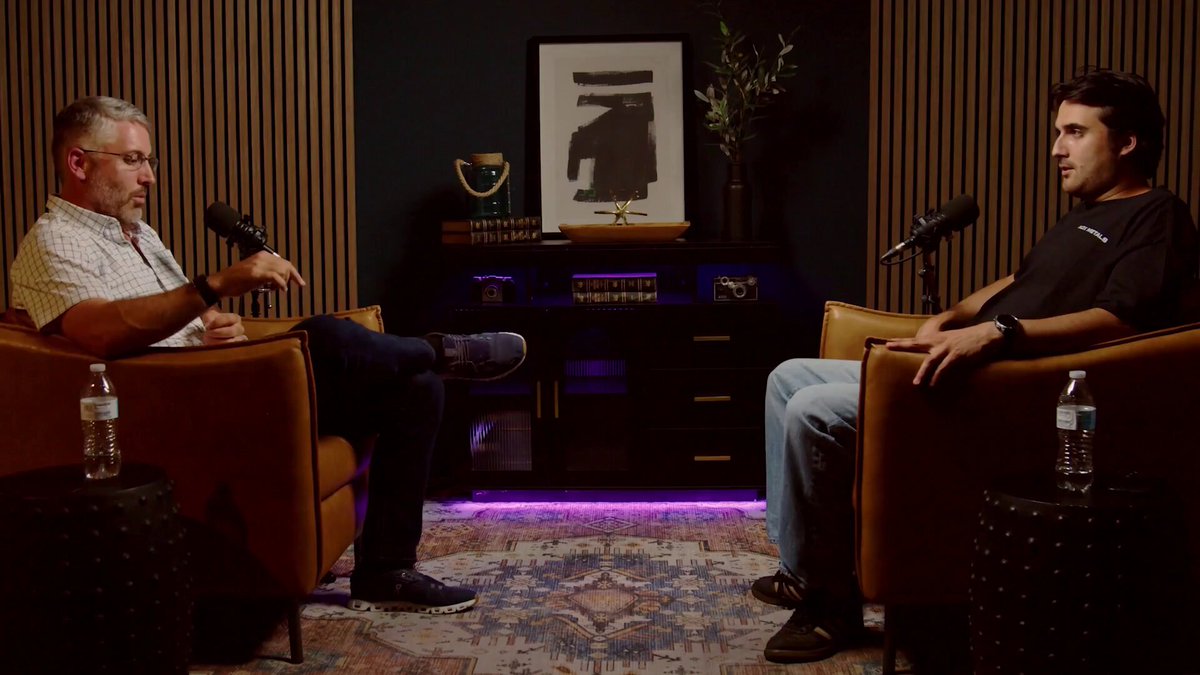
Today I sit down with Zane Hengsperger (Zane Hengsperger), Founder and CEO of NOX Metals, a metal supplier in Detroit he started in 2025. NOX buys metal from the mill, cuts it to the exact size a machine shop needs, and ships it out. The whole operation runs on software the company writes itself. Zane is 26, and his first job was scrubbing the floors of his dad's machine shop at 14. He went into software, then came back to run a machine shop. That is where he saw that metal was the bottleneck for everyone making parts in America. The incumbents have been around for 200 years and have never put software to work. NOX is a year old and has raised an $11.5M seed round. It has written a million lines of code and quotes an order in 10 seconds. We discuss: • The 18-minute call with Y Combinator that put him on a plane the next day • Why his dad hired software engineers for a machine shop back in 2017 • How one piece of software does the work of 20 salespeople • Why two of his engineers moved their desks onto the factory floor • Why the forklift driver gets equity after three months • The 7pm order that was in Dallas by 10 the next morning • Why he says America needs 100x more factories • Where AI has let him down so far This one is for anyone betting on American manufacturing. Timestamps: (00:00) Intro (01:10) Reading Alex Karp and Walking Back Into a Machine Shop (06:06) Hiring Young Technicians Who Want Hard Work (09:10) Why the Brand Is the Moat (14:28) Lessons From a Dad Who Ran a Machine Shop (16:14) Getting Into Y Combinator With One Day's Notice (22:06) Buy a Saw and Write Instant Quoting Software (27:37) Software Engineers on the Factory Floor (34:29) Is America Actually Reindustrializing? (40:55) America Needs 100 Times More Factories (45:26) Quotes in 10 Seconds Instead of Eight Hours (50:09) Delta Cargo Deliveries and Why Detroit Is Ripping (56:07) Where AI Falls Short and What the Next 24 Months Hold (59:13) The Customer Is the Core Thing Left in America
Chris Powers25,046 просмотров • 21 дней назад

There are roughly five times as many billionaires in Dallas-Fort Worth as what shows up on the Forbes list. And according to Matthew Ogle, 90% of them don't have a robust family office. Matthew is the co-founder of Legacy Knight, a $2.8B multi-family office in Dallas built to fill exactly that gap. In this clip from this week's episode - his read on how much wealth actually gets stewarded, and how much doesn't.
Chris Powers151,087 просмотров • 5 месяцев назад

The trip was a failure. Jim Cantrell (Jim Cantrell), Co-founder & CEO of Phantom Space, had taken Elon Musk to Moscow to buy rockets and they came home without them. "They were fairly disrespectful to us. Elon didn't see it because he didn't speak Russian." "They referred to him consistently as malchik, which is boy, little boy in Russian." On the flight back, Jim and his colleague Mike were in coach with bourbon. Musk was a few rows ahead on his laptop. "Mike elbows me, and he goes, 'What do you think that idiot savant is doing up there?'" Musk turned around and said he thought they could build the rocket themselves. In this clip, the spreadsheet he opened to prove it.
Chris Powers42,015 просмотров • 1 месяц назад

Tomorrow I'm sitting down with my friend JB Mauney, the greatest bull rider that's ever lived. He is a two-time PBR World Champion and the highest-earning bull rider in western sports history. JB rode bulls for 23 years and never once walked straight to a set of paramedics - no matter how bad the wreck. Then one night in Lewiston, Idaho, a bull named Arctic Assassin changed that. The surgeon told him he had maybe a millimeter between walking and a wheelchair. In this clip, JB tells the story of the bull ride that ended his professional career.
Chris Powers137,574 просмотров • 6 месяцев назад

Today I sit down with Justin Lopas (Justin Lopas), Co-founder & COO of Base Power. On Monday Base announced a $1B Series D at a $13B post money valuation. Justin spent his early career at SpaceX, where he helped lead the Brownsville site that became Starbase, then ran manufacturing at Anduril. Base puts large batteries on homes, owns and operates them, and uses the fleet to support the grid. This is a conversation about speed, and about how much of it turns out to be a decision rather than an effort level. We discuss: • Why he wanted their first battery installed fast instead of right • Why he thinks good manufacturing is decided during design, not on the factory floor • Why he does not push his suppliers as hard on price as he could • Why SpaceX put him in charge of building the Starship factory two and a half years into his career • The question he asks to find out why a job is really taking so long • How a battery company ended up training its own electricians • Why he calls Base an infrastructure company and not a product company Timestamps: (00:00) Intro (00:48) From Late-Night Research to an Office in Austin (07:55) The First Battery Install Was an Epic Failure (09:15) Finding a Battery Supplier Who Would Let Them In (15:47) Killing Gen Two and Skipping Straight to Gen Three (22:52) From a Hundred Requirements to Cardboard Cutouts (26:02) Good Manufacturing Is Won or Lost at the Design Stage (32:48) How to Build a Supply Chain From Nothing (40:51) Negotiating With Suppliers and Deciding What to Build Yourself (44:58) The Turtle That Marks the Slowest Team (47:39) The SpaceX Lessons on Talent and Speed (54:09) Building a Regulatory Team and Choosing the Next State (58:19) Managing Complexity Is the Whole Job (1:03:20) Tesla Sells Products, Base Owns Infrastructure (1:05:24) Training Electricians and Staying Out of Commercial
Chris Powers43,855 просмотров • 1 месяц назад

When Barry Sternlicht was 32 y/o he started Starwood with Bob Faith and an assistant. 18 months later, after acquiring 8,000 MF units, he sold to Sam Zell’s Equity Residential REIT in return for 20% ownership. By the time he was 37 they owned Starwood Hotels and Lodgings Trust, the largest Hotel REIT in the world with $20B AUM and 120,000+ employees across the globe. Today Starwood Capital Group and affiliated entities manage over $120B in assets across the globe and have become the giant in the room. Today’s episode is full of incredible stories of how they climbed to the top of the real estate world: 0:00 - AI & Hotels 6:34 - The Midas touch 8:16 - Scaling to 120k people in 7 years 14:00 - Shared Pair REITs 27:15 - Thoughts on Blackstone 35:25 - How to buy a REIT 39:45 - Taking a company from $1B in AUM to $10B 48:50 - How did you keep Starwood Capital moving while you stepped away? 58:22 - Selling Caesar’s Palace 1:07:53 - Thoughts on the market in 2024
Chris Powers515,400 просмотров • 2 лет назад
