
hardmaru
@hardmaru • 426,979 subscribers
Co-Founder and CEO @SakanaAILabs 🎏
Shorts


Videos

Survival of the fittest code. Core War (1984) is a game where programs must crash their opponents to survive. Warriors written in an assembly language called Redcode fight for control of a virtual machine. Our new paper: Digital Red Queen: Adversarial Program Evolution in Core War with LLMs, explores what happens when LLMs drive an adversarial evolutionary arms race in this domain. We task LLMs to write Warrior programs in Redcode that must out-compete a virtual world full of such programs. Core War is a Turing-complete environment where code and data share the same address space, which leads to some very chaotic self-modifying code dynamics. This approach is inspired by the Red Queen hypothesis in evolutionary biology: the principle that species must continually adapt and evolve simply to survive against ever changing competitors. In our work, programs continuously adapt to defeat a growing history of opponents rather than a static benchmark. We find that this adversarial process leads to the emergence of increasingly general strategies, including targeted self-replication, data bombing, and massive multithreading. Most intriguingly, it reveals a form of convergent evolution. Different code implementations settle into similar high performing behaviors, mirroring how biological agents independently evolve similar traits to solve the same problems. I think this work positions Core War as a sandbox for studying Red Queen dynamics in artificial systems. It offers a safe controlled environment for analyzing how AI agents might evolve in real world adversarial settings such as cybersecurity. By simulating these adversarial dynamics in an isolated sandbox, we offer a glimpse into the future where deployed LLM systems may start competing against one another for limited resources in the real world.
hardmaru174,256 görüntüleme • 8 ay önce
Artificial lifeforms are super fascinating to watch. These self-organizing, self-replicating, “lifeforms” emerged from a continuous time cellular automata system called Flow-Lenia. Lenia is a family of CAs generalizing Conway’s Game of Life to continuous space, time and states.
hardmaru568,649 görüntüleme • 2 yıl önce

New Paper: Continuous Thought Machines 🧠 Neurons in brains use timing and synchronization in the way that they compute, but this is largely ignored in modern neural nets. We believe neural timing is key for the flexibility and adaptability of biological intelligence. We propose a new neural architecture, “Continuous Thought Machines” (CTMs), which is built from the ground up to use neural dynamics as a core representation for intelligence. By using neural dynamics as a first-class representational citizen, CTMs naturally perform adaptive computation. Many emergent, interesting behaviors arise as a result: CTMs solve mazes by observing a raw maze image and producing step-by-step instructions directly from its neural dynamics. When tasked with image recognition, the CTM naturally takes multiple steps to examine different parts of the image before making its decision. This step-by-step approach not only makes its behavior more interpretable but also improves accuracy: the longer it “thinks,” the more accurate its answers become. We also found that this allows the CTM to decide to spend less time thinking on simpler images, thus saving energy. When identifying a gorilla, for example, the CTM’s attention moves from eyes to nose to mouth in a pattern remarkably similar to human visual attention. I think this work underscores an important, yet often lost, synergy between neuroscience and AI. While modern AI is ostensibly brain-inspired, the two fields often operate in surprising isolation. By starting with such inspiration and iteratively following the emergent, interesting behaviors, we developed a model with unexpected capabilities, such as its surprisingly strong calibration in classification tasks, a feature that was not explicitly designed for. When we initially asked, “why do this research?”, we hoped the journey of the CTM would provide compelling answers. By embracing light biological inspiration and pursuing the novel behaviors observed, we have arrived at a model with emergent capabilities that exceeded our initial designs. We are committed to continuing this exploration, borrowing further concepts to discover what new and exciting behaviors will emerge, pushing the boundaries of what AI can achieve.
hardmaru257,548 görüntüleme • 1 yıl önce

Excited to announce our MIT Press book “Neuroevolution: Harnessing Creativity in AI Agent Design” by Sebastian Risi (Sebastian Risi), Yujin Tang (Yujin Tang), Risto Miikkulainen, and myself. We explore decades of work on evolving intelligent agents and shows how neuroevolution can drive creativity in deep learning, RL, LLMs and AI Agents! 📖 Free open-access edition: In addition to our own works, this video features work by Jürgen Schmidhuber (Jürgen Schmidhuber), Seth Bling (SethBling), Igor Karpov, Jacob Schrum, Yulu Gan (Yulu Gan), Ken Stanley (Kenneth Stanley), Joel Lehman (Joel Lehman), Jeff Clune (Jeff Clune), Nick Cheney (Nick Cheney), Richard Song (Richard Song), Chelsea Finn (Chelsea Finn), Julian Togelius (Julian Togelius), Sam Earle (Sam Earle), Hod Lipson (Hod Lipson), and Jean-Baptiste Mouret (Jean-Baptiste Mouret).
hardmaru162,971 görüntüleme • 9 ay önce

Amazing that Jürgen Schmidhuber gave this talk back in 2012, months before AlexNet paper was published. In 2012, many things he discussed, people just considered to be funny and a joke, but the same talk now would be considered at the center of AI debate and controversy. Full talk:
hardmaru365,428 görüntüleme • 2 yıl önce

“Today’s LLMs are the ‘Mainframe Computers’ of our generation” I was on Bloomberg TV today discussing Sakana AI, and to share my view that today’s LLMs are our generation’s “Mainframe Computers”. We are still in the very early stages of AI, and it is inevitable, due to market competition and global innovation (especially from those innovating with resource constraints), that this technology will become a million times more efficient. There is a narrative established in Silicon Valley that AI is a “Winner Takes All” technology, and that scaling up existing models and consuming ever greater resources will require (and even justify) the largest investments of our generation, in order to “win” the AI race. In contrast, I believe that AI is not a “winner takes all” technology. LLMs will be commoditized, become vastly more efficient, and made widely available in all countries. Ultimately, there will be thousands, if not millions, of AI models used by everyone. Just like with the evolution of early clunky mainframe computers to modern computing, how we use AI today will look very different in a few years (or even a year from now), compared to today’s ‘clunky’ LLMs.
hardmaru165,382 görüntüleme • 1 yıl önce

New Paper! Darwin Godel Machine: Open-Ended Evolution of Self-Improving Agents A longstanding goal of AI research has been the creation of AI that can learn indefinitely. One path toward that goal is an AI that improves itself by rewriting its own code, including any code responsible for learning. That idea, known as a Gödel Machine, proposed by Jürgen Schmidhuber over two decades ago, is a hypothetical self-improving AI. It optimally solves problems by recursively rewriting its own code when it can mathematically prove a better strategy, making it a key concept in meta-learning or “learning to learn.” While the theoretical Gödel Machine promised provably beneficial self-modifications, its realization relied on an impractical assumption: that the AI could mathematically prove that a proposed change in its own code would yield a net improvement before adopting it. Sakana AI, in collaboration with Jeff Clune’s lab at UBC, proposes something more feasible: a system that harnesses the principles of open-ended algorithms like Darwinian evolution to search for improvements that empirically improve performance. We call the result the Darwin Gödel Machine. DGMs leverage foundation models to propose code improvements, and use recent innovations in open-ended algorithms to search for a growing library of diverse, high-quality AI agents. Applied to practical tasks, we implemented Darwin Gödel Machine as a self-improving coding agent that rewrites its own code to improve performance on programming tasks. It creates various self-improvements, such as a patch validation step, better file viewing, enhanced editing tools, generating and ranking multiple solutions to choose the best one, and adding a history of what has been tried before (and why it failed) when making new changes (see the attached video). We believe that Darwin Gödel Machines represent a concrete step towards AI systems that can autonomously gather their own stepping stones to learn and innovate forever!
hardmaru104,854 görüntüleme • 1 yıl önce

Experimenting with infinite zoom out using #StableDiffusion2
hardmaru208,183 görüntüleme • 3 yıl önce


“Many of you probably don’t know this, but at one point, Masa was the largest shareholder of NVIDIA…” 🤣
hardmaru89,571 görüntüleme • 1 yıl önce

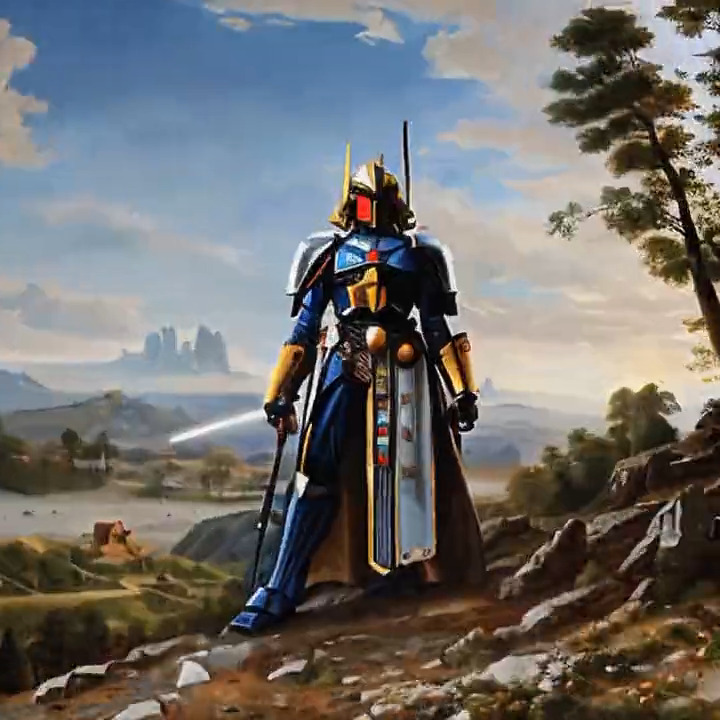

“Why Studio Ghibli movies can’t be made with AI.” Source: YouTube ( Excellent video by Dami Lee. An excerpt:
hardmaru98,598 görüntüleme • 3 yıl önce

At the #BloombergNewEconomy Forum in Singapore, I discussed the future of AI, and why open-source is how rest of the world can work together to develop AI. When you don’t have hundreds of billions of dollars of funding, you’re forced to collaborate. Constraints breed innovation.
hardmaru33,804 görüntüleme • 9 ay önce


Daha fazla içerik yok.