

Grey
@jgreyfriend • 20,690 subscribers
Building cool stuff. Co-Founder @trykashu. Systems engr
Videos


A “duck hunting trip” was planned. In November 1910, Senator Nelson Aldrich, head of the National Monetary Commission, arranged a meeting. But it wasn’t in Washington. It was on Jekyll Island, Georgia, owned by J.P. Morgan and other elites. Aldrich gathered 5 men. All boarded a private train using fake names.
Grey1,389,168 просмотров • 1 год назад

Why the secrecy? Because if the public knew private bankers were designing a central bank, it would’ve been political suicide. "We were as secretive as conspirators... we knew that what we were about to do would be criticized." – Frank Vanderlip So they used first names only. Staff were dismissed. No press allowed.
Grey1,131,434 просмотров • 1 год назад

What did they actually create? In 9 days on Jekyll Island, they drafted a blueprint: • A national reserve system • 15 regional Reserve Banks • A central governing board • Ability to expand/contract currency supply • Privately owned but federally supervised It wasn’t called a “central bank”, too controversial. Instead: The Federal Reserve System.
Grey966,375 просмотров • 1 год назад

So what does the Fed do? Today, the Federal Reserve: • Controls interest rates • Regulates banks • Prints (and retracts) U.S. dollars • Acts as lender of last resort • Backs over $20 trillion in money, credit, and liquidity It is the most powerful financial institution in the U.S. and possibly the world.
Grey690,077 просмотров • 1 год назад

But is it truly public? Or private? This is still debated. • The Fed is a public-private hybrid • Regional Fed banks are privately owned by commercial banks • But the Fed Chair is appointed by the President • Congress provides oversight but cannot dictate policy That hybrid structure began on Jekyll Island.
Grey608,844 просмотров • 1 год назад

In 2021, Stanley Druckenmiller explained how he compounded at 30% for 30 years straight. He broke down why: - Winning isn’t about being right - Markets reward puzzle-solvers - Entitlements threaten youth 12 lessons from Druckenmiller on markets, risk and the future of America:
Grey246,514 просмотров • 8 месяцев назад

In 2010, George Soros gave a 40-minute masterclass on why humans misjudge market reality. He explained why: - Markets distort reality - Bubbles are logical, not irrational - Regulators must fight markets 12 lessons from Soros that change how you see financial markets forever:
Grey225,725 просмотров • 8 месяцев назад

Jim Simons built the most profitable hedge fund in history. Not with insider info. Not with Wall Street traders. He quietly compounded 66%+ annually while everyone else argued on TV. 13 timeless money lessons from the man who out-earned Buffett, Soros & Dalio combined:
Grey91,888 просмотров • 9 месяцев назад

Elon Musk in 2008: "NASA was going to pay Russia $70M per astronaut. SpaceX could do it for $15M" Musk is presenting SpaceX to a small audience. He shows a video of the Falcon 9 first stage firing: "This is almost a million pounds of thrust in vacuum, about four times the maximum thrust of a 747. It's pretty much Armageddon down there. You don't want to be standing at the base of that test stand." He explains the NASA contract: "The contract SpaceX has right now is to demonstrate cargo transfer to the space station and return of experiments to Earth. What we're hoping NASA will exercise is an option on that contract to also carry astronauts. I think they will exercise that option fairly soon." On the coming gap in American spaceflight: "The Space Shuttle is retiring in 2010. So unless our spacecraft is active, the US will not have the ability to send people to orbit. For about five or six years, unless SpaceX is successful, there will be no American manned space capability. There'll just be the Russians." He describes the situation bluntly: "The Russians are charging us over $70 million per seat after the shuttle retires. They got us over a barrel and they're doing us hard. We'll spend half a billion dollars per year on the Russians just buying tickets for six or seven astronauts to go to the space station." Musk shares SpaceX's cost: "Our cost per person, even assuming no reusability, assuming every bit of it is expended and no refurbishment, is about $15 million per person. And it's us. The jobs are here. So I think it's kind of a no-brainer. But no-brainers in Washington DC don't always happen." On Congress: "We've been given money for the cargo portion but not for the manned portion. The amount we're asking for to get this done is $300 million. For every year that we're dependent on the Russians, we have to send them half a billion dollars. It seems kind of ludicrous. But anyway, that's DC." Someone asks about the space elevator: "The idea is you have this really long cable, like 40 to 60,000 miles long, with the ends way out in space and the base on Earth. There are a lot of issues with the space elevator. It relies on super strong materials, carbon nanotubes. Until we build, say, a carbon nanotube footbridge, then I think we should not really be thinking too much about building a 60,000-mile elevator. Not this century." On space solar power: "If there's anyone in the world who should love space solar power, it's me. I'm chairman and the largest shareholder of a solar company called SolarCity, and I've got a rocket company. So it should be perfect. Unfortunately, I don't think space solar power makes sense. I wish it did because that'd be awesome. But even if you assume it costs zero to transport the solar panels to space, when you take into account the equipment to convert the energy to microwaves, then equipment on the ground to convert it back to electricity, just that capital cost blows you out of the water. It's not competitive with terrestrial solar power. So there's no point in even thinking about it." On fuel costs: "The fuel and oxidizer cost is really super low. For our big rocket, it's only a couple hundred thousand dollars. For our small rocket, it's about $30,000 or $40,000. If you just look at the propellant cost, it's very, very cheap." On the long-term goal: "One of the design goals for Falcon 9 is that it can go from in the hangar to in the air in under 60 minutes, which would be super fast for a rocket, particularly a big rocket. It's going to take several flights before we get there. But as long as we lay the foundation and make sure the design is capable of that, we can at least have the possibility of getting to a flight an hour in the future."
Grey56,512 просмотров • 5 месяцев назад

Charlie Munger built Berkshire Hathaway to $1.1 Trillion. He made $2.6 Billion for himself. Not by predicting stocks, but by avoiding • Stupidity • Bad incentives • Emotional decisions 15 timeless money principles that outperformed generations of “genius” investors:
Grey83,248 просмотров • 9 месяцев назад

In 1998, Jamie Dimon got fired from Wall Street’s most powerful bank. But he went on to build JPMorgan into an $800B institution. His principles: • Fortress balance sheets • Stress-test the worst case • Incentives that punish stupidity 14 lessons from this masterclass:
Grey60,024 просмотров • 9 месяцев назад

In 2010, Jim Simons gave a masterclass at MIT on mathematics, business & building the most successful hedge fund in history. His frameworks: • Be guided by beauty • Collaborate with the best • Slavishly follow the model 15 lessons from the greatest investor of all time:
Grey50,255 просмотров • 7 месяцев назад

Bill Ackman explained how to invest like a billionaire in just 12 minutes:
Grey70,018 просмотров • 1 год назад

Today we announce Kashu to the world, having raised exactly $0. We built Kashu for a simple reason: businesses should not have to wait on their own money. Kashu is the first B2B payment platform of its kind, letting you access your credit and move capital with ease. Trillions in credit lines sit unused. 80% of Americans have credit cards. Millions of SMBs face constant cash flow pressure. We turn that credit into usable capital. Pay suppliers. Cover payroll. Float inventory. Move faster. This is a new layer for how money moves. Welcome to Kashu.
Grey38,602 просмотров • 6 месяцев назад

In 2025, Bill Ackman explained how he made billions by thinking differently about businesses. He talks about: • Why durability matters more than price • How royalty businesses compound forever • Why permanent capital saves investors 12 lessons from Ackman's masterclass:
Grey40,165 просмотров • 8 месяцев назад

In 2024, Jeff Bezos gave a masterclass on how to build companies that outlive their founders. His frameworks: - No 'Safe' decisions - Disagree and commit - Wealth created for others 13 lessons that helped Jeff Bezos build a $2.3T+ wealth: 1) Make “far from cowardly” decisions.
Grey29,720 просмотров • 9 месяцев назад
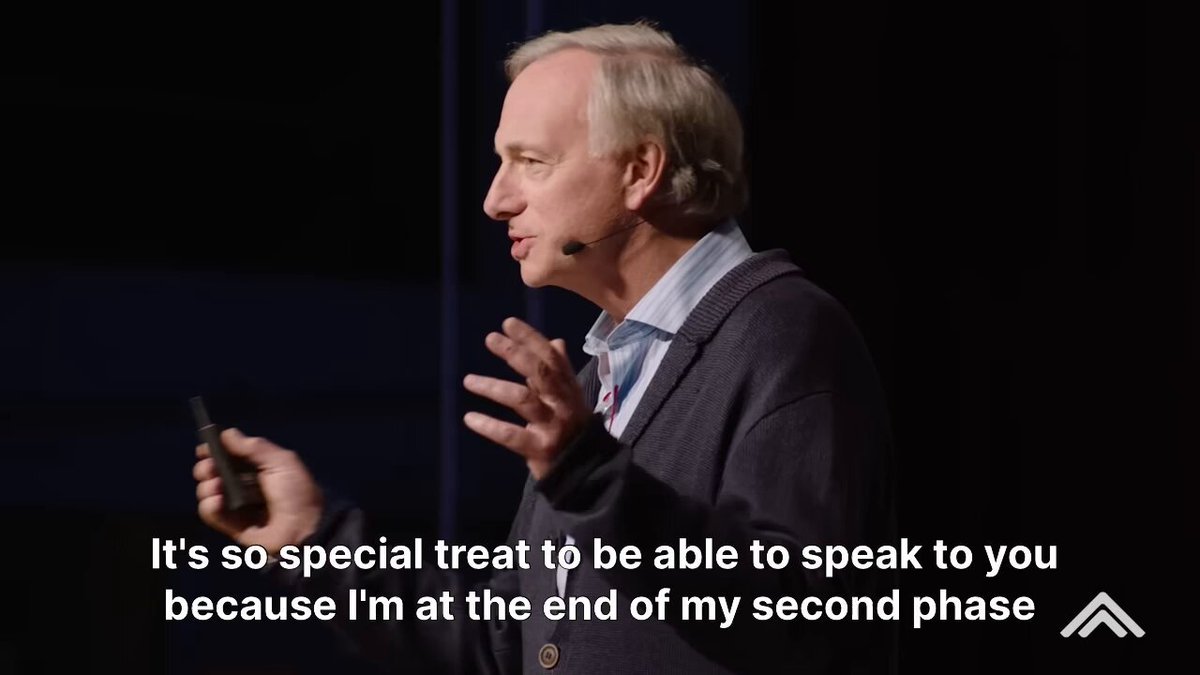
In 2017, Ray Dalio literally gave a 1-hour masterclass on principles & decision-making. He built the world's largest hedge fund from nothing. His frameworks: • Pain + reflection = progress • The 5 steps to success • Idea meritocracy 14 lessons on life and work:
Grey20,314 просмотров • 7 месяцев назад
