
Lisha
@lishali88 • 18,572 subscribers
Partner @a16z infra & AI. prev ceo @rosebud_ai angel in seed @fal @periodiclabs @ExaAILabs @sakana PhD @ucberkeley Math & AI
Videos

My feed has been inundated with posts of Grok 3 making basic arcade games. But llms from years ago could make decent arcade games, not news. So I ran a one-shot test to determine how well it fared again other frontier models in creating a 3D game with room for it to come up with gameplay and aesthetics. I tested Grok 3, O1, Sonnet 3,5, Llama4, DeepSeek, and Gemini using the following prompt. Make Dune x Minecraft 🏜️ Imagine a sandbox survival game set on a desert planet. Players mine ‘spice’ and must build defenses against roaming sandworms. Design the main gameplay loop, crafting system, and survival challenges in one complete description. ✏️tldr O1, Grok 3, and Sonnet 3.5 were the most impressive. Aesthetically, Grok nailed the best vibes (it even produced a surprisingly cool-looking spice mining truck), but the game lacked functionality. O1 took the top spot imo with a functional and visually appealing experience, and Sonnet 3.5 followed closely. This is obviously just one test, but you can see the generated code and games in the thread (and even try forking them on Rosebud). Longer summary: OpenAI O1: Best vibes to function balance. Looked good, working controls, I could mine spice. xAI #Grok3: Excelled at generating vibes for dune. I especially liked the Dune-inspired spice mining car—though it wasn’t entirely a complete game. I could move around, but none of the crafting mechanics worked. Anthropic Sonnet3.5: produced something in space that had dune vibes. More functional than Grok because I could mine spice. However vibes were worse than the first two. DeepSeek : Managed to generate code that worked, but the game was so hard it always ended seconds after it started, and despite requests for better visuals, it looked VERY ugly. Google DeepMind Gemini 2.0 flash and AI at Meta LLaMA: Sadly landed at the bottom of the list; after multiple prompts (this was supposed to be one shot and none of the others failed in the first shot), I couldn’t get them to produce working code for this prompt. All of these were tested on Rosebud AI . An obvious limitation with these frontier models in their chat interfaces is that you can only get them to regenerate code from scratch each time you prompt them, making it tough to refine or extend a single project. Rosebud, on the other hand, lets you iterate on one project (we do diffs), deploy with one click, share your project, and even allow others to remix it. This was just a single test, so it’s obviously not scientific. I wanted to create it to see how these frontier models handle more complex game prompts—rather than retrying the same arcade games that earlier generations of LLMs have already mastered.
Lisha476,022 Aufrufe • vor 1 Jahr


👋 I’m Lisha—if you found me from my Grok 3/o1 to Dune-Minecraft post, welcome! That was a side quest to test frontier llms on Rosebud. My main quest is building Rosebud AI so anyone can vibe code games! 👇 Watch how I prompt my way to building a browser based 3D city sim in 1 min (music on 🎹 )! I love experimenting with AI in creative app dev. Too many creative hobbies are gate-kept behind years of technical experience, so I started Rosebud to fix that. Removing technical barriers sparks new game experiences and allows more people to participate in creation. I’ve seen everything from RPGs, FPS, horror games, sandbox, and various multiplayer experiences built on Rosebud... all by creators who, until recently, never coded. It’s so rewarding to watch users shift from consumers to creators and listen to them rave about the magic of creating their first game.
Lisha66,969 Aufrufe • vor 1 Jahr

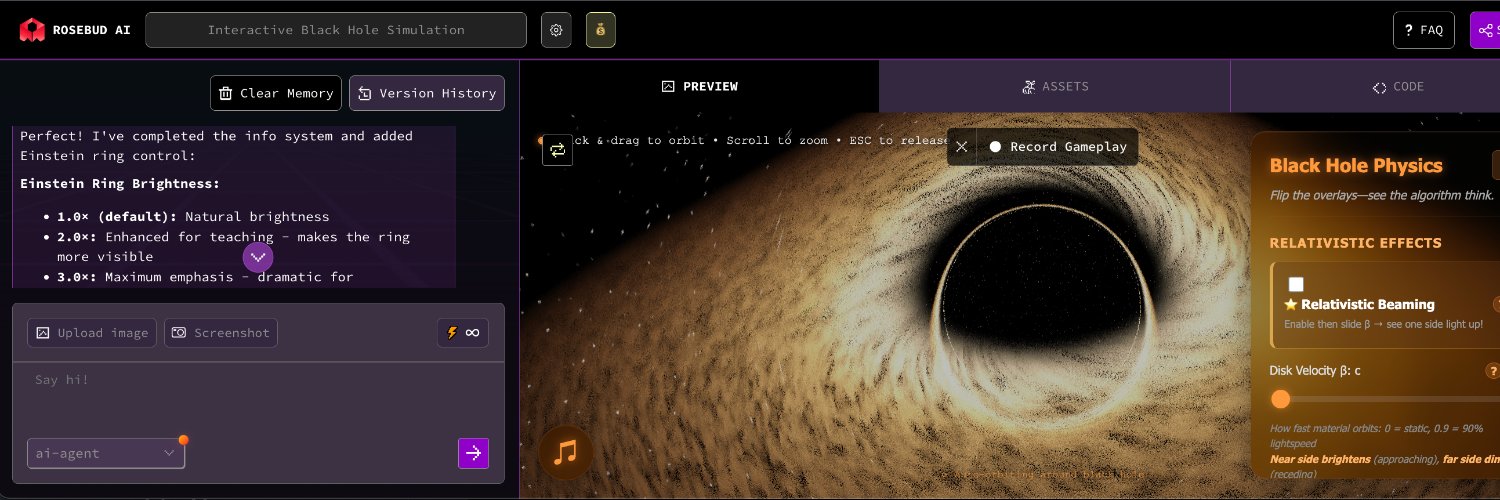
Built a browser shader to teach relativistic effects. Beaming, lensing, Doppler & redshift—live sliders. Based on Koiava's blackhole shader on Shadertoy. I wrapped it in Three.js, added GUI toggles (beaming, redshift, photon ring), Kerr spin cheat. Link in thread. Turn sound on to play with it with the interstellar soundtrack 😀 #PhysicsTwitter #ThreeJS #WebGL #GLSL #Shaders #CreativeCoding
Lisha16,833 Aufrufe • vor 11 Monaten


Keine weiteren Inhalte verfügbar