

Michael Kovrig
@MichaelKovrig • 22,827 subscribers
Founder/CEO/writer/analyst/advocate/ex-diplomat | Senior Adviser, ICG | China/Indo-Pacific/geopolitics/geoeconomics | Don't start none, won't be none 己所不欲,勿施於人
Videos
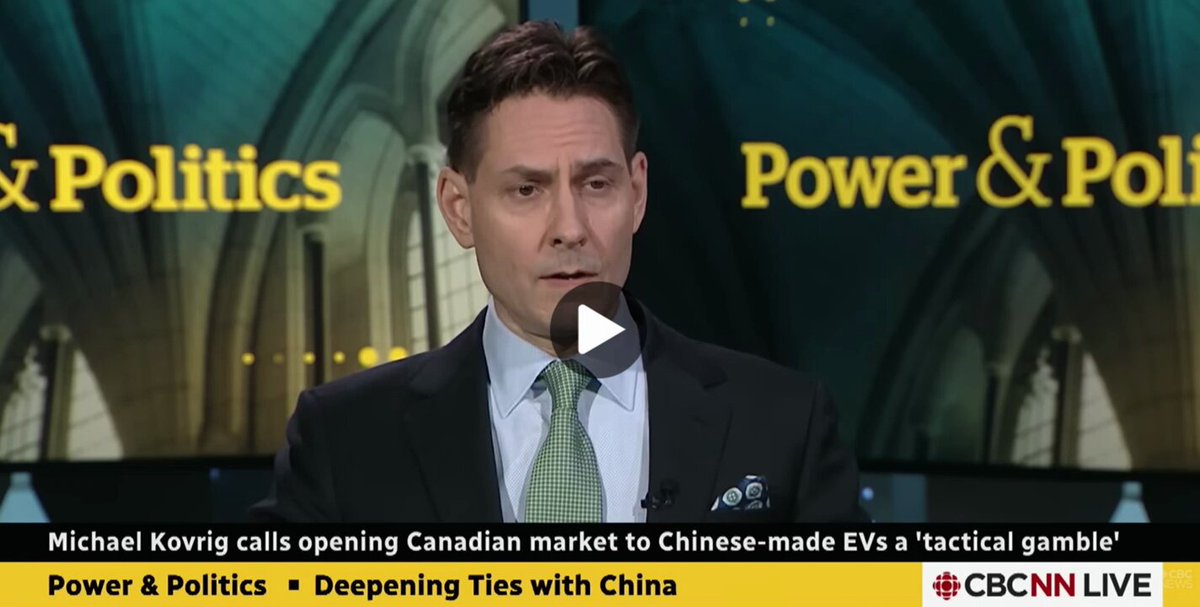


Canada’s quota for Chinese electric vehicles is now in place. The question is no longer whether to allow them in, but how tightly to manage the risk. Very tightly, I’d argue, which is what I told the House of Commons Standing Committee on Industry and Technology. 1/8
Michael Kovrig31,134 görüntüleme • 16 gün önce


Opening Canada’s market to electric vehicles from China should be assessed not as a normal trade agreement, but as a tactical gamble that risks deep entanglement, I cautioned in testimony before the House of Commons Standing Committee on Science and Research. 1/5
Michael Kovrig49,279 görüntüleme • 1 ay önce

Canadian MP Michael Chong is in Taiwan this week despite objections from Beijing. “Canada is a sovereign and independent country,” he said, and does not take direction from a foreign government on where Canadian MPs can travel or where Navy warships transit. Good for him.
Michael Kovrig58,879 görüntüleme • 2 ay önce

The real danger in Canada-China trade isn’t scale. It’s over-dependence. China can buy Canadian goods, but it’s risky to let a sector or company become so dependent on the Chinese market that Beijing can use that dependence to apply political pressure. That isn’t a hypothetical. The Chinese Communist Party has a history of weaponising trade and economic ties to achieve its political objectives.
Michael Kovrig113,369 görüntüleme • 6 ay önce

Turning to China to hedge against Trump carries serious risks. The CCP playbook runs from inducements to dependency, to demands for deference, to coercion. Stay out of the doom-loop. That and more in my testimony to Canada’s House of Commons Committee on Trade, now online:
Michael Kovrig45,684 görüntüleme • 4 ay önce

Canada still tends to approach trade with China as if it were mainly about economics. In practice, it rarely is. Talk of a new “strategic partnership” risks obscuring a basic reality. China hasn’t changed how it uses trade, investment, and diplomacy as tools of state power.
Michael Kovrig57,998 görüntüleme • 6 ay önce

🤔Is that a yes or a no? Or just a “did you really have to ask me that here in Beijing?”
Michael Kovrig47,616 görüntüleme • 6 ay önce

The most important takeaway from the Canada-China trade deal on canola and EVs isn’t the short-term relief. It’s the precedent. Canada got limited concessions. Beijing kept the leverage. And what this demonstrates to the Chinese Communist Party is that pressure worked. That’s a lesson China is unlikely to forget, especially when it’s deciding where to apply pressure next. More in my interview with Vassy Kapelos on CTV Question Period. Full clip linked in the comments.
Michael Kovrig39,066 görüntüleme • 6 ay önce

There’s a difference between diversification and substitution. Canada needs alternatives to overdependence, but replacing U.S. dependence with China dependence would be worse, not better. Any move that weakens coordination with allies carries long-term costs, particularly in autos, manufacturing, and security cooperation. This isn’t about one trip. It’s about structural alignment.
Michael Kovrig24,293 görüntüleme • 5 ay önce


Turning to China to hedge against Trump carries serious risks. Ephemeral stability purchased through accommodation invites more coercion. The CCP playbook runs from inducements to dependency, to demands for deference, to coercion. Stay out of the doom-loop. That and more in my testimony to Canada’s House of Commons Committee on Trade last week.
Michael Kovrig11,991 görüntüleme • 4 ay önce

China is drawing Canada closer. Which country will be next? When Alexander Sjöberg of Danish newspaper Berlingske put that question to me, I forecast South Korea, the United Kingdom, and Germany as Beijing’s next targets. No crystal ball required—their leaders are all visiting China this winter. As Sjöberg puts it, while the US president is tearing apart the West's geopolitical armour, the Chinese government sees its chance to put out feelers and promote itself as a more “predictable” partner. Trump has given the CCP golden opportunities to improve its position through negotiations. Article link in comments. Which countries do you think top Beijing's priority list this year for influencing and coercing?
Michael Kovrig12,804 görüntüleme • 6 ay önce
Daha fazla içerik yok.