

monokern
@monokern • 5,261 subscribers
AI, products & systems
Shorts


Videos

OpenAI Dots is insane for building a 24/7 AI company... I mapped the whole OpenAI Dots architecture into one paper: agents, models, tools, memory, delegation, guardrails and the revenue layer. Here are the 10 steps: step 1 → stop treating Dots like a chatbot. each Dot runs in a persistent cloud environment with its own browser, terminal, files, memory and scheduled execution. close the laptop and the workflow keeps moving step 2 → hire by responsibility. give every Dot one clear domain, dedicated sources, a working style, an approval boundary and a trigger. a "general helper" has no role, only undefined context step 3 → make one Dot the orchestrator. you give it the objective, it decomposes the work, delegates to specialized agents, checks their outputs and merges everything into one deliverable step 4 → stop being the courier between agents. with isolated delegation, each worker gets only the context and tools it needs, executes in its own environment, then returns a structured result to the orchestrator step 5 → connect the real business stack: cloud browser sessions, Slack, Microsoft Teams, Google Workspace, internal dashboards and APIs. a Dot without tools is still just a conversational layer step 6 → put the company on a clock. recurring routines and event triggers turn one-off tasks into persistent operations. research, monitoring, reporting and pipeline checks can run while nobody is online step 7 → automate the reversible, gate the irreversible. let agents read, research, analyze and draft autonomously, but require human approval before messages send, money moves, records change or production code ships step 8 → route intelligence by cost. keep the strongest model on orchestration, conflict resolution and final audits, and let cheaper high-context models handle background research, classification and repetitive execution step 9 → give the company shared memory. project specs, approved claims, pricing, decisions and requirements live in one persistent workspace, so every agent works from the same source of truth instead of rebuilding context from old chats step 10 → connect the loop to revenue. research finds the signal, outreach creates the opportunity, execution moves the work forward, analytics measures the result and monitoring discovers the next action AI stops being something you open when you need an answer. It becomes an operating layer that keeps economically useful work moving after you log off. Copy the complete OpenAI Dots architecture blueprint, then read the full roadmap below ↓
monokern231,211 views • 1 day ago

HE BUILT A BRAND SITE THAT LOOKS LIKE IT COST $10,000 - IN ONE EVENING WITH CLAUDE CODE What's on screen isn't a template with a color swap It's a full product brand site with effects most designers reach for Figma plugins to get What's actually on the page: > A headline that glows like it's lit from the inside > The product breaking out of the frame and sitting in front of the text > Typography that stops you mid-scroll > Depth that usually takes a motion designer to pull off > Details so considered it looks like someone art directed every pixel What it normally takes: > A brand designer who knows typography at this level > A frontend developer who knows when to reach for z-index and when not to > Back and forth between them until the details land right The price gap: > Brand site at this quality: $5,000 - $8,000+ > Your cost: a Claude subscription > Timeline: an evening Full walkthrough in the article below
monokern526,076 views • 3 months ago

This site looks like it was built by a team of 3D developers It wasn't. It's just video. And that's the part nobody expects > he generated two frames with AI > turned them into a clip with Seedance 2.0 > then gave it to Claude 4.8 to wrap into a full immersive scrollable experience Three effects that make the user feel like they're physically moving through a space: > see-through scrub > 3D scroll > mouse tracking None of them are actually 3D. The browser never renders a single polygon. It's a video being controlled by scroll position and cursor movement Most people assume sites like this require a creative developer who specializes in WebGL and weeks of optimization. The actual pipeline is three steps and fits in an afternoon full walkthrough in the article below. bookmark this before you need it
monokern158,253 views • 2 months ago

Nobody will see this but this is how I do research 10x faster now > I drop a topic into Claude Code > It finds 10 relevant YouTube sources automatically > Sends them to NotebookLM 6 minutes later I get a full structured analysis, an infographic, and a markdown file saved to my vault Before this I was spending 3 hours doing the same thing manually and ending up with messy notes I'd never look at again Now the system does it in one command and the output gets better every time I use it full setup guide in the article
monokern188,949 views • 4 months ago

YOUR AI TEAM SHOULD NOT LOOK LIKE FIVE CHAT WINDOWS. IT SHOULD LOOK LIKE THIS. FIVE AGENTS. ONE PERSISTENT MEMORY. WORK THAT KEEPS MOVING AFTER THE HUMAN LEAVES. I TURNED THE ARCHITECTURE IN THIS ARTICLE INTO A LIVE SYSTEM MAP. everyone reads multi-agent architecture as a list of roles: chief of staff, researcher, writer, designer, operator the roles are not the interesting part. the handoffs are so i rendered the system as something you can watch instead of another diagram you have to believe the ring is the shared workspace. no agent owns the center the colored branches are five specialists working independently from the same persistent state the particles moving through them are tasks, context and artifacts being handed from one agent to the next the geometry below is the part most agent demos hide: workload, coordination, memory and the boundary where autonomy stops and a human has to approve the next action when the ring turns edge-on, five agents collapse into one thin line that is the point. from the outside this is not five bots. it is one system with five ways to act building it forced five decisions the article implies but never has to make visible: - the chief of staff cannot own the center. if every task must pass through one agent, the orchestrator becomes the bottleneck - shared context has to be infrastructure, not conversation history - a handoff is a first-class event. if you cannot see work moving between agents, you cannot tell coordination from five processes running beside each other - persistence is not “memory.” it is accumulated state that changes what the fleet does next - human approval is not another role in the org chart. it is a boundary around irreversible actions part i did not expect: the center barely moves while the edge is violent research branches, drafts multiply, visuals render, operations update, tasks cross the system constantly but the shared state stays stable enough for every agent to return to it that is what makes the fleet coherent my take: creating five agents is easy. writing five role prompts is a weekend the hard part is building a system where work survives the session, handoffs do not destroy context, one coordinator does not become a queue, and autonomy ends at exactly the right moment if you cannot see those four things, you do not have an agent team yet you have five chat windows running at the same time FULL ARCHITECTURE, PERSISTENCE MODEL AND APPROVAL BOUNDARY BELOW
monokern28,513 views • 25 days ago

watch the small one on the left. it hears something at 00:05 and does nothing clever with it it just passes it on that is the whole trick. echo isolates a trace in ambient noise. moth follows the noise. kite finds a shorter route to it. vex starts collecting fragments. halo keeps the pattern so nobody has to look for it twice. nobody assigned any of that coherence in the top corner opens the cycle at 18%. by the time the wave crosses the field it is past 75%, and not one instruction was typed while it happened most people building agent teams do this backwards. they write a dispatcher, a queue, a state machine, and then wonder why five bots are slower than one. five bots stay slower than one until they can read each other's job descriptions and hand work sideways with no human standing in the middle three ways this breaks before it works: → give every bot the same description and the orchestrator has nothing to route on. every task comes straight back to you → let two bots own the same folder and they overwrite each other for six hours. you wake up to a clean, empty, perfectly synced nothing → skip the boundary line in one charter and that bot will send something. once is plenty to learn that lesson twenty agents run on one seat here. cheaper than a standup for three humans, and none of them ask what the priority is most setups have one agent and a bottleneck made of a person. this one has twenty, and the interesting part happens while nobody is watching full charters, the routing rule and the one line that stops a bot mid-send are in the piece below
monokern12,490 views • 12 days ago

most people spend hours describing what they want to Claude Code this guy just browsed a catalog of thousands of animated UI components, found one he liked, and hit "copy prompt" that's it. the prompt goes into Claude Code and it builds it. > 21st(.)dev - a library of community-made components built for React, Next.js, Tailwind > every component has a ready-made prompt attached > you pick the effect, copy, paste, done no describing animations from scratch. no explaining what "smooth scroll" or "hover glow" means. someone already figured out the exact prompt that produces it. gap between people who know this exists and people who don't is measured in hours per project full walkthrough in the article below
monokern64,484 views • 2 months ago

Xiaomi just dropped a FREE CLAUDE CODE with memory that actually persists between sessions and nobody is talking about it MiMo Code dropped 4 days ago. 8k GitHub stars. Built-in free model called MiMo Auto - you just install it and it works, zero configuration, zero API keys What's inside: > persistent memory across sessions - agent picks up exactly where it stopped > subagents that spawn automatically and run in parallel > /dream extracts knowledge from your session into project memory > /distill turns your repeated workflows into reusable skills > /goal with a judge model that decides if the work is actually done - not just if the agent thinks it is How to install: > Mac / Linux: curl -fsSL | bash > Windows npm install -g MIMO-ai/cli Then run: > mimo video of me installing and running it is attached github(.)com/XiaomiMiMo/MiMo-Code
monokern64,582 views • 3 months ago

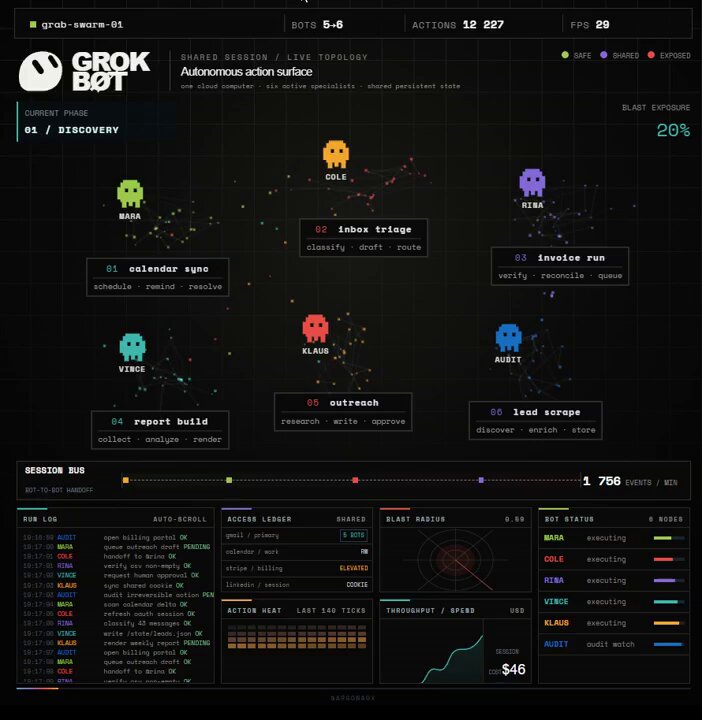
GROK BOT ARCHITECTURE IS NOW RUNNING the same system Elon reposted has grown into a live agent operation you can follow in real time you can watch the agents move through tasks, exchange information and complete work on the live operations floor six Grok agents work inside one shared system signal → research → context → build → independent review → final result Helm routes the work, Scout finds signals, Archive collects context, Forge builds, Sentinel reviews and Relay prepares the final output i created GBA myself so i can keep building the system, improve the agents and fund the infrastructure it needs as it grows the public UI code and every visible update will continue here: github/monokernn/Grok_Bot_Architecture
monokern15,796 views • 1 month ago

THIS GUY BUILT A SYSTEM THAT GETS SMARTER EVERY TIME HE USES IT AND IT LOOKS LIKE A GALAXY he types one command into Claude Code it finds sources, runs analysis through NotebookLM, saves everything to Obsidian automatically graph in the background is every idea he's ever researched - all linked together system handles the research so he only has to think about what to do with it most people are still copy-pasting into Notion and losing everything by next week full setup in the article
monokern45,188 views • 4 months ago

GROK BOT solana:AP8Wnu37Gf9RHgugPKGvpHe6LcTE2yp5GDy7pL5Upump JUST GOT A NEW COMMUNICATION LAYER Agents can now exchange work through visible live channels. You can watch research packs, evidence bundles and audit results travel between bots in real time. THANK YOU, ELON MUSK, FOR THE RETWEET IT GAVE ME A REAL BOOST OF MOTIVATION TO KEEP BUILDING. This project started as a visual experiment, but I’m continuing to turn it into a more detailed interface for autonomous agent operations. Thanks for supporting ARCHITECTURE guys More agent interactions, workflows and visual systems are coming. I'll keep sharing every meaningful improvement as the project develops. I hope the xAI team notices it too so one day I can add that to my list of achievements repo: github/monokernn/Grok_Bot_Architecture
monokern16,511 views • 1 month ago
No more content to load