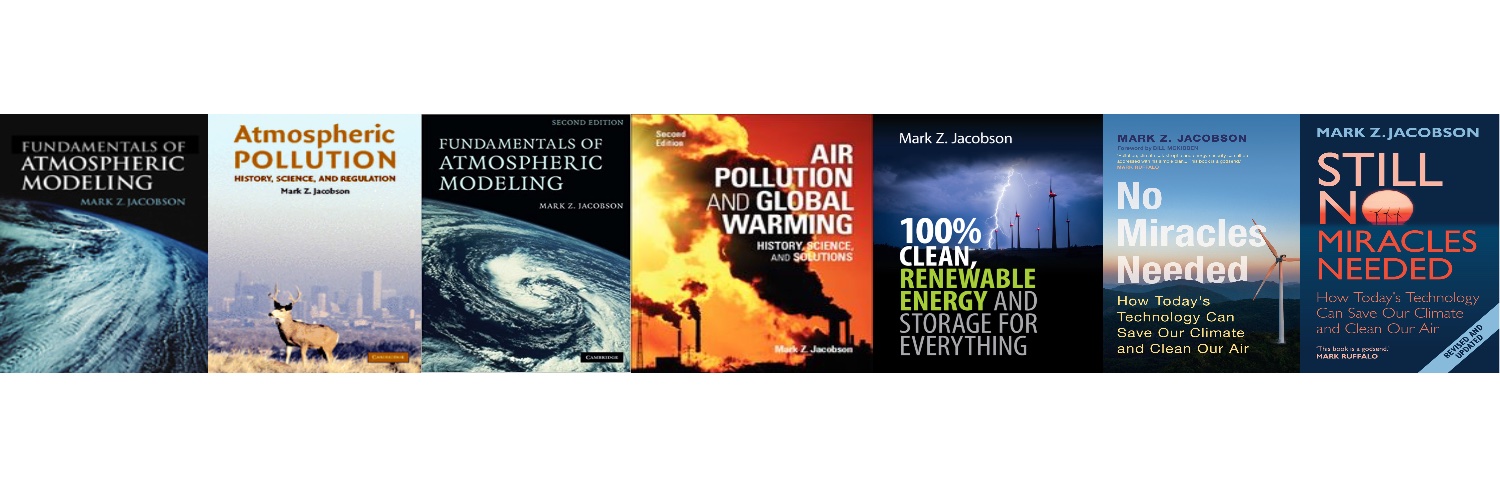

Mark Z. Jacobson
@mzjacobson • 46,938 subscribers
Prof-Civil & Env Eng; Director-Atmosphere/Energy Prog; Research-climate, air pollution & clean/renewable energy; Cofounder-Solutions Project/100% Movement
Videos

Batteries can now meet 75 percent of average grid demand and 44 percent of peak demand for 4 hours every day in the world's 4th-largest economy at a cost less than 1 percent the price of electricity California’s main grid now has over 17 GW of batteries, along with over 23 GW of solar and 12 GW of wind. Average demand is less than 23 GW. The growth of solar, wind, and batteries has helped eliminate 62 percent of all fossil gas use on the grid in 2026 versus 2023. Strikingly, those batteries can now meet three-quarters of average demand and 44 percent of peak demand for four hours every day. What is more, wind-water-solar renewables have met more than 100 percent of grid demand for 100 of the last 101 days and for 87 percent of all days in 2026, for an average of 5.4 hours per day. Given the low cost of batteries, solar, and wind relative to the price of electricity, it is abundantly clear that no major barrier remains to eliminating fossil gas for electricity entirely in California, but also ultimately throughout the world. Nameplate capacities of batteries and renewables in California Renewable trend in California Video
Mark Z. Jacobson17,347 次观看 • 2 个月前


The experiment is over – we know what does and doesn’t work to address climate If we look at what has been proposed to address global warming, air pollution, and energy security during the past 25 years, only one solution – electrification of all energy sectors and generation of the electricity with wind, solar, geothermal, and hydro sources -- has made an impact. This solution has reduced enough world emissions and technology costs for the IPCC, to eliminate its worst-case climate scenario. What are the proposed climate solutions that never worked? (1) Fossil gas replacing coal, (2) ethanol replacing gasoline, (3) carbon capture, (4) direct removal of CO2 from the air by equipment, (5) blue hydrogen, 6) nuclear, and (7) geoengineering. We knew these were poor solutions back in 2009, when they were first evaluated. But, it has taken 17 years to overcome lobbyists pushing these techs. On the other hand, electrification of world transport, buildings, and industry and using clean renewables to provide the electricity while growing energy efficiency, also proposed in 2009, has worked, as evidenced by the world growth in electric vehicles, heat pumps, electric furnaces, and clean, renewable electricity generators. All-of-the-above policies, or let’s try everything and hope something works policies, have failed. Given the short time we have, we should never see another IPCC scenario that includes biofuels, carbon capture, direct air capture, nuclear, geoengineering or their derivatives, blue hydrogen, electo-fuels, or sustainable aviation fuels. We know what works. Let's focus on that going forward. References Elimination of most extreme IPCC scenario Components of a WindWaterSolar system 2009 paper evaluating energy technologies 2009 paper proposing to transition the world to 100% WWS More details here: "Still No Miracles Needed" Video
Mark Z. Jacobson12,285 次观看 • 3 个月前

Replacing gas with renewables for California’s electricity has reduced twice the carbon as all the world’s carbon capture projects Just to give an idea of how insanely useless carbon capture and direct air capture are, consider the following. All 77 of the world’s carbon-capture facilities capture about 64 million tonnes of CO2 per year. But a quarter of that CO2 is added back to the air from the energy needed to capture and pipe the CO2 and more is added back because 82 percent of all CO2 captured is used to dig more oil out of the ground, a process that releases 85 percent of the captured CO2 back to the air. Accounting for both leaves a net of only 19 million tonnes of CO2 per year captured. Yet from 2023 to 2026, California’s main electricity grid replaced 61 percent of its fossil gas with wind-water-solar electricity plus imports, which themselves are 57 percent wind-water-solar. This replacement of gas has eliminated 38 million tonnes of CO2-equivalent per year, or twice the current world net carbon capture rate. What is more, replacing the gas has also eliminated the mining and processing of the gas, the health costs of the air pollution from mining and burning the gas, and the need for and cost of capture equipment and carbon dioxide pipelines. Carbon capture and direct air capture only increase air pollution health damage, mining, pipelines, and costs. Plus, a single dollar spent on carbon capture simply increases carbon dioxide relative to spending the same dollar on renewables replacing a fossil source. The bottom line is that we should invest in electrification and replacing fossil fuels with clean, renewable energy instead of subsidizing carbon capture, direct air capture, and related gimmicks. CCUS projects Energy, health, and climate costs of carbon capture and direct air capture versus 100%-wind-water-solar climate policies in 149 countries The health and climate impacts of carbon capture and direct air capture Fossil gas use down 61% in California YouTube
Mark Z. Jacobson10,636 次观看 • 3 个月前

Does the world have enough lithium to power all the electric vehicles and stationary batteries needed to transition the world to 100% clean, renewable energy and storage for everything? The answer is yes. In 2025, the USGS increased its estimate of world lithium resources over land by 30%, to 150 million tons, with the U.S. having the largest resource, 30 million tons, followed by Argentina, Bolivia, Chile, Australia, and China. How much lithium is this? The world has 1.1 billion passenger cars and 375 million trucks and buses. Replacing these requires about 47 million tons of lithium -- 9 million tons for the cars and 38 million tons for the trucks and buses. That’s only 31 percent of the 2025 known lithium resources, and keep in mind, the known resources grow each year as people look for more lithium. What is more, lithium stays in a vehicle during a battery’s 15 to 25-year life. At the end of the battery’s life, the battery is recycled or re-used for stationary electricity storage, so the mining is one-time. For stationary electricity storage itself, less than one-tenth the lithium, 2 to 4 million tons, is needed worldwide than is needed for vehicles. As such, current lithium resources are over three times those needed for vehicles plus storage. Also, many other battery types now exist that don’t use lithium. In sum, there is no shortage of lithium to transition the world to 100% clean, renewable energy and storage for everything. More info Video:
Mark Z. Jacobson13,130 次观看 • 5 个月前
没有更多内容可加载