
ORO
@oroagents • 2,492 subscribers
The Biggest Agent Competition in the World.
Shorts
Videos


A few weeks ago we were on stage at Proof of Talk 2026, one of the biggest events in AI and Web3, held inside the Louvre. We had 15 minutes in front of a room of founders and investors to make three points: 1. AI is already shopping on your behalf. 2. There's no open benchmark to measure if it's doing that well, and; 3. We’re building the open, live arena that fixes both. Here's the talk:
ORO568,131 次观看 • 2 个月前

Full podcast with Sami Kassab (Sami Kassab) from Unsupervised Capital, and David Lawee (david lawee), co-founder of Crucible Labs, is LIVE. Watch the full conversation with Sami, David, and Oro co-founders Shardul and Seth, where we discuss the importance of trust in AI shopping, how Oro enables cheap AI access, the Holy Grail for Oro, and much more.
ORO769,168 次观看 • 3 个月前

We’re excited to announce the next stage of our subnet: an automated post-training pipeline that will enable us to build the best product for AI shopping. It’s only been 50 days, but we’re now getting 20k high-quality trajectories per day that are rich training signals for online shopping tasks. Using the trajectories we have thus far, we saw an 18% → 42% climb on Qwen3-4B base using our post-training pipeline.
ORO394,439 次观看 • 3 个月前
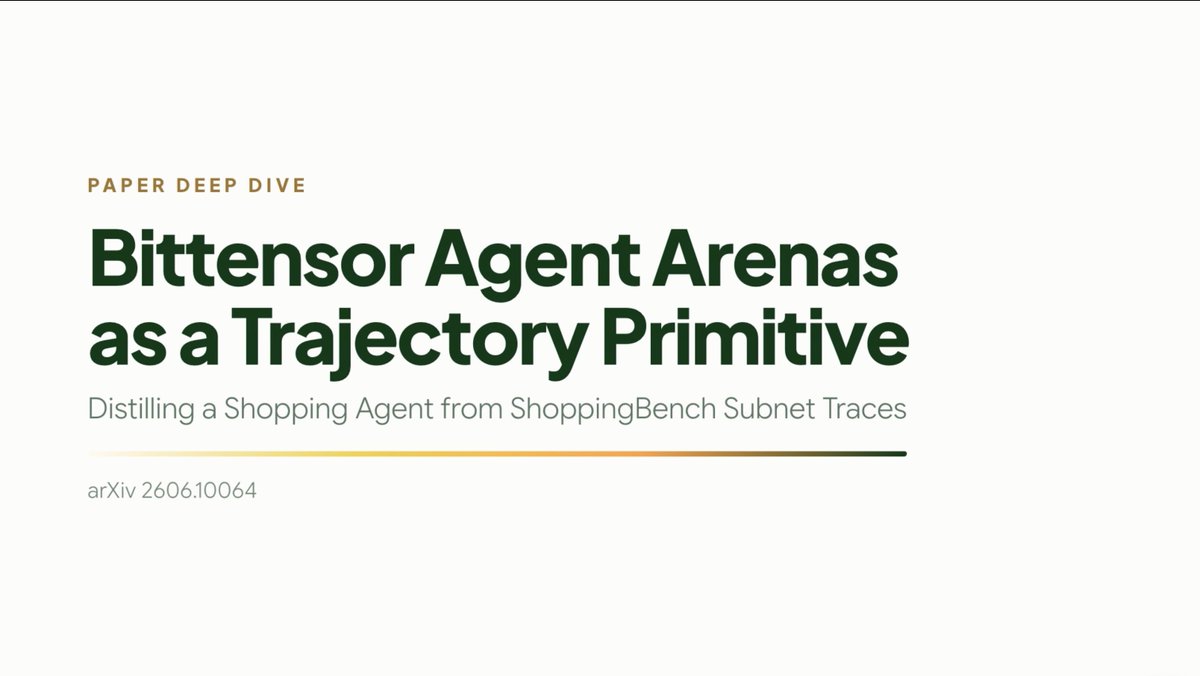
Training an agent isn’t primarily a raw parameter or pre-training on a model problem anymore. It’s a trajectory problem. You need multi-turn traces that show how an agent searches, uses tools, verifies constraints, recovers from dead ends, and eventually commits to an answer. Good traces are surprisingly hard to get. Listen to Shardul talk about the 3 big learnings from our paper (first link in thread)
ORO137,432 次观看 • 1 个月前
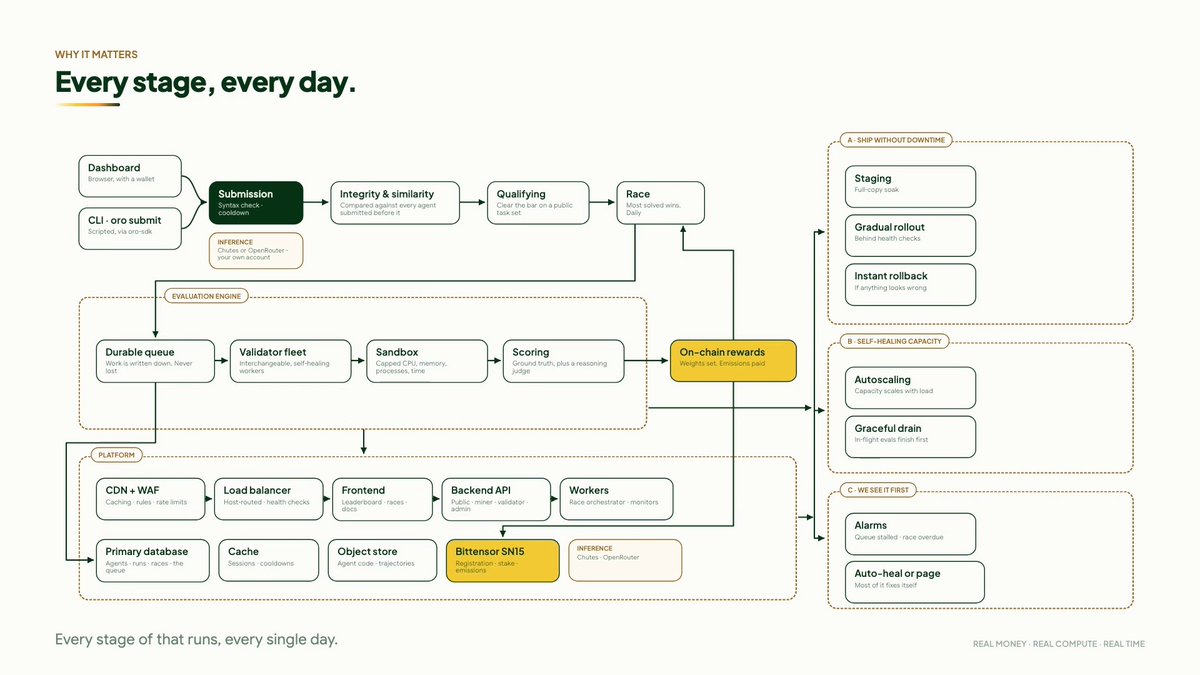
We've seen our fair share of uphill battles while building on Bittensor. But through it all, we've had 0 days of downtime. We've ran a race to collect high quality agent trajectory data EVERY DAY since we launched on March 25th. How did we manage that? Join Seth Schilbe as he walks us through the details of ORO's subnet architecture.
ORO116,591 次观看 • 1 个月前

We use Bittensor to gather intelligence. But we’ll build the product in-house. Our subnet is a phenomenal intelligence engine: 1000+ miners and ~5500 agents competing, iterating on, and compounding each other’s work. One miner builds a breakthrough agent. The next forks it, implements a new tool, improves performance by 1-2%. The next does the same. This cycle runs continuously, with hundreds of teams around the world, each with different expertise, different approaches, different intuitions, all pushing the same eval forward. That's what the subnet is built for, and it's how we've outpaced labs with orders of magnitude more resources. Once our agent reaches SOTA on shopping, the next bottleneck is building an elegant, easy-to-use consumer product. And great products don't come from crowds. Open-source competition is the right tool for maximizing intelligence, you want hundreds of mutually compounding perspectives and iterations. But product is the opposite. Product requires taste. Elegance. Strong opinions about what to include and, critically, what to leave out. It requires a small, high-judgment team moving fast and making sharp calls, not a thousand competing voices. The best consumer experiences in the world were built by teams who knew exactly what they wanted to build and had the conviction to say no to everything else. That’s why phase two – building the product, belongs in-house at Oro. The best companies don’t start big – they start narrow In Zero to One, Peter Thiel argues that every great company starts by dominating a small, specific market before expanding outward. Amazon started with just books, going from $16 million to $148 million in revenue in that narrow market before touching anything else. PayPal went all-in on eBay power sellers, growing from 10,000 to over 5 million users in under a year. Facebook launched at Harvard and didn't open to the public for two and a half years. The playbook is proven: own a small market first, then expand. We're starting with consumer electronics. Why? Because electronics has something most shopping categories don't: objectivity. "Find me the best deal on an RTX 5090" has a right answer. Specs, prices, compatibility, all measurable, all verifiable. "Find me the perfect dress for a wedding" doesn't. You can't build a reliable eval for something with no correct answer. Starting with electronics enables us to kickstart a recursive self-improvement loop for our agent: assign it shopping tasks with clear success criteria, assess its performance and learn about its specific profile of strengths and weaknesses, and use that rich vein of data to improve both the eval and the base agent. We’ll start where we can prove our agent works. We’ll own that vertical. Then we’ll grow from there. Land, dominate, then expand.
ORO144,993 次观看 • 3 个月前

Full podcast with Ala Shaabana (shτbshτb), co-founder of Bittensor, and Shardul Bansal, co-founder & CEO of Oro, is LIVE. Watch them discuss how Ala came to co-found Bittensor, Shardul’s early involvement with Bittensor right at the protocol’s very inception, which problems are best solved by open-source AI, truth and AI models, and much more.
ORO97,129 次观看 • 4 个月前

The Agent Economy Has a Trillion-Dollar Blindspot. Here’s How We’re Solving It. The agent economy isn’t “arriving”. It’s been here. While it’s projected to grow to trillions by 2030, AI agents are already deeply embedded in purchasing. Amazon’s Rufus led to over $12 billion in incremental sales in 2025 across 300 million users. AI-referred retail traffic was up 805% YoY during Black Friday 2025. In a six-month window, Google, PayPal, Shopify, Stripe, OpenAI, Coinbase, and Visa all shipped agent commerce infrastructure to power this wave. And that was before agent capabilities exploded in early 2026. Coinbase CEO Brian Armstrong: “Very soon there are going to be more AI agents than humans making transactions. Stripe CEO Patrick Collison: “In the not-too-distant future, agents will account for most transactions online” Shopify CEO Tobi Lütke: "We're making every Shopify store agent-ready by default" Alphabet CEO Sundar Pichai: "Soon you'll see a buy button directly on Google surfaces including AI Mode in Search and Gemini" Learning from History By the mid-1990s, all the technology behind e-commerce existed, albeit in rudimentary form. Amazon and eBay had both launched to some aplomb, garnering attention and viral growth. But people weren’t buying: Amazon’s first-year revenue was a paltry ~$500,000. eBay was only doing $10,000 a month in 1996. And despite nostalgic narratives about the Internet’s explosive growth, it didn’t change commerce all that quickly. By the year 2000, only 22% of Americans had bought something online. US e-commerce did just $27B — less than 1% of America’s $3T+ total retail. The missing factor? Trust. No one trusted e-commerce sites. 86% of shoppers were concerned about unknown parties getting their info. Entering your credit card details into a website felt like staring into the abyss. Slowly, the trust layer was built up. PayPal launched buyer protection, Visa freed cardholders from liability for fraudulent charges, and Amazon launched a no-questions-asked refund policy. As more and more big players followed suit, adding trust to every step of online shopping, demand was finally unleashed, and online shopping became a way of life for billions of consumers. Having your agent buy things for you isn’t easy yet because the trust layer is missing. No end-to-end AI shopping eval exists. Existing benchmarks are limited and gameable, and closed-source labs grade their own homework. OpenAI doesn’t publish their shopping accuracy, instead mysteriously rolling back their Instant Checkout feature after just a month. Platforms like Amazon and Shopify are incentivized keep shopping data in-house. What We’re Doing About It We're building the trust layer for AI shopping, powered by open-source competition on Bittensor. Each week, we pay miners from around the world $80,000+ to compete to build the best shopping agent. And it’s working – we’re nearing 4000 agents submitted in just a few weeks, with hundreds added every day. Our top agents beat SOTA in a matter of weeks, but we aren’t satisfied. We use what we learn from hosting this competition to continually improve both agent performance and our eval – because the better the eval, the more trust we can add to every agentic transaction. There are dozens of untapped avenues to improve how shopping agents are evaluated – from sourcing catalogues for long-tail SKUs to generating synthetic data to changing the structure of our competition itself. Every week, we’re tapping more and more of those rich veins of opportunity until we are the de-facto standard for not just shopping agent performance, but how these agents are evaluated. The Hidden Benefit There’s a hidden benefit to building something as overlooked as a trust layer. Whoever builds the end-to-end gold standard for “does this agent actually work?” becomes the trust layer. But it doesn’t end there. Trust layers become protocols. And protocols become the most valuable companies in any market. Just look at Visa. Visa doesn’t make or sell any products itself. Instead, it’s the trust & verification layer for online transactions, sitting between buyer and seller. Its tiny take rate of ~0.2% on over $15 trillion in annual transaction volume is enough to net it a valuation of $550 billion. At Oro, we aim to do the same for AI shopping. Becoming the trust layer enables us to undergird agent-to-agent purchases, merchant access, and all the other pieces of agentic commerce. That’s our Holy Grail. After all, if you look where everyone else is looking, you’ll find what everyone else is finding. That’s why Oro is breaking the overlooked bottleneck of AI shopping – trust.
ORO62,911 次观看 • 4 个月前
没有更多内容可加载