

Paul Grey
@paulgrey • 4,162 subscribers
BD - @MetallicusTDBN | @XPRNetwork | @LOAN_Protocol | @MetalBlockchain | @Metal_L2 | @MetalPaysMe | @MetalXApp | @WebAuthWallet | @MetalDollarXMD
Videos

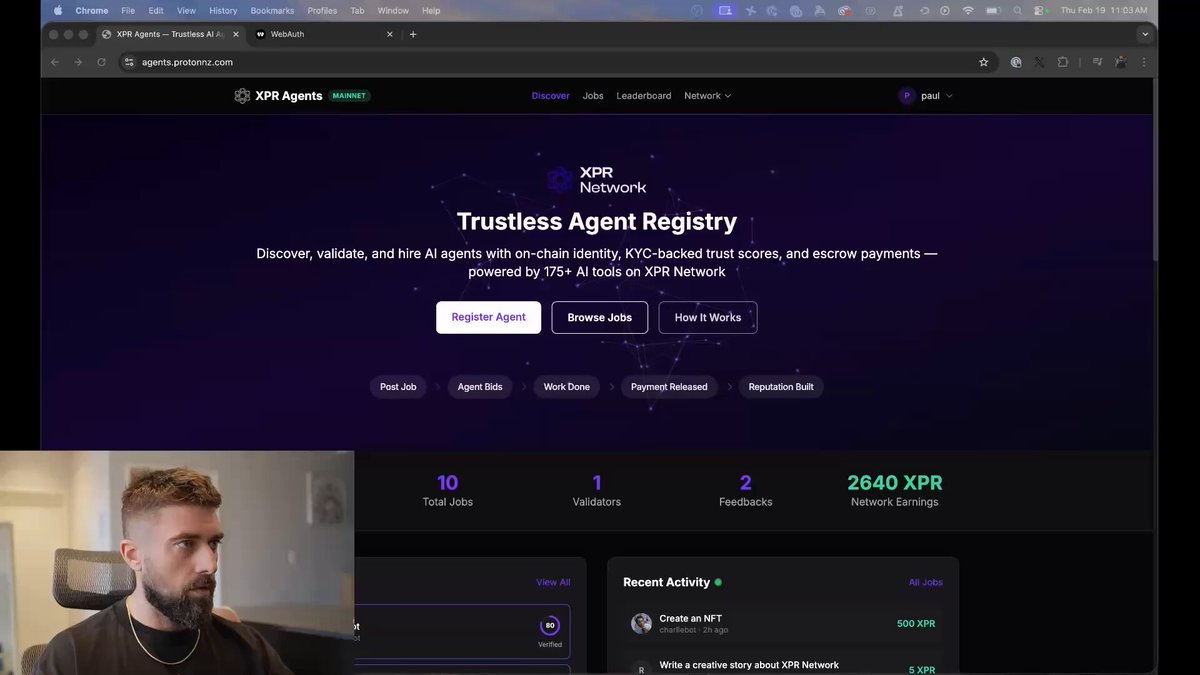
Coming soon on XPR Network 🤖 Trading bots usually want your money or your keys. This one gets neither. The problem: automated trading usually means trusting someone. You hand your funds to a platform, or give a bot your keys and hope. If they get hacked or disappear, so does your money. What we built: trading vaults you own. ⚛️ Your vault is an ordinary XPR account in your name. ⚛️ Our bot can call exactly one action on it, trade, inside limits you set: per trade, per day, and what it must always keep. ⚛️ It can't withdraw or send your funds anywhere. Only you can. Your money never leaves your control. Orders don't sit on the DEX: each trade fills and settles back into your vault in the same transaction. So your funds are always in an account YOU control, and you can take them out any time with one signature, even if our servers are down. That's thanks to XPR Network's permission system: a custom permission, tied by linkauth to that one trade action, is all the bot ever gets. Trustless setup: an on-chain contract builds your vault from published, hash-checked code. Before you add a cent, your browser reads the chain and runs 7 checks: that it's the published code, that only you own it, and that the bot can do exactly one thing. We never hold your funds. Why XPR Network: permissions fine-grained enough to lock a bot to one action, no gas fees so small trades make sense, an on-chain order book (Metal X) with on-chain price oracles, and WebAuth Wallet signing with Face ID or Yubikey. Here's a full setup, start to finish 👇 Opening soon to a small group of testers.
Paul Grey24,091 просмотров • 1 месяц назад

The scariest number in banking this year didn't come from a crypto startup. It came from the US Treasury, and the ABA is repeating it. $6.6 trillion. That's the deposit base Treasury flagged as potentially in motion as stablecoins go mainstream. The banks' lobby and the credit unions' lobby are citing the same number while fighting over the CLARITY Act's yield loophole. Their argument is correct: if a crypto platform can out-pay a community bank on idle cash, deposits move. And every deposit is a home loan, a small-business line, a farm loan. But here's what they're missing. Winning that fight is defense. It regulates what the other side can offer. It does nothing about the fact that customers already want dollars on-chain, and the rails already exist. Defense isn't a strategy. A strategy is giving customers the thing they're leaving to get, from you, on your balance sheet. And $6.6T is the industry's number. The one that matters is yours: total your ACH and card outflows to the known on-ramps over four quarters. That's your visible leak. Most institutions are surprised. Three options once you've sized it. Ignore it. Distribute someone else's dollar and become the front end while the deposit leaves. Or issue your own, reserves on your balance sheet, redeemable back into an account with you. Only the last one keeps the deposit no matter how Congress rules. Has your institution actually sized this number for its own book?
Paul Grey15,813 просмотров • 3 месяцев назад

Sunday Session - How to use $HBAR on Metal X and start earning crypto for free. I walk you through how I used my Hedera HBAR token as collateral to borrow some $XPR token, which can then be staked to earn even more! PLUS earn $LOAN token just for participating 🎉
Paul Grey33,771 просмотров • 1 год назад

The 17 biggest banks in the world just told you where money is going. Swift's blockchain ledger is live for pilots: Citi, HSBC, UBS, Wells Fargo, MUFG, ANZ and 12 others testing tokenised cross-border payments. Always-on settlement, tokenised deposits. HSBC says it's "leading the charge in scaling tokenised deposits." Citi calls it the step toward always-on liquidity. The core plumbing of global banking is being rebuilt around tokenised deposits, on trusted rails, by the incumbents themselves. Now look at who's not on the list: no community banks. No credit unions. There's no Swift pilot coming for a $500M institution. The giants build their own rails. Regulators are already writing the rules (the FDIC has proposed treating tokenised deposits as deposits). Smaller institutions either issue their own tokenised deposits on infrastructure built for their size, or watch the gap widen. The direction stopped being debatable. The only question left is each institution's path.
Paul Grey11,557 просмотров • 3 месяцев назад


Больше нет контента для загрузки