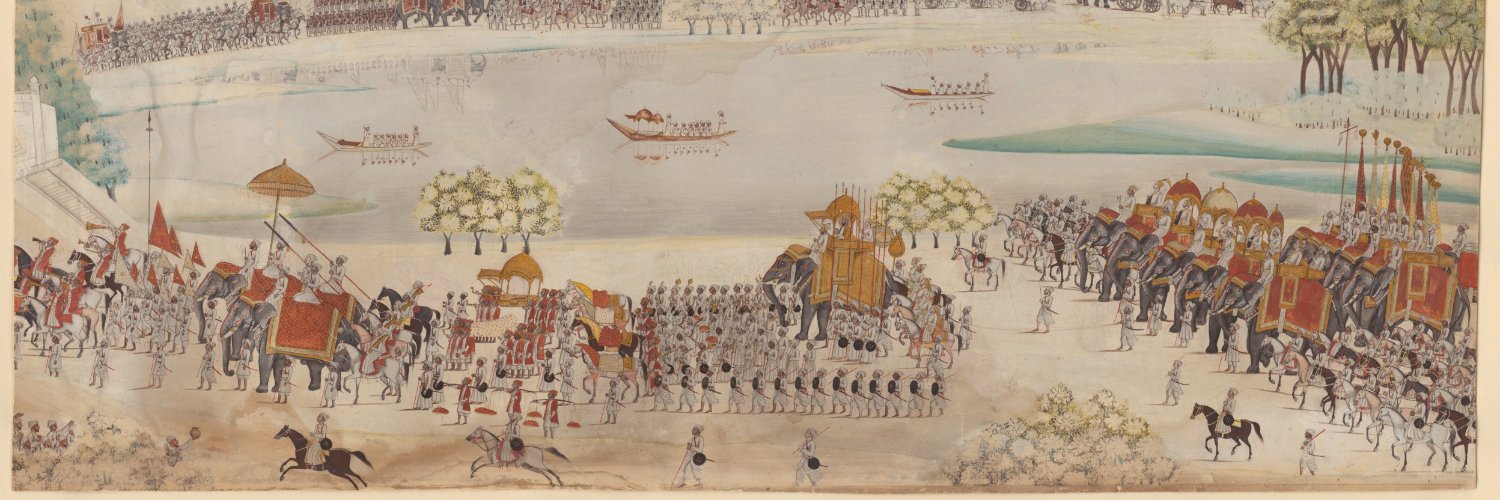
Indian Muslim Archives's banner
Indian Muslim Archives's profile picture

Indian Muslim Archives

@Rustum_026,432 subscribers

I mostly share history, art, culture, food, attire, traditions, and heritage of the Indian Muslim community. Sometimes I delve into politics & current affairs.

Shorts

Hinduism does not belong to Manipur. It was forcibly imposed by King Pamheiba, around 1720, involving severe religious persecution of natives to force conversions. Hindu radicals fool others by saying they never imposed their religioun upon others. Therefore, read this entire post carefully and in full. It was in the coming of the third Hindu mission that sounded the death-knell of the old Meetei religion and customs. The leader of the mission was Shanta Das Gossai. He preached the doctrines of Ramanandi dharma of Hinduism to the king. The principal god of this faith is Rama, the hero of Ramayana. He came to Manipur at the head of a band of missionary in 1720. Pamheipa appointed Shanta Das Gossai his guru. He also allowed him to baptize all those who wanted to embrace Ramanadi at his own free will. However, it did not win many adherents. Nimandi, Gaudiya and Sakhya faiths of Hinduism, being deprived of state patronage, could not evolve further but U-Mang-Lai continued to exist even when the King forbade worshiping them. Though it lost the patronage of the king, U-Mang-Lai worship continued its toleration. The hopes of Shanta Das Gossai to convert the Meeteis to his faith were showing no prospect of fulfillment. He, therefore, urged the king to adopt anti-Meetei religion policy - demolition of U-Mang-Lai temples, dismissal of Meetei priests and shamans and discontinuation of the Meetei customs in the royal court. After giving such recommendation, Shanta Das Gossai left for Sylhet for temporary stay there. As the chronicle records, "The year of Thoutapa Heiton 1643 Kum Sak... Friday, the 8th of Wakching (26th December 1721 CE), Guru Mahanta was escorted from Chinga to Thangpicharou." The Sanamahi Laikan gives us interesting information about the iconoclastic zeal of Shanta Das Gossai, which led to the destruction of U-Mang-Lai temples and idols of Meetei ancestral divinities. Under his pressure, the king misused his imperial authority to convert his Meetei subjects to Ramanadi. As Hinduism is against meat eating and drinking liquor the first step took up by the King was prohibition of cow-slaughter, meat eating, brewing wine, and domestication of pig and fowl in the capital Before Manipur adopted Hinduism, meat eating was greatly favored and drinking was probably common among the people. The step of the king gave a very rude shock to the Meeteis. The Cheitharon Kumpapa records the punishments inflicted to those who disobeyed the order, "The year of Puthem Yithai 1644 Kum Sak...the first day of the month Langpan began on Friday (August/September 1722 CE )... On that day all the people of the seven sageis of the Keiroi and Leikais who ate beef were punished by flogging and Khungoinapa.... The year of Wamanpa Mupa 1645 Kum Sak... the first day of the month Thawan began on Monday (2nd August 1723 CE). On that day domestication of pig and fowl in the villages prohibited. All the piggeries in the capital were sent to Lawai... The year of Moirang Khoitong 1646 Kum Sak... the first day of the month Poinu began on Tuesday (16th November 1724 CE). On that day, all the disobeyed piggeries from the villages were punished by fine." In August 1723 CE, the king officially forbade the worship of U-Mang-Lai. The Cheitharon Kumpapa records, "The first day of the month Langpan began on Tuesday (31st August 1723 CE). On that day, the Sangkais of the nine U-Mang-Lai gods and two Lamapis were dismantled to discontinue worshipping them". In November 1723 CE, the orthodox Meetei priests and Shamans from the principal royal temples were replaced by the Hindu Brahmins. As the Chronicle records, "Friday, the full moon day of Hiyangkei (12th November 1723 CE), the Pamons started managing the worship of Laiyingthou Nongsapa, Yimthei Lai, Panthoipi and Taipang-Khaipa."

Hinduism does not belong to Manipur. It was forcibly imposed by King Pamheiba, around 1720, involving severe religious persecution of natives to force conversions. Hindu radicals fool others by saying they never imposed their religioun upon others. Therefore, read this entire post carefully and in full. It was in the coming of the third Hindu mission that sounded the death-knell of the old Meetei religion and customs. The leader of the mission was Shanta Das Gossai. He preached the doctrines of Ramanandi dharma of Hinduism to the king. The principal god of this faith is Rama, the hero of Ramayana. He came to Manipur at the head of a band of missionary in 1720. Pamheipa appointed Shanta Das Gossai his guru. He also allowed him to baptize all those who wanted to embrace Ramanadi at his own free will. However, it did not win many adherents. Nimandi, Gaudiya and Sakhya faiths of Hinduism, being deprived of state patronage, could not evolve further but U-Mang-Lai continued to exist even when the King forbade worshiping them. Though it lost the patronage of the king, U-Mang-Lai worship continued its toleration. The hopes of Shanta Das Gossai to convert the Meeteis to his faith were showing no prospect of fulfillment. He, therefore, urged the king to adopt anti-Meetei religion policy - demolition of U-Mang-Lai temples, dismissal of Meetei priests and shamans and discontinuation of the Meetei customs in the royal court. After giving such recommendation, Shanta Das Gossai left for Sylhet for temporary stay there. As the chronicle records, "The year of Thoutapa Heiton 1643 Kum Sak... Friday, the 8th of Wakching (26th December 1721 CE), Guru Mahanta was escorted from Chinga to Thangpicharou." The Sanamahi Laikan gives us interesting information about the iconoclastic zeal of Shanta Das Gossai, which led to the destruction of U-Mang-Lai temples and idols of Meetei ancestral divinities. Under his pressure, the king misused his imperial authority to convert his Meetei subjects to Ramanadi. As Hinduism is against meat eating and drinking liquor the first step took up by the King was prohibition of cow-slaughter, meat eating, brewing wine, and domestication of pig and fowl in the capital Before Manipur adopted Hinduism, meat eating was greatly favored and drinking was probably common among the people. The step of the king gave a very rude shock to the Meeteis. The Cheitharon Kumpapa records the punishments inflicted to those who disobeyed the order, "The year of Puthem Yithai 1644 Kum Sak...the first day of the month Langpan began on Friday (August/September 1722 CE )... On that day all the people of the seven sageis of the Keiroi and Leikais who ate beef were punished by flogging and Khungoinapa.... The year of Wamanpa Mupa 1645 Kum Sak... the first day of the month Thawan began on Monday (2nd August 1723 CE). On that day domestication of pig and fowl in the villages prohibited. All the piggeries in the capital were sent to Lawai... The year of Moirang Khoitong 1646 Kum Sak... the first day of the month Poinu began on Tuesday (16th November 1724 CE). On that day, all the disobeyed piggeries from the villages were punished by fine." In August 1723 CE, the king officially forbade the worship of U-Mang-Lai. The Cheitharon Kumpapa records, "The first day of the month Langpan began on Tuesday (31st August 1723 CE). On that day, the Sangkais of the nine U-Mang-Lai gods and two Lamapis were dismantled to discontinue worshipping them". In November 1723 CE, the orthodox Meetei priests and Shamans from the principal royal temples were replaced by the Hindu Brahmins. As the Chronicle records, "Friday, the full moon day of Hiyangkei (12th November 1723 CE), the Pamons started managing the worship of Laiyingthou Nongsapa, Yimthei Lai, Panthoipi and Taipang-Khaipa."

66,789 görüntüleme

The main point of this post was simply that Muslims sheltered him, and he himself acknowledged that in his video:

The main point of this post was simply that Muslims sheltered him, and he himself acknowledged that in his video:

18,397 görüntüleme

1st Bengal Lancers (100% Hindustani Muslims) is Asia’s one of the oldest and most decorated regiments; est. 1803. Their War Cry: “Himmat-e Mardan; Madad-e Khuda” (the masculine valour, the aid of divine) (the courage of man is aided by the god

1st Bengal Lancers (100% Hindustani Muslims) is Asia’s one of the oldest and most decorated regiments; est. 1803. Their War Cry: “Himmat-e Mardan; Madad-e Khuda” (the masculine valour, the aid of divine) (the courage of man is aided by the god

47,994 görüntüleme

There is a widespread misconception among Indian Muslims that Islam came to India and suddenly sparked a great revolution, where Hindu Dalits (“untouchable” castes) rejected Brahminism, broke the chains of slavery, and converted to Islam. This is FAKE! Let me elaborate on this: This narrative stems from the assumption that Dalits were some subjugated rebels, wary of subjugation and discrimination, and would act like freedom-seeking slaves, ready to overthrow their tyrannical masters at any moment. However, the reality was far more complex. Hindu theology, social structures, and institutions had entrenched their marginalisation so deeply that it operated on every level, mental, social, physical, and even within imagination itself. When Islam arrived in North India, hammering the Kshatriyas and Raiyyas (kings and lords), there were very few Muslims living there. Muslim rulers lacked local manpower and, for this reason, had to continually recruit soldiers from already Muslim regions. If Dalits were truly so rebellious, they would have joined Muslims en masse against Brahmanical dominance, but no such movement appears in the history of Indo-Muslim advent. Had they done so, they would without any doubt have eventually have risen to positions of power. ——— The (relatively higher) sense of equality and fraternity in Islam is world-famous, and it was not merely theoretical, it existed in practice. We have numerous examples from Indo-Muslim history to support this; I will mention what is just one drop in an ocean: There was a Delhi Sultanate writer named Ziauddin Barani, who spent much of his life lamenting that the Sultans of Delhi were appointing “low-born” individuals to the highest positions in the Sultanate. Malik (later Sultan) Nasir-ud-Din Khusrau Khan and Khan-i Khanan Malik Husamuddin, both brothers were slaves and that too from the Barwar tribe, considered an avarna group (below Shudra in Hindu social hierarchy). Theatyer was married to the youngest daughter of Sultan Alauddin Khilji. However, I would like to point out, for the satisfaction of the readers, that both of these men were exceptionally handsome in appearance. ——— Dalits were also not pro-Muslim or particularly empathetic toward Muslims; on the contrary, they often shared the same, if not greater, hostility toward Muslims as upper-caste Hindus did. It was an age of deep superstition, and many Dalits firmly believed that Brahmins were descendants of gods (Baman Devta), and that incurring their curse (shraap) would bring ruin. They did not typically operate within institutions that brought them into direct contact with Indo-Islamic society or allow them to be influenced by it. Leaving Hindu fold for Islam was far bigger than this. At most, the influence extended to regarding certain Muslim pirs or faqirs as saints with mystical or healing powers, revering them while still remaining within the Hindu fold. ——— For a more neutral perspective, let us leave the Gangetic plain and, for instance, turn to the region of present-day Tripura, which recorded just four conversions in the year 1911. Manaranjan Ganguli (Brahmin) Uma Kanta Chandra (Taluqdar, i.e., a big landlord) Gurudas Roy's nephew (Brahmin) Babgo Pal (Kayastha) Similarly, in the Akhbarat (newsletters) from the era of Aurangzeb, we read abundant entries noting that “today, this guild of merchants has converted to Islam,” or that “this Brahmin, this Rajput, this Khatri has embraced Islam,” and that they were subsequently honoured. There are also records stating that such members of such and such artisan communities adopted Islam, with officials directed to congratulate them and extend special attention and care. In my reading of all publicly available volumes, I have yet to find any instance where an entire Dalit guild or locality is recorded as having embraced Islam.

There is a widespread misconception among Indian Muslims that Islam came to India and suddenly sparked a great revolution, where Hindu Dalits (“untouchable” castes) rejected Brahminism, broke the chains of slavery, and converted to Islam. This is FAKE! Let me elaborate on this: This narrative stems from the assumption that Dalits were some subjugated rebels, wary of subjugation and discrimination, and would act like freedom-seeking slaves, ready to overthrow their tyrannical masters at any moment. However, the reality was far more complex. Hindu theology, social structures, and institutions had entrenched their marginalisation so deeply that it operated on every level, mental, social, physical, and even within imagination itself. When Islam arrived in North India, hammering the Kshatriyas and Raiyyas (kings and lords), there were very few Muslims living there. Muslim rulers lacked local manpower and, for this reason, had to continually recruit soldiers from already Muslim regions. If Dalits were truly so rebellious, they would have joined Muslims en masse against Brahmanical dominance, but no such movement appears in the history of Indo-Muslim advent. Had they done so, they would without any doubt have eventually have risen to positions of power. ——— The (relatively higher) sense of equality and fraternity in Islam is world-famous, and it was not merely theoretical, it existed in practice. We have numerous examples from Indo-Muslim history to support this; I will mention what is just one drop in an ocean: There was a Delhi Sultanate writer named Ziauddin Barani, who spent much of his life lamenting that the Sultans of Delhi were appointing “low-born” individuals to the highest positions in the Sultanate. Malik (later Sultan) Nasir-ud-Din Khusrau Khan and Khan-i Khanan Malik Husamuddin, both brothers were slaves and that too from the Barwar tribe, considered an avarna group (below Shudra in Hindu social hierarchy). Theatyer was married to the youngest daughter of Sultan Alauddin Khilji. However, I would like to point out, for the satisfaction of the readers, that both of these men were exceptionally handsome in appearance. ——— Dalits were also not pro-Muslim or particularly empathetic toward Muslims; on the contrary, they often shared the same, if not greater, hostility toward Muslims as upper-caste Hindus did. It was an age of deep superstition, and many Dalits firmly believed that Brahmins were descendants of gods (Baman Devta), and that incurring their curse (shraap) would bring ruin. They did not typically operate within institutions that brought them into direct contact with Indo-Islamic society or allow them to be influenced by it. Leaving Hindu fold for Islam was far bigger than this. At most, the influence extended to regarding certain Muslim pirs or faqirs as saints with mystical or healing powers, revering them while still remaining within the Hindu fold. ——— For a more neutral perspective, let us leave the Gangetic plain and, for instance, turn to the region of present-day Tripura, which recorded just four conversions in the year 1911. Manaranjan Ganguli (Brahmin) Uma Kanta Chandra (Taluqdar, i.e., a big landlord) Gurudas Roy's nephew (Brahmin) Babgo Pal (Kayastha) Similarly, in the Akhbarat (newsletters) from the era of Aurangzeb, we read abundant entries noting that “today, this guild of merchants has converted to Islam,” or that “this Brahmin, this Rajput, this Khatri has embraced Islam,” and that they were subsequently honoured. There are also records stating that such members of such and such artisan communities adopted Islam, with officials directed to congratulate them and extend special attention and care. In my reading of all publicly available volumes, I have yet to find any instance where an entire Dalit guild or locality is recorded as having embraced Islam.

32,521 görüntüleme

Kathak and Urdu are both part of Hindustani (Gangetic) culture. If you hate "Gangu influence" so much, why not denounce both Kathak and Urdu? Why being selective? Anyway, you should indeed stop Gangu Kathak (left) and start Punjabi Bhangra (right).

Kathak and Urdu are both part of Hindustani (Gangetic) culture. If you hate "Gangu influence" so much, why not denounce both Kathak and Urdu? Why being selective? Anyway, you should indeed stop Gangu Kathak (left) and start Punjabi Bhangra (right).

12,173 görüntüleme

1st Bengal Lancers (100% Hindustani Muslims) is Asia’s one of the oldest and most decorated regiments. It is such a highly respected regiment that the Royal British Army was required to salute it if it passed by. War Cry: “Himmat-e Mardan; Madad-e Khuda”

1st Bengal Lancers (100% Hindustani Muslims) is Asia’s one of the oldest and most decorated regiments. It is such a highly respected regiment that the Royal British Army was required to salute it if it passed by. War Cry: “Himmat-e Mardan; Madad-e Khuda”

49,618 görüntüleme

Where ocean and prayers meet: — Kadalur Juma Masjid, Kerala, India.

Where ocean and prayers meet: — Kadalur Juma Masjid, Kerala, India.

20,380 görüntüleme

When our Amal is restored, we will ban such tamashebaazi and organise parades in the Nawabi fashion, like our elders. Only that it will be far grander, larger, and bolder. Here is an Indian Muslim cavalry guard (Hyderabad riyasat), during the last stages of Indian Muslim rule.

When our Amal is restored, we will ban such tamashebaazi and organise parades in the Nawabi fashion, like our elders. Only that it will be far grander, larger, and bolder. Here is an Indian Muslim cavalry guard (Hyderabad riyasat), during the last stages of Indian Muslim rule.

42,909 görüntüleme

In response to the killing of four Indian Muslims by Pakistan-sponsored terrorists, the Imams all over India expressed their grief during today's Jummah, and Indian Muslims protested, expressing their outrage against such heinous crimes.

In response to the killing of four Indian Muslims by Pakistan-sponsored terrorists, the Imams all over India expressed their grief during today's Jummah, and Indian Muslims protested, expressing their outrage against such heinous crimes.

25,299 görüntüleme

The Indian Muslims are the sole inheritors of the Indo-Islamic legacy, without any counterparts. Everything else is simply a cultural extension of those Ganga, Yamuna, & Narmada based entities.

The Indian Muslims are the sole inheritors of the Indo-Islamic legacy, without any counterparts. Everything else is simply a cultural extension of those Ganga, Yamuna, & Narmada based entities.

13,665 görüntüleme

Videos

Rustum_0's profile picture

The visionary Abul Kalam Azad foresaw all of this and warned the following about the Pakistan plan (which included Bangladesh): "And the only outcome of the creation of Pakistan has been that the position of Muslims in the Indian subcontinent has been weakened. The Muslims who remained in India became weak, and the crores of Muslims who stayed behind in India would forever remain vulnerable to Hindu oppression and vengeance, while the Muslims living in Pakistan would be unable to offer them any real assistance. Likewise, the Muslims living in Pakistan, who themselves would suffer from social, economic, and political weakness and backwardness, would receive no meaningful help from the Muslims remaining in India. These Muslims living in Hindu-majority regions would one day suddenly wake up to find themselves strangers and foreigners in their own homes and homeland. They would become educationally and economically backward, left at the mercy of a government transformed into a purely Hindu rule. Even if a government of complete Muslim majority were established in Pakistan, it would still never solve the problem of the Muslims living in India. I am even prepared to ignore every other aspect of this issue and examine it solely from the perspective of Muslim interests. If it could somehow be proven that the Pakistan scheme would truly benefit Muslims, then I would accept it and devote all my strength to persuading others to accept it as well. But the reality is that this scheme would not bring even the slightest benefit to the collective and national interests of Muslims, nor would it…" ——— If you note, Bangladesh remains deeply economically dependent on India and, as a result, cannot afford to antagonise it, compelling it to do almost everything in order to please the Indian government. Remember the words of Maulana again: "Likewise, the Muslims living in Pakistan, who themselves would suffer from social, economic, and political weakness and backwardness, would receive no meaningful help from the Muslims remaining in India."

Indian Muslim Archives

56,140 görüntüleme • 22 gün önce

Rustum_0's profile picture

Since another Hindutva film is set to be released, based on Shivaji zamindar of Raigarh, here are two contemporary accounts comparing his rule with the Muslim rule. English factory letter (Karwar to Bombay), dated 1 July 1675 CE, informs about the pitiful condition of his subjects and their wish and prayers for liberation through the establishment of Muslim rule. “... under Sevagees (Shivaji's) government, they have robbed all the country people soe much as to the seed they should sowe, soe that the next year the men will be ready to eat one another for the new crop will be very small, all people pray that the moores (i.e., Muslims) may come and regaine (i.e., rule) the country and there is a rumor that they will come after the raines, Timmanna waited their coming to joyne them a few dayes more will discover that certainty...” Dr. John Fryer, an English traveller to India (c. 1673–1682), observed the brutality committed by Shivaji's administration on his subjects and contrasted it with the Bijapur Sultanate's milder taxes and more prosperous rule. “... It is a general calamity, and much to be deplored, to hear the complaints of the poor people that remain, or are rather compelled to endure the Slavery of Seva Gi (Shivaji): the desies (desais, or Shivani's revenue collectors) have land imposed upon them at double the former rates, and if they refuse to accept it on these hard conditions (if nonied men) they are carried to prison, there they are famished almost to death; racked and tortured most inhumanly till they confess where it is: They have now in limbo several Brachmins (Brahmins), whose flesh they tear with pincers heated red-hot, drub them on the Shoulders to extreme anguish, (though according to their Law it is forbidden to strike a Brachmin.) This is the accustomed Sawce all India over, the Princes doing the same by the Governors, when removed from their offices, to squeeze their ill-got estates out of them; which when they have done, it may be they may be employ'd again: And after this fashion the desies (desais) deal with the combies'; so that the great fish prey on the little, as well by land as by sea, bringing not only them, but their families into eternal bondage. However, under the King of Visiapour (i.e., the Muslim Sultan of Bijapur) the taxations were much milder, and they lived with far greater comfort...”

Indian Muslim Archives

65,798 görüntüleme • 1 ay önce