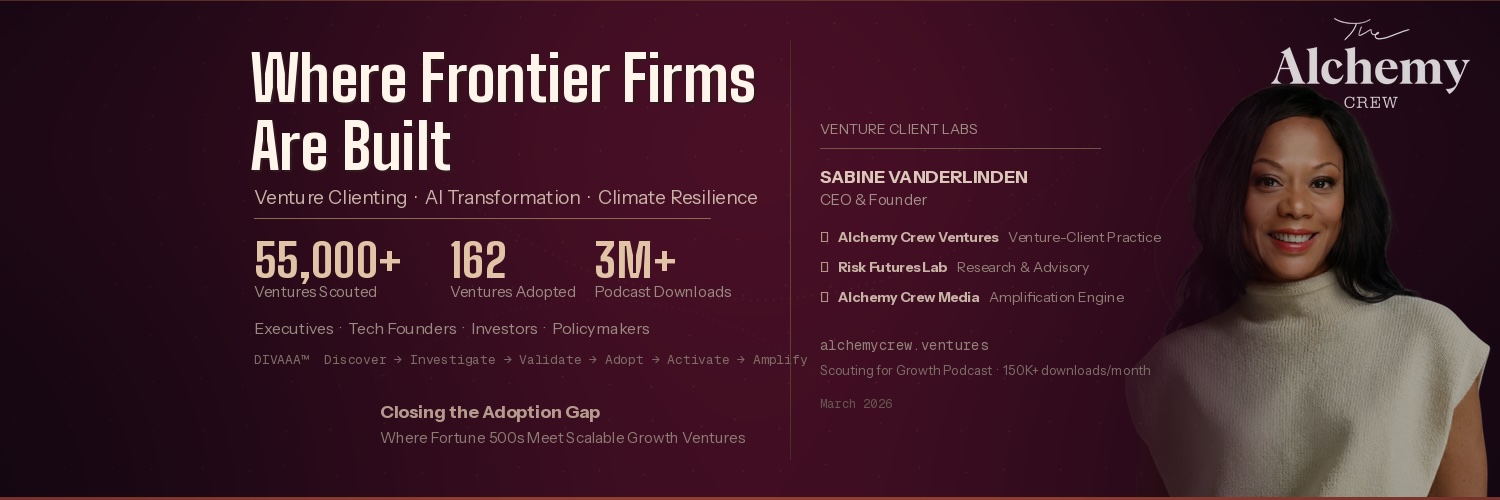

Sabine VanderLinden
@SabineVdL • 50,064 subscribers
Venture Client Model Architect | CEO Alchemy Crew Ventures | Board Chair | Host #ScoutingforGrowth | Where Fortune 500s meet growth ventures | #Frontier #AI
Videos

Responsible AI should not feel like the path of most resistance. That was the strongest idea from my SAS Innovate conversation with Reggie Townsend, leading Data Ethics, Governance, and Social Impact at SAS Software. Reggie framed governance not as a compliance layer, but as a way to scale human judgment. Too often, we innovate first and govern later. Model selected. Agent deployed. Process built. Then governance arrives at the end and feels like friction. Bolt it on after the fact, and resistance is guaranteed. The opportunity: design responsible AI, so it becomes intuitive, action-oriented, and useful in the flow of work. That is what Reggie meant by making responsibility "irresistible." Second point: Use cases must lead. When everyone can access the same models, differentiation will not come from the technology. It will come from how leaders define outcomes, govern applications, and connect business value to institutional trust. The risk does not live in the model. The value does not live in the model. Both live in the use case. For CEOs and boards, this is the shift: from model-first oversight to outcome-first accountability. Better questions before scaling AI: - What human decision are we shaping? - What business outcome are we improving? - What risk are we containing? - What judgment are we extending? Responsible AI becomes strategic when it helps people make better decisions, faster, with greater confidence. Most leaders can't see where governance sits inside their AI operating model. SAS AI Navigator makes it visible: Design for the human. Not only the technology.
Sabine VanderLinden835,838 Aufrufe • vor 4 Monaten


The real shift in insurance isn't adding AI to existing processes. It is redesigning the entire operating model around autonomous decision-making. We call this becoming a Frontier Firm. Stop layering new tech over fractured legacy systems and start leading the transformation.
Sabine VanderLinden438,333 Aufrufe • vor 5 Monaten

The shift from Copilot to Autopilot is happening now. This is the Agentic Frontier, and while 82% of leaders are investing in it, most are not ready. Why? Because they're stuck in Phase 1 (AI Assistants) while the winners are already building for Phase 3 (Human-Led, Agent-Operated) operations. The gap between pilot and production is where most AI initiatives die. It's not a tech problem. It's a culture, governance, and data problem. But it's possible to cross this chasm. Enjoyed attending Microsoft Ignite with the EY team this past week. I learn about their "Client Zero" journey, 400,000+ people were enabled with operational AI tools. How? They didn't just deploy AI—they became AI-first. Here's the 3-step action plan to cross the frontier: 1️⃣ Mindset Shift: From prompting AI → delegating outcomes to AI. 2️⃣ Laser Focus: Target one painful, high-volume, low-creativity process to prove ROI and build momentum. 3️⃣ Build the Foundation: Create an AI-ready data estate and robust governance. You can't build a skyscraper on a swamp. Start small. Scale fast. I learn one think during my San Francisco visit. It is no longer the question of whether autonomous agents will reshape your industry, but when—and whether you'll lead or follow. Learn how >
Sabine VanderLinden236,535 Aufrufe • vor 10 Monaten

You already know this! The Frontier Firm doesn’t run on AI. It runs on human-agent teams. Day 2 of SAS Innovate, the deeper story is the one no one is leading with: A new operating model where every employee becomes an agent boss, commanding a constellation of specialized agents under their supervision. Headcount is no longer the unit of capacity. The Human-Agent Ratio is. Make sure to take advantage of the Digital Pass Later today, I will be releasing my next article... which will capture my findings from my Day 2 discovery.
Sabine VanderLinden55,691 Aufrufe • vor 5 Monaten
Keine weiteren Inhalte verfügbar