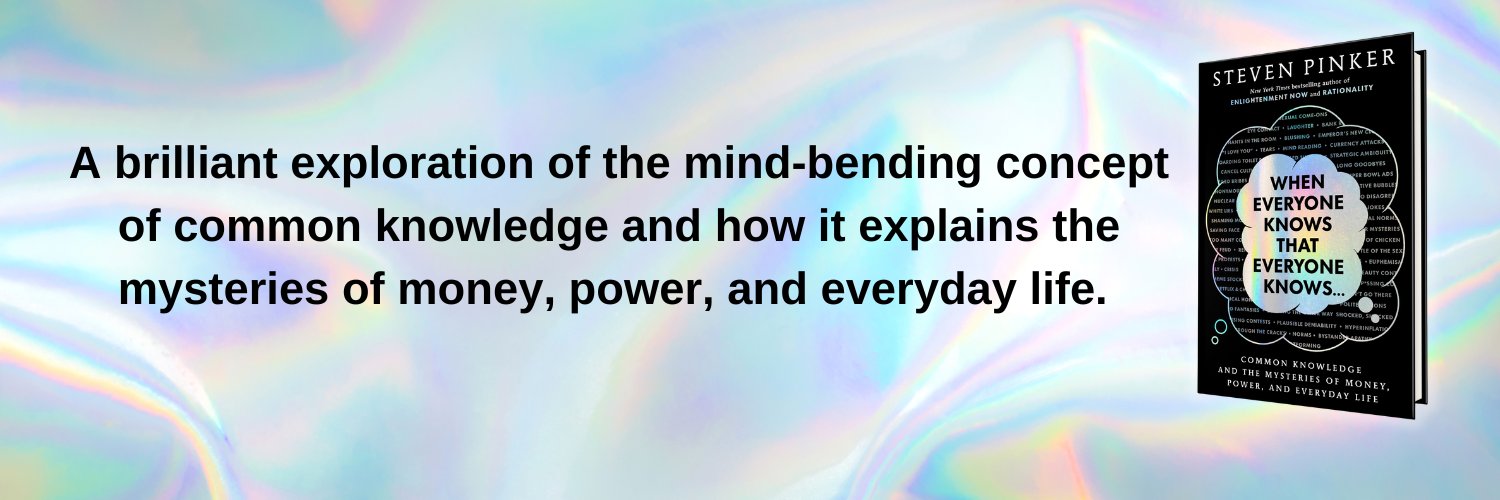
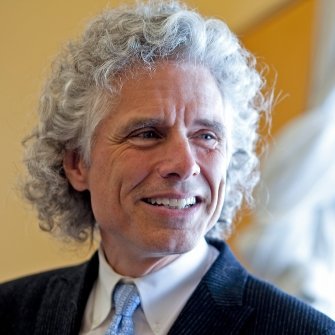
Steven Pinker
@sapinker • 860,759 subscribers
Cognitive scientist at Harvard.
Shorts


Videos

David Deutsch (David Deutsch) and I discuss AGIs and subjectivity on the Joe Walker Podcast (Joseph Noel Walker): David Deutsch: I think it’s inevitable that AGIs will be capable of having internal subjectivity and qualia, because that’s all included in the letter G in the middle of the name of the technology. Me: Well, not necessarily, because the G could be general computational power, the ability to solve problems, and there could be no one at all who’s actually human. David Deutsch: But there ain’t nothing here but computation. It’s not like in Star Trek: Data lacks the emotion chip, and it has to be plugged in. But there’s nothing possibly in that chip apart from more circuitry like he’s already got. Me: But, of course, the episode that you’re referring to is one in which the question arose: Is it moral to reverse engineer Data by dismantling him, therefore stopping the computation? Is that disassembling a machine, or is it snuffing out a consciousness? Because there is an alternative view that subjectivity depends also on whatever biochemical substrate our particular computation runs on. And I think there’s no way of ever knowing. David Deutsch: I think we can answer that question before we ever do any experiments, even today, because there’s no difference in principle between a computer that runs partly by electricity and partly by chemicals and one that runs entirely on silicon chips. Because the latter can simulate the former with arbitrary accuracy. Me: Well, we don’t have to solve the problem this afternoon in our conversation, but, in fact, I think it is not solvable. But the simulation doesn’t necessarily mean that it has subjectivity. It could just mean it’s a simulation; that is, it’s going through all the motions. It might even do it better than we do, but, you know, there’s no one home. There’s no one actually being hurt. David Deutsch: Well, you can be a dualist. You can say that there is mind in addition to all the physical stuff. But if you want to be a physicalist, then there’s this thought experiment where you remove one neuron at a time and replace it with a silicon chip, and you wouldn’t notice. Me: Well, that’s the question. An external observer wouldn’t notice. How do we know that, from the point of view of the brain being replaced—every neuron by a chip—it’s like falling asleep? That when it’s done and every last neuron is replaced by a chip, you’re dead, subjectively, even though your body is still making noise? David Deutsch: That means that when your subjectivity is—there is something happening in addition to the computation. And that’s dualism. Me: I mean, again, I don’t have an opinion one way or another, which is exactly my point. I don’t think it’s a decidable problem. But it could be that that extra something is not ghostly substance. It could be that the stuff that the brain is made of is responsible for that extra ingredient of subjective experience, as opposed to intelligent behavior. I think we’re going to be having the same debate a hundred years from now. David Deutsch: Yeah, maybe one of the AGIs will be participating in the debate by then.
Steven Pinker135,841 просмотров • 10 дней назад

The French Revolution was a disaster: killed 2 million people, led to the rise of Napoleon--perhaps the world's first totalitarian fascist dictator, who began wars of conquest that killed an additional 4 million people, led to the restoration of slavery, to the restoration of the monarchy, and a delay of democracy in France by perhaps a century. Russian Revolution killed several million, led to the Russian Civil War--which killed another 9 million--led to the rise of Stalin, who killed 20 million. There's an old cliché: you can't make an omelette without breaking a few eggs. Well, it ignores the fact that people aren't eggs, and that generally does not result in an omelette. Again, the Chinese Revolution, perhaps the most disastrous event in history, led to the Great Leap Forward and the Cultural Revolution, killed perhaps 30 to 40 million people altogether. Clip from the Institute of Art and Ideas
Steven Pinker3,093,714 просмотров • 1 год назад

From my interview with The New Society The New Statesman: Headlines are a bit of a misleading way to understand history because, you know, bad things happen, but bad things happened 50 years ago, too, and we tend to forget them. When you actually plot things like poverty, war, homicide, and literacy, most of these are way better now than they used to be. How did that happen? And there are a number of hypotheses that I float as to why cooperation and human flourishing in general have increased. One of them is an expanding circle of empathy, another concept from Singer: as we rub shoulders, as we exchange stories with people who are unlike ourselves, we come to realize that we're not special just because we're us and they're them. You're bound to understand people when you kind of see the world from their perspective. But another could be—and this, again, Singer suggested—that sheer raw reason can make us more moral, more cosmopolitan, more universal, as we realize that there's nothing special about me just because I'm me. There's something that is inherently disinterested and universal about reason. And, of course, I care about me more than I care about other people, but I can't convince you that that is a moral imperative—that you have to care about me more than you because I'm me and you're not. And so, just that symmetry kind of pushes toward a kind of more ethical code: a golden rule, a categorical imperative, or the veil of ignorance, where simply discounting your own proprietary interest in yourself steers you toward a defensible morality.
Steven Pinker74,920 просмотров • 11 дней назад


Henry Shevlin (Henry Shevlin), Dan Williams (Dan Williams), and I discuss AI and "superintelligence." You get all of these maladaptive outcomes—all this cruelty and waste and competition and aggression—precisely because there was no designer who wanted to minimize any of these things. Natural selection did its thing. If AI were simply allowed to evolve without any kind of human intervention, then that would be a risk. But in the case of AI, there is intelligent design. I mean, us. These are gadgets. I think it’s illicit to anthropomorphize AI as being like human beings, which are products of natural selection, when AIs are not products of natural selection. They’re products of intelligent design. And so the engineers can think, “Well, these are the goals that we want to optimize. These are the kinds of side effects that we want to minimize. These are the kinds of things that we wouldn’t in a million years allow it to do.”
Steven Pinker31,983 просмотров • 5 дней назад

I spoke with Pooja Arora about Marxism: One is: What’s remarkable is that Marxism has been tried. Now, of course, defenders of Marxism say it hasn’t really been tried anywhere, but certainly the people who implemented it claimed they were implementing Marxism. And this is a massive experiment—a global experiment—with a very clear outcome. Namely, the Soviet Union was a disaster. The imposition of communism on Eastern Europe was a disaster. The imposition of communism in Venezuela was a disaster. The imposition of communism in Maoist China was a disaster. Disaster in terms of both poverty and oppression and genocide and stupid wars. So the world has told us what happens under communism, and it’s a sign of how out of touch intellectuals can be that there are still people who defend it despite the entire world giving a very clear-cut answer. One more is: would you rather live in North Korea or South Korea? Would you rather live in the old East Germany or West Germany? We have an experimental group and a matched control group in terms of culture, language, and geography, and the answer is crystal clear. So this is a sign of, I think, the pathology of intellectual life—that Marxism can persist. The other is, you did call attention to one of the appeals of Marxism, though, and more generally of heavy, strong influence of government guided by intellectuals, which is that there are certain kinds of reforms that you can state as principles. You can articulate them verbally as propositions—like equality, human rights, democracy—but there’s other kinds of progress that take place in massive distributed networks of millions of people, none of whom implements some policy. But collectively, there is an order, an organization that’s beneficial. So that can happen organically through, for example, the development of a language. No one designed the English language. It’s just hundreds of millions of English speakers. They coin new words. They forget old words. They try to make themselves clear. And we get the English language and the other 5,000 languages spoken on earth. Likewise, a market economy is something where knowledge is distributed. You don’t have a central planner deciding how many shoes of size 8 will be needed in a particular city, but rather information is conveyed by prices, which are adjusted according to supply and demand. And you’ve got a distributed network of exchange of information that can result in an emergent benefit. Now, intellectuals tend to hate that. They like rules of language—of correct grammar. They like top-down economic planning. They like cultural change that satisfies particular ideals described by intellectuals. And so rival sources of organization, like commerce, like culture—traditional culture—tend to be downplayed by intellectuals. And this can be magnified by the fact that many dictatorships give a privileged role to intellectuals, which may be why, over the course of the 20th century, and probably continuing to the present, there has not been a dictator that has not had fans among intellectuals—including the mullahs and ayatollahs of Iran, but also the communist dictators: Mao and Castro, even Stalin in his day. And every other dictator has had, actually, often fawning praise from Western intellectuals.
Steven Pinker1,117,222 просмотров • 9 месяцев назад

"I like to quote the founder and proprietor of Our World in Data, who said that the papers could have had the headline: “187,000 people escaped from extreme poverty yesterday, every day for the last 30 years.” But you never saw that headline, and as a result, a billion people escaped from extreme poverty. One of the most significant events in human history, and no one knows about it."
Steven Pinker164,635 просмотров • 1 месяц назад

From my appearance on 60 Minutes: Me: Research works. If you want to freeze society where it is, then cripple the research enterprise. Bill Whitaker of 60 Minutes: Is that whole idea being lost in the harsh rhetoric by the administration? Me: The attack on universities is a tragic blunder. For all the foibles of universities, and there are many, and I pointed them out, universities' research makes life better, massively so. Why would you want to cripple it? It's something that the United States does really, really well.
Steven Pinker944,649 просмотров • 11 месяцев назад

Like an appreciation of progress, reading and literacy are among the things that are good but cognitively unnatural. That is, they go against our evolved nature. We didn’t evolve with print; it was a recent invention. Reading, for many of us, has become so second nature that we just assume it’s the most natural way of getting information. But what we’ve seen, especially in the last 10 years, when video has become so cheap because of the cloud computing revolution and the broadband revolution, is that a lot of people, unlike us, much prefer to listen and watch than to read. You just see this: when I go to Google and ask a basic question about how to unstick my printer or solve a problem, I get like five videos. And I just want a paragraph that would solve it. I don’t want to see Seth saying, “Hi, welcome to my show. If you like it, subscribe and give it a like.” So just help me solve the problem. But clearly there’s something unusual about me, because people are going for the video. And the massive availability of video—of TikTok, of YouTube—means that people may not be getting the practice or putting in the effort into literacy, which we have reason to believe was one of the drivers of the Flynn effect and of cognitive sophistication in general. Human Progress
Steven Pinker547,760 просмотров • 7 месяцев назад

Is there a crisis of meaning? "Overall, across the world, there's reason to believe that happiness has increased for obvious reasons: people are living longer, they're less poor, they're better educated, and so on. So that would suggest, but not prove, that there has not been a decline in meaningfulness. It's still possible. But just anecdotally, there have been complaints that life is meaningless as far back as you go. You know, Ecclesiastes: “Vanity of vanities, all is vanity.” Henry David Thoreau in 1854: “The mass of men lead lives of quiet desperation.” And how a guy living in a cabin on a pond could know this is unclear, but that was the perception. T. S. Eliot: “We are the hollow men, we are the stuffed men”—1920s. Starting in the '50s, there was a great fear of alienation. That was the big issue, and part of the counterculture was how suburban middle-class life was meaningless and empty and plastic and artificial. There was The Pursuit of Loneliness, a 1970 bestseller by Philip Slater, and Jimmy Carter's malaise speech in the late 1970s. So it's a constant complaint. The fact that people say it doesn't necessarily mean it's true." Human Progress
Steven Pinker40,324 просмотров • 26 дней назад

They got the same DNA. Genes are the same. Same mother, same father, same older siblings, same younger siblings, same number of books in the house, same number of TVs in the house, same teachers, same everything. So they should be absolutely indistinguishable. They should be, you know, clones. Well, if you know a pair of identical twins, you know they’re not indistinguishable. They have separate personalities. I know this intimately, having two identical twin uncles, Barry and Mark, who are more similar than people picked off the street at random, but no one in the family had any doubt which was which. They each had their own personality, and that’s true of all individuals. Well, that leads to a real puzzle that I think psychologists have not really thought through enough, which is: how can they be different? It’s not their genes. It’s not their environment—at least not anything stable about the environment, like who your mother is or what neighborhood you live in. Thinkable
Steven Pinker363,565 просмотров • 10 месяцев назад

I explain why the accusation that Israel is committing "genocide" is blood libel. Me: The application of the word genocide to refer to tens of thousands of war deaths is, I mean, I think it is a kind of blood libel. It's trying to import the moral opprobrium that we associate with genocide to a designated enemy, in this case, Israel. I think because I alluded to my side bias, the sides in this case being the sides that a lot of hard left critical theory has defined, namely white oppressors against everyone else's victims. Moynihan: It's pretty strong to say this is like a blood libel. Me: Well, it is a blood libel in the sense that it is an accusation of deliberate murder, ill-founded in that the, and one could disagree with Israel's campaign against Gaza, one could say that this is not justifiable, it's not a just war. It's still different from deliberately murdering as many people as possible, as in, and we know there have been genocides. I think it really is a terrible blood libel, and it's a sign of how people's moralizing in the service of demonizing and dichotomizing, dividing the world into good and evil can just flatten their ability to analyze and to think clearly.
Steven Pinker393,076 просмотров • 1 год назад

Brian Keating () and Rebecca Newberger Goldstein (Rebecca Newberger Goldstein) discuss "The Law of Physics Behind Depression." Rebecca Newberger Goldstein: The thing that suicidally depressed people feel is that they don’t matter; others do, they don’t. Nothing they can do will ever make them matter. It’s a terrible, terrible feeling. And what this means is they cannot abide their own presence. Brian Keating: What if there is a law of physics that explains why depression feels the way it does? Rebecca Newberger Goldstein: When I first learned about the second law of thermodynamics, it seemed—I couldn’t quite conceptualize it. We are subject to the second law of thermodynamics, which, you know, has a tragic dimension. In fact, when I was a graduate student, it occurred to me, oh my gosh, biological systems are really just organized to resist the second law of thermodynamics. In some sense, biology is a response to this supreme law that tells us that, in closed systems, energy never increases; entropy never decreases. Entropy never decreases, and if there’s any way for it to increase, it will. Entropy is the measure of the disorder of a system. The more disorder, the higher the entropy, and the less efficient the work you can get out at the end of the system. And in fact, Rudolf Clausius, the physicist, said that the universe itself will go to thermal equilibrium—what we call the heat death—and so there will be no more energy to be gotten out of it at the end of the system. Rudolf Clausius, the 19th-century physicist who formulated the concept of entropy, which means literally “transformation from within”—there’s poignancy in that. This transformation from within is going to the end of the system. And he said that the universe itself will go to thermal equilibrium, to what we call the heat death, and so there will be no more energy to be gotten out of it. Brian Keating: So let’s start with that story you tell first about Ludwig Boltzmann, who solved one of the great paradoxes of physics, the irreversibility paradox. Talk about that. And then why, in your mind, was he so traumatized, perhaps, or so full of dread of his equation that he took his own life? So talk about that. Rebecca Newberger Goldstein: So there was this great paradox, which is that most—probably most—of the processes that we observe are irreversible. If you film them—and tell me if I’m being too elementary, because I’m going to be very—you know, if you film them, like let’s say I crack open an egg and I stir it up and then I fry it, and somebody filmed this and then reversed the film, anybody who sees the reverse of that film is going to know it was reversed. That cannot happen in nature: that the egg is going to uncook itself, unscramble; the yolk is going to separate from the albumen and jump into the shell and seal up. Impossible, right? So almost everything that we see is irreversible. Brian Keating: Yes. I saw that line, Rebecca. It made me think, because you mentioned it in the context of his daughter, Elsa, finding her father’s dead body. And it wasn’t like he showed any sign. I mean, we can’t go into the minds of someone who dies by suicide, right? Yes. But at the same time, you’d think, well, this would be a more common thing. And so, is depression sort of a—you know, they used to think of miasmas and things in the air, you write about that in the book—is depression, at heart, an entropic collapsing process? Rebecca Newberger Goldstein: I have spoken to a lot of people who suffer from clinical depression. And I want to say, first of all, that the U.S. hotline for suicide prevention is The thing that suicidally depressed people feel is that they don’t matter. Others do. They don’t. Nothing they can do will ever make them matter. It’s a terrible, terrible feeling. And what this means is they cannot—they can’t abide their own presence. I really think it shows how strong this mattering instinct is in us. If you can’t somehow appease it, you can’t abide your own presence. And so, what the people I’ve spoken to—and one is a very, very good philosopher who has suffered from depression—have told me is that, phenomenologically, this is exactly what it feels like. It feels like psychic disintegration. So, in some sense, yes—happiness is a very ordered state. And I would go even further: everything worth living for is an ordered state. I think knowledge—knowledge, knowledge, knowledge—is better than ignorance. Clarity is better than confusion. Flourishing is better than suffering. Love is better than hatred. Beauty is better than ugliness. These are truisms; these are what we all accept. Look at the thing that’s better: it’s an ordered state. And its negation is a disordered state. So I think—I would argue—this is a very kind of Spinozist argument, trying to get out of the laws of nature some ethical enlightenment, some ethical guidance, because that’s what we want. We want ethical guidance. So we know we want to matter. We know we do all sorts of things to matter. Some people do very bad things in order to matter. Some of the people I’ve spoken to… they do. They want power over others. They want dominance. They want to make other people’s lives miserable. These are bad things, right? They cause an increase in entropy. This is how I judge people now: are you increasing entropy, or are you decreasing it? -- Full video in link below.
Steven Pinker161,870 просмотров • 6 месяцев назад


On Trump flouting norms and why this is a negative development: "[One of the] remarkable things about Donald Trump—and uniquely among American politicians—is that he has violated norms that have been in place, such as: you don’t boast, you don’t blatantly lie. I mean, all politicians lie because all human beings lie. But they lied under the cover of claiming to be honest. With Trump, it’s patent that he just doesn’t care about factual accuracy. He’ll say things that are in his interest and that demonize his opponents, with little regard for factual accuracy. Insulting a woman’s appearance, insulting war heroes, insulting patriots, insulting his predecessor in office, flattering enemy leaders, insulting allies—all of these things—there’s never been a law against them, but they just seemed to be things that a decent leader would not do. By doing them and not suffering consequences, the danger is that he is actually destroying norms that were a pretty good idea. For example, whether he was trolling or semi-serious about, say, annexing Greenland—let alone Canada, my own country—there has been a norm since World War II that nation-states are immortal, borders are grandfathered in, aggressive conquest is taboo. Now, of course, like any norm, it can be floated. Russia is obviously floating it now. But even to talk about floating it, even casually as Trump is doing, I think is a negative development." Clip from an interview with UnHerd.
Steven Pinker275,039 просмотров • 1 год назад

I had the pleasure of being a guest on Science of Perception Box, a video podcast from Unlikely Collaborators. New episodes drop every Wednesday. Me: Eye contact can often generate common knowledge. We know, even from the ethological literature in animal communication, that eye contact is a very potent signal because you’re looking at the part of the person that’s looking at the part of you that’s looking at the part of them that’s looking at the part of you. And so eye contact can generate common knowledge. It often resolves ambiguities in, say, a car stopping and a pedestrian crossing. Establishing eye contact would be a way of generating that common knowledge. Christof Koch: Or two cars merging on a freeway, right? The other guy sort of briefly nods. Me: Exactly. And in fact, I was tickled to see a sign in the San Francisco airport parking lot, which I actually photographed and included in the book. It has a cartoon of a pedestrian and a driver, with a dashed line joining their eyes, and it says, “Make eye contact before crossing.” There it is. Yes. Dr. Heather Berlin
Steven Pinker35,729 просмотров • 1 месяц назад

On Into the Machine, Tobias Rose-Stockwell (Tobias Rose-Stockwell) and I discuss trust in journalism and common knowledge: Me: The standards that we enjoyed in the earlier era of journalism did not always exist. Most news was fake news. There were stories of babies born talking, speaking Latin; of Martian civilizations; of Bigfoot in the forest; and of fake scandals involving politicians. Tobias Rose-Stockwell: The question I have is: How did that assurance come to be? The New York Times, for instance, emerged as a trusted institution in a time when there were very few trusted institutions. Your average news consumer would go out and see the New York Herald, the New York Times, and another newspaper. One month, the Herald would have a story about animals escaping the Central Park Zoo that did not happen. The New York Times would report on, you know, some business news. The other paper might report on gossip. Month over month, trust was built among these different papers, which eventually became common knowledge: “Oh, you can actually trust this one or that one.” And thus an institution was kind of born in that process.
Steven Pinker41,246 просмотров • 1 месяц назад

If thought were independent of language, we wouldn’t have any use for language, because the whole point of language is to convey ideas. So it’s not independent, but it’s not the same thing as language. We know it’s not the same thing for many reasons. One of them is: how would children learn language to begin with if they were incapable of thinking until they had language? The way that language acquisition has to work is that children have some understanding of the world, of the objects around them, of the intentions of the people that they interact with, and they map them onto the sequences of sounds and gestures that they perceive. Also, we know that there are many forms of thought that are not linguistic, such as visual imagery, spatial cognition, and mental maps, all of which are specialties of Professor Tversky, who I’m sure will enlighten us about those. Even when it comes to the content of language, what we take away after the words have faded is the gist of language, not the words themselves. Within a few seconds after I stop speaking, or a few minutes after you’ve read something, you probably could not reproduce a single sentence verbatim, but hopefully you would come away with the content, the meaning, the gist. And one of the most robust findings in our field, cognitive psychology, is that long-term memory for gist is far more robust than memory for text itself. We know from studies of the brain that there are networks of language in the brain that are not the same as the parts of the brain that light up when people are thinking visually, thinking spatially, or thinking in terms of motion. Again, to go back to one of Professor Tversky’s specializations, we can imagine tying a shoe; we can imagine diving off a board. We have auditory imagery—a song can run through our head—and there are probably other forms of thought that we don’t even have names for. We also know that we sometimes struggle to put our thoughts into words. We write down a sentence, and we realize, no, that’s not what I meant, and rewrite it until the sentence comes out right. Full Institute of Art and Ideas video:
Steven Pinker110,726 просмотров • 6 месяцев назад

The fact that the universe doesn’t care about you doesn’t mean that other humans don’t care about you, or that we don’t have to care about other humans. That is, there is a purpose, there is a meaning: that is, to make people as well off as possible, to increase flourishing, to increase knowledge and life and health and freedom and safety. These are really, really meaningful. At least, I think they are. I don’t see anything wrong with them. I don’t think that that should leave you empty. And the fact that we live in a cold universe—that is, the laws of physics, the laws of biology, the behavior of viruses and bacteria and parasites and fungi—they don’t care about you. I’m sorry, they don’t care about you. And the sooner you realize that, the more you’ll be able to attend to the things that really do matter. Human Progress
Steven Pinker106,531 просмотров • 6 месяцев назад