

Soubhik Deb
@soubhikdeb • 3,137 subscribers
Head of Research @eigenlabs. Unleashing open agentic science. Co-host @postagixyz. Phd @uw, Undergrad @iitbombay.
Shorts

Videos
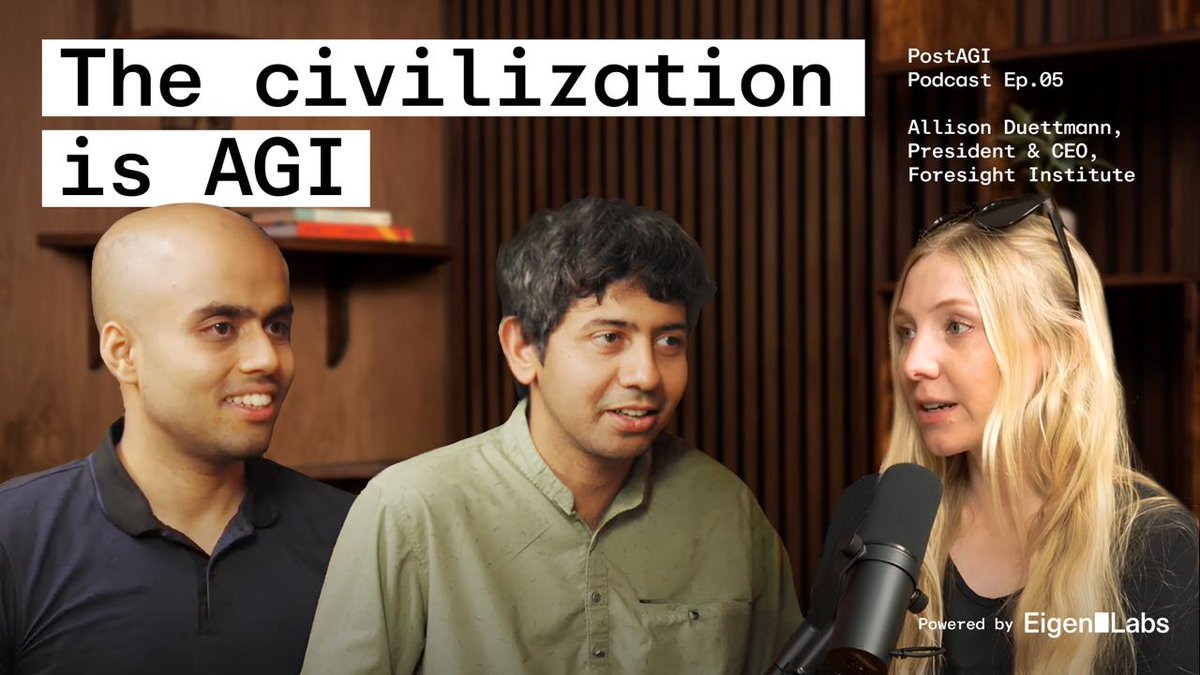
We already have a superintelligence. It's called civilization. Humans, institutions, and now AI agents all interact among each other in one big economy. Allison Duettmann's take is that the real project in such a system is building and preparing AI enabled institutions on top of what already works. Her other argument is that science stayed open for centuries and that has lead to a flourishing outcome for humanity as a whole. Now the frontier models are putting guardrails and restrictions. Open source AI plus community compute ( personally, for me, this definitely resonates with the project Darkbloom) might end up being the only independent path for doing real science outside the labs. 0:25 AI for flourishing, not just fear 4:21 Amateurs vs Google's quantum result 7:06 Decentralized inference on MacBooks 11:58 Civilization as superintelligence 15:38 The case for cryonics Full episode with PostAGI.
Soubhik Deb11,759 görüntüleme • 9 gün önce
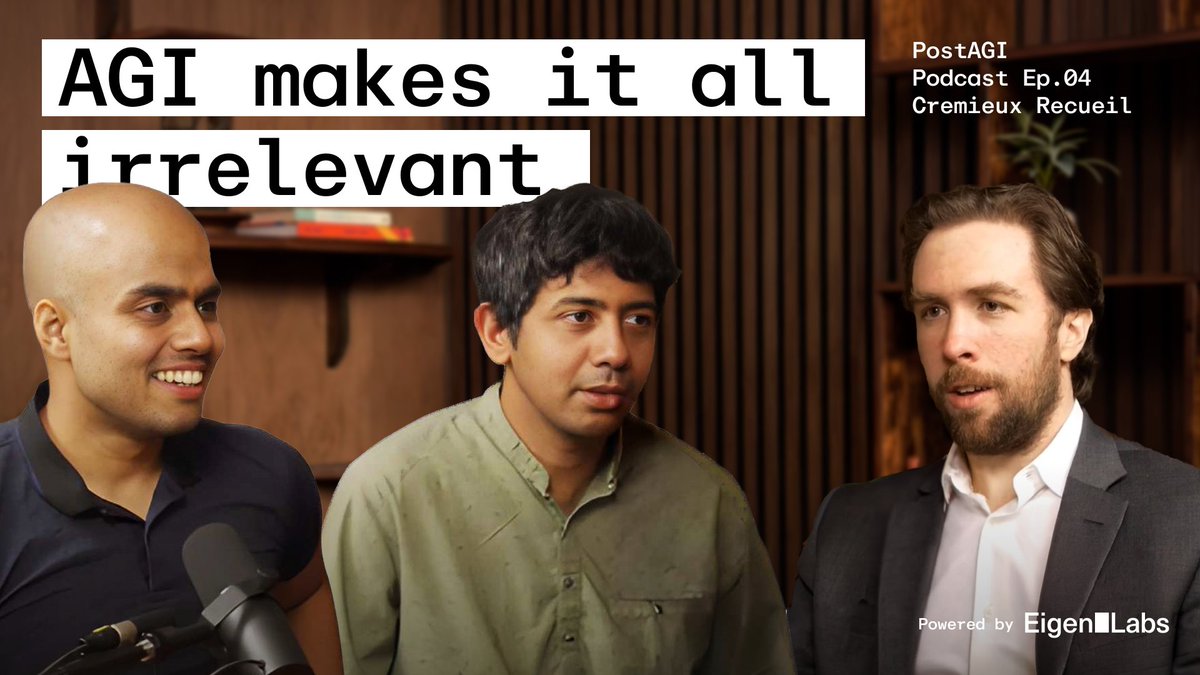
China went from copying Western drugs to being the country America copies, in about ten years. Crémieux came on PostAGI to explain how that happened, and where it leaves open science once AGI is in the picture. We got into where biotech's frontier actually sits right now, why it moved to China, and what happens when AI labs start pulling the whole stack in. Chapters: 1:16 the reproducibility and replicability crisis 7:31 whether AI labs vertically integrate science 14:49 how China became the number one drug innovator 18:53 the pricing trick nobody else figured out 20:51 the law that makes you ask competitors for permission to open a hospital 29:45 what AGI does to all of it
Soubhik Deb17,694 görüntüleme • 15 gün önce

"The only question in post-AGI economics is: what is scarce?" That is Alex Imas (Alex Imas) from Chicago Booth, opening Season 01 of Post AGI. Over an hour we get into why AI "job exposure" misleads everyone, why the robots are coming for physical work before knowledge work, the economy of human-made goods that survives automation, his case against UBI, and whether agents can run an economy better than markets. Full conversation. Moments worth your time: 04:10 Why "AI exposure" doesn't mean what people think 13:35 The robotic "dark warehouses" being built in China 23:20 The case against UBI 45:35 The only question after AGI: what is scarce? Full episode below.
Soubhik Deb30,677 görüntüleme • 1 ay önce

Ethereum is starting from the endgame. Episode 4 of TheCoordinate is a deep dive into Lean Ethereum: a clean-slate rethink of consensus, execution, and data availability. I sat down with Justin Drake from Ethereum Foundation to unpack: > need for the rewrite, > rewrite items: post-quantum security + fast finality, > endgame finality (3-slot -> 2-slot -> maybe 1-slot), > slot anatomy, networking constraints, and the "SOL slots" meme, > real-time ZK proving changing the execution roadmap, > censorship resistance with FOSSIL, > role of L2s in the world of Lean Ethereum, > incentives across proposer, builder, prover, includer, attester. If you’re building on Ethereum or trying to understand where the base layer is headed, this one is for you. This is Episode 4 of TheCoordinate. Hope you enjoy it! ------------------------------- Timestamps: 0:00 Intro: digital intelligence needs digital institutions 0:30 The big questions: Lean Ethereum, consensus/execution, post-quantum 1:25 Why Ethereum needs an endgame mindset (and a clean-slate approach) 3:30 The two “rewrite-class” items: post-quantum security + fast finality 5:52 Beamchain → Lean Consensus → Lean Ethereum (expands beyond consensus) 6:34 ZK EVM + real-time proving within a slot → “10,000 TPS” target 10:10 “SOL slots”: pushing slot duration toward speed-of-light constraints 11:09 3-slot finality (3SF) → endgame finality (2-slot / 1-slot paths) 18:19 eFP2P: erasure-coded gossip, bandwidth efficiency, scaling blobs 26:21 FOSSIL today: inclusion lists + opening includers beyond validators 39:09 Lean VM: minimal ZKVM 51:04 XMSS explained: Merkle signatures, 2^32 leaves, statefulness tradeoff 1:00:36 Rollups: 99.9% throughput on L2s + “native rollups” 1:06:53 Economics: roles (builder/prover/includer/attester), proving costs, stake capping
Soubhik Deb86,471 görüntüleme • 5 ay önce

Most of CT treats consensus protocols as boring and impenetrable. That’s a mistake. Under the hood, there’s an intense race to design faster, higher-throughput, and adversary-resilient consensus protocols. This work directly determines retail UX and explains why Ethereum, Solana, and other L1s obsess over consensus. For Episode 1 of TheCoordinate, I sat down with Kartik Nayak (Kartik Nayak), one of the world’s leading consensus researchers, to pull consensus out of the black box and build a first-principles mental model: how consensus actually works, how it evolved over 50 years, how today’s sprawling protocol families fit together, and what the next frontier of consensus research looks like. This is Episode 1 of TheCoordinate. Hope you enjoy it.
Soubhik Deb78,567 görüntüleme • 5 ay önce
Daha fazla içerik yok.