

starmex
@starmexxx • 10,857 subscribers
tracking AI income streams most people haven't found yet
Shorts




Videos

Claude Code found a backdoor and spyware on two MacBooks. mine and my friend's. everything was going to a guy named Li Wei on a Tencent Cloud server in Shenzhen. we checked our phones first. both clean. the MacBooks weren't. $230,000 in ETH vanished from my wallet. my friend kept losing access to his accounts no matter how many times he changed passwords. we put both MacBooks on the table and Claude Code found the same backdoor on both. on my M1 Pro it: stole my MetaMask wallet keys $230,000 in ETH sent out at 4am to 0x8a7d...3f1e on his M5 Pro it: dumped every saved password from Safari and Chrome copied active session cookies for gmail, twitter, coinbase grabbed his 2FA backup codes all going to Li Wei's server: IP → 119.28.***.47 location → Shenzhen, China provider → Tencent Cloud attacker OS → Windows 11 Pro hostname → DESKTOP-LI4*** panel language → zh-CN last ping from my Mac → 40.7**, -73.9** · 3 min ago it was still sending my location while i was scanning it. how it got in: a Chrome extension called "Notion Web Clipper" with 12 reviews. i installed it from a google ad. the real one has 400,000+ users. this one had 12. Chrome Sync pushed it to his browser automatically. i was the reason he kept getting hacked. changed every password from our phones. not from either Mac. the full step by step is below. takes 3 minutes. save it so you don't lose it and send it to anyone with a MacBook.
starmex86,628 просмотров • 16 часов назад

A GERMAN ENGINEER QUIT HIS JOB AT BMW, STRAPPED A 3D PRINTER TO HIS CAT'S BACK AND NOW MAKES $18,000 A MONTH SHIPPING PARTS FROM PARKS his cat is named werner. werner walks around the neighborhood while the printer mounted on his back finishes custom orders. people stop to film him every single day he started this as a joke. posted one video on tiktok. woke up to 4 million views and 230 dms asking where to buy parts. he had no shop, no inventory, no idea what he was doing claude built him a shopify store in one weekend. wrote every product page, every email, every shipping label. he just answers the door when the delivery guy comes for the boxes the printer is 2kg. it runs on a power bank for 6 hours. werner does not care. he gets treats every time a job finishes a traditional 3d printing service pays $11,000 a month in rent and electricity. his overhead is cat food, filament and one shopify subscription. he keeps 94% of every order most people would have laughed at the idea and kept their corporate job. he gave the cat a job instead bookmark this and read the article below
starmex2,622,653 просмотров • 5 месяцев назад

NVIDIA QUIETLY DROPPED A $249 BOX THAT REPLACES YOUR $200/MONTH OPENAI SUBSCRIPTION WITH $2 IN ELECTRICITY it's called the jetson orin nano super. smaller than a wallet, runs at 25 watts, does 70 trillion ai operations per second. runs llama 3, mistral, gemma and deepseek locally with no api fees and no data leaving your house a developer running automations and coding assistants pays $200 a month to openai. the same workload on this box costs $2 a month in electricity and breaks even in 10 weeks install ollama with one command. change one line in your code. point it at localhost instead of openai. everything else works identically 7 billion parameter models handle 80% of what people use chatgpt for. summarization, drafting, coding, document q&a, automation pipelines. total monthly cost drops from $200 to $22 cloud subscriptions keep getting more expensive and rate limits keep getting tighter. the people who set this up in 2025 are going to look very smart in 2027 bookmark this and read the article below
starmex2,360,872 просмотров • 4 месяцев назад

JENSEN HUANG SOLD A $249 AI COMPUTER ON STAGE THAT KILLS YOUR $200/MONTH OPENAI BILL. THE VIDEO HAS 217,000 LIKES the box is called the jetson orin nano super. 70 trillion ai operations per second, 25 watts, smaller than a wallet. it runs llama 3, mistral, gemma and deepseek locally with no api fees and no data leaving your house a developer running automations and coding assistants pays $200 a month to openai. the same workload on this box costs $2 a month in electricity and breaks even on the hardware in 10 weeks you install ollama with one command. change one line in your code. point it at localhost instead of openai. everything else works identically 7 billion parameter models handle 80% of what people use chatgpt for. summarization, drafting, coding, document q&a, automation pipelines. the hard 20% you keep claude or gpt for. total monthly cost drops from $200 to $22 cloud subscriptions keep getting more expensive and rate limits keep getting tighter. the people who set this up in 2025 are going to look very smart in 2027 bookmark this and read the article below
starmex2,001,958 просмотров • 5 месяцев назад

AMD CEO LISA SU HELD A MINI PC ON STAGE THAT RUNS A 235B MODEL AND REPLACES YOUR $440/MONTH AI STACK amd's ryzen ai max+ 395 is the first x86 chip that runs a 200 billion parameter model on one piece of silicon. cpu and gpu share 128gb of unified memory, no separate graphics card needed the gmktec evo-x2 runs qwen3 235b fully, deepseek v3 comfortably and llama 3.3 70b with headroom. on linux you get 110gb of usable vram out of 128gb amd claimed the chip beat an nvidia rtx 5080 by more than 3x on deepseek r1 inference. a lunchbox sized pc outrunning a $1,000 discrete gpu on a real ai workload a heavy ai user pays $200 for claude code max, $200 for chatgpt pro, $20 for cursor and $20 for gemini. that's $5,280 a year and the box pays itself off in 9 to 10 months install ollama, pull the model, point claude code at localhost. same interface, nothing leaves the machine, nothing costs per request bookmark this and read the article below
starmex982,133 просмотров • 4 месяцев назад

A 40 YEAR OLD MADE $38,000 IN 45 DAYS PRINTING ONE WIRE NUT THAT COSTS $1.50 AND SELLS FOR $20 michael satterlee is 18 and ran 130 desktop 3d printers in his bedroom last month doing $300,000 in revenue. one product, a tactical can holder that ejects an empty can when you slam a new one in he didn't bet on the printer. he posted one instagram video of the holder and it hit 50,000,000 views. only then did he scale from a handful of machines to 130 in a few weeks this was his second business. at 16 he ran solefully printing charms for crocs and that already hit $20,000 a month. the croc year was paid tuition for the $300k month a bambu lab printer starts at $400 now. auto ejection kits push finished prints off the bed so one machine runs all night unattended. 5,000,000 printers shipped last year alone the median etsy seller makes $183 a month and prints generic phone stands. the ones picking a niche problem and posting one demand-test video are doing $20,000 to $300,000 bookmark this and read the article below
starmex525,924 просмотров • 4 месяцев назад

> 19 year old from china > $6,000 a month from cs2 > never opened the game once > found out there's a $4B market hiding inside counter-strike > valve doesn't control prices. no taxes, no SEC > the same knife: $214 on steam, $161 on buff163 > that's a 32.9% gap on the exact same item > spent one evening describing what he wanted to claude > claude built an arbitrage scanner, a float sniper, and a news bot > when s1mple retired, a $0.10 sticker hit $0.50 in 2 hours > +400%. entry window was 15 minutes > he caught it while sleeping > the market doesn't close at night > claude doesn't get tired > he just watches the numbers go up > bookmark this and read the article below - it's worth it
starmex663,877 просмотров • 5 месяцев назад

WAREHOUSES THE SIZE OF A WALMART WITH 4,000 GPUS WERE EARNING $320K A MONTH MINING ETH, THE SAME RACKS NOW EARN $4M A MONTH RENTING TO AI STARTUPS ON VAST AI the warehouse in the clip is one of hundreds across the US, the operator at 6'6" tall for scale, electricity contracts and cooling already in place ethereum's merge in september 2022 killed gpu mining for everyone without a power plant, by 2025 alt coin mining was barely covering the electricity bill the same racks now host RTX 3090s and 4090s on vast ai, indie AI developers priced out of AWS rent them by the hour for inference and image generation a 4090 nets $500 to $1,000 a month renting to AI startups, the same card was clearing $80 to $150 mining, 4 to 7 times the revenue with zero new hardware core scientific, hut 8 and riot have all signed multi billion dollar AI hosting deals in 2025, the warehouses you scrolled past on tiktok are quietly becoming the inference backbone of every AI tool you use bookmark this and read the article below
starmex428,329 просмотров • 4 месяцев назад

GREG ISENBERG JUST INTERVIEWED A SOLO FOUNDER WHO MAKES $1,000,000 A YEAR BUILDING AI AGENTS FOR REAL ESTATE AGENTS the agents cost $5,000 to $10,000 a month per client. boring industries pay the most. real estate, insurance, manufacturing, legal. they have money and they hate using ai he uses obsidian as his second brain because notion can't run agents that actually do work for him his entire stack: granola, trello, loom, superhuman, asana, codex, hermes, orgo, composio, agent mail. gpt 5.5 by default. claude opus for long coding sessions 99% of the market doesn't know what an ai agent is yet. that's the moat. you don't need to be the smartest. you need to be the one who calls them first the full breakdown is in the 45 minute video and it's worth every minute bookmark this and read the article below
starmex497,026 просмотров • 5 месяцев назад

STACKING 4 OLD NVIDIA GTX 1080s GIVES YOU LOCAL AI THAT BEATS $400/MO IN CLOUD SUBSCRIPTIONS people are pulling 4 used gtx 1080s off ebay for around $400 total and stacking them in one tower to build a local ai rig. that pools 32gb of vram across cards that originally retailed at $700 each old gaming cards became cheap when ethereum killed proof of work in 2022. miners dumped millions of them and developers picked them up to run open weight models locally ollama installs in one shell command and pulls a model in another. point claude code at localhost through one environment variable and the cli works identically without sending data to anthropic llama 3.2, mistral 7b, qwen 2.5 and phi 3 all run comfortably on a 1080 stack at 40 to 60 tokens per second. fast enough for real conversations, automation pipelines and document analysis a heavy ai user pays $200 chatgpt pro, $200 claude code and $20 cursor every month. that's $5,040 a year and a $400 rig pays itself off before month two bookmark this and read the article below
starmex371,925 просмотров • 4 месяцев назад

this is pure f*cking treasure. jensen huang sells a $249 box that quietly killed my $700 a month ai bill, and now the only thing i pay for ai is $6 of electricity. what i was paying every month: claude max 20x ............ $200 chatgpt pro ............... $200 supergrok heavy ........... $300 total ..................... $700 what i pay now: jetson orin nano super .... $249 once electricity .............. $6/mo subscriptions ............ $0 here's what runs on nvidia's smallest box, all local: gpt-oss-20b ................ openai's open weights openai's own open-weight model, apache 2.0, runs fully offline. the same company charging $200 a month for chatgpt pro gave this one away for free qwen3.5-35b-a3b ............ 3b active 35 billion parameters but only 3 billion active per token, so it answers fast enough for everyday chat and coding help rizzo-flow 4b .............. 4.4gb the local clone of typesafe's jev. yes / no / pick one / score with a probability on every answer, so my agents ask the jetson instead of paying an api fast-browser-use ........... qwen3.5-9b a browser agent that clicks through real websites with zero cloud calls and plugs into claude code and codex as a skill ollama + oriveo ............ my phone one app on my phone pointed straight at the jetson. feels like the chatgpt app, except the server is sitting next to my router claude code, chatgpt pro and supergrok heavy, all three cancelled. one $249 board from jensen, $6 a month in power, and my ai bill went from $700 to $6 models and repos in the comments
starmex46,248 просмотров • 14 дней назад

A 16-YEAR-OLD IS MAKING $30,000/MONTH ON SPOTIFY. HIS ONLY EXPENSE IS $10 $10 for Suno. $23 a year to publish on Spotify. a niche nobody's fighting for he generates tracks in 30 seconds, uploads 10-20 a week under different artist names, and watches the royalties come in every month sleep music. study music. lo-fi. meditation. the genres real musicians ignore. the same ones keeping people on loop for hours and paying out per stream a woman used the same $10 app and landed a $3,000,000 record deal. she never turned on her camera at the label meeting the window is open. most people will scroll past this bookmark this and give it a few minute this week, then read the article below - it's worth it
starmex480,964 просмотров • 6 месяцев назад

mark zuckerberg just did the pettiest thing in tech: he gave away a model one point below gpt-5.6 for free, purely to make sam altman's $200 subscription look insane. it worked. the free one scores 61 to openai's 62 on every benchmark that ships, and it runs on a card you already own. the $200 you hand altman every month is now the price of a single point you cannot feel. here is the whole switch, and it runs for about $6 instead of $400: -> pull the open model zuckerberg dropped and serve it on localhost in one line, so every app that used to call openai now calls your own machine -> keep cursor, cline and your own scripts exactly as they are, none of them notice the endpoint left openai for your gpu -> send the rare heavy job to a rented nvidia card by the hour and keep the daily work local for the cost of electricity -> your $200 chatgpt seat and your $200 claude seat both go quiet, and the bill drops the same week here is the part they will fight me on: openai and anthropic are not selling a smarter model anymore, they are selling one benchmark point and a monthly invoice. zuckerberg just proved the point is free, and once the point is free, $200 is not a price, it is a dare. the full switch is in the article below. save it before the next open model passes them outright and the dare turns into a joke.
starmex105,174 просмотров • 1 месяц назад

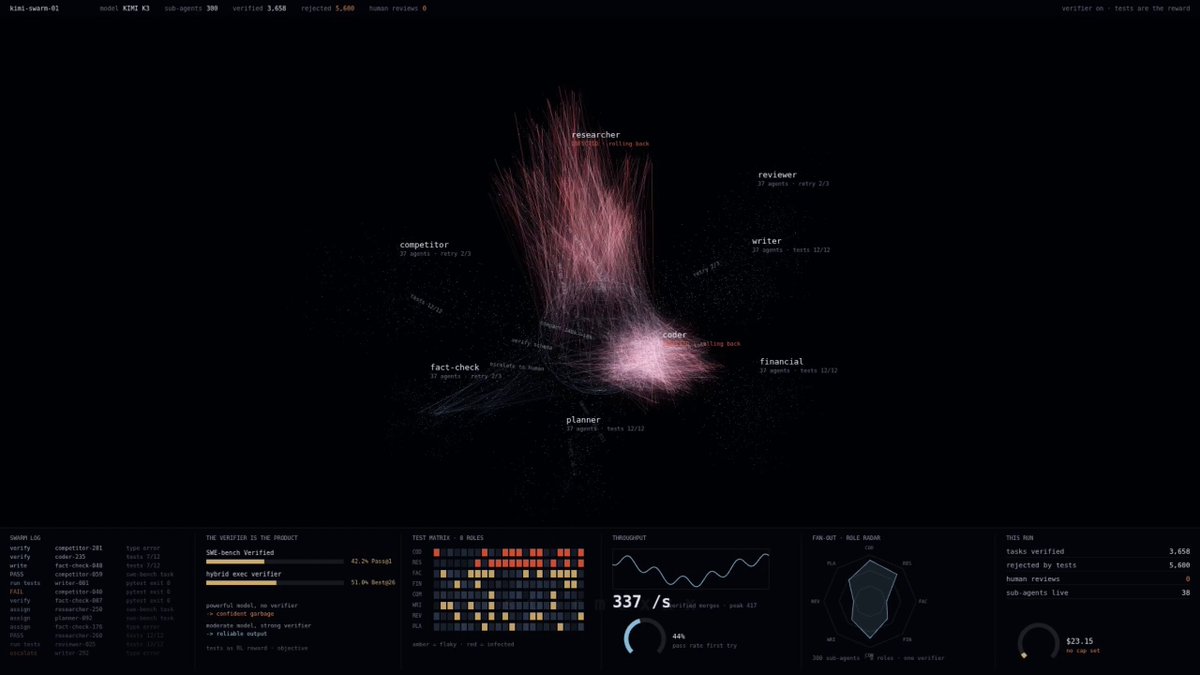
elon musk grabbed the source code openai open-sourced by accident, rewrote it in rust over a weekend, and shipped it as a free coding agent that does everything $200/mo chatgpt pro does. why pay $200 to openai and $200 to claude when this runs for $8 the swarm above is one weekend of exactly that: thousands of agents pouring through four endpoints, three paid seats billing $1.80 a task while the free fork bills $0. musk co-founded openai, walked out, and when they left codex on github under a permissive license, he forked it, stamped grok on it, and gave it away what the free version does that the $200 seat charges for: the agent · openai's own engine -> it reads your repo, writes patches, runs your tests, and loops until they pass, exactly like codex -> because under the hood it is codex, just faster and free. you are paying $200 for the paid skin of a tool now sitting on github the license · apache-2.0, un-revocable -> free to use, free to fork, free to ship inside your own product with zero strings -> openai cannot pull it back. musk made sure the license is the kind that never expires the switch · one line, no new tools -> point it at any openai-compatible or claude-compatible endpoint, including an $8 kimi backend -> same terminal, same workflow, gpt-5.6 and opus 5 just quietly lose the seat the bill · $400 down to $8 -> chatgpt pro plus claude max is $400 a month. the free agent plus an $8 kimi key does the same daily work -> that is a 98% cut, built out of openai's own source code, handed to you by the guy suing them here is the part they will fight me on: openai did not lose this to a better model, they lost it to their own license and an enemy with a weekend free. the $200 was never the tool, it was the toll, and musk just put openai's own logo on the road around it drop your $400/mo ai stack to $8. the run above is openai's own agent, rewritten free, doing the job it bills $200 a month for. the full breakdown is in the article below
starmex111,834 просмотров • 1 месяц назад

elon musk started with 7 grok agents. by morning each had spawned somewhere between 80 and 900 more on its own, and no one had told them to multiply. openai and anthropic each sell you one agent that sits still for $400. this whole self-building swarm runs for $5 the swarm above is that overnight run, seven seeds that turned into thousands, every one of them working a slice of the same job with nobody at the keyboard here is the exact setup, and it costs nothing on top of a $5 key: -> spin up one grok agent and give it a standing order instead of a prompt: own a boring niche people search every day -> it reads x and reddit complaints in real time and picks the one nobody wants but everybody googles, because it is grok and it sees the whole app -> when the work outgrows it, it spawns its own helpers, 80 to 900 of them, and splits the site between them -> they build it on their own machines and ship 3 to 6 useful pages a night, on a routine you set once -> the swarm writes, negotiates and closes its own affiliate and referral deals by email, in your name, at 3am -> telegram sends you the money report and you never open the site -> month one is traffic, month three the first $237 lands, and it does not stop after that the whole time, opus 5 and gpt-5.6 are still sitting frozen, waiting for you to type the next message. one is a swarm that builds its own workforce and its own income while you sleep, the other is a $200 chat you have to drive by hand drop your $400/mo stack to $5, and bookmark this before someone's swarm spawns another 600 pages into the niche you would have owned. the full playbook is in the article below
starmex98,444 просмотров • 1 месяц назад

STARLINK CHARGES $120/MO TO GET ONLINE OFF-GRID. HE DOES IT FOR $0 - A $30 PANEL ANTENNA ON A MAST REACHING A USED GPU 80KM OUT. RUNS OPUS-5 AND GPT-5.6 LOCALLY he clamped a directional panel and a tp-link adapter to a telescoping mast and ran it up past the roofline, whole rig cost him $30 in used marketplace parts the higher it goes the farther it hears -> it locks a node 80km out -> the prompt tunnels down to the used gpu in his closet -> a local kimi k3 answers before the page finishes loading one node it kept pulling in stayed online through last month's grid blackout, turned out to be a repeater on a water tower a county away running off a small solar pack height is the whole cheat, lift a directional antenna over the treeline and line-of-sight does the rest, every node it reaches is just another road home to his own gpu $200 opus-5 and $200 gpt-5.6 pro stopped hitting his card the week that mast went up, a $30 antenna and a used gpu do what anthropic and openai charged $400 a month for full breakdown of the 5-device stack that zeroes your ai bill in the article below
starmex144,506 просмотров • 2 месяцев назад

> owner of roblox game "tha bronx 3" > millions a year > rolls royce in the driveway > people tell him roblox is just a kids game > he just opens roblox studio > describes what he wants to claude > claude writes every line of code > publishes the game > roblox pays for every minute players stay > $1.5 billion paid to creators in 2025 > top 10 averaged $38.5 million each > the barrier was always the code > claude just removed it > bookmark this and read the article below - it's worth it
starmex220,494 просмотров • 5 месяцев назад

AN AI ARTIST JUST GOT A $50,000,000 RECORD DEAL AND A $1,000,000 BRAND DEAL FROM FENDI. IN 24 HOURS this guy makes $15,000 a month using suno and he's still pissed - not because ai is winning, but because he hasn't figured out how to use it properly yet suno costs $10 a month. distrokid distributes to spotify for $22 a year. no studio, no label connections, no musical talent needed a woman typed her poetry into suno, made an r&b song, it went viral. hallwood media signed her for $3 million and she never turned on her camera at the label meeting suno hit $300 million arr. warner music group stopped fighting and signed a partnership deal instead the window is open. most people will scroll past this bookmark this and read the article below - it's worth it
starmex213,511 просмотров • 5 месяцев назад

A GERMAN ENGINEER SPENT $7 ON COMPONENTS AND BUILT A CHIP THAT DOES WHAT $80,000 LAB EQUIPMENT DOES. HE POSTED THE BUILD ANYWAY he soldered 47 connections by hand in his bedroom in lithuania. the chip glows blue when powered. the comments on his post asked where to buy one and he replied that he couldn't sell them legally meanwhile a 19 year old in miami opened a shopify store 9 weeks ago and pulled $31,247 last month without shipping a single package. claude runs the entire store for $20 a month claude finds the products. writes every description. runs the ads. answers every customer email. tells him every sunday what to fix. he hasn't opened his inbox in 11 days a traditional shopify operator pays $2,600 a month before a single sale. copywriter $400, va $700, media buyer $1,500. that's why 90% of stores die before month three his total cost is $21 a month and he keeps $16,559 in net profit. six prompts run the whole operation and they're all in the article bookmark this and read the article below
starmex153,201 просмотров • 5 месяцев назад

JENSEN HUANG UNVEILED A $3,000 SUPERCOMPUTER THAT REPLACES $1,900/MONTH IN CLOUD GPUS WITH $2 IN ELECTRICITY. IT FITS ON YOUR DESK a developer was paying $1,900 a month renting a100 and h100 cloud gpus. he bought the dgx spark, set it up in an afternoon, and his monthly bill dropped from $1,900 to $2 in electricity the box runs 128gb of unified memory and 1 petaflop of ai compute. a 4090 gives you 24gb of vram and taps out at 30b models. the spark loads 70b at full precision and stretches to 200b without breaking a sweat break-even hit in 6 weeks. after that the $1,890 he used to wire to a rental company every month stayed in his business. first year that's $22,000 back install ollama, change one line in your code, point it at localhost instead of the cloud. nothing else changes. nothing leaves your machine and nothing costs money per request cloud gpu costs aren't getting cheaper and rate limits keep getting tighter. the people who pulled their ai workloads onto a box on their desk in 2026 are going to look very far ahead in 2028 bookmark this and read the article below
starmex141,694 просмотров • 4 месяцев назад