Wes Huff
@WesleyLHuff • 190,139 subscribers
Interested in all things Bible. This is my official and only X account.
Shorts


Videos


Prior to the Council of Trent in 1545 there was no such thing as an agreed upon “Roman Catholic Bible.” Cardinal Ximenez (who died in 1517 - the very year Martin Luther nailed his 95 Thesis to the Castle Church door in Wittenberg) in the preface to his Complutensian Polyglot Bible described the 7 books of the Deutercanon as “books outside the canon.” He explains that their purpose is to be “received by the Church rather for the edification of the people than for the authoritative confirmation of ecclesiasitcal doctrines.” In essence, Ximenes’s position was: valuable and edifying for Christians, but outside the primary canon and insufficient by themselves to establish doctrine.
Wes Huff406,013 просмотров • 2 месяцев назад


This Easter, I invite you to look at Jesus, consider what he said and did, and ask for yourself what I believe is the most important question you will ever answer: Did he really leave behind an empty tomb? And if he did, what does that mean for you? This video was made possible and in collaboration with my friends at Childlike Media.
Wes Huff475,738 просмотров • 6 месяцев назад


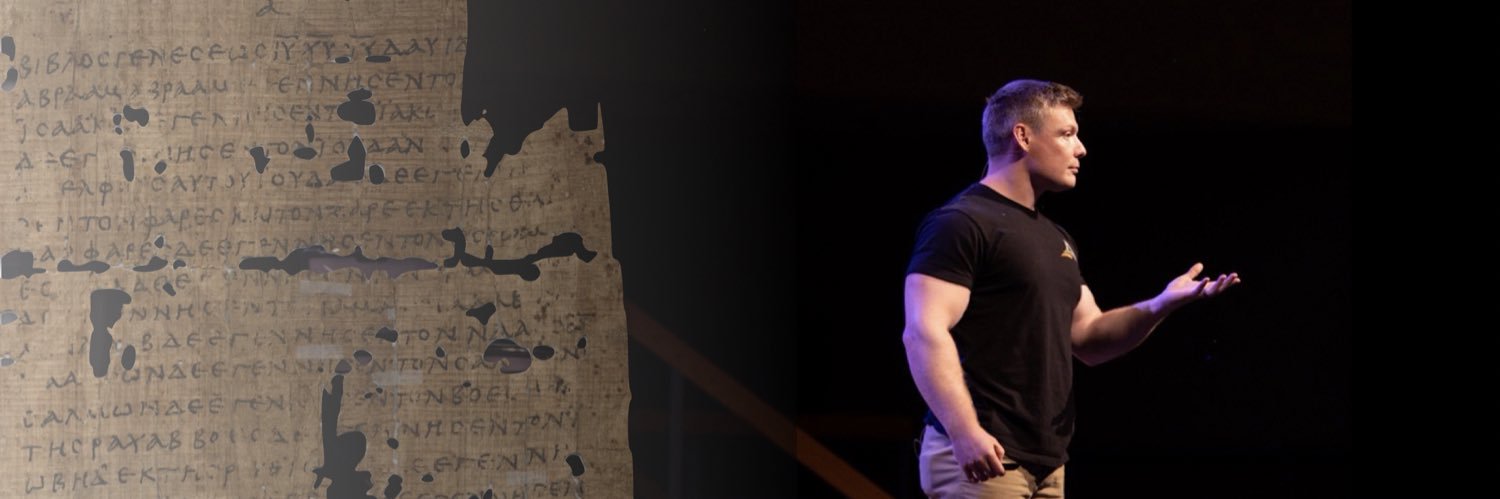
Long before the Council of Nicaea, long before medieval cathedrals, and long before Christianity became a dominant force in the Roman world, Christians were already making an extraordinary confession: Jesus Christ is Lord. And this page from Papyrus 46 one of our earliest physical witnesses to that confession. I just launched the newest manuscript in my facsimile collection and it is none other than the very test of Philippians 2 that contains this amazing “Christ Hymn.” Check it out and get your own personal copy at
Wes Huff48,327 просмотров • 1 месяц назад


For physical training has limited benefit, but godliness is beneficial in every way, since it holds promise for the present life and also for the life to come. - 1 Timothy 4:8. Go workout — it’s good for your body and mind. But also make sure you’re “working out” in godliness. I see a lot online about “optimization,” if you went to the gym but didn’t read your Bible and pray today you’re grossly imbalanced and unoptimized.
Wes Huff73,250 просмотров • 1 месяц назад

If you’re arguing that “the Septuagint” or “the Dead Sea Scrolls,” both included certain books, and on that basis we must have those books in our Bibles today, then you have a big problem. Both “the Septuagint” and “the Dead Sea Scrolls” are mini-libraries — they include documents considered both scriptural and non-scriptural in their day. For example, the Letter of Aristeas, 3rd and 4th Maccabees, the Ascension of Isaiah, the Testament of Job, the Life of Adam and Eve, the Psalms of Solomon, and the Assumption of Moses are all part of the Septuagint collections. The Testaments of the Twelve Patriarchs, The Community Rule, recordings of the last words of Joseph, Judah, Levi, Naphtali, and Amram (the father of Moses) were amongst the Dead Sea Scrolls. Few (if any) of these books are considered scripture today by modern Christian or Jewish groups. Both the Septuagint and the Dead Sea Scrolls are representative of ancient library collections — collections that contained scripture but that were not themselves wholly considered scripture. We today group them in these convenient categories with these helpful titles, but it is a misunderstanding to think of them as, or necessarily representative of, a single thing.
Wes Huff168,285 просмотров • 5 месяцев назад

The grass withers, the flower fades, But the word of our God endures forever.
Wes Huff57,368 просмотров • 1 месяц назад

“The church no more gave us the New Testament canon than Sir Isaac Newton gave us the force of gravity… Newton did not create gravity but recognized it” - J.I Packer (As cited in Kenneth J. Collins and Jerry L. Walls, Roman but not Catholic: what remains at stake 500 years after the Reformation (Grand Rapids: Baker Academic, 2017), 21). By the time the church was having discussions of canon lists and what books did or didn’t possess the mark of inspiration. The books of inspired scripture had already been written, read, copied, passed around, and disseminated for some time. Paul is already being recognized as scripture within the 1st century by Peter in 2 Pet. 3:16, and Paul himself is quoting Luke as scriptural alongside Deuteronomy in 1 Timothy 5. And let’s not forget that the Christians in the first century had a Bible: we call it the Old Testament. When Paul says “all scripture is God breathed” in 2 Timothy, no one is confused about what Paul means when he uses the term “scripture.” Just because books existed as independent documents in the form of physical scrolls and books separate from one another prior to the fourth century with them being codified all in one single unit then, doesn’t mean that they weren’t the Bible prior to that point. We need to be careful not to read back an anachronistic perspective due to our modern privilege of being able to easily have all the biblical books in a single-bound-volume. This is largely due to the amazing and streamlined process of publishing today.
Wes Huff372,508 просмотров • 1 год назад


Today’s #manuscriptmonday is the Crosby-Schøyen Codex which contains a letter of Melito of Sardis, a Christian author in the 2nd century. Melito wrote out a list of Old Testament books he considered scripture that aligns quite closely with the Protestant Old Testament. Melito’s list from around 170 AD included all Old Testament books except possibly Esther, whereas the standard Protestant Old Testament contains thirty-nine books. Since Melito excluded Esther, his collection would have contained approximately thirty-eight books—only one fewer than the Protestant canon. Along with the lack of Esther Melito inverted the order of Numbers and Leviticus compared to traditional Jewish arrangement, suggesting he may have reorganized material based on his own theological priorities. Despite these variations, Melito’s fundamental agreement with the Protestant canon on which books belong to Scripture demonstrates remarkable early Christian consensus. A Jerusalem list from the same period (c. 170) included all thirty-nine Old Testament books, suggesting that by the late 2nd century, the core content of the Protestant Old Testament was already widely recognized as authoritative, even if questions about Esther and organizational schemes remained unsettled.
Wes Huff163,272 просмотров • 7 месяцев назад

I collect swords but haven’t made a sword related post in a while. So, here’s a rare sighted sword related post.
Wes Huff347,041 просмотров • 1 год назад

