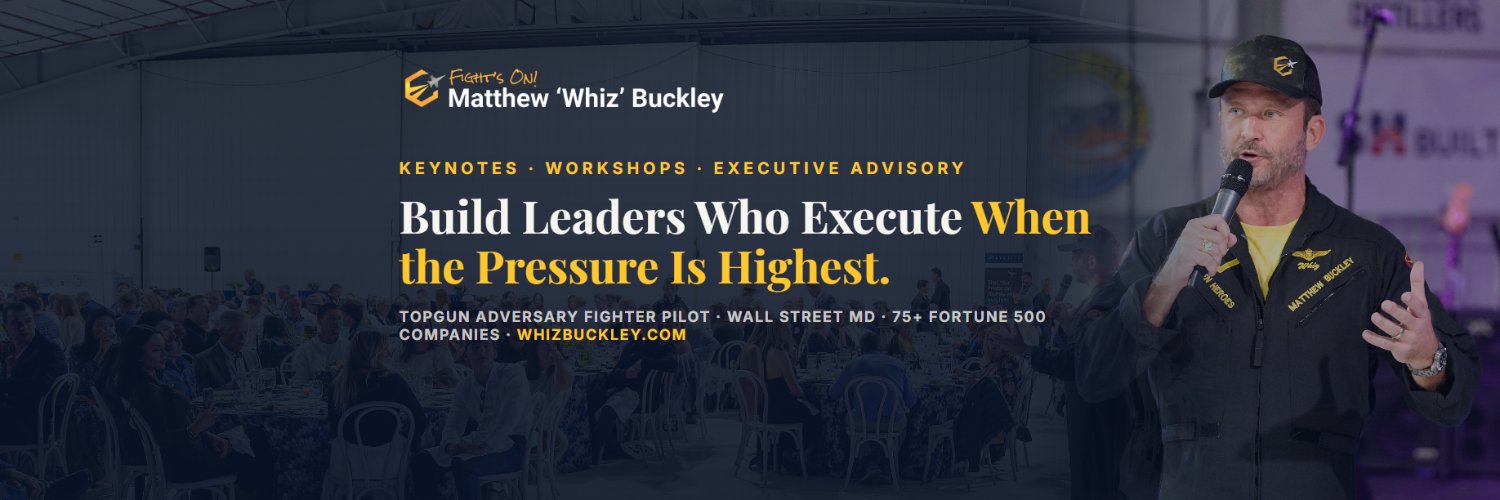
Matthew 'Whiz' Buckley's banner
Matthew 'Whiz' Buckley's profile picture

Matthew 'Whiz' Buckley

@WhizBuckleyGrp • 15,316 subscribers

TOPGUN Adversary Fighter Pilot | Keynote Speaker & Execution Advisor | Wall Street MD | Founder, No Fallen Heroes Foundation | Host, MAX Afterburner | Author

Shorts

When did this pilot decide to eject from his Hornet? Most people say when the engine quit. When the nose rolled over. When he was pointed at the ground. All wrong. He decided to eject before he ever strapped into that jet. He decided in the brief. That’s Capt. Bews, Canadian Forces, flying a practice pass for an air show at Lethbridge, Alberta. Right engine failed. Left engine at MAX afterburner. The jet rolls. He is out in the blink of an eye, chute barely open, and the jet goes up in a fireball behind him. He walked away with three compression fractures in his back. Here is what you don’t see in the video. Before every sortie, we contingency plan. At the end of the planning process — before we bring the red team in to tear the plan apart — we sit there and work through what can realistically go wrong and exactly what we will do about it. The time to figure out what I’m going to do when a SAM comes off the rail at me over Iraq is not when the missile comes off the rail. I already worked that out sitting on the carrier in the air conditioning with a cup of coffee. We call it chair flying. So when it happens, I’m not figuring it out. I’m executing. We don’t contingency plan so that nothing goes wrong. We contingency plan so that when it does, we are not making the biggest decision of our lives under the worst conditions a human being can make one. Bews had no time to think. He didn’t need any. He had already done the thinking. So here’s my question for you. Does your team contingency plan? Or does your team react? I teach leaders and teams how to do the first one. Learn how: Fight’s On!

When did this pilot decide to eject from his Hornet? Most people say when the engine quit. When the nose rolled over. When he was pointed at the ground. All wrong. He decided to eject before he ever strapped into that jet. He decided in the brief. That’s Capt. Bews, Canadian Forces, flying a practice pass for an air show at Lethbridge, Alberta. Right engine failed. Left engine at MAX afterburner. The jet rolls. He is out in the blink of an eye, chute barely open, and the jet goes up in a fireball behind him. He walked away with three compression fractures in his back. Here is what you don’t see in the video. Before every sortie, we contingency plan. At the end of the planning process — before we bring the red team in to tear the plan apart — we sit there and work through what can realistically go wrong and exactly what we will do about it. The time to figure out what I’m going to do when a SAM comes off the rail at me over Iraq is not when the missile comes off the rail. I already worked that out sitting on the carrier in the air conditioning with a cup of coffee. We call it chair flying. So when it happens, I’m not figuring it out. I’m executing. We don’t contingency plan so that nothing goes wrong. We contingency plan so that when it does, we are not making the biggest decision of our lives under the worst conditions a human being can make one. Bews had no time to think. He didn’t need any. He had already done the thinking. So here’s my question for you. Does your team contingency plan? Or does your team react? I teach leaders and teams how to do the first one. Learn how: Fight’s On!

40,869 просмотров

Videos

Больше нет контента для загрузки