1/ 🔥 New paper: Differentiable Vector Quantization (DiVeQ) 🔥... Vector quantization (VQ) is a key building block in modern AI. It links continuous data like images and audio to discrete representations (tokens) used by transformers.show more

Arno Solin
78,967 次观看 • 5 个月前
Vector Database by Hand ✍️ Vector databases are revolutionizing... how we search and analyze complex data. They have become the backbone of Retrieval Augmented Generation (#RAG). How do vector databases work? [1] Given ↳ A dataset of three sentences, each has 3 words (or tokens) ↳ In practice, a dataset may contain millions or billions of sentences. The max number of tokens may be tens of thousands (e.g., 32,768 mistral-7b). Process "how are you" [2] 🟨 Word Embeddings ↳ For each word, look up corresponding word embedding vector from a table of 22 vectors, where 22 is the vocabulary size. ↳ In practice, the vocabulary size can be tens of thousands. The word embedding dimensions are in the thousands (e.g., 1024, 4096) [3] 🟩 Encoding ↳ Feed the sequence of word embeddings to an encoder to obtain a sequence of feature vectors, one per word. ↳ Here, the encoder is a simple one layer perceptron (linear layer + ReLU) ↳ In practice, the encoder is a transformer or one of its many variants. [4] 🟩 Mean Pooling ↳ Merge the sequence of feature vectors into a single vector using "mean pooling" which is to average across the columns. ↳ The result is a single vector. We often call it "text embeddings" or "sentence embeddings." ↳ Other pooling techniques are possible, such as CLS. But mean pooling is the most common. [5] 🟦 Indexing ↳ Reduce the dimensions of the text embedding vector by a projection matrix. The reduction rate is 50% (4->2). ↳ In practice, the values in this projection matrix is much more random. ↳ The purpose is similar to that of hashing, which is to obtain a short representation to allow faster comparison and retrieval. ↳ The resulting dimension-reduced index vector is saved in the vector storage. [6] Process "who are you" ↳ Repeat [2]-[5] [7] Process "who am I" ↳ Repeat [2]-[5] Now we have indexed our dataset in the vector database. [8] 🟥 Query: "am I you" ↳ Repeat [2]-[5] ↳ The result is a 2-d query vector. [9] 🟥 Dot Products ↳ Take dot product between the query vector and database vectors. They are all 2-d. ↳ The purpose is to use dot product to estimate similarity. ↳ By transposing the query vector, this step becomes a matrix multiplication. [10] 🟥 Nearest Neighbor ↳ Find the largest dot product by linear scan. ↳ The sentence with the highest dot product is "who am I" ↳ In practice, because scanning billions of vectors is slow, we use an Approximate Nearest Neighbor (ANN) algorithm like the Hierarchical Navigable Small Worlds (HNSW).show more

Tom Yeh
192,022 次观看 • 2 年前
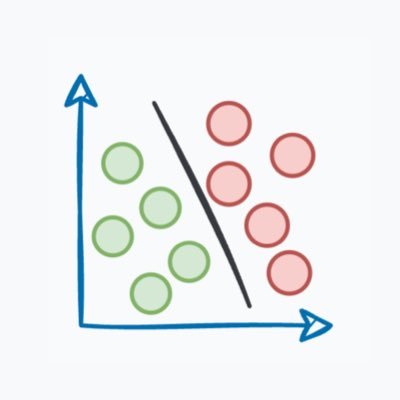
K-Means is simple. Making it fast on GPU isn't.... Flash-KMeans is an IO-aware implementation of exact k-means that rethinks the algorithm around modern GPU bottlenecks. By attacking the memory bottlenecks directly, Flash-KMeans achieves: - 30x speedup over cuML - 200x speedup over FAISS Using the same exact algorithm, just engineered for today’s hardware. At the million-scale, Flash-KMeans can complete a k-means iteration in milliseconds. Here's why this matters today: K-means has always been an offline primitive. Something you run once to preprocess data and move on. These speedups change that. ↳ Vector databases like FAISS use k-means to build search indices. Faster k-means means you can re-index dynamically as data changes, not batch it overnight. ↳ LLM quantization methods need k-means to find optimal weight codebooks, per layer, repeatedly. What takes hours could now take minutes. ↳ MoE models need fast token routing at inference time. Millisecond k-means makes it viable to run this inside the inference loop, not just in preprocessing. The 200x over FAISS is the number to internalize. FAISS is the industry standard. Most production vector search systems sit on top of it. Link to the paper and code in next tweet!show more

Akshay 🚀
36,317 次观看 • 6 个月前
K-Means is simple. Making it fast on GPU isn't.... Flash-KMeans is an IO-aware implementation of exact k-means that rethinks the algorithm around modern GPU bottlenecks. By attacking the memory bottlenecks directly, Flash-KMeans achieves: - 30x speedup over cuML - 200x speedup over FAISS Using the same exact algorithm, just engineered for today’s hardware. At the million-scale, Flash-KMeans can complete a k-means iteration in milliseconds. Here's why this matters today: K-means has always been an offline primitive. Something you run once to preprocess data and move on. These speedups change that. ↳ Vector databases like FAISS use k-means to build search indices. Faster k-means means you can re-index dynamically as data changes, not batch it overnight. ↳ LLM quantization methods need k-means to find optimal weight codebooks, per layer, repeatedly. What takes hours could now take minutes. ↳ MoE models need fast token routing at inference time. Millisecond k-means makes it viable to run this inside the inference loop, not just in preprocessing. The 200x over FAISS is the number to internalize. FAISS is the industry standard. Most production vector search systems sit on top of it. Link to the paper and code in next tweet!show more
Daily Dose of Data Science
23,748 次观看 • 4 个月前
I vibe coded a visual PDF search app with... ColQwen2. This is how it works: - Store PDF files as images in a Weaviate AI Database vector database - Embed images and text with a multimodal late-interaction model (ColQwen2) - Generate token-wise (and summed) similarity maps to highlight image patches with high similarity Now I need to refactor the messy vibe-coded project. In the meantime, you can check out the Notebook this demo is based on to try it out yourself:show more

Leonie
34,494 次观看 • 1 年前
Researchers made KMeans 200x faster. And the new technique... also beats approaches like cuML and FAISS. Flash-KMeans is an IO-aware implementation of exact KMeans that redesigns the algorithm around modern GPU bottlenecks. By attacking the memory bottlenecks directly, Flash-KMeans achieves: - 33x speedup over cuML - 200x speedup over FAISS This speedup comes from how it moves through GPU memory. Standard KMeans runs in two steps, and both are bottlenecked by reads and writes to GPU memory: 1) The first step matches every point to its nearest centroid. Standard KMeans computes the full point-to-centroid distance matrix, writes it out to GPU memory, then reads it back to find each nearest centroid. That write-then-read round trip is the bottleneck. Flash-KMeans combines the distance calculation with the nearest-centroid step, so the result is computed on-chip and the full matrix is never written out. 2) The second step recomputes each centroid by averaging the points assigned to it. Standard KMeans has thousands of threads writing into the same centroid slots at once, so they stall waiting for their turn. Flash-KMeans sorts points by cluster first, turning scattered writes into sequential reductions that read and write memory in one efficient pass. Using these two optimizations at the million-scale, Flash-KMeans completes a standard KMeans iteration in a few milliseconds. The video below depicts this in action. Several reasons why this is important: KMeans has always been an offline primitive. Something you run once to preprocess data and move on. These speedups make the approach viable in several runtime-critical systems. ↳ Vector indices like FAISS use KMeans to build search indices. Faster KMeans means you can re-index dynamically as data changes. ↳ LLM quantization methods need KMeans to find optimal weight codebooks, per layer, repeatedly. What takes hours could now take minutes. ↳ MoE models need fast token routing at inference time. Flash-KMeans makes it viable to run this inside the inference loop, not just in preprocessing. I have shared the paper in the replies. That said, memory is the real constraint Flash-KMeans solves, and the problem is not just limited to clustering. The vectors a RAG system stores after indexing create similar bottlenecks. I wrote a detailed walkthrough recently on cutting this vector memory by 32x with binary quantization, querying 36M+ vectors in a few milliseconds. Read it below.show more

Avi Chawla
89,234 次观看 • 3 个月前
Someone built an AI you power with a hand... crank it is called CrankGPT and its running without any battery, internet or data centre just you turning a handle like it is 1900 SqueezLabs built it using a Raspberry Pi 5 with 8GB of RAM an audio card and a 20 watt hand crank generator it takes about 30 seconds of cranking to boot into a working voice assistant and the onboard capacitor gives you roughly 20 seconds of runtime before you have to start cranking again they have used it to generate small images even write code 🤯 this proves you can run a real AI model on almost no power while everyone is building billion dollar data centres two guys put AI in a boxshow more

Sweep
11,610 次观看 • 3 个月前
Nano Banana Pro is a really good cartographer. Used... it to turn low res satellite imagery into a detailed hand drawn map and vector HD map. Pretty wild how well it segments everything and even recovers paths/roads hidden under tree cover. Looks way more detailed than the current google basemap which is pretty sparse in countries like India. Included both in video for comparison.show more

Bilawal Sidhu
554,024 次观看 • 10 个月前
(1/6) X-Humanoid 🤖: Scaling up data for Humanoid Robots.... We convert human daily activity videos (from Ego-Exo4D) into humanoid videos (i.e., Tesla Optimus) performing tasks like cooking or fixing a bike. This data can be potentially used to train robot policies and world models. 🔥 Project page: Paper link:show more

Mike Shou
88,752 次观看 • 9 个月前
I designed these worksheets to turn Agentic AI concepts... into simple math problems you can do by hand. ✍️ Download PDF: Problems 1 to 5: 1. Count the tokens: split on spaces, one word per box 2. Subword splitting: when one word is three tokens 3. Punctuation counts: the marks are tokens too 4. Tokens per word: the ratio that turns words into a bill 5. Will it fit? A document against a context window Why am I making these worksheets? AI is making people (including me) think less. It's just too easy to ask AI a few questions about a new AI concept and start to believe I get it. Until recently, we could use a coding problem to practice a new AI concept. But now it has become too easy to ask AI to write the code, and we start to think we must know the concept, since we technically solved a coding problem. Thus, my approach is to recast AI concepts as simple math problems we must solve with pen and paper. Using our hands is one way to motivate ourselves to start thinking again. ✍️ ~ Prof. Tom Yehshow more
Tom Yeh
18,291 次观看 • 1 个月前
You can now create AI images directly from Google... Slides. No need to spend hours searching for images for your presentations. And this feature is available for free. Here's how to activate it: 1. Go to labs .google .com 2. Scroll down to "Google Workspace". 3. Click on the "Learn more" button to access the waitlist. When it's activated, you'll see the button that appears in Google Slides as in the video. Click on it and enter your prompt: E.g.: "a cat in front of a raspberry pie". You can even choose different styles: photography, vector art, sketch, ... This will save a lot of time when creating slideshows! Don't hesitate to follow me to learn how to do more with AI.show more

Paul Couvert
318,258 次观看 • 2 年前
What if crypto research was as easy as chatting... with ChatGPT, but powered by real market data👑 Introducing CMC AI, a powerful new tool from CoinMarketCap that combines the speed of AI with the depth of live crypto data. It delivers fast, data-backed answers to your questions: ✅ Want to know why Bitcoin's price is rising? ✅ Curious about the latest news on your favorite cryptocurrency? ✅ Need sentiment analysis? It pulls real-time data and explains it in seconds. But it goes far beyond basic Q&A. In the future, you’ll be able to ask anything! For example, you could ask it to: – Discover undervalued tokens based on volume, MC, and sentiment. – Compare Layer 1s or L2s by adoption, speed, and dev activity. – Detect rug-pull risk via wallet distribution and tokenomics red flags. – Break down your portfolio by risk, correlation, and potential return. – Explore new use cases in DeFi, AI, RWA and DePIN And much more! 🔗Try it here: CMC AI changes how you learn, think, and act in Web3🧠show more

Alaoui Capital
34,908 次观看 • 1 年前
AI video just reached a new level. Seedance 1.5... Pro by BytePlus turns static images into cinematic videos with real action and realism. Key features: • Native audio generation with ultra precise lip sync • Multilingual dialogues with multiple speakers • Natural motion, expressive emotions and cinematic quality visuals • Stable, premium output ready for narration, ads and professional creative work This does not look like an AI video. It feels like real footage, synchronized, expressive and production ready. #Seedance #AIVideo #VideoGeneration #BytePlusAIshow more

Enzo Sanchez | IA
95,539 次观看 • 8 个月前
🔥 ByteDance's official AI creation platform Dreamina is about... to globally launch Dreamina Seedance 2.5. This isn't just another model update. It's built for professional AI filmmaking. What's new: - Up to 50 multimodal reference assets per generation (images, videos, audio) - Up to 30-second continuous video generation Plus professional editing features, multilingual creation, and an end-to-end workflow inside Dreamina. Dreamina Seedance 2.5 is built for creators who want to tell complete stories. AI video is moving beyond short clips. Try Dreamina here: #Dreamina #DreaminaSeedance25 #DreaminaPartner #AIVideo #ByteDanceshow more

Hasan Toor
56,215 次观看 • 1 个月前
MiniMax H3 is now 50% OFF on Magnific for... 2K video, only until September 1. 🔥 I’ve been trying MiniMax H3 on Magnific, and it feels like a big upgrade for AI video creation. It’s not just about turning text into videos. You can use text, images, videos, and audio together in one prompt, giving you more control over the final video. Here’s what makes it stand out: - Multimodal: Use text, images, video, and audio in one prompt. - Multiple references: Add up to 9 images, 3 videos, and 3 audio files. - 2K video: Create videos up to 15 seconds long. - Built-in sound: Generate voice, music, and sound effects with the video. - Easy editing: Remove objects or transfer motion easily. - More control: Control the camera, characters, and voice. You can use it to turn posters into videos, moodboards into short films, and product images into ads. It also helps bring your ideas to life with realistic movement, lighting, reflections, and sound. The workflow is simple: give it your references → generate → edit → refine. Try MiniMax H3 on Magnific:show more

Markandey Sharma
96,964 次观看 • 1 个月前
🔥Exciting Announcement: New Exchange Listing Expected soon. We're getting... close to a key milestone in the expansion of #AtlasNavi and $NAVI. Keep an eye out for updates and the unveiling of details! 🎁 GUESS the CEX by commenting below for a chance to win $100 in $NAVI tokens. The winner will be chosen at random. #NAVI #DePinshow more

ATLAS NAVI | AI Navigation APP with 1M Downloads
35,651 次观看 • 2 年前
🔥 EPIC! Donald Trump just dropped the new White... House ballroom and is refusing to back down to Democrat legal attempts to block it This man is building a BALLROOM and military security complex wanted by presidents for decades, and their TDS makes them think it's a bad idea? Absolutely stunning. To imagine the left wants THIS to be "BLOWN UP" when they re-take power is psychotic 🤡 Build it and make it IMPOSSIBLE to demolish, Mr. President! 🇺🇸show more

Eric Daugherty
55,482 次观看 • 5 天前