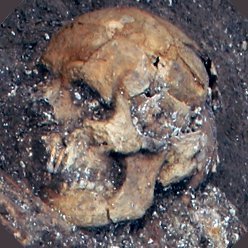
Facial reconstruction of a 4,500-year-old Ural Yamnaya/Tamarutkul man from... the Orenburg Region A special place in the study of the Yamnaya culture is occupied by its Cis-Ural variant (Smirnov, 1965), one of whose principal characteristics is the high proportion of burials in a right-side position, as well as the greater quantity of copper tools found in the graves. Due to its geographical distribution, this variant is also referred to as the Ilek group (Morgunova & Kravtsov, 1994; Kuznetsov, 2010), on the basis of which a distinct Tamarutkul type was identified (Bogdanov, 2004). According to Morgunova (2011; 2014a), the origins of this group are local, representing the development of Yamnaya populations of the Volga-Ural interfluve that ultimately derived from the Khvalynsk Eneolithic culture. According to another interpretation, the Ilek group was closely related to the Poltavka population of the Volga region, with its origins connected to a North Caucasian impulse represented by the Novotitorovka group (Kuznetsov, 1996a, 2010). Other researchers have likewise traced a Caucasian component in the Tamarutkul culture (Mimokhod, 2009, pp. 160-164). Bogdanov (2004), on the other hand, proposed the reverse direction of influence, particularly suggesting an influence of the Cis-Ural population on populations of the North Caucasus. In contrast to the contemporaneous Early Poltavka population of the Volga region, the Tamarutkul population of the Cis-Urals represents a different cranial complex: mesomorphic, dolichocranial, and more strongly profiled, corresponding broadly to the Southeuropid steppe type (Khokhlov, 2017, p. 88; appendix, Tables B.32–33; text, Tables 29–30). As a hypothesis, it has been proposed that the appearance both in the Cis-Urals (Tamarutkul) and in the northwestern Black Sea region (Late Yamnaya) of groups with somewhat similar archaeological traditions-including burials in a contracted position on the side and populations characterized predominantly by a dolichocranial, mesomorphic southern Europid type-may be connected with the outward spread of related groups, such as the Novotitorovka/"Wagon Burial" cultural tradition, from the North Caucasus (Khokhlov, 2000, p. 315; 2013a, p. 259), (Khokhlov et al. 2024) Combat-related trauma is extremely rare in the preceding Eneolithic, with only one known case from Khvalynsk II, burial 13 (Khokhlov, 2010b, p. 418). In Yamnaya populations, trauma affected 21.7% of the sample, including potentially lethal injuries. Nasal fractures (which occurred in both sexes, at a ratio of approximately 3.5:1 (Khokhlov & Kitov, 2019, pp. 273–274)) were the most common and likely often resulted from everyday interpersonal violence. The higher trauma frequency among Early Bronze Age Volga-Ural pastoralists may reflect greater mobility and increased contact with other groups in frontier zones. In later kurgan cultures, particularly the Tamarutkul/Ilek group of the Southern Urals, trauma increased to 30.9%, with a greater variety of injuries. During the Middle Bronze Age, combat-related trauma became more prominent, especially among the Tamarutkul population of the Cis-Urals, where nasal fractures were relatively uncommon. Given the population's possible migrant origins (Khokhlov, 1998b; 2017), this may reflect competition between groups over access to the Kargaly copper mines. Overall, the Tamarutkul skulls were characterized as belonging to the Southeuropid type, which anthropologists have linked with the North Caucasian Novotitorovka culture. Although the Novotitorovka culture emerged within the broader Yamnaya cultural sphere, it morphologically resembles the preceding Maykop-Novosvobodnaya culture (Shevchenko, 1983, p. 84; Gei, 2000), likely due to the assimilation of the aforementioned cultural group. The reconstructed individual is characterized as having a relatively narrow face and a dolichocranial Europid morphology (Vasiliev, I. B.; Kuznetsov, P. F.; Turetski, M. A., 2000), with a large cranial length of 195 mm, a small cranial breadth of 133 mm, a medium bizygomatic breadth of 132 mm, a medium-large bigonial breadth of 104 mm, and a zygomaxillary angle of 122°show more