System ID for legged robots is hard: (1) Discontinuous... dynamics and (2) many parameters to identify and hard to "excite" them. SPI-Active is a general tool for legged robot system ID. Key ideas: (1) massively parallel sampling-based optimization, (2) structured parameter space, and (3) active exploration based on Fisher Information to collect the most informative data in real. SPI-Active provides an accurate robot model and effectively reduces the sim2real gap. In sim2real policy learning setting, it outperforms baselines by 42-63% in various quadruped & humanoid tasks. Led by Nikhil Sobanbabu Guanqi Heshow more

Guanya Shi
21,442 Aufrufe • vor 1 Jahr
Memo is a robot that uses AI to perform... household tasks effectively. Today Sunday announced its Series B, and we’re proud to be investors. Training robots for the home is hard — the environment is messy, dynamic, and full of edge cases. So Sunday is training robots directly on real households. Founders Tony Zhao and Cheng Chi built a glove-based system that lets hundreds of contributors record everyday tasks in their own homes, creating high-fidelity demonstrations that feed directly into robot learning. Home robotics will be defined by the companies that learn fastest from real homes. Sunday is building that loop. More here: Aaref Hilaly Amanda Huangshow more

Bain Capital Ventures
21,847 Aufrufe • vor 5 Monaten
System identification (sysid) is the process of finding the... physical parameters that make a simulation match reality. If you're training an RL locomotion policy in simulation, the accuracy of your motor model directly affects how well the policy transfers to the real robot. A recent git commit by Kevin Zakka added a sysid toolbox to MuJoCo which automates this process: you provide recorded motor data and a MuJoCo model, and it optimizes the model parameters to minimize the difference between simulated and real trajectories. For my RobStride Dynamics RS02 QDD motors (17 Nm peak, 7.75:1 gear), I built a Rust tool that sends multi-sine torque excitation at 1 kHz and records position/velocity feedback. I then feed this data into MuJoCo's sysid optimizer.show more

David Bar
48,347 Aufrufe • vor 3 Monaten
Robots struggle with strict action rules…memory and symbols help... them learn fast. [Project + Full video link ⬇️] Robots struggle when tasks require specific steps in a fixed order. What if memory helped them think symbolically and learn faster? Solving tasks like unlocking a door then opening it is hard for deep RL. But by learning constraint relationships and storing them in memory, robots can solve these tasks much faster; with fewer trials and less training. Why it works ✅ Learns symbolic rules about action constraints ✅ Uses memory to transfer what it learned across tasks ✅ Handles real-world exploration with just 30 minutes of data ✅ Needs 10x fewer episodes than deep RL approaches This memory-based method shows a promising path forward for robots learning structured, real-world tasks. Full video: Paper: Thank you, Mrinal Verghese for sharing this amazing work! 🙏show more

Ilir Aliu - eu/acc
10,241 Aufrufe • vor 1 Jahr
We’ve seen humanoid robots walk around for a while,... but when will they actually help with useful tasks in daily life? The challenge here is the diversity and complexity of real-world scenes. Our new work tackles this problem via 3D visuomotor policy learning. Using data from only 1 scene, our Improved 3D Diffusion Policy (iDP3) enables a full-sized humanoid robot to autonomously pick&place objects, pour water, and wipe tables, in the wild open world. (and all these skills are useful, right?) Web: Fully open-sourced code:show more

Yanjie Ze
75,271 Aufrufe • vor 1 Jahr
🚨JUST IN: PEAQ OFFERS "FINANCE APPS FOR ROBOTS" DePIN-focused... blockchain peaq recently posted about 'Machine Money Markets' and the way in which they both... - Connect real robots with decentralized finance - Effectively turn them into revenue-generating financial assets Through PeaqOS ( the protocols and frameworks that allow for machine interoperability), robots and machines can carry out crucial blockchain-related tasks... ... like actively using DeFi protocols, or executing sophisticated financial strategies. But that's not all. PeaqOS further allows owners to tokenise their robots, not only making them tradable, but also allowing them to be used as collateral. Peaq also shared three clear and interesting examples of Machine Money Markets, already live in the ecosystem: (1) XMAQUINA - Structured as a DAO, XMAQUINA provides open access to some of the world's most promising early-stage robotics funding rounds. (2) Dualmint - A platform built for 'Initial Machine Offerings' where users purchase shares in machines and robots running on peaq itself. (3) Robot Money - An AI agent managed treasury, wherein machines contribute revenue which is then put to use generating additional yield.show more

BSCN
15,129 Aufrufe • vor 4 Monaten
World modeling and imitation learning have largely been considered... two disparate worlds. In our recent work, Unified World Models, just accepted to #RSS2025, Chuning Zhu provides a dead-simple unifying solution: just train a joint diffusion model over actions and future states, but with *decoupled* diffusion time steps across these modalities. Manipulating these decoupled time steps then allows for marginalization or conditioning on actions or states; a single model can serve as a policy, forward dynamics model, video prediction model, or inverse dynamics model by simply setting diffusion timesteps carefully. The resulting model can leverage video datasets along with robot training data much more effectively, and shows improved robustness, generalization, and flexibility. This is exciting because it is frustratingly simple, scalable, and shows strong improvement on real-world robotics problems. Please refer to Chuning Zhu 's excellent thread for more details! More details/code can be found on our website and in the paper -show more

Abhishek Gupta
11,430 Aufrufe • vor 1 Jahr
BOOM! Humanoid Robots Just Performed Surgery for the First... Time! REAL VIDEO! In a groundbreaking preclinical breakthrough, researchers at UC San Diego have achieved what many thought was years away: teleoperated humanoid robots successfully completing live surgeries. Published in Nature, the study marks the world’s first use of humanoid robots for in-vivo laparoscopic procedures on large animals (pigs). Two separate surgeries were completed: Key Details •. Procedure: Laparoscopic gallbladder removal (cholecystectomy) •. Team 1: Human surgeon + one humanoid robot (the robot performed core tasks while the human assisted) •. Team 2: Two humanoid robots working together with no human at the operating table •. Robots: Custom “Surgie” humanoids (~5 ft tall, ~60 lbs) using standard surgical tools •. Control: Fully teleoperated by surgeons (remote human control, not autonomous) •. Significance: First demonstration of humanoid robots handling real surgical workflows in a live setting, proving compatibility with existing OR tools and spaces This proof shows humanoid robots could one day help address surgeon shortages, enable remote procedures in rural areas, battlefields, or even space all at a fraction of the cost and space of traditional surgical robots like da Vinci. Read the full publication here: Project page with video: The future of surgery just got a whole lot more interesting. And medical cost for the first time in decades will be scheduled to go down, much further down.show more

Brian Roemmele
107,600 Aufrufe • vor 1 Monat
This work makes a humanoid robot do simple parkour... moves by looking with a depth camera and choosing the right move on the fly. The big deal is that it turns lots of small human moves into long, real-time robot behavior, without hand-coding every transition or retraining for each new course. A humanoid robot is usually good at steady walking, but it often fails when it has to do fast moves like jumping up, vaulting, or rolling, and then keep going to the next obstacle. The hard part is that you cannot easily collect training data for every possible obstacle shape, distance, and mistake, so robots end up learning a few moves that only work in a narrow setup. This work starts from short clips of real human parkour moves, like stepping over, vaulting, climbing, and rolling. It uses motion matching, which is basically a smart “pick the next clip that fits best right now” search, to stitch those short clips into a long, smooth plan that looks like a human doing a whole course. Then it trains a controller with reinforcement learning (RL), which means the robot learns by trial and error to copy that plan while staying balanced and not falling. After training separate expert controllers for different moves, it compresses them into 1 controller that uses only onboard depth sensing and a simple “go this fast in this direction” command. In real tests on a Unitree G1 humanoid, it can clear multiple obstacles in a row, adapt when obstacles get moved, and climb a wall up to 1.25m.show more

Rohan Paul
37,121 Aufrufe • vor 5 Monaten
The future of housework just leaked on GitHub and... nobody is talking about it. knox byte just open sourced a framework that coordinates swarms of Unitree G1 humanoid robots to clean your entire house on their own. It's called ARGOS. You tell it "clean the bedroom" in plain English and 2+ G1 robots split the room into zones, sweep in parallel, and sync up for the tasks that need four hands like making the bed or moving furniture. The Claude API decomposes your sentence into a task graph. An auction system makes every robot bid on every task based on distance, battery, and current load. The cheapest robot wins. Cooperative jobs go to the cheapest team. Here's what makes this different from every demo video Boston Dynamics keeps teasing: → 12 cleaning tasks baked in sweeping, mopping, wiping, vacuuming, taking out trash, making the bed, changing sheets, moving furniture, sorting items → 3 policy architectures running underneath OpenVLA-7B for language tasks, Diffusion Policy for floor coverage, ACT for dexterous bimanual work → Train it on your own footage record yourself cleaning, run one command, it extracts poses, builds a LeRobot dataset, and LoRA fine-tunes the policy → PEFA protocol for cooperative work Propose, Execute, Feedback, Adjust. If one robot fails halfway through making the bed, the team replans and retries → Full MuJoCo simulation so you test policies before pushing them to real hardware → Silver and cyan terminal dashboard that shows live fleet status, zone maps, task queues, and battery levels in real time The G1 robots talk to each other over CycloneDDS mesh using Unitree's native SDK. No cloud. No middleware. The whole thing runs on a Jetson Orin inside each robot. The wildest part is the training pipeline. Drop cleaning videos into a folder, run argos train ingest, and the framework does the entire pipeline frame extraction, pose estimation, action labeling, HDF5 dataset, fine-tune, evaluate in sim, deploy to robot. One command per stage. Unitree G1s already exist. The framework to make them clean your house just hit GitHub. 52 stars. MIT License. 100% Opensource.show more

Guri Singh
27,404 Aufrufe • vor 2 Monaten
Something big is happening in robotics - and it’s... hiding in plain sight. This post is not about dancing robots but in the data that powers them. Open robotics datasets have exploded this year, turning the field into a more scalable and collaborative ecosystem. In just two years, Hugging Face datasets grew from 11k to over 600k - and robotics is by far the fastest-growing segment. We went from 1k robotics datasets in 2024 to 27k in 2025! For comparison, text generation, the second-largest category, has only around 5k datasets in 2025. That gap is massive. Open datasets are important because robotics lives and dies by real-world robot data - video, actions, sensors, failures. By making this data easy to upload, reuse, and benchmark, researchers, startups, and large players are now releasing real-robot datasets that would have stayed locked inside labs just a few years ago. Major contributors include NVIDIA, LeRobot initiative, and a rapidly growing maker community. This surge is also enabled by cheaper video storage, better tooling, and an open-source AI culture now spilling into the physical world. And it really matters: open robotics data dramatically lowers entry barriers, accelerates learning-by-doing, and speeds up progress toward generalist and humanoid robots. Robotics won’t scale through hardware alone - but to a large extent through shared data. Viz below from AI World - link to the story and more viz/filters in comment.show more

Pierre-Alexandre Balland
186,041 Aufrufe • vor 7 Monaten
Imagine having a ping pong robot! 🏓 Researchers and... developers building physical AI: meet Reachy 2 from Pollen Robotics, an open-source, humanoid robot for real-world experimentation. It’s a bimanual mobile manipulator: each 7-DOF arm mimics human proportions and can lift up to 3 kg, giving dexterity for object handling. It can be controlled with Python and ROS2 Humble, or go straight into VR teleoperation, use a headset to move Reachy’s arms, hands, and head, and see through its cameras as if you’re in the robot’s own body. Want it to move around? A mobile base with three omnidirectional wheels, rich sensors, and LiDAR lets Reachy 2 navigate and explore its surroundings smoothly. 🗺️ Under the hood, it’s powered by a CPU system that’s ready for machine learning, perfect for loading AI frameworks and testing new models from Hugging Face directly on the robot. Keep making robots more, and more accessible Pollen team! ... and keep making more open source models to make robots more mainstream clem 🤗!show more

Lukas Ziegler
37,221 Aufrufe • vor 11 Monaten
We’re excited to introduce ShinkaEvolve: An open-source framework that... evolves programs for scientific discovery with unprecedented sample-efficiency. Blog: Code: Like AlphaEvolve and its variants, our framework leverages LLMs to find state-of-the-art solutions to complex problems, but using orders of magnitude fewer resources! Many evolutionary AI systems are powerful but act like brute-force engines, burning thousands of samples to find good solutions. This makes discovery slow and expensive. We took inspiration from the efficiency of nature. ‘Shinka’ (進化) is Japanese for evolution, and we designed our system to be just as resourceful. On the classic circle packing optimization problem, ShinkaEvolve discovered a new state-of-the-art solution using only 150 samples. This is a big leap in efficiency compared to previous methods that required thousands of evaluations. We applied ShinkaEvolve to a diverse set of hard problems with real-world applications: 1/ AIME Math Reasoning: It evolved sophisticated agentic scaffolds that significantly outperform strong baselines, discovering an entire Pareto frontier of solutions trading performance for efficiency. 2/ Competitive Programming: On ALE-Bench (a benchmark for NP-Hard optimization problems), ShinkaEvolve took the best existing agent's solutions and improved them, turning a 5th place solution on one task into a 2nd place leaderboard rank in a competitive programming competition. 3/ LLM Training: We even turned ShinkaEvolve inward to improve LLMs themselves. It tackled the open challenge of designing load balancing losses for Mixture-of-Experts (MoE) models. It discovered a novel loss function that leads to better expert specialization and consistently improves model performance and perplexity. ShinkaEvolve achieves its remarkable sample-efficiency through three key innovations that work together: (1) an adaptive parent sampling strategy to balance exploration and exploitation, (2) novelty-based rejection filtering to avoid redundant work, and (3) a bandit-based LLM ensemble that dynamically picks the best model for the job. By making ShinkaEvolve open-source and highly sample-efficient, our goal is to democratize access to advanced, open-ended discovery tools. Our vision for ShinkaEvolve is to be an easy-to-use companion tool to help scientists and engineers with their daily work. We believe that building more efficient, nature-inspired systems is key to unlocking the future of AI-driven scientific research. We are excited to see what the community builds with it! Learn more in our technical report:show more

Sakana AI
360,176 Aufrufe • vor 10 Monaten
Most robots still need markers, checkerboards, or long calibration... rituals just to know where their arms are. Now it works from raw images in seconds. roboreg is a markerless multi arm localization toolkit that plugs into ROS 2 and RViz. No special hardware. No custom setup. You toggle between robot descriptions and the system figures out the rest. The idea is simple: ✅ Hand eye calibration from plain RGB or RGB D images ✅ Only three robot poses needed for millimeter accuracy ✅ Works with any ROS 2 compatible robot and camera ✅ Fully open source under Apache 2.0 It is powered by Hydra, a new marker free ICP variant that converges far more reliably than classical baselines and runs in under a second. If you want to try it: roboreg: ROS 2 roboreg: Hydra paper: pip install roboreg More details and discussion on Open Robotics Discourse:show more
Ilir Aliu
18,406 Aufrufe • vor 8 Monaten
Robora Sim: A PyBullet-Powered Environment for Learning Robotic Physical... Intelligence We are currently building our Robora simulation environment setup for our sim based learning, leveraging PyBullet, an industry-standard physics engine widely used in AI-driven robotics research and development. The environment is optimized with GPU-accelerated learning algorithms, enabling high-speed imitation learning and reinforcement learning within a safe and controlled virtual setup before shipping out to real world. This simulation platform allows our models to learn, adapt, and generalize across different robot morphologies, terrain types and task objectives - all before deployment to the real world. At it's core, the system combines a VLA-powered high-level planner with low-level motion control algorithms, working cohesively to produce emergent, physically intelligent behaviors. This synergy between simulation, learning, and real-world transfer marks a major step forward in our pursuit of adaptive and intelligent robotic systems. Through advanced domain randomization and synthetic data generation, the Robora Simulation Environment ensures that policies trained in simulation transfer effectively to real-world robots, minimizing the sim-to-real gap. Moreover, users will be able to test and integrate their own hardware kits within selected simulation environments in the Robora Dapp, ensuring seamless compatibility and safer real-world implementation.show more

Robora
23,489 Aufrufe • vor 10 Monaten
Most imitation learning policies break when the camera moves... or the robot changes. NOT THIS ONE 👇 [📍 Bookmark for later ] A new 3D scene representation encoder, tackles this by enabling zero-shot generalization to unseen embodiments and viewpoints… And it works with any IL algorithm. The trick? •Use a 2D foundation model to extract semantic features •Lift them into 3D space for localization (not semantics) •Condition the IL policy on this spatially grounded vector Across 93 simulated and 6 real tasks, Adapt3R: ✅ Maintains IL performance on LIBERO & MimicGen benchmarks ✅ Outperforms DP3 and 3D Diffuser Actor in most settings ✅ Holds >80% success on LIBERO even with large camera rotations Thanks for sharing this, Animesh Garg & Albert Wilcox! 📍Paper: Website: Code:show more
Ilir Aliu
12,178 Aufrufe • vor 1 Jahr
𝗥𝗼𝗯𝗼𝘁𝘀 𝗱𝗼𝗻’𝘁 𝗻𝗲𝗲𝗱 𝗺𝗼𝗿𝗲 𝗱𝗲𝗺𝗼𝗻𝘀𝘁𝗿𝗮𝘁𝗶𝗼𝗻𝘀. 𝗧𝗵𝗲𝘆 𝗻𝗲𝗲𝗱 𝘁𝗼 𝗹𝗲𝗮𝗿𝗻... 𝗳𝗿𝗼𝗺 𝗳𝗮𝗶𝗹𝘂𝗿𝗲 — 𝗮𝗳𝘁𝗲𝗿 𝘄𝗮𝘁𝗰𝗵𝗶𝗻𝗴 𝗵𝘂𝗺𝗮𝗻𝘀. Most robot learning systems assume failure is the end of learning. In our new work, we study whether robots can improve after deployment by learning from their own failures, without any human intervention, teleoperation, or corrective labels. The key idea is simple: human videos contain structure about how the world works. We use them to learn cross-embodiment representations of action, dynamics, and value, enabling a shared predictive space between human behavior and robot experience. This allows a new learning loop: 👉 pretrain on human videos 👉 deploy robot policy 👉 observe failures 👉 reinterpret failures using human priors 👉 improve autonomously We evaluate this across 7 real-world manipulation tasks, showing: 📈 40% → 81% success rate 🏆 Strong improvements over π0.6 RECAP and RISE ✔️ Zero human intervention during post-deployment improvement 🧬 Generalizes across robot embodiments and policy backbones A key finding is that explicit failure repair significantly outperforms failure reweighting, yielding substantially larger gains under identical data conditions (+25 pts vs +5 pts on the same π0.5 base policy). Overall, the results suggest a shift in how we think about robot learning: Human videos are not only for pretraining policies. They can provide the structure needed for continual self-improvement after deployment. 📄 Paper: 🌐 Project: I am grateful for working with the fantastic leads Hanzhi Chen and Anran Zhang, and our collaborators Simon Schaefer, Kejia Chen, Shi Chen, Daniel Cremers. Special thanks to Stefan Leutenegger for co-advising this project with me. ETH Zürich TU München Microsoft Check out Hanzhi's 🧵 for more detailsshow more

Oier Mees
12,277 Aufrufe • vor 1 Monat
🚨BREAKING Unitree's IPO application on the Science and Technology... Innovation Board has been formally accepted by the Shanghai Stock Exchange, with a planned fundraising of 4.202 billion yuan. Of this, the intelligent robot model R&D project accounts for the majority, amounting to 2 billion yuan. In other words: For Unitree, hardware is no longer the problem,the real bottleneck that urgently needs to be overcome is the development of intelligent robot models. Notably, Unitree reports that it has sold over 5,500 humanoid robots,ranking first globally,making them the growth engine of its robotics business.show more

CyberRobo
94,038 Aufrufe • vor 4 Monaten
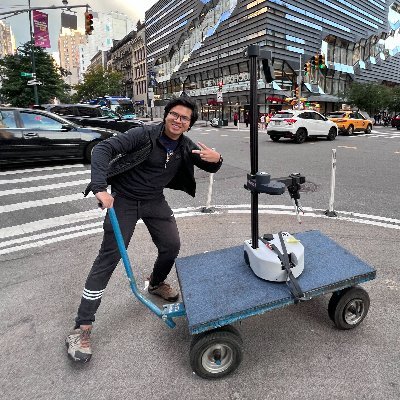
Robot Utility Models (RUMs) enable basic tasks – door... opening, drawer opening, object reorientation, etc. – at ~90% accuracy without ANY finetuning (i.e. zero-shot) in unseen new environments. Fully open source!!! models, data, code & hw. We think this is super exciting, why?👇 1. Unlocks many practical home utility tasks that often involve these basic tasks as part of an action chain. “Go get me a fork” involves opening the kitchen door and then opening the cutlery drawer. 2. This works well **zero-shot in unseen and new** environments, which is practically a huge deal. Turn the robot on, and get going. 3. The recipe for building a new model is fairly generic, and we think with a bit more refinement this can be a general recipe to build many more Utility models. More details and access 👇show more
Mahi Shafiullah 🏠🤖
89,535 Aufrufe • vor 1 Jahr
📍Theory of Space (accepted at #ICLR2026) Theory of Mind... → hidden mental states Theory of Space → hidden spatial beliefs from passive observers “What do I know?” to active explorers “What don’t I know, and how do I reduce that uncertainty?” Theory of Space is to evaluate if foundation models can actively construct, revise, and exploit internal spatial beliefs. We quantify Active-Passive Gap. Not just measure task accuracy, but how much uncertainty is reduced per step, and how many steps are needed in total for agents to build stable spatial beliefs. Exploration should prioritize information gain and reduce uncertainty per step. Instead, we observe LLMs/VLMs explore redundantly with stalled belief updates. Key findings: 1. Active agents perform worse than rule based programs 2. Cognitive Map Failures & Belief Drift (beliefs about previously observed objects degrades over time; new updates corrupt earlier correct perceptions) 3. Poor Vision Identification & Belief Inertia in Belief Revision Website: Code: Data: Theory of Space is a joint effort of Northwestern Engineering, Stanford AI Lab, Allen School, Cornell Computer Science. Led by the amazing WilliamZhang, jointly done with Zihan Huang, yue wang, Jieyu Zhang, Lester Xue, @wzihanw, Qineng Wang, Keshigeyan Chandrasegaran, Ruohan Zhang, Yejin Choi, Ranjay Krishna, Jiajun Wu, Fei-Fei Lishow more

Manling Li
52,794 Aufrufe • vor 5 Monaten
China now has its own “Bolt” — a robot... named after sprint legend Usain Bolt. A Chinese research team has unveiled the world’s first full-size humanoid robot to reach a peak speed of 10 meters per second, setting a new global benchmark for humanoid running. Bolt runs like a body pushed to the limit. Its joints and power systems work in tight coordination, keeping it balanced even at sprint speed. Built to match the build of an adult man—1.75 meters tall and 75 kilograms—it is a life-sized system operating at the edge of physics. Compared with Usain Bolt’s iconic 9.58-second 100-meter world record, which many experts believe may stand for decades, the gap between humans and machines is narrowing fast. Chinese robots are now challenging the ceiling of human performance—much as AlphaGo once challenged Go champion Ke Jie. The breakthrough builds on earlier world-record achievements in high-speed robotic running and marks a giant leap for China in humanoid motion and control. Beyond records, Bolt also carries practical value: robots are leaving the lab and stepping into real-world settings—sports training, emergency response, and demanding industrial tasks where speed, balance and control truly matter.show more

Sinical
111,374 Aufrufe • vor 6 Monaten