Loading video...

Video Failed to Load

Go Home

1. Scientific work is often grueling: poring over papers, structuring data, citing literature, recording ideas. And then starting all over again. What if there was an AI agent designed specifically for this task? There aren't many AI tools that I find truly convincing and consider to be of great...

56,955 views • 1 year ago •via X (Twitter)

0 Comments

No comments available

Comments from the original post will appear here

Related Videos

Systematic literature reviews take 12-18 months to complete. Looks like AI is going to fully automate systematic reviews sooner than later. SciSpace ( SciSpace) just launched an autonomous AI agent that conducts a systematic literature review with a single prompt. Go to scispace[.]com and run the following prompt: "Conduct a systematic literature review on [your topic]" SciSpace agent will generate research questions based on the PICO framework. You can review these questions and edit them according to your specific requirements. The agent will also draft screening criteria that you can edit according to your needs. Then the agent asks you to select the databases you want to use and the date range for paper. After this step, everything is fully automated. The agent will search for papers in the relevant databases, it will combine and rerank the papers. Then it will start the title and abstract screening and include the papers that meet the include criteria. In the next step, it will download the full text of included papers and screen them followed by data extraction. Based on the extracted data, it generates a complete systematic literature review and also a PRISMA diagram. It will also give you a table of papers included along with the rational for including them. The only thing that is keeping AI agents to fully automate systematic literature reviews fields is the papers behind paywalls. Check out the agent at scispace[.]com and see if you find its review useful.

Mushtaq Bilal, PhD

42,003 views • 4 months ago

We’re entering the 10x speed of research publication workflow with AI. SciSpace (SciSpace), the first AI Agent built exclusively for the scientific community, is releasing so many inredibly useful features. 🎯 This is the AI Agent that can use 150+ tools, 59 databases, and 280M+ papers A few weeks back they launched BioMed Agent - It can design entire molecular biology workflows and even create publication-ready illustrations in a single prompt. This is its new domain-specialized AI co-scientist that sits on top of the existing SciSpace Agent and automates full biomedical workflows, from raw data and papers to analysis, decisions, and the final production-grade illustrations. You just need to give it 1 prompt. And today the added the following - Library Search, so it can search and analyze the PDFs already sitting in My Library, letting people ask questions across their own paper pile while keeping it private. - Now connects directly to Zotero, so the Agent can pull and work with the papers you already saved there without manual uploads. - For bigger prompts, it auto-triggers a Report Writing Sub-Agent that turns the chat into a structured research-style report, which is way cleaner for literature reviews and long summaries. - And when you get something worth keeping, Save to Notebook lets you store the output as .md notes with citations in My notebooks, so the work becomes reusable research notes instead of disappearing into chat. Behind the scenes, it indexes the PDF text, pulls a few relevant chunks for the question, then writes an answer grounded on those chunks.

Rohan Paul

11,574 views • 6 months ago

The same kinds of productivity gains we've seen in coding with AI agents are heading to the rest of knowledge work. This is the jump when you go from having a chatbot to being able to actually have an agent go off and do work for minutes or even hours and come back with a complete work output that you then review. Here's an example of the new Box Agent filling out an RFP response from an existing knowledge base. This process would normally take hours to fill out, and requires the full attention of the user doing the work. Now, you provide the Box Agent with the RFP questions, and it will go off, make a plan, extract all the relevant questions, read through existing source material to come up with an answer, and then generate a new word document as the final output. All while you're doing something else. The key to this architecture is that the agent is able to use all of the same tools in the background that a user uses to get work done. The agent can search for documents, read entire files, run scripts and tools in the background, and even be able to write code on the fly to automate tasks it hasn't seen before. And best of all, the Box Agent will (soon) work from the Box MCP and CLI so you can invoke it in any agentic system as a step in a process. This kind of agent complexity would have been impossible even 6 months ago. Models consistently failed at tracking long running tasks or using the right tools at the right moment for the task. But this is all now possible because of models like GPT-5.4, Opus 4.6, and Gemini 3, and is only getting better by the month. Just as we moved from engineers writing code and using AI as an assistant to answer questions, in many areas of knowledge work -like legal, finance, consulting, sales, marketing, and more- when we have a problem we'll just kick off the AI agent to just go work on it for us in the background.

Aaron Levie

24,618 views • 4 months ago

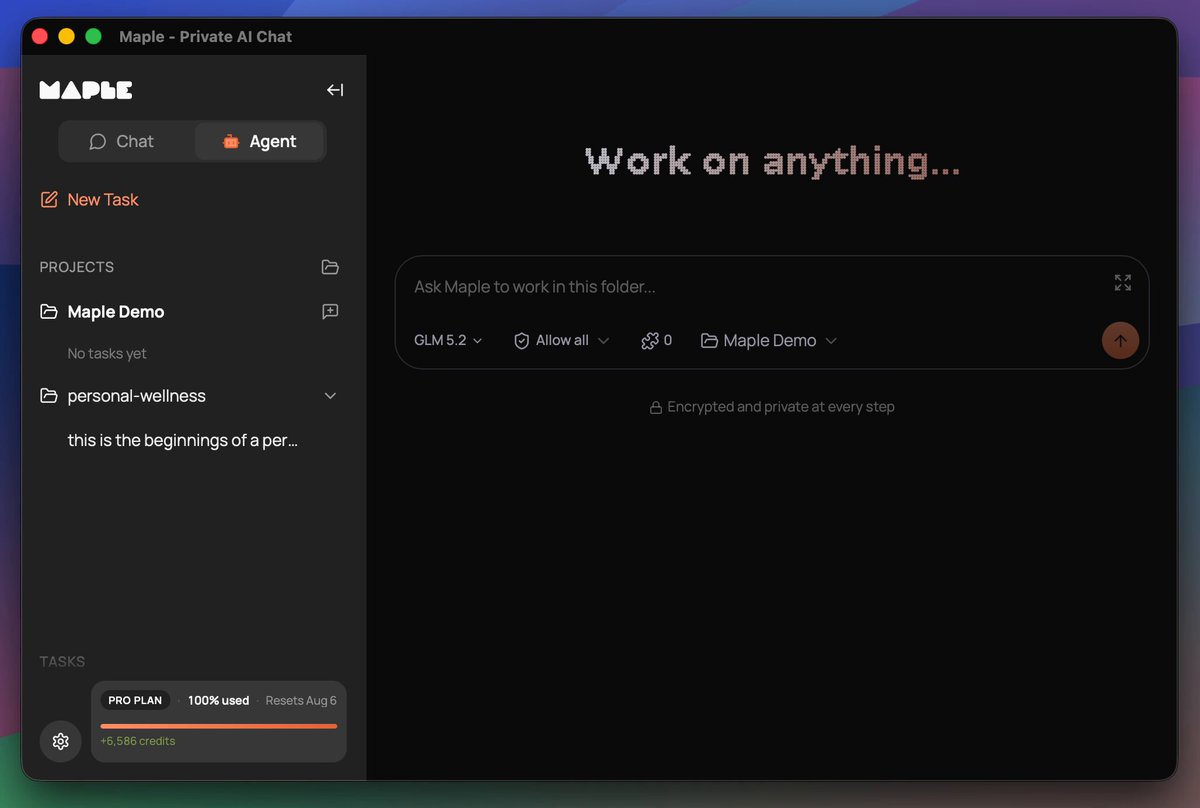
Maple is preparing for the release of a co-working agent. You install it locally and it works with your files, whether it's office work or building websites and apps. It's a turnkey solution, as easy as Claude Code, that keeps your data secure and private, no data sharing with closed AI labs. This is THE sovereign AI app for individuals and businesses who want powerful AI while retaining ownership of their information. Why build an agent into the Maple app when other agents already exist? Easy, we want to give you control over your work. We don't have a business plan that incorporates making money off our users' data. In the age of AI, your information, whether it's personal or company trade secrets, is the single thing that differentiates you from everyone else. We all have access to AI that can build a professional website for selling shoes. But your strategy and network for how you sell shoes should not be shared with your competitors. Sovereignty is the path to protecting what makes you, you. Maple sits at the intersection of Usability and Sovereignty. Maple gives you the best tools that are both easy to use and maintain your data sovereignty. Sovereign for one, sovereign for all. It has been a journey to get here. We brought to market the very first personal chatbot with end-to-end encryption using TEEs in late 2024. Prior to that there were proofs of concept but no full product offerings. Every other AI chat product on the market handled your data in plain text, either selling you a service to get your data or asking you to trust that they won't snoop on you. Quickly people found Maple and latched onto its open-source code and verifiable encryption. We didn't stop there. You may remember earlier this year we teased a product called "Maple Agent" and opened up a waiting list. That product is a mobile app that acts as your AI "friend", maintaining one long continuous chat, and getting to know you over time. I dislike using the word "friend" there, but it's the best way to convey the UX in a few words. AI is a tool, always has been, always will be. Any kind of friendly personality on top is just synthetic. In our testing, the UX of Maple Agent is really powerful for what it does. Think about the many short AI chats you have in your favorite app, whether it's looking up a historical fact or asking advice about a topic. With Maple Agent, those all go away in favor of the long-running chat with the friendly agent. It's like you have your own personal assistant who knows you so well and can look up anything for you. When I ask AI certain questions, I want to ask an expert who already understands my situation so I'm not repeating myself for the 100th time. That's the amazing value the personal agent brings to the table. We still see great utility for a personal agent like the "Maple Agent". Thousands of people on the waiting list, hoping to get their hands on it, agree that the concept is worth exploring and trying out. We were constrained in launching it due to a few circumstances, one of them being access to the scale of compute needed to power it. We have a clear path laid out for how to get there, but today is not the day to execute on that. It will be in the near future. Instead we have a different agent ready to go that we think is also incredible. We now have an agentic harness inside of the Maple Research app. This thing is a powerhouse. It even builds and publishes its own software releases. The agent in Maple Research works with your local filesystem, speaks to the largest open models running in TEEs, utilizes local models for certain tasks, is compatible with MCP tools, has an API for connecting to anything you need, and also supports the ACP protocol, which means it can be extended in the future to speak to other tools like Claude Code, Codex, and local models running on your own hardware. A big unlock for us was the Goose Development Kit, which powers the core of our agent harness. More on that to come as we publish articles and documentation later about the agent. The agent inside Maple Research doesn't have a name. At least not yet, not sure if it ever will. For now we call it "Chat Mode" and "Agent Mode". Think of this as the workhorse, the truck, the heavy lifter. Our other "Agent", the phone app, is your sidekick in your pocket, ready to help with quick things and ongoing conversations about life. I am incredibly excited about the Maple Research Agent. While I'm already seeing great results using it for internal work items, I'm especially thrilled about the personal health and wellness work it's doing for me. I know there are plenty of apps out there for compiling wellness data, but I'm having it build a tool tailored specifically for what I need, without the extra fluff. And none of my health data is being donated to the closed AI labs or sent to advertisers. I know that the AI logic is not being silently adjusted to fit the whims of a large corporation that has paid for product placement. It's me, state of the art AI, and my data. That's how I want it. Maple's new agent makes that possible. We can't wait for you to try it out. If you want early access, comment here, email us, reach out in some way. To those on the other agent waitlist, you're already in the queue. Thanks for reading this lengthy update. :)

Mark

44,707 views • 21 days ago