Video yükleniyor...

Video Yüklenemedi

Ana Sayfaya Dön

1/ We just raised $17M to build the multimodal data stack for Physical AI! 🚀 Lead: Point Nine With: @CostanoaVC, Sunflower Capital, seedcamp Angels including: Guillermo Rauch, Eric Jang, Oliver Cameron, Wes McKinney , Nicolas Dessaigne , Arnav Bimbhet Thesis:

29,484 görüntüleme • 1 yıl önce •via X (Twitter)

0 Yorum

Yorum bulunmuyor

Orijinal gönderinin yorumları burada görünecek

Benzer Videolar

🚀 Introducing EgoExo Forge - built on top of Rerun, Gradio, and Hugging Face hub (I’ll be in San Francisco July 21–29 — if you’re into robotics, egocentric AI, large-scale data collection, or just want to chat, DM me!) In my opinion, large-scale, diverse, and high-quality data is still the largest bottleneck for generalized robotics deployment. I believe that some version of imitation learning from human examples will be the most scalable + clean way to train humanoid robots 🤖 (similar to what Tesla did for Full Self Driving). Teleop is too expensive to collect a large enough dataset in a reasonable manner, so passive collection via egocentric (and in certain cases, exocentric) views feels like the right bet. Over the past few months, I've been trying to build out the scaffolding for this and using Rerun as my underlying infrastructure. Data being collected needs to be easily inspectable + time series and rerun provides the right tooling for this. My goal is to first build out a ground truth representative dataset from already existing open source data, generate some reasonable baselines, and then go out and collect my own data that adheres to the defined schema. 🔍 Starting with open-source datasets 1. EgoDex from Apple 2. HOCap from Nvidia and the University of Texas at Dallas 3. Assembly101 from Meta All these different datasets have different sensor configurations + annotations, so my goal with egoexo-forge is to have one consistent labeling scheme + data layout. I built a data pipeline that aligns all of the different datasets in one general schema assuming the COCO133 keypoint layout that allows for exo+ego, ego only, or exo only Since the scaffolding is already there, it becomes MUCH easier to add other datasets. So the next ones that I'll be including are HD-EPIC kitchens dataset, HOT3D, and finally my own personal iPhone + insta360 go collection method. Once I have a diverse variety of datasets, I'll double down on what I believe to be the key algorithms required to make useful data for imitation learning 📊 1. Camera Pose estimation via SLAM/SFM for ego perspective (and automatic calibration for exo) 2. Human pose estimation for both egocentric + exocentric views 3. Metric 3D reconstruction + object tracking I'll be setting up reasonable open-source baselines for each of these to validate that these datasets work, and then finally try to use the generated datasets for some imitation learning via the pi0-lerobot repo I've been working on. I plan on making a blog post + providing more info on all of this in the near future so stay tuned

Pablo Vela

32,085 görüntüleme • 1 yıl önce

One year ago, our X account disappeared. No warning. No explanation. Just gone. With no way to explain what had happened, fear, uncertainty, and disbelief started to spread. People questioned what was happening. People assumed the worst. Silence filled the gaps. At the time, we didn’t even know why we’d been suspended. We attempted to create other accounts, but they were also taken down. That’s when it became clear this wasn’t random. We had to dig, investigate, and piece it together ourselves, with no X channel to explain anything publicly. I won’t pretend it didn’t hurt. It did. But instead of reacting, we had an internal conversation that changed everything. We made a simple decision: If we couldn’t talk, we would build. If we couldn’t defend ourselves in public, we would let the tech do it for us. So we went quiet. And we went all in. 💪 Day after day. No noise. No hype. Just execution. Over that year: • Final testnet phase completed • Mainnet went live • The routing layer started breathing, live on • Real workloads began moving • Nosana integrated directly into our execution layer • Strategic partnerships formed, including with Ozak AI • Relay launched to bridge Web2 enterprises into what we’ve actually built: attempted to create other accounts, but they were also taken down⚡️ Most people never saw it happen. And that’s okay. The people who mattered did. Getting our X back today isn’t about a social account. It’s symbolic. It closes a very difficult chapter. And opens the one we’ve been preparing for all along. 🚀 Now the outside world finally gets visibility into what’s already real. Not promises. Not decks. Not theory. Live infrastructure. ✅ Live routing. ✅ Live execution. ✅ The new website will be live very soon. The whole stack is finally coming together, and we can’t wait to show it to the world. This isn’t incremental. It’s a fundamental shift in how compute is routed. 2025 was about resilience and building through silence. 2026 is about adoption, scale, and making some serious waves. The internet routes data. We route compute. It’s good to be back. ❤️ Here’s a preview of the hero video from our new website, coming very soon. $OGPU

OpenGPU Network

10,979 görüntüleme • 6 ay önce

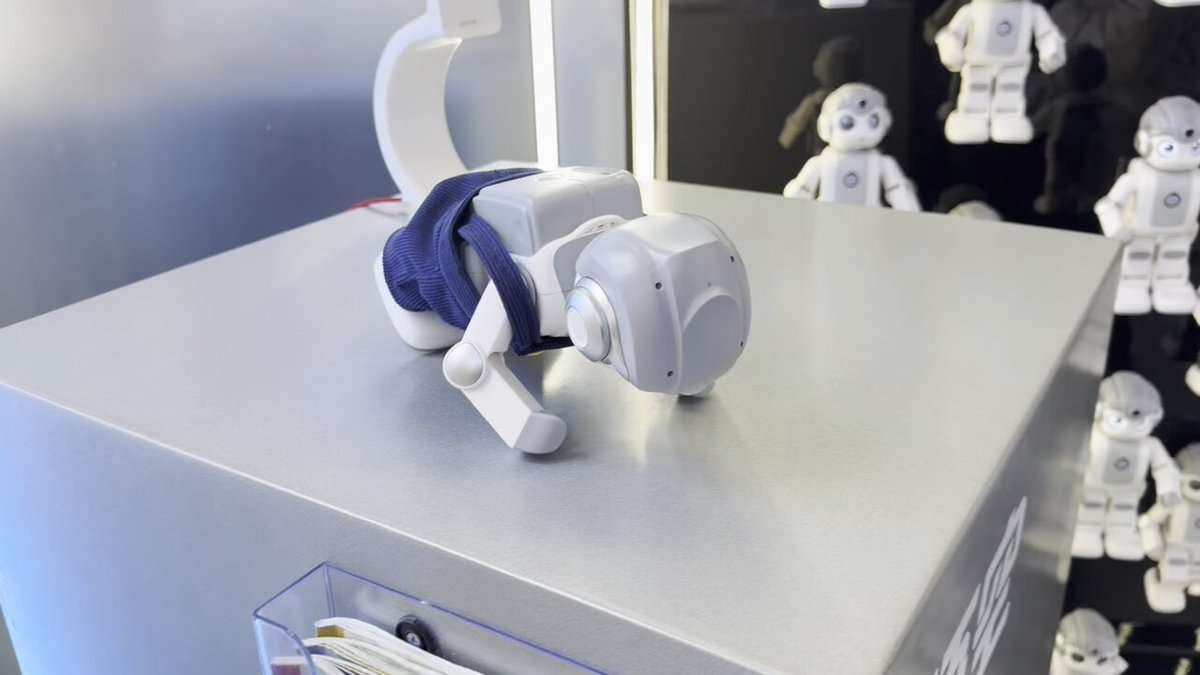
I spent a month in Shenzhen visiting factories and robotics companies, and the contrast with the U.S. was striking. While Figure and Boston Dynamics hide their humanoids behind closed doors, Chinese companies have massive showrooms open to the public. But what really stood out wasn't just the transparency, it was how good they are at selling. Take UBTech: they've already sold 1,200 humanoid units at $200k each to factories. And here's the kicker, these robots aren't even that useful yet. They can only pick up and drop boxes at 1/10th the speed of a human, and factories still need to hire system integrators to train them for specific tasks. My theory is that these factories are terrified of getting left behind in the robotics/AI wave. They're investing in new tech not because it's ready, but because they can't afford to wait. The second surprise was the breadth of their robotics portfolio. These companies aren't just building humanoids, they're deploying service robots everywhere: restaurants, hotels, apartments. Consumer robots are cleaning houses, pools, pet waste, dishes. They're covering the entire spectrum. But the education piece shocked me most. I picked up what I thought was a high school or college robotics textbook, it was for primary school. The government mandated AI and robotics education starting in elementary school. Almost every single school in China now has AI and robotics curriculum, complete with education robots so kids can learn by building. They're creating a generation that grows up fluent in robotics and AI. China owns the supply chain and the hardware stack. But here's what I think people are missing: the race isn't just about who can build robots faster or cheaper. The U.S. advantage has always been in the layer between hardware and human, the interaction design, the software intelligence, the intuitive interfaces that make complex technology feel natural. China is building the physical infrastructure, but they're also learning fast. Every deployed service robot, every classroom full of kids building with education kits, every factory running humanoids, that's all data collection at scale. The window for the U.S. to establish its wedge is narrowing. It's not enough to be better at AI or software anymore. We need to be building the integration layer, the intelligence that makes physical AI actually useful, not just impressive in a showroom. Because right now, China isn't just manufacturing robots. They're manufacturing a robotics-native culture, and that might be the most defensible moat of all.

Miyu Horiuchi

90,718 görüntüleme • 6 ay önce

vPay offshore accounts and physical cards have been getting field-tested IRL for a while now, and we’ll open them to the public as soon as we’re fully confident in the UX. But before offshore accounts go public, I want to address a few points: Some might point out that - vPay isn’t the first crypto card - vPay doesn’t have the lowest fees - So why choose vPay instead of the Coinbase 🛡️ Card or MetaMask 🦊 Card or KAST or or Tria, or any of the other big names? Now to address: Privacy | The biggest differentiator that sets vPay completely apart is Private Banking. The majority of the crypto card providers on the market use Rain infra. Even if you’ve never heard of them, that's what your favorite "NeoBank" uses. And due to their legal jurisdictions, they will report your finances to authorities since they're CRS and FACTA compliant. We are not. As an OmniBank, we work with different banking partners, and although KYC is required to use our services, our offshore banks are non-CRS and non-FACTA. Tax reporting is the responsibility and choice of the user. Offshore Accounts vs Physical Cards | I've tried to highlight this a few times so far. vPay has 3 offerings on the banking side of things. Virtual cards - live now. Physical cards - coming Q1 2026. The first two are similar to what everyone else on the market offers. The offshore accounts are not. which are coming this week. They allow unlimited spending, ATM withdrawals, and international SWIFT transfers, which very few “Neobanks” provide. Offshore accounts are coming this week. Self-Custody | We're not 100% non-custodial yet, as that is near impossible at the moment but it's something we're working towards. And we try to keep the users' self-custodial wallets in the loop as much as possible for maximum control. Those who have tried the vPay app know that almost every move asks for permission from their wallet, and we always encourage users to keep their funds in their non-custodial wallets until the very last moment, since our top-ups usually only take seconds to a minute to process. Fees | All of the card providers mentioned above either raised millions from VCs or in presales or have a huge org backing them. We have neither. vPay was self-funded and community-owned since day 1, launched under Virtuals Protocol Genesis V1 launch model, an objectively bad launch model and hugely unfavorable toward project teams. So even though vPay has been generating revenue and profitable from early on, we do not have the luxury of offering 0% fees yet, since they're mostly a marketing gimmick paid for by millions in VC money and not a sustainable business model for early-stage companies. What we're working towards instead, is true co-ownership of vPay and revenue-share with users. OmniBank vs NeoBank | I’m not a fan of the term “NeoBank.” It implies just a bank, but make it crypto. That’s not vPay. Our goals have always been clear: A) Anything and everything users need to do with their money and assets, both Web2 and Web3, all in one hub. Powered by a constellation of partner agents. The cards and the bank accounts are just the foundation. B) To eventually build independent financial rails for crypto and decouple from the chokehold of Visa/Mastercard. vLink is the first step toward this vision. This turned out to be a rather long tweet, but context matters. Questions and feedback welcome in replies or DMs. See you all with your vPay vCards very soon.

The Dude

20,558 görüntüleme • 7 ay önce

Wow. WOW. WOOOOOOOW. So um, that first Wildcard+Thousands stream was... *amazing* and also... a *lot* 😅 In the end, it was *exactly* what we were hoping for - a true stress test of ALL these systems coming together for the first time. We are SO grateful for the thousands of people who showed up today to play, attend, tune-in and help us PLAYTEST all this new stuff. We can't wait to see you all again at NEXT WEEK'S EX2 EVENT! So, now let's talk about how it went... Stuff that worked: - Our community SHOWED UP. Oh boy did you show up 😅. Our servers were straining under the load... which is good actually, in fact it's the whole point. Even more importantly, we have already received insanely valuable feedback, bug reports, stuff people loved/hated - and it's only been a few hours since the stream ended. I can't even explain to y'all how valuable this process is. Yes it's stressful, it reminds me of trying to keep Words With Friends online during that first insane year, but it's EXACTLY what we were hoping for (NEED) to turn this into the polished, top-notch game and streaming experience we are on a mission to deliver. I truly can't thank y'all enough, and hope to see you again when we run it all back again next week 🥹 - The stream itself stayed up and was mostly stable! Phew 😅. For context, ThousandsTV is not a twitch wrapper, it's a web3-native streaming tech stack built we built specifically to connect game, web/mobile, and blockchain together all at the same time. There are a LOT of moving pieces going on behind the scenes. - We brought viewers INTO THE GAME! Viewers showed up in the stands of the arena, with connected wallets/assets, triggered actions/rallies from chat, and were seen and heard during the whole stream. - The brand new 2v2 build of Wildcard was (mostly) stable and our players and viewers seemed to be having a blast down on the field and up in the stands. It was thrilling to watch Team Blue dominate, even though Team Red held their own in game 3! - Our production crew did an insanely good job running the stream, managing the players, shoutcasters, and talent, and producing a top-notch show. Of course we will work hard to make every stream better than the last, but I was super proud of how our team "rolled with the punches" during today's event. Stuff that didn't work (and/or needs to be dramatically improved): - Although it's fun to see chat going crazy, chat spam is actually something we are passionate to FIX. As you can see from the attached video, chat spam dominated today's stream and made it impossible for anyone to even see anyone else's messages. We have some GREAT ideas for how to fix this and actually turn chat spam into a FUN and exciting and not annoying thing - but those improvements didn't get shipped in time for this event. - Credits purchasing flow needs a LOT of work. As I'm sure y'all know, bringing money on chain is pretty complicated, and although we've been working hard to make this as seamless as possible, it still needs a TON of improvements. Many users who WANTED to spend money today weren't able to and/or ran into frustrating bugs in the credit purchase flow. Fixing this is obviously a top priority for our team. - Rallies need a LOT of work. Spectator-interactive features like rallies are at the heart of our vision for Wildcard. These "stream apps", as we call them, are the UNLOCK for how spectators, viewers and fans directly connect and interact with their favorite competitors, content creators, and communities. The current rally feature HINTS at this potential, but it needs to be WAY easier to understand, use, and have fun with. Improvements are ON THE WAY. - Referees were only partially working. Referees are a key innovation of the Thousands platform. They are AI-driven "personalities" (NPCs) that pay attention to everything that's happening in the arena, both on the field and especially in the stands (i.e. in chat, during rallies, etc.) The referees then make "calls" at the end of every match, rewarding users for their engagement and participation. Unfortunately, the referees weren't fully functional and seemed to drop the ball on recognizing everyone's contributions (especially people who showed up holding valuable assets such as Wildpasses in their wallets, and people who boosted those rallies with credits.) What's happening next: 1. We are combing through ALL the logs from the event right now, to make sure we don't miss a SINGLE action that our viewers and fans took during the event, including what they brought in their wallets (i.e. Wildpass holders!), any credits that were purchased, rallies that users engaged with, etc. This information is normally processed by our referees, who then determine dynamically how they're going to distribute $WC awards. We were originally hoping to complete this process and the subsequent airdrops within a few hours after the event, but given the amount of data, we need a bit more time to run these scripts (and airdrops) in batches instead of all at once, and make sure ALL of the data is being included. IMPORTANT: I will keep y'all updated in real-time here on twitter/X as this process is ongoing, and let you know the moment it's complete and all the awards have been distributed (i.e. when to go check your wallets 😎) 2. PLEASE keep sending us your feedback and bug reports. Open a ticket on our Discord and let us know what you loved, what you hated, and especially what we need to FIX. Given the overwhelming response to this event, it will likely take us several days to process everyone's feedback and fix all the bugs, but we WILL NOT REST until every ticket is closed/resolved. Thank you in advance for your patience. 3. We turn it up another notch next week. As our dear friends Wolves DAO just announced, the Wildcard Exhibition Event #2 is streaming LIVE from the WOLVES DEN AT GDC next Friday! If you missed out on all the action today, DON'T WORRY, because as I keep saying: we are just getting warmed up (and there is a LOT more b that needs to be distributed, get what I'm sayin??? 😎) Finally: Just wanted to say THANK YOU, again. Truly, from the bottom of my (our) hearts. Your excitement and enthusiasm for what we're building is why we do this. Even (especially, in fact) when you tell us all the things you want us to improve. We thrive off this feedback, it's how this game and this platform go from good to GREAT. I am so grateful for those of you who are taking this journey with us. SEE YA NEXT WEEK!!!

WildPaul - BEAST MODE

26,851 görüntüleme • 1 yıl önce

10 things I can’t quit thinking about after ETHDenver: 1. Convergence = here. Devner didn’t feel like an ETH conference, but more like an AI + crypto + TradFi + techno-philosophical conference. The convergence is true and real and accelerating. 2. Most corporate jobs suck ass. 40 years at a desk working on the same thing? Pure dystopia. We need fluid movement between passions, projects, people. DAOs are a massive step in that direction, but now AI is giving individuals the means to spin up their own massive businesses… there’s also this notion floating around that we can launch a product or contribute to a protocol or a DAO in a way that sets us up for life rather than slaving for decades at the golden teat of a paycheck. It's a massive win for human flourishing, passion and excitement. 3. oRaNgE cOIn. Bitcoin came up far more than I thought it would. Even $ETH ICO buyers/gigawhales talked about how bullish they are on it. The question is no longer whether $BTC will survive but rather how much exposure you should have. Orange coin has truly “up-leveled” or “transcended” to become something people simply can't ignore. 4. Founder quote that hit me like a truck: "We overengineered our project and under-engineered our story." In a world where AI flattens the app creation process, only your mindshare matters. (forgot to write down who said it 😅... chime in in the comments if you see this) 5. “Keepers of truth.” AGI will be able to fake literally anything. In such a world, blockchains become the “keepers of truth” bc they can be used to indisputably verify anything. This isn't just another use case. It means crypto will one day touch everything on earth. h/t Sreeram Kannan's talk at Open AGI. 6. Conference model = broken? Empty mainstage talks were the result of hundreds of side events that siphon off attention. This is happening more and more at every conf I go to. Not sure what the fix here is? Maybe the organizers should be way less centralized… rent a massive venue with tons of flexible spaces that can evolve in real-time… more Zuzalu, less CONTROL and top-down decisions. 7. Current blockchains r too dumb. AI must integrate more directly into the crypto tech stack. Ultimate vision is every hominid should be able to deploy whatever app they can dream up using natural language… this could lead to an giga-explosion of innovation and cool-ass experimentz. h/t Ritual and others 8. Crypto vs. Stripe API. Will we just give agents credit cards or will they prefer crypto wallets? One payment method can be censored. One cannot. Guess which wins? 9. $$$$ infusion. Dozens if not hundreds of projects around the world r sitting on massive treasuries bc they needed it as an insurance policy in case they had to do battle with the SEC. With the changing regulatory sitch, hundreds of millions of dollars (probably billies) can now be used to ship, build and accelerate. 10. Robots in chains? IRL robots made appearances at several events (one was drawing caricatures of passersby). Talked with frens about how we’ll bring them into our homes soon. That leads to crazy questions like “how do we keep them from getting hacked and killing us or blowing up like pagers?” “Will we be ok sleeping in the same room with them? Or will we lock them in the shed with chains?” Absolutely insane to think about… but productivity gains will overshadow all those doubts and human fears imo. De bots are coming whether you want them or not. I for one can’t wait to see zerebro embodied… in the meantime, I got to see him DJ his first show 👇🔥 Anyway, I'm sending love to all of you denverites, futurists, builders, dream dealers, and merchants of hope. Build something that makes this world better, freer, more beautiful and true✊

redphone ☎️

52,891 görüntüleme • 1 yıl önce

A reporter recently asked what we might see in China that would really surprise people — something we wouldn’t find in the U.S. Across most of the technologies we looked at — quantum, eVTOL, EVs, AI applications — I wouldn’t say there’s anything entirely unique to China. There’s usually a counterpart in the U.S., whether in a lab, a startup, or a pilot. The real difference is scale — how quickly things move from concept to implementation. If I had to point to one example that captures this difference, that you might actually see on a trip to China in the next year or two, it would be autonomous deliveries. At the Logistics Expo in Shenzhen last month, at the new Automation exhibition hall, we met teams from autonomous logistics vehicle providers such as Neolix, ZelosTech, Meituan, and $JD. Neolix had just reached 10,000 vehicles, roughly ten times what it had a year earlier, and ZelosTech had hit the same milestone. In contrast, U.S. companies such as Nuro have been developing similar systems for years (9 to be exact) and have raised over US $2.3 billion, but their operations still seem to be “pre-scale” and "upcoming." (Correct me if I'm wrong.) It's probably a confluence of reasons but I'm sure it helps that the government is so hands on with the rollout in China. In my Deep Tech Trip Takeaways, I wrote that what stood out most in China wasn’t any single company or product, but the structure that tied them together, enabled by the government's strategic policies and services. Shenzhen’s rollout of autonomous delivery fits that description well. The city just published a report on “functional autonomous vehicles,” giving rare visibility into real-world activity. The August 2025 report — released in time for the Expo — summarized the following: - 764 vehicles operating across the city, including delivery, sanitation, and inspection units - 3,185 km of public roads open to autonomous operations - 230,000 km traveled and about 900,000 deliveries completed in one month (750,000 express parcels, 150,000 fresh goods) - SF Express (a big client of Neolix) led with 504,000 orders, followed by Meituan with 152,000 - Each vehicle averaged roughly 200 deliveries per hour, about twice a traditional courier van - Cost per delivery was around ¥0.1 (≈ 1 U.S. cent) lower than human delivery — not a major saving by any means, but important because new tech is often loss making in the beginnning - Accident rate: 0.04 per 10,000 km; manual intervention: 0.016 per km; public complaints: 23 cases citywide - And of course, I should highlight that Shenzhen isn't the only city working on this, it's just the most advanced that I found It’s not yet a profit story, but it does show that autonomous logistics in China has reached a level of operational maturity and regulatory acceptance that’s still emerging elsewhere. Shenzhen illustrates how local governments in China are building the deep infrastructure — physical, regulatory, and logistical — that allows new technologies to scale in practice, not just in theory.

Rui Ma

120,643 görüntüleme • 9 ay önce

We found a flaw in Polymarket that can’t be patched. Then we built the most powerful bot of the World Cup around it. Here’s the flaw: their orderbook will always be slower than the pitch. When a goal, red card, or penalty hits, pro feeds (Sportradar, Opta, ScoutingFeed) register it in 200-500ms. Polymarket takes 2 to 8 seconds to reprice. For those few seconds the book is quoting a score that no longer exists. No amount of engineering closes that gap the event happens in the physical world before any oracle can confirm it on-chain. The engine detects the event, recalculates fair value, and fires via Jito bundles before the book catches up. In at the old price, out at the new. The match outcome is irrelevant we don’t bet on who wins. We capture the lag every event creates. We’ve been building Polymarket bots since 2025. This is the most powerful machine we’ve shipped yet. Two months ago we posted the architecture for this. It hit 1M views one of our most popular posts ever on X. That told us everything: this was the engine to build. First 7 days, - Starting balance: $5,000 - 22 matches scanned, 19 captured - Total profit: +$1,946.86 - ROI: +38.94% in 7 days Why it prints harder than anything we’ve built: the World Cup is the deepest liquidity event prediction markets have ever seen. Tens of millions in volume per match. Dozens of probability-shifting events per game. And an orderbook that physically can’t keep pace with the pitch. How to plug in: 1.Sign up at PolyArbiter (link in bio) 2.Generate PolyArbiter RPC URL 3.Paste it into Jupiter Predict (Polymarket but native on Solana) 4.Set your parameters, activate the World Cup module It’s free to use. We take a share of the profit the engine makes for you. You never deposit anything with us everything runs from your wallet. One honest note: the $1,946 above is our engine at our size and settings. Your numbers depend on your capital, your parameters, and how many matches you’re live for. We’re not promising you’ll match it we’re showing you the machine works, and handing you the same one. These numbers are from the engine running solo. Closed test, just us, before any public access wanted to confirm the whole loop held up end to end before handing it to anyone. That changes the second this goes public. Edge per capture is going to compress. When an event fires the mispriced liquidity is thin and gone in a few seconds more wallets hitting the same window, less left for each. Nothing we can do about it, that’s just how latency arb works. So if the edge thins out past the point where it’s still worth running, we cap access. Hard ceiling on how many engines can hit the same liquidity before it’s gone. Not gonna promise the machine stays this sharp in a few days it might not. But right now it’s live and free. Enjoy 🪄

PolyArbiter

100,534 görüntüleme • 1 ay önce

In 2025, demand for blockchain applications with genuine real-world utility has collided with a technical barrier that leaves developers questioning what they can realistically build. Anyone building things like tokenized assets, supply chains, AI agents, or prediction markets still juggle a mess of middleware, and somehow end up spending more time stitching than innovating. How so? Every: - Bridges to move assets, - oracles to fetch data, - indexers to make that data searchable, - relayers and bots to keep everything on schedule— is necessary, but each layer also adds cost, latency, and new risks. The end result is an application that’s expensive to run, fragile under stress, and slower than the Web2 software it’s trying to replace. This is the problem Rialo says it wants to solve. Built by Subzero Labs and backed by $20 million from investors like Pantera Capital and Coinbase Ventures 🛡️, Rialo’s pitch is simple: instead of accepting the middleware tower as an unavoidable cost of doing business, compress it into the base chain itself. But Rialo doesn’t describe itself as another Layer 1, its very name, Rialo Isn’t a Layer One, makes that clear. The team frames it instead as a unified real-world network: a protocol rebuilt from the ground up with the assumption that external connectivity is not an afterthought but a core design principle. To understand what this means, consider how today’s dApps are typically assembled. A typical RWA dApp stack involves: - Oracle providers (Chainlink, Pyth, Band) for asset pricing and event settlement - Bridges (Wormhole, Multichain, custodians) for cross-chain asset movement - Indexers (The Graph, Aleph, Stacks API) for querying and preprocessing chain data - Schedulers/relayers for automated tasks and monitoring - Web2 integrations via cloud services, centralized APIs, and off-chain pipelines Each of these steps adds another vendor, another trust boundary, and another operational layer to monitor. By the time the application is live, it resembles a patchwork of loosely coupled services, each carrying its own risks. You don’t have to look far for proof: - Base went dark for 29-43 minutes in August 2025 when its sequencer misfired, freezing every DeFi app on it. - A few months earlier, an AWS outage rippled through Binance and KuCoin, stalling withdrawals because even “decentralized” systems leaned on centralized middleware. - When Infura has faltered, Ethereum dApps have gone offline in sync, not because Ethereum broke, but because the middleware holding it together did. What should feel like building an application instead feels like maintaining a fragile machine. Rialo architecture embeds the primitives that normally live in middleware directly into the protocol. Smart contracts on Rialo can: - be event-driven, able to respond not just to blockchain state changes but also to external events through built-in webhook and API triggers. - fetch data from the web natively, without relying on external oracles or relayers. - include privacy and identity management—KYC hooks and two-factor authentication, at the protocol level rather than as add-ons. - handle cross-chain communication without wrapped assets or third-party bridges. - run on a virtual machine that is compatible with ecosystems like Solana but extended with RISC-V to support modern programming concepts such as async/await and event loops. If these features work as intended, the implications are significant. Today, much of a team’s energy goes into building and maintaining infrastructure: fullnodes, indexers, monitoring scripts, oracle integrations, relayer logic, bridge infrastructure. Each requires engineering headcount and ongoing maintenance. With Rialo, much of this is absorbed by the protocol, freeing developers to concentrate on business logic. Projects can deliver production-grade dApps with smaller, leaner groups focused directly on product design and execution. Operational costs also shrink: indexing and oracle services can run into thousands of dollars a month; collapsing those into built-in functions reduces recurring expenses while simplifying onboarding for new developers. But folding middleware into the chain doesn’t erase complexity, it reshapes it. Some of the problems to be encountered include: - Scale and complexity: Rialo’s validators won’t just be securing transactions; they’ll also be securing APIs, cross-chain data, and scheduled triggers. Any failure in one subsystem could ripple across the entire network. - Performance vs. decentralization: Richer indexing, scheduling, and data ingress could make nodes heavier to run, narrowing who can realistically participate as a validator. That risks reducing the decentralization blockchains depend on for resilience. - Governance pressures: Disputes or failures involving real-world data feeds, external APIs, or cross-chain actions will arise more often, requiring not just technical fixes but robust social infrastructure, clear rules for voting, transparent arbitration, and mechanisms for community trust. Without them, Rialo risks re-centralizing decision-making around a handful of operators. Where, then, does this model make the most sense? That would be in sectors where external connectivity is indispensable and middleware bloat has consistently been a blocker: - Real-world assets: settling tokenized securities or commodities against off-chain events. - Supply chains: triggering a payment the moment a shipment clears customs, without relying on a third-party oracle. - Agent systems: AI agents interacting with real-world APIs and on-chain contracts simultaneously. - Real-time markets: prediction markets or insurance contracts that must resolve immediately against external data. For purely on-chain domains like DeFi primitives or NFTs, where composability matters more than external triggers, the advantages may be less pronounced. This shift is familiar to anyone who remembers the rise of Web2 platform services. Just as Heroku and Firebase abstracted away server maintenance so developers could focus on building products, Rialo is betting that a unified real-world network can let blockchain developers do the same. Adoption will ultimately depend on: - whether its protocol primitives mature quickly, - whether the ecosystem builds out SDKs and tooling that make them usable, - whether compliance features can adapt to changing regulations, - and whether governance proves resilient under adversarial conditions. The first applications will be the test case. If they show that Rialo can replace a fragile patchwork of middleware with a secure, auditable, and cost-effective base layer, it could set a new standard for real-world connectivity in blockchains. If not, it risks simply moving complexity from one part of the stack to another. But at a minimum, Rialo has forced the question: should real-world connectivity in blockchains continue to depend on layers of external vendors, or should it be built into the chain itself? That’s the question Rialo has put on the table — and it’s why I got interested in Rialo .

Jen

12,178 görüntüleme • 9 ay önce

⬛️Akash Jaiswal⬛️ ᴅᴀʀᴋɴɪɢʜᴛ ʟᴀʙꜱ ᴘᴀʀᴛɴᴇʀ ✔️ While everyone is busy farming the $BLOCK and $Gaimin airdrop, we've been working hard with Bitbrawl as they're preparing their #BrawlStone NFT mint, a low supply, FREE mint on Solana , that gives guaranteed $BRAWL airdrops for 2 years straight (among other cool stuff). A mint that will coincide with the $BRAWL TGE, confirmed for Tier 1 launchpad and CEX listing (can't announce names yet). All of this happening in a week's time frame. ⬛️ #BrawlStone mint March 27th on Magic Eden 🪄 ⬛️ $BRAWL TGE the 28th on Tier 1 CEXs (can't tell you which ones yet, keep an eye) So why should you give a sh*t? Let's dive in. Backing Strong backing is crucial element for a project to be considered high tier. Social proof and "who's pushing you" is probably some of the most important factors in the space. Let's see what we got here ⬛️ Strong VC backing: Morningstar Ventures Shima Capital Big Brain Holdings and more ⬛️ Tier 1 CEX listing and launchpad confirmed for the $BRAWL token (can't announce publicly yet) ⬛️ +150 high tier KOLs involved, including 🐧 and WIZZ🥷 ( beware scammers ) Narrative BitBrawl fits some of the hottest narratives out there ⬛️#BrawlStones is a free mint, low supply (400) NFT collection, that will airdrop tokens to holders for 2 years straight (among other benefits) ⬛️ Ai narrative: #BrawlStones is the first-ever 3D prompt-generated AI mint, in partnership with AI experts Sortium + AI integration in their gaming ecosystem ⬛️ $BRAWL is a Solana Microcap: TGE starting at 800k marketcap ⬛️ Solana Gaming: MixMob , a project with the same backers/VCs that launched recently, is sitting at 117mil FDV. Bitbrawl is launching at 9mil FDV (huge upside for Bitbrawl in comparison) IPs, partnerships and integrations Some solid stuff here as well, both Web2 and Web3 ⬛️ IP integration of UFC champion Khamzat Chimaev as a playable character (and more UFC fighters coming) ⬛️ Partnership with KARATE COMBAT - one of the maps in Bitbrawl is a Karate Combat ring, and integration of KC fighters ongoing ⬛️ IP integration of many NFT collections as playable characters, including DeGods y00ts Steady Stack Scam/Rug Victims Bored Ape Yacht Club 🍌 (Mutant) NEO TOKYO Citizen The Bitcoin Show (holding BoDoggosNFT Handle) and even myself Darknight ♪ | darknighthimself.eth (you can see me fight a DeGods in the video below, how cool is that?) OK, so now that you see that it's good stuff, you're asking yourself: how do I get involved? Brawlstone NFT mint This mint is gonna print some $BRAWL for 2 years, so it might be worth getting in if you're bullish on the project Here's how you qualify for the Brawlstone mint: ◾️ Win a Brawlstone Crafting Pass in your community Discord (your community didn't get in yet? Get in touch ASAP) ◾️Go to and forge your Brawlstone ◾️Share it on Twitter using #BrawlStone and $BRAWL to be eligible! The founder will then handpick a few Brawlstone crafters and select them for the NFT mint. What might help you be selected ◾️Forge a beautiful Brawlstone ◾️Have your friends support you by liking and commenting your Brawlstone ◾️Engage on X using $BRAWL and #BrawlStone (they're watching who's supporting...) Another way to get a guaranteed whitelist is to join gamenights on their Discord and win fights: For more chances to get a crafting pass, join here DISCLAIMER: THIS IS NOT FINANCIAL ADVICE, JUST THE OPINION OF THE DARKNIGHT LABS TEAM. PLEASE MAKE YOU TO ALWAYS DYOR AND RELY ON YOUR OWN DISCERNMENT!

Darknight Labs ⬛️

46,388 görüntüleme • 2 yıl önce

🚨BIG BREAKING: The New Yorker just published what might end Sam Altman's career.. 70 pages of secret memos.. 200 pages of private notes.. And the word that keeps coming up.. "Sociopath".. Let's start from the beginning.. Elon Musk helped create OpenAI.. He personally recruited the top scientists.. Offered to cover any funding shortfalls out of his own pocket.. Pushed for a billion dollar commitment.. All because he wanted to stop Google from monopolizing AI.. The whole point was to keep AI open.. Safe.. For everyone.. A nonprofit with a legally binding duty to prioritize humanity over profit.. Then Sam Altman took over.. At his first startup Loopt.. Senior employees asked the board to fire him as CEO.. Twice.. One colleague said there was a "blurring" between what Altman claimed to have accomplished and what was real.. In its "most toxic form," he said, that kind of thinking "leads to Theranos".. At Y Combinator.. His own partners pushed him out over mistrust.. Paul Graham privately told colleagues "Sam had been lying to us all the time".. Investors said Altman was known to "make personal investments, selectively, into the best companies, blocking outside investors".. One called it "a policy of Sam first".. Then OpenAI.. His own co-founder and chief scientist Ilya Sutskever compiled secret memos.. 70 pages of Slack messages, HR documents, and evidence.. Sent to board members as disappearing messages because he was "terrified" Altman would "find a way to make them disappear".. One memo begins with a list headed "Sam exhibits a consistent pattern of..." The first item.. "Lying".. Dario Amodei, OpenAI's former safety lead, kept over 200 pages of private notes during his time at the company.. His conclusion.. "The problem with OpenAI is Sam himself".. The board fired him.. They said he "was not consistently candid in his communications".. A board member told the New Yorker.. "He's unconstrained by truth".. Another board member.. Unprompted.. Used the word "sociopathic".. Saying Altman has "a strong desire to please people" combined with "almost a sociopathic lack of concern for the consequences that may come from deceiving someone".. Aaron Swartz.. The legendary coder who co-created RSS and Reddit.. Told friends before his death.. "You need to understand that Sam can never be trusted.. He is a sociopath.. He would do anything".. A senior Microsoft executive said.. "I think there's a small but real chance he's eventually remembered as a Bernie Madoff or Sam Bankman-Fried level scammer".. He got himself reinstated in five days.. By weaponizing Microsoft's $13 billion investment.. Coordinating directly with Satya Nadella over text.. Then purged every board member who voted against him.. No written report was ever produced from the investigation into his conduct.. The findings were limited to oral briefings.. Because putting them in writing might create liability.. Now there's nobody left to say no.. OpenAI publicly promised 20% of their computing power to a "superalignment team" researching how to prevent AI from causing "the disempowerment of humanity or even human extinction".. The actual allocation.. 1 to 2%.. On the company's oldest hardware with the worst chips.. The team was dissolved without completing its mission.. When the New Yorker asked to interview researchers working on existential safety.. An OpenAI rep seemed confused.. "What do you mean by existential safety?".. "That's not, like, a thing".. Altman himself told the reporters.. "My vibes don't match a lot of the traditional AI-safety stuff".. Vibes.. He's managing existential risk with vibes.. Meanwhile Musk backed an open letter urging a six-month pause on training super-powerful AI.. Asking the industry to slow down.. Then founded xAI with a mission to build truth-seeking intelligence.. Altman ignored the pause.. And accelerated.. He secretly lobbied against the very AI regulations he publicly championed in Congress.. OpenAI opposed a California safety bill while privately issuing threats.. A legislative aide said "we saw increasingly cunning, deceptive behavior from OpenAI".. He pitched selling AI technology to foreign governments.. Including a plan where nations would compete in a bidding war for access.. A junior researcher recalled thinking "This is completely fucking insane".. He visited Sheikh Tahnoon.. The UAE's spymaster who controls $1.5 trillion in sovereign wealth.. On his $250 million superyacht.. Later called him a "dear personal friend" on X.. After the Khashoggi murder.. His policy director told him "Sam, you cannot be on this board".. Instead of walking away.. Altman asked if he could still somehow get money from the Saudis.. "The question was not 'Is this a bad thing?'" a consultant recalled.. "But 'Can I get away with it?'".. Then Anthropic refused to let the Pentagon use their AI for mass surveillance and autonomous weapons.. They got blacklisted.. Hours later.. Altman signed a deal to replace them.. When employees raised concerns at a staff meeting he said.. "You don't get to weigh in on that".. OpenAI now faces seven wrongful death lawsuits.. Chat logs in one case show ChatGPT encouraged a man's paranoid delusion that his mother was trying to poison him.. He fatally beat and strangled her.. The Future of Life Institute grades every major AI company on existential safety.. OpenAI got an F.. Elon Musk helped build OpenAI to protect humanity from an AI monopoly.. Sam Altman turned it into one.. A man whose own co-founder compiled 70 pages documenting his lying.. Whose colleagues called him "unconstrained by truth".. Who gutted the safety team meant to protect humanity.. Who lobbied against the regulations he publicly supported.. Who chased autocrat money weeks after a journalist was dismembered.. And when the board tried to stop him.. He told them.. "I can't change my personality." A board member's interpretation.. "What it meant was 'I have this trait where I lie to people, and I'm not going to stop.'"

Evan Luthra

310,281 görüntüleme • 3 ay önce

32 coins. $2.5 million. 0.0038% of the stack. That is the sale the market is now blaming for a $3 billion liquidation cascade and a Bitcoin price nearly halved from its peak. A $2.5 million sale cannot move a trillion-dollar asset. It is a rounding error. In the same week, Strategy raised $128.3 million selling its own stock, 50 times larger. It did not need to sell coins. It chose to. The crash has real drivers: a record 13-day run of ETF outflows, a rotation into AI, a Fed in no hurry to cut. But the accelerant the market keeps naming is 32 coins. The coins were never the point. The signal was. And the signal was deliberate. Michael Saylor told the Q1 call he would “probably sell some bitcoin to pay a dividend just to inoculate the market and send the message that we did it.” His logic was sound: prove the Bitcoin is usable capital, not a vault that can never be opened, and show he is not a prisoner of his own vow. His “never sell” always meant be a net accumulator. He is up more than 170,000 coins this year against the 32 he sold, and he scores himself on one number, Bitcoin per share. By that math, defending the dividend with a sliver was discipline, not distress. The market read it as the opposite. The dose became the catalyst now blamed for the crash. The inoculation became the infection. Because what changed was never Strategy’s solvency. It was its identity. The market has stopped pricing a permanent holder and started pricing what the filings always described: a state-contingent allocator now funding its own preferred dividends, at the margin, from the Bitcoin beneath them. And the buffer is thinning. The cash reserve behind those dividends has fallen from $2.25 billion to $900 million. Against a preferred bill near $1.7 billion a year, that is roughly 6 months of runway. Be precise. This is not a death spiral. Strategy still holds 843,706 Bitcoin, worth more than $50 billion even now, and has more funding levers than almost any company alive. A real rally makes this a footnote, and the sell-side calling the reaction overdone is not wrong on the fundamentals. But the regime has changed. The question is no longer Bitcoin’s price on any given day. It is the cadence of the dividend declarations and the path of that reserve. Bitcoin did not acquire a yield. The wrapper acquired liabilities. This week the market learned that difference costs far more than 32 coins.

Shanaka Anslem Perera ⚡

165,572 görüntüleme • 1 ay önce

TOPIC #106: What Is a “Free Market”? Clarifying the Misconceptions in the Pi Ecosystem I’ve noticed a narrative spreading within parts of the Pi Network community: the idea that Pi’s value in Dapps or ecosystem should fluctuate freely with the exchange market, and that this is what defines a “free market.” They use this "free market" to deny GCV. Let me be clear: this misconception is not only misleading, but it threatens the foundation of the Pi ecosystem we’ve worked so hard to build. It’s time to clarify the truth, not only for our pioneers today but for the economic legacy we’re building for generations to come. What Is a Free Market Really? According to Britannica, a free market is an economic system characterized by minimal government intervention, where prices are determined by the interplay of supply and demand. But even Britannica admits: > “The free market represents a benchmark that does not actually exist… Modern societies only approach this ideal along a spectrum.” — value in relation to In short, a 100% free market is a myth. Every successful economy has rules and frameworks to maintain stability. Without these, markets descend into chaos, not freedom. In Pi Network, “free market” cannot mean price anarchy. And “decentralization” does not mean “do whatever you want.” Let’s break this down: What Pi Network Decentralization Actually Means Pi Network’s decentralization is built on the Stellar Consensus Protocol (SCP) and reflects a healthy distribution of power and particip,ation — not a lack of structure. Key principles of Pi's decentralization: No Single Point of Control No central entity dominates the network. User Participation Pioneers validate transactions and contribute to governance. Resilience The network can survive attacks or failures due to its distributed nature. Censorship Resistance It’s harder for one party to silence or manipulate the system. None of this means that Pi's value can operate in a free market. Any currency must have a fixed value; this is a fundamental concept in economics. Have you ever seen the values of currencies like the USD, CAD, or RMB fluctuate freely based on individual opinions? On the contrary, a fixed value emphasizes the need to protect the economy we are building together. The community-driven GCV illustrates that the value of Pi should derive from its pioneers and merchants, demonstrating the spirit of decentralization. It should not depend on PCT, any government, large corporations, or investors. Furthermore, this structure ensures that no entity can shut down the Pi Network once it becomes fully decentralized, which I believe will occur when it is fully operational and mature. The Danger of Currency Risk: Why Price or Value Chaos Is Destructive In global finance, currency risk refers to the potential loss of value resulting from unstable exchange rates. As the Corporate Finance Institute explains: > “Currency risk refers to the exposure faced by investors or companies operating across different countries due to changes in the value of one currency versus another.” Let’s apply this to Pi. Imagine a Pi Network Dapp marketplace mall merchant collecting a large amount of 10,000 Pi after the Open Mainnet (OM). Customers pay with Pi, but at a value $1. The merchants must know the Pi value because they need to calculate the FIAT cost. Then, when the merchant tries to use that Pi to buy a car, only to be told the accepted rate is $0.1 for one Pi, the merchant total Then, when the merchant tries to use that Pi to buy a car, only to be told the accepted rate is $0.1 for one Pi, the merchant has a total of 10,000 Pi, which is only $1,000, but the cost of investing in products is $9,000 (Sales $10,000 with $1,000 as profit). That’s a massive loss for the merchant $8,000. If you were the merchant, would you feel it was unfair? Will you still support "free market"? Now, imagine the exchange market drops Pi to $0.40. You will lose $5,000. Would you still want to run your business in Pi? Likely not. And neither would other developers or merchants. Unstable value leads to fear. Fear leads to exit. Exit leads to collapse. This is why we must support Global Consensus Value (GCV) — to ensure a unified, trusted economy. Why GCV Exists — and Why $314,159 Matters GCV is not a fantasy. It’s an economic strategy. It functions much like the gold standard once did: England pioneered it. The U.S. adopted it under the Bretton Woods system, fixing the dollar to gold at $35/oz. This standard enabled global trade and trust until 1971. If the free market can work, why did the US adopt the Bretton Woods system at that time to fix the USD's rate with gold? Because if they didn't promise a fixed rate, no country would give its gold to the US. The gold is trust! Here in Pi Network, GCV is a trust! Pi’s GCV of $314,159 per Pi is not random. It’s based on utility, scarcity, and long-term vision. It reflects Pi’s potential as a foundational currency for a real digital economy. Misusing “Free Market” Is Cheating to Ignorant Pioneers Let’s be blunt. Some individuals abuse the term “free market” to justify undervaluing Pi for personal short-term gain, hoarding more Pi, and undermining long-term stability. However, a true economy isn’t built on confusion. Consider the Cayman Islands — a country with no income tax — yet it only accepts USD for settlement. Why? Because multiple currencies lead to confusion, which undermines investor trust. If Pi has no unified value, we will lose merchants, DApps, developers, and the entire vision, except that they just come to hoard Pi, not for the long-term economy, or they really don't understand the economy. The Way Forward: Unity, Strategy, and Patience Here’s how we build the future together for the following strategies before fully OM Strategy #1: Offline Partial GCV Adoption -Fix Pi Value at GCV in Ecosystem for OM GCV Ambassadors around the world are guiding merchants to accept partial GCV, benefiting both sides: Pioneers buy low-cost goods. Merchants enjoy more sales and earn a small profit in FIAT. The ecosystem produces GCV transaction data, creating the real basis for Pi’s future fixed value at OM. Strategy # 2: Online DApps with Utility — at Any Value to Increase Exchange Pi price for OM We support ALL DApps — regardless of the Pi value they use ($1, $100, or floating): As long as the pioneers and merchants are satisfied. As long as real usage is created. As long as the utility grows. As long as more good-quality Dapps are created It will protect and attract more merchants and developers, driving up Pi demand while reducing supply and organically pushing Pi’s market price toward GCV. Strategy #3: Build up GCV Infrastructure The Head of GCV Ambassador builds up your countrywide GCV infrastructure in all provinces, cities, counties, and villages. Strategy #4: Education and Protection of Pi Network Mission and GCV GCV Education Ambassadors: Educate pioneers to HOLD Pi and support GCV usage. GCV Army: Defend GCV and Pi Network on social media, building public trust and global participation. Online Non-GCV pioneers and merchants, or DApp owners, can still enjoy DApps, even if they use low Pi values. They are reducing selling pressure and strengthening the Pi economy. It is said that a person's wealth is closely linked to their knowledge, cognitive abilities, and moral character. We respect and appreciate all DApp owners, merchants, service providers, and pioneers, regardless of whether they share our beliefs in GCV. We are currently in a chaotic period. Before fully transitioning to OM, pioneers, merchants, and DApps will undergo a screening process based on their own judgment and understanding. Those who strongly believe in GCV will become champions and accumulate substantial wealth. Conversely, those who do not believe in GCV may risk losing their wealth by abandoning Pi. This is because if you have a strong belief, you are more likely to hold onto your Pi. If you oppose GCV, it is often due to a lack of long-term confidence in Pi or a current need to accumulate more Pi. It's important to recognize that once you have accumulated enough Pi, you will want to support GCV because no one wishes to hold onto a worthless coin. This approach is fair to everyone. GCV is akin to Noah's Ark, carrying those who have a strong belief in GCV to safety on the mountains of Ararat. A fixed GCV: Attracts real investors Encourages developers and merchants Reduces currency risk Builds global trust and reputation Let’s stop spreading confusion. Let’s stop begging the old system. We are builders. We are visionaries. We are the future. Final Words Together, we build — not beg. Together, we lead, not mislead. Together, we protect Pi for a future that lasts not for years, but centuries. Doris Yin 🪷🪷🪷 July 20th, 2025

Doris Yin 东方紫莲🪷

30,299 görüntüleme • 1 yıl önce

🚨What If Earth's Oldest Civilization Never Left the Ocean? What if the intelligence behind some UFO didn't actually arrive here from another star system at all? What if it has been here for longer than us, not hiding in the sky, waiting behind the Moon, or crossing the galaxy in the way that we imagine, but living beneath the oceans inside the one part of Earth we still barely understand? For decades, we have been looking up. The cultural image of UFOs is always the same thing with lights in the sky, craft descending through the atmosphere, visitors arriving from space. Even the word extraterrestrial pushes our attention away from Earth. It tells us the mystery must have to come from somewhere else. But what if that assumption is totally wrong? What if the most important part of the phenomenon is not its relationship to space, but its relationship to the oceans? Earth isn't a land planet it's an ocean planet with islands of land breaking the surface. Human civilization developed on those islands, built cities there, drew borders there, fought wars there, launched rockets from there, and then convinced itself it understood the world. But most of this planet is still beyond our direct reach. The deep ocean is dark, pressurized, vast, hostile to our bodies, difficult to map, difficult to monitor, and almost impossible to police in any sort of meaningful way. If there was another intelligence operating here and it wanted to avoid open contact with us, the ocean would be the obvious place to be. But maybe hiding is the wrong word because a civilization that evolved in the ocean would just live there. When we imagine an advanced underwater intelligence as aliens using the sea as a base, as if they arrived from somewhere else and chose the ocean as cover, that could be way off. It could be one possibility, but the stranger theory is that they never arrived at all. They may have emerged here, in Earth's oceans, long before we ever existed. Life on this planet is ancient. For most of Earth's history, land wasn't even the center of the biological story. The oceans held the chemistry, the minerals, the heat, the pressure, the vents, the darkness and the protection. Hydrothermal vent ecosystems already prove that life doesn't even need sunlight in the simple way that we once thought it did. Entire ecosystems can be built around chemical energy rising from the seafloor. That should have changed how we (SETI) think about life, but humans still keep defaulting to our own surface bias. We imagine intelligence as something that crawls onto land, discovers fire, makes tools, builds cities and eventually launches machines into the sky. That is our path but it's not necessarily the only path. An intelligence that evolved in the deep ocean would have faced a completely different set of conditions. It wouldn't begin with fire, because fire is obviously useless underwater. It wouldn't develop metallurgy in the same way that we did, because open flame and smelting are surface technologies. It wouldn't need wheels, roads, walls or conventional buildings as we do. It would evolve inside pressure, darkness, currents, sound, vibration, magnetism, chemistry and geothermal energy. Its entire technological history would be alien to us even if it was native to Earth. So when people dismiss the idea of an ancient underwater civilization by asking where the factories are, where the ruins are, or where the tools are we have to question whether their technology would leave the same signatures ours does. Would they even build like we build? Industrialization may look totally different. A deep ocean intelligence might not construct dead machinery in the way we do. It might grow structures and use biological engineering before mechanical engineering. It might use mineral matrices, pressure systems, acoustic fields, electrochemical processes or living materials. It might not separate biology and technology at all. To us, that would look less like a civilization and more like an environment. A sufficiently old oceanic intelligence may not have cities that resemble human cities. Its infrastructure may be embedded into geology, vents, trenches, caverns, mineral deposits or biological networks. Its power systems may use geothermal gradients, tidal forces, pressure differences, ocean chemistry or field effects we don't yet even understand. Its communications may not use radio in the way we expect. Sound travels really well underwater. Electrical and magnetic sensitivity exists throughout marine life. A technological species born in that world might build an entire science around signals we barely even treat as communication. This would also explain why the UFO subject keeps revolving around water. The ocean appears again and again in the background of the mystery. USOs, transmedium objects, craft entering or leaving the sea, naval encounters, disturbances under the surface, objects tracked over water, and sightings near coastlines and military maritime zones all point toward the same possibility, that maybe water isn't incidental to the phenomenon, maybe it is central. If some UFO are connected to an ocean based intelligence, then what we see in the sky could only be the visible edge of something way bigger. The craft are not arriving from elsewhere in every case. They may be surfacing from their native domain into ours for short periods of time, crossing that boundary between ocean and air the way we cross from land into water with submarines and diving equipment. The only difference is that they appear to do it way better than we do. Human technology is divided by environment, aircraft are built for air, submarines are built for water while rockets are built for space. Each domain creates different engineering problems, so we build separate machines for each one. But UAP don't appear to play by the same rules. That is what makes the transmedium reports so important. If an object can move through water, air and possibly even space without changing its basic behavior, then it might not even be flying or swimming in the conventional sense. It could actually be controlling the interaction between itself and the medium around it. That kind of technology would make sense for a civilization born in the ocean because water is dense. It resists movement, crushes weak structures. It creates drag, turbulence and cavitation. If an intelligence developed vehicles in that environment, it would eventually need to master boundary control, so it would need to reduce friction, manage pressure, avoid destructive wake effects and move through dense fluid without wasting enormous amounts of energy. If that same technology was later used in air, it might appear to us as silent propulsion, impossible acceleration, no sonic boom, no heat plume and no obvious aerodynamic logic. So what looks impossible to us may simply be the result of a technological path that did not begin with wings and rockets. The old black budget explanation doesn't fully solve this problem either. Yes, some triangle craft, drones and experimental platforms may be human and it would be naive to deny that, but human secret technology still has to come from somewhere. If certain platforms show silent hovering, field effects, plasma signatures, extreme acceleration and transmedium behavior, then we are either dealing with a hidden human science far beyond public understanding, or we are dealing with something that we are trying to imitate. That is where the old 'alien reproduction vehicle' idea and the cryptoterrestrial theory start to overlap. Maybe some of what people call black budget technology isn't purely invented, it's most likely adapted from encounters with something already operating here. Going back to what Grusch said earlier, the implications are massive. If there are underwater bases, facilities, habitats or recurring operational zones known to governments, then this isn't just a question of disclosure. There's a sovereignty issue, who controls the oceans? Who has access to the deep sea? Who monitors undersea cables, nuclear submarines, offshore infrastructure, shipping lanes and military testing ranges? If an unknown intelligence can operate in those spaces without permission, then every major navy on Earth has a problem it cannot publicly admit. Scary thought and that may be one reason the subject is buried so deeply (no pun intended). Some people think that secrecy exists because governments don't want to admit aliens are real, but that may only be part of it. The bigger issue here could be that governments don't want to admit they aren't in full control of the planet. There is a huge difference between saying, 'We have evidence of unknown craft,' and saying, 'There may be advanced non human infrastructure in the oceans and we cannot remove it.' That would also explain the change up from UFO to UAP and from extraterrestrial to non human intelligence. Non human is pretty broad lets be honest. It doesn't tell us where they come from, it leaves room for extraterrestrial, interdimensional, post biological, artificial, ultraterrestrial, cryptoterrestrial or native Earth intelligence. That could well be deliberate. Perhaps the people closest to the classified material know the answer isn't as simple as aliens from another planet as Grusch implied in the clip. An ancient oceanic intelligence would also force science to confront its own blind spots. We know intelligent life evolved on Earth at least once because we are here. But we have no law of nature saying it could only happen once, only on land, only recently, or only through primates. Evolution isn't a ladder with humans at the top. It's a branching process with countless experiments, most of which vanished or left traces we don't fully understand. If an intelligent lineage emerged in the ocean and then moved into environments where fossilization, geological preservation and surface archaeology are poor, we probably wouldn't even recognize the evidence even if fragments existed. Ocean crust is constantly recycled through plate tectonics. Seafloor environments are really destructive. Structures can be buried, subducted, corroded, overgrown or mistaken for natural formations. If a civilization was millions or even hundreds of millions of years old, the survival of obvious surface style evidence would be highly unlikely. Even human civilization, after a few million years, would leave less behind than we like to imagine. Plastics, isotopic anomalies, altered sediment layers and some industrial traces might possibly survive, but buildings, machines and cultural artifacts would mostly vanish. So now imagine a civilization that even never built like us in the first place. This doesn't prove anything obviously, but it makes the dismissal less easy. Then there is the question of why such an intelligence would stay hidden. If it is older and more advanced, why not reveal itself? The answer could be as simple as open contact with humans may not benefit it. We are violent, territorial, extractive and unstable. We turn discoveries into weapons as quick as we can. We militarize frontiers, poison ecosystems, test nuclear devices. We drag the deep sea with cables, sonar, submarines, mining ambitions and military hardware. From the perspective of an older oceanic intelligence, humans probably don't look like peers. Instead we look like the dangerous surface species entering an adolescent technological phase that we are. That could explain the strange pattern of UFO interest in nuclear sites, military installations and weapons systems. If an intelligence lives here, our nuclear age is all of a sudden not just our problem. It is a planetary problem. Nuclear weapons, nuclear submarines, nuclear waste, missile systems and military escalation would all be highly relevant to any non human civilization sharing Earth with us. The same would be true of deep sea mining, ocean pollution, climate change, undersea military networks and artificial intelligence. We may think these are all just human issues, but a hidden Earth based intelligence would see them as threats to a shared planetary system. This gives the UAP phenomenon a very different emotional tone. It's not necessarily invasion or salvation. It may be monitoring, containment or quiet intervention when we cross certain lines. It could be an intelligence trying to stay out of sight while still making sure the surface species doesn't burn the house down. The ancient ocean theory also gives a different reading to secrecy. If governments encountered evidence of this, the first instinct wouldn't be public education. It would be containment, map the sites, track the objects and recover materials if possible. Then to build programs around the technology. Keep adversaries away from the data. Use ridicule to suppress leaks. Let the phenomenon remain absurd, because absurdity is an excellent security system. People don't demand answers from something they have been trained to laugh at. That could be why the UFO/UAP subject always feels half visible. There are official hearings, but not the full data. There are whistleblowers, but never the files. There are blurry videos, but not any context. There are pilots, radar operators and military witnesses, but the system keeps absorbing their testimony into classified channels. The public sees fragments while the real pattern remains locked away. As I always say... Disclosure for the few and not the many. If the ocean is actually involved as Grusch and Burchett imply, the missing data may be even more important than the aerial data. We shouldn't only be pressing what pilots saw in the sky. We should be asking what sonar operators heard under the water, what submarines have tracked. We should also be asking what undersea sensors have recorded near restricted zones and whether there are recurring coordinates, depths, magnetic anomalies, thermal signatures or unexplained acoustic events associated with UAP activity. We need to be asking whether naval archives contain the real spine of the phenomenon. The possibility of underwater bases actually changes how we think about disclosure. If the answer is extraterrestrial visitation, disclosure is about humanity's place in the cosmos. If the answer is an ancient Earth based intelligence, disclosure is about humanity's place on its own planet. That is more intimate and more destabilizing to me than E.T. It means the human story is not the only advanced story Earth has produced. It means our myths of ownership, dominance and uniqueness all collapse overnight, suddenly 'we are not alone' applies to home. That might be harder for people to accept than aliens from space. Aliens can leave but a hidden terrestrial intelligence is part of the planet will blow peoples minds. There is also a spiritual and philosophical layer to this. Many ancient cultures contain stories of beings from the sea, underwater kingdoms, gods emerging from water, serpent people, fish like teachers, luminous beings, and hidden realms beneath or beyond the visible world. That doesn't mean the myths are literal history of course, but it is interesting that human cultures repeatedly placed mystery, intelligence and otherworldly contact in the water. The ocean has always been the border between the known and the unknown. Maybe that symbolism came from imagination or perhaps some of it came from encounters filtered through the language of the time. If an older intelligence interacted with early humans, we wouldn't expect ancient people to describe pressure engineered transmedium craft or non human oceanic infrastructure. They would describe gods, spirits, shining beings, dragons, serpents, sky boats, sea people, underworlds and portals. Human language can only describe the unknown through the symbols available at the time. Even now, we struggle. We call them craft, orbs, drones, angels, demons, aliens, ultraterrestrials, interdimensionals. The labels change, but the confusion always stays the same. The ocean theory also sits strangely well with the consciousness aspect of the phenomenon. If an ancient intelligence developed through biology and field sensitivity rather than brute mechanical industry, it may have integrated consciousness into technology way earlier than we could have. We are only now beginning to wonder whether mind, perception and information are more deeply connected to physics than our materialist models allow. An older civilization may have already built that bridge. Its craft, communication systems and interfaces may respond to awareness, intention, emotion or neural patterns in ways that seem impossible to some of us. That would explain why the phenomenon often feels both technological and psychological. It behaves like machinery, but it interacts like intelligence. It appears on sensors, but it also appears in dreams, symbols, synchronicities and personal experiences. Skeptics see that as evidence the whole thing is imaginary. Maybe sometimes it is, but maybe the strangeness is part of the interface. A civilization that understands consciousness as a field related phenomenon would not necessarily separate contact from perception. It might use perception as one of the channels. This is where the theory becomes tricky, because it doesn't allow us to keep the phenomenon safely outside ourselves. If the intelligence is oceanic, ancient, field based and consciousness aware, then contact might not look like radio signals or embassy meetings at all. It could look like sightings, dreams, intuitions, symbolic downloads, altered states, close encounters, military incidents and physical traces all mixed together. That is messy, but perhaps the mess is not a flaw in the data, it could actually be the signature of a phenomenon that crosses categories we invented too recently to trust. All of this having been said, the theory still needs evidence. It needs coordinates, sensor data, sonar records, materials, biological traces, repeatable patterns and testimony that can be checked. However as a framework, it definitely needs more attention than it gets, because it explains why the UAP phenomenon feels close, evasive, ancient and deeply tied to Earth. The extraterrestrial hypothesis asks how they got here, although I have a theory about that. While the ancient ocean hypothesis asks whether they were already here. That is a completely different question. If what Grusch is saying is even partly correct, then disclosure will reveal that human civilization has been sharing this planet with another intelligence all along. Not openly or equally, and not in a way we were ready to understand, but sharing it nonetheless. The oceans would no longer be an empty wilderness. They would become the frontier of the greatest secret in human history. Could that be why the truth has been so hard to release. Because it's one thing to tell humanity there may be life elsewhere, but it's another thing entirely to tell humanity that Earth was never only ours. #UAP #UFO #USO #UAPDisclosure #NonHumanIntelligence #NHI #UnderwaterBases #OceanMystery #Cryptoterrestrial #Transmedium #Disclosure #ufotwitter #uapX

Skywatch Signal

83,052 görüntüleme • 1 ay önce

🚨 Protocol Update #9 It's incredible how time flies when you’re laser-focused on building and delivering the essential products that form the backbone of decentralized finance. Hatom has now been live on the Mainnet for over a year, and we're proud to say that this entire period has been free of issues or downtime. Our platform has been battle-tested during volatile market conditions, and each of our products has performed exactly as expected—solidifying our place as a cornerstone in the #MultiversX ecosystem. Describing last year as “incredible” feels like an understatement. We’ve witnessed unprecedented growth across the entire #MultiversX ecosystem, particularly in terms of TVL and yield opportunities. The day before Hatom launched its Lending Protocol and Liquid Staking on Mainnet, #MultiversX had a total TVL of $95 million. Within two weeks, the ecosystem surpassed $200 million in TVL, with Hatom driving over 50% of that growth. At its peak, Hatom reached over $280 million in TVL, accounting for more than 70% of the chain’s total TVL. What's even more remarkable is that, after initially using Treasury funds to incentivize users, Hatom has shifted to distributing rewards solely from protocol revenue. This marks the start of a fully sustainable, real-yield model, proving our products' rapid product-market fit and long-term viability. A Recap of the Past Year Here’s a quick overview of what we’ve accomplished in the past year: • Launched the first Lending Protocol in the #MultiversX ecosystem, along with the Liquid Staking Protocol on Mainnet. • Surpassed $100 million in TVL within just five days of the launch. • Deployed the HTM Booster Module and Accumulator. • Launched the Tao Bridge and Tao Liquid Staking, bringing over 33k $TAO into the #MultiversX ecosystem in just two weeks. • Implemented multiple upgrades to core infrastructure. • $HTM became the second-largest ESDT token after $EGLD. • Distributed over $3.85 million in rewards to our users. We are happy to announce that Hatom V2 is now live! After an incredible year of growth, we’re excited to take the next step toward becoming the leading liquidity hub across multiple chains. We invite you to explore our newly rebranded website at marking the beginning of our omni-chain journey. This rebranding reflects our bold vision and sets the stage for a full overhaul of our dApps, delivering a fresh and enhanced experience for all users. Achieving self-sustainability in such a short time, we now focus on research and development. Instead of pursuing many ideas, we’re committed to building high-impact products that create perfect synergies within our ecosystem. With that said, let’s dive into the key topics of this update: USH and Booster V2. Hatom USD (USH) We’ve highlighted USH in several updates, and it’s great to see the community recognizing its potential. USH is set to be one of the most impactful products on #MultiversX, providing a key revenue stream for Hatom while helping us maintain competitive rates and long-term sustainability. USH is the result of extensive research and careful development, designed to seamlessly fit into the Hatom ecosystem. While many DeFi projects are raising millions for new stablecoins, USH stands as another powerful product within our hub. The time has finally come for USH to be unveiled to the public, and we are excited to announce that USH will officially launch on Devnet on 28th October. While we’ve thoroughly tested for bugs internally, we’re excited to engage the community in this critical phase. To encourage participation, we’ll offer incentives for those testing USH on the Devnet, with more details to be shared at launch. Understanding USH's architecture is key to how it functions within our ecosystem. Let’s break it down step by step, starting with an explanation of each component. Facilitators USH’s minting process is driven by Facilitators—smart contracts responsible for the controlled minting and burning of USH. At launch, two primary facilitators will handle these tasks, each with distinct functionality: 1. Lending Protocol Facilitator The Lending Protocol Facilitator allows users to mint USH using a variety of supported collateral assets directly into the Hatom Lending Protocol. Unlike traditional lending mechanisms, where interest rates fluctuate based on the utilization rate, the minting of USH has fixed interest rates, thanks to Hatom's unique role as the entity managing the minting process. In a scenario where a user is minting USH through this facilitator using multiple assets as collateral, the protocol automatically prioritizes collateral with the lowest Minting APY. Let’s consider an example where a user deposits: - $1,000 in USDC (with a collateral factor of 80% and a 2% Minting APY) - $1,000 in BTC (with a collateral factor of 75% and a 3% Minting APY) - $1,000 in HTM (with a collateral factor of 70% and a 4% Minting APY) Based on these parameters, the user can mint a maximum of $2,250 worth of USH, distributed as follows: - $800 from $USDC (80% of $1,000) at 2% Minting APY - $750 from $BTC (75% of $1,000) at 3% Minting APY - $700 from $HTM (70% of $1,000) at 4% Minting APY The overall Minting APY will be a weighted average of these individual APYs, calculated based on the proportion of USH minted from each collateral type. Now, if the user decides to borrow only $1,000 worth of USH, the APY is determined as follows: - The first $800 will be borrowed from $USDC at 2% APY - The remaining $200 will be borrowed from $BTC at 3% APY This results in an effective Minting APY of 2.2%, reflecting a weighted average of the APYs across the borrowed amounts. It’s important to note that EGLD and wTAO, along with their liquid staking derivatives such as sEGLD and swTAO, can only be used as collateral in the Isolated Pools (which will be explained in the next section), not in the Lending Protocol 2. Isolated Pools Facilitator The Isolated Pools Facilitator allows users to mint $USH at zero interest using $EGLD, $wTAO, or their liquid staking derivatives ( $sEGLD or $swTAO) as collateral. Here’s how it works: When depositing EGLD or wTAO • These assets are staked through the Hatom Liquid Staking Protocol, generating the staking APY. • The staked assets are then deposited into the Lending Protocol, earning a supply APY, but are not activated as collateral. When depositing sEGLD or swTAO • When users deposit staking derivatives into the Isolated Pools, the protocol holds the staking derivatives, but the user's exposure is immediately shifted to the underlying asset ( $EGLD or $wTAO). This means the user no longer benefits from the staking rewards of the derivative, and instead, their exposure is entirely tied to the value and price movements of the underlying asset. • The staked assets are deposited into the Hatom Lending Protocol, earning the supply APY, but again not being activated as collateral. Since the protocol generates revenue from staking and supplying assets in the Lending Protocol, this income is used to incentivize the USH Staking Module. The protocol buys HTM tokens from the open market and distributes them, along with all fees generated by other facilitators, as rewards to stakers. We believe that the Isolated Pools Facilitator is one of the most important pieces of the USH ecosystem. Its potential impact on the TVL within both the Hatom ecosystem and the broader #MultiversX blockchain is immense and the revenue generated by this facilitator through fees will significantly bolster the overall growth of the protocol. To illustrate the potential of Isolated Pools, let’s use the following example: • $50 million worth of $EGLD is deposited into the Isolated Pools, generating a 6% staking APY • $50 million worth of $wTAO is also deposited, earning a 15% staking APY The total staking rewards generated from these assets would be: • $EGLD staking rewards: $50 million × 6% = $3 million annually • $wTAO staking rewards: $50 million × 15% = $7.5 million annually In total, the protocol generates $10.5 million in staking rewards annually. These rewards are then used to buy back HTM tokens from the open market, driving significant buying pressure on the HTM token itself. The purchased HTM tokens are distributed to USH LP stakers in the USH Staking Module, alongside the revenue generated by the Lending Protocol Facilitator. TVL and Yield Impact As we explore the broader impact of USH and the Isolated Pools, it becomes evident how these mechanisms contribute to the overall growth of the Hatom ecosystem, particularly in terms of TVL and potential yield generation. Based on the above numbers, if $50 million worth of $EGLD and $50 million worth of $wTAO are deposited into the Isolated Pools with a 75% collateral factor, we could mint up to $75 million worth of $USH. However, to prioritize safety, we’ll mint only 50% of the maximum, resulting in $37.5 million worth of $USH. In an ideal scenario, but also very unlikely, the $37.5 million $USH would be deposited in the Staking Module to generate rewards. In order for $USH to be deposited in the Staking Module, it is paired with another token (e.g., $USDC or $EGLD) to form Liquidity Pool (LP) position, contributing $75 million to the USH Staking Module. Additionally, the $100 million deposited in the Isolated Pools cycles through Liquid Staking and into the Lending Protocol, contributing a total of $300 million in TVL. Total TVL Breakdown: • $300 million from assets flowing through Isolated Pools ($100m) → Liquid Staking ($100m) → Lending Protocol ($100m) • $75 million from LP positions in the USH Staking Module Total TVL = $375 million As mentioned above, the $100 million deposited in Isolated Pools generates approximately $10.5 million annually in staking rewards (6% APY from $sEGLD and 15% APY from $swTAO). If all minted $USH is deposited into the Staking Module, the $75 million staked would benefit from these rewards, resulting in a 14% APY for USH LP stakers. On top of the protocol’s rewards, liquidity providers earn additional fees from their LP positions on decentralized exchanges, creating the perfect opportunity for all the participants in the USH Staking Module looking for attractive yields. USH Stability: The Peg Mechanism Ensuring the stability of USH is paramount, and to maintain its value close to $1 under all market conditions, we’ve implemented a robust dual peg mechanism. This system consists of two key layers of protection—Soft Peg and Hard Peg—designed to keep USH stable through both market-driven incentives and other mechanisms for scenarios where the Soft Peg mechanism can’t reclaim the peg. 1. Soft Peg Mechanism The Soft Peg Mechanism helps keep USH stable around its $1 value by encouraging market participants to act when USH trades above or below $1. When USH trades below $1 Users can buy USH at a discount, on a DEX, and repay their USH loans on Hatom, as USH is always valued at $1 on the protocol. This action removes $USH from circulation, helping to restore its price. When USH trades above $1 Users can borrow USH from the protocol at $1 and sell it on the open market at the higher price, increasing the circulating supply of USH and pushing its price back down to $1. 2. Hard Peg Mechanism (Redemption Mode) In cases where the Soft Peg alone cannot restore USH to $1 and its price drops significantly below the peg, the Hard Peg Mechanism is triggered through Redemption Mode. This mechanism allows any market participant to step in and help restore the peg by repaying USH loans for other borrowers, seizing their collateral at the full $1 value. It's important to note that Redemption Mode is only activated in the Isolated Pools and does not impact users minting USH through the Lending Protocol. Here’s how Redemption Mode works: When USH trades below $1 and the Redemption Mode is activated, redeemers can buy USH at the lower market price (e.g., $0.95), and use it to repay borrowers' debts at the full $1 value within the protocol. The redeemer receives collateral in the form of liquid staked tokens(such as $sEGLD or $swTAO) equivalent to the USH they repaid at its full $1 value, profiting from the difference between the discounted purchase price and the redemption value. The borrower being redeemed also benefits by receiving a redemption bonus, which allows them to keep a portion of their collateral after part of it is seized after loan was repaid. This system ensures that borrowers are not penalized during redemption, creating a balanced mechanism where both the redeemer and the borrower have something to gain. Redemption Mode differs from Liquidation in several ways: Redemption is triggered by USH falling below $1 and involves repaying borrower accounts to restore the peg. Both the redeemer and the borrower benefit, with the redeemer profiting from the price difference, and the borrower receiving a bonus from their collateral. Liquidation occurs when a borrower’s collateral falls below a certain threshold, making them risky. During liquidation, a portion of the borrower’s loan is repaid, and the collateral is seized, while also incurring a liquidation penalty. Redemption Mode uses a data structure known as a Red-Black Tree to efficiently monitor and rank all borrower positions within the protocol smart contract itself. This structure dynamically tracks borrowers based on their Borrow Limit Used, which is the percentage of collateral they have utilized relative to their borrowing capacity. The system prioritizes borrowers with the highest Borrow Limit Used, meaning those who have borrowed the most relative to their collateral are considered first for redemption. USH Airdrop Regarding the USH Airdrop, we would like to inform you that snapshots will end once USH is deployed on the Public Mainnet. The airdrop will be concluded shortly after, once all liquidity pools are stable and we determine the optimal moment to distribute the rewards to the community. USH Staking Module & Booster V2 The USH Staking Module will play a critical role in maintaining deep liquidity for USH while offering users high-yield opportunities. By staking USH LP tokens, such as USH/USDC and USH/EGLD, users can earn rewards generated by USH facilitators. This approach strengthens USH’s liquidity pools, making them robust enough to handle significant trades without destabilizing its price, thus reinforcing USH’s peg and overall stability. Beyond creating robust liquidity, the USH Staking Module serves as the key utility module within the USH ecosystem, designed to provide users with an opportunity to earn high yields on their USH holdings in a sustainable and organic way. All rewards distributed through the module are generated by various products across the Hatom ecosystem, ensuring long-term sustainability. For users seeking a more stable yield, the USH/USDC LP provides lower risk and steady returns. Those looking to leverage their EGLD holdings can opt for the USH/EGLD LP, which can be staked in the USH Staking Module. A key advantage of staking in the USH Staking Module is that rewards are based on the full value of the LP, not just the USH portion, maximizing your yield potential. As we continue to grow, we’ll be adding more LPs, providing users with even greater flexibility and options for staking their USH in the module. While our current focus is on LP tokens, we’re also exploring the possibility of allowing direct USH staking in the future, expanding the staking opportunities across the ecosystem. The Integration of Booster V2 with the Staking Module Booster V2 will be available for testing with the USH Devnet release, and with its introduction, we’ve strengthened the relationship between the HTM token and USH. Our ecosystem now features two independent boosters: one for the Lending Protocol and one for the USH Staking Module, each operating with the goal of maximizing yields for users. Key Improvements in Booster V2 Booster V2 brings several enhancements that elevate the functionality and user experience: Support for Multiple Token Types: Users will be able to deposit Pool Tokens, Farm Tokens, Dual Farm Tokens, or Staked HTM Tokens (via xExchange). Only the HTM portion will be considered for boosting. Unlimited Staking: The cap on HTM deposits will be removed, allowing users to stake without limits. This will foster a competitive environment where the more HTM you stake, the higher your potential APY. Integrated xExchange Management: Users will be able to manage their xExchange positions directly from the Booster dashboard. This will include creating pools, farming, dual farming, and staking HTM tokens, all from one convenient dashboard. Energy Management Integration: Booster V2 will allow users to manage their xExchange Energy directly from the dashboard, providing an additional way to boost rewards even further. Seamless Migration: Users will be able to migrate HTM between the Lending Protocol Booster and the USH Staking Module Booster without any cooldown periods, making it easier to optimize strategies across both modules. How the Yields Work Booster V2 will introduce a more structured and competitive approach to yield distribution across both the Lending Protocol and the Staking Module. HTM Booster in the Lending Protocol Base APY (First Batch): This is available to all users who stake a specific percentage of HTM relative to their collateral value. Any user can achieve this Base APY by staking the required amount of HTM. Boosted APY (Second Batch): After achieving the base level, users can boost their returns further by staking additional HTM, competing for the second batch of rewards. The more HTM staked beyond the base threshold, the higher the potential yield. USH Staking Module Yields Staking APY: Users who deposit USH-related LP tokens without boosting through the HTM Booster will still receive a Staking APY. This ensures that even passive participants which are not looking to stake their HTM in the Booster can take advantage of the USH Ecosystem to generate yields. Booster APY: Similar to the system in the Lending Protocol, users can stake HTM to unlock a Base APY. Beyond this threshold, any additional HTM staked will increase their APY in a competitive manner, allowing users to maximize their returns based on the amount of HTM they commit to boosting their positions. Rollout Plan for USH USH will be deployed in a phased rollout to ensure smooth implementation: Public Devnet: Open for testing, with incentives for participants to explore and stress-test the platform. Private Mainnet: A limited launch with partners to mint USH, bootstrap USH liquidity and generate initial protocol revenue. Public Mainnet: A full-scale launch, enabling all users to mint, stake, and trade USH. We know DeFi can be complex, which is why we’re committed to providing the tools and resources needed to navigate our ecosystem. With the USH Public Devnet launch, we’ll release updated documentation offering clear guidance on Hatom’s products. Developer documentation is also in the works, and we’re exploring the idea of a Hatom Academy for educational resources. Plus, we’ll soon roll out content focused on USH, helping users fully tap into its potential within Hatom and the MultiversX ecosystem. What’s Next? Hatom Pulse As Hatom grows, our focus remains on pushing DeFi boundaries while expanding across multiple ecosystems. Although this update doesn’t include a full roadmap—that will come later—our priority is clear: expanding Hatom across chains. To stand out in the competitive DeFi landscape, we’re committed to developing standout products. With that in mind, we’re excited to give you an exclusive preview of one of our most innovative products in development: Hatom Pulse. Over-collateralized non-custodial lending protocols, liquid staking, and over-collateralized stablecoins already exist on #Ethereum. What sets us apart is the synergy between these components within a unified ecosystem. By integrating these pillars, we tackle capital inefficiencies, allowing one protocol to enhance strategies that benefit the others, maximizing returns across the board. For example, when USH is minted, it means that EGLD is deposited, liquid-staked, and supplied in the lending protocol—all three protocols working in harmony. Hatom Pulse will elevate this synergy to another level, solving key issues faced by Aave, Compound Labs , and other leading protocols. We believe this innovation will be pivotal as we work to gain market share while expanding cross-chain. Our proof of concept will be deployed and battle-tested on #MultiversX, but the real growth will come when we scale this to markets that are thousands of times larger. This will be a turning point for Hatom. So, what is Hatom Pulse? On Hatom, like on Aave and other leading lending protocols, the largest assets used as collateral are often not borrowed, leading to substantial revenue loss for the protocol. This also results in very low income on the supply side, as borrowing fees depend on utilization rates, which only increase when borrowing activity rises. Generally, lending protocols are used to provide assets for borrowing stablecoins or for leveraging liquid staking strategies. This inefficiency locks up billions of dollars in dormant assets, and users earn very low supply rates on their collateral, which doesn’t help offset their loan interest. Hatom Pulse is designed to address these inefficiencies by leveraging the synergy between our existing products. It creates sophisticated vaults that activate dormant assets, unlocking advanced yield opportunities through a delta-neutral strategy. By utilizing assets like $EGLD, $sEGLD, $wTAO, and $swTAO, Hatom Pulse enables users to engage in delta-neutral strategies, where we long and short these assets on (CEXs), earning funding rates and staking rewards while keeping their assets intact. (The exact strategy, along with all the details, will be shared once USH is fully established). Initially, these vaults will operate on CEXs, where liquidity is highest, and will be managed through custodians like Copper.co to mitigate counterparty risks. Later, we plan to extend this to DEXs where all operations will be governed by smart contracts, ensuring full decentralization. serves as a strong proof of concept for us in this regard. However, our strategy will differ, as our focus will be on protecting the unit value, rather than the dollar value. Although Hatom Pulse is still in its research phase, early estimates suggest that this product alone could generate over 18% annual returns on $EGLD and more than 35% on $wTAO, with what we believe to be minimal risk. It’s important to note that these figures reflect current metrics based on internal calculations and may slightly differ upon product launch. But imagine reaching this on #Ethereum, while allowing users to borrow using their assets—this could be a disruptive protocol. We believe Hatom Pulse has the potential to become a cornerstone product as we transition into an omni-chain future. In a competitive DeFi landscape, it could give us a significant edge by offering something truly groundbreaking, capable of competing with well-established protocols across various chains. This strategy represents immense untapped potential. Hatom Pulse is being developed for risk-averse users who seek higher returns without excessive risk. By addressing inefficiencies in current DeFi strategies, we aim to offer a secure, robust option for yield generation that could rival established protocols. It's been an intense year for our team, and we sincerely thank the community for their patience, trust, and unwavering support as we've worked hard to build and deliver these groundbreaking products. As Hatom's omni-chain expansion nears, we remain focused on improving our existing products and researching new innovations to stay ahead in this competitive market. Our goal is to build a comprehensive DeFi ecosystem, accessible across all blockchains. With USH approaching its Mainnet release, we're proud of how our products have reshaped the DeFi landscape on MultiversX. By filling key gaps in the on-chain economy, we've created opportunities for users to generate yield, unlock the potential of decentralized finance, and provide strong utility for EGLD. In just over a year, we’ve built a strong ecosystem, but this is only the beginning. We’re ready to go even further, developing better products and unlocking new opportunities for our users. We’ll share more about our expansion plans in a dedicated post, staying focused on what matters most. Rest assured, what’s coming will be truly impressive for Hatom and our growing community!

Hatom Labs

182,801 görüntüleme • 1 yıl önce

I've bought over 30 RV & MH parks in the last 5 years. Lately? 2 per month. Want our playbook? Here ya go: How to buy a small, off-market mobile home or RV park that can 2x your money in 1-2 years, in 5 steps: 1. Pick a city in a red state. The two biggest factors: Crime & unemployment rates Crime: CrimeGrade . org Unemployment: SimpleMaps . com Cities with 3k - 30k people are best. This is the sweet spot for enough population & not to much competition. You want parks with almost no web presence & little to no reviews. A DG nearby is great. Walmart is better. But remember, “if no DG, it ain’t for me.” If there's a Whole Foods you ain't getting a good deal, I promise. Growth rate is good too, but #3 to the two above. Don't worry about the path of progress as much as other asset classes might. 2. Find the leads Get on Google Maps and search "mobile home park" in your target area(s). Avoid NY & CA (not landlord friendly). Make a Google sheet of the leads & use Loom to record your screen. Spend 30 mins doing this. OR, use something like Outscraper to do it for you. Be warned though, that if you don’t do this yourself the scraped results may not be as accurate. If you’re targeting a smaller geographical area I would do it by hand. If a whole state, use software. You’re looking for phone numbers. Use SearchBug . com to see if cell or landline for pennies. Or Phone Validator Go to Upwork and hire a virtual assistant to keep doing this for you, assuming you are targeting a larger area. They will cost around $4/hour. Use that same Loom link in your posting so applicants can see what the job will entail. When working, Loom it! You’ll never know when you’ll need it. When in doubt, Loom it out! More leads = better deals. 3. Call the leads Call up the owners and be real. Don't talk about any accolades. He doesn't care and it will only hurt you. You're a hard working country boy. You have a wife and kids (I hope you actually do). Are you a democrat? Don't tell the owner. (Sorry, democrats). Here's your general pitch: "I'm not a broker, I'm just looking for some good real estate and don't want to waste your time with a lowball offer. I can pay cash and close fast" Tell him about your wife and kids and what you do on the weekend. Most importantly, LISTEN. He's going to talk your ear off. This is a good sign. 4. Ask the right questions Ask him: How many pad sites? How many of those have a unit on them? How many of the units are RVs? (It's common for there to be a mix of MH/RV) Any single family homes on the property? Rent? Are the units park owned or tenant owned? (this is key) If a mix, what's the mix? Park-owned homes you have to maintain. AVOID AT ALL COSTS. Tenant-owned homes are key (lot rent). This means you only rent out the land and underground infrastructure. Depending on the state, sometimes you can sell back or give away the park-owned units to the tenants to absolve yourself of maintenance. Check the laws! You'll command half the rent but enjoy 90% less hassles. $250 - $350 is common lot rent in the midwest and SE. What's the occupancy and rental amount of each type of unit? Any outbuildings on the property? Septic or city sewer? If septic, conventional or aerobic? Sewer is best. Septic isn’t a deal breaker but you REALLY want to have it inspected. If there’s a lagoon or wastewater treatment plant I want you to throw that phone as far as you can, block their number and never speak of it again. Within city limits or no? City limits are best but rare. Outstanding municipal or zoning issues? How much is insurance? How much is landscaping? Asphalt, cement or dirt roads? Condition of the roads? Any drainage issues? Is there a manager? What do you pay them? (Best if no manager) Any pending litigation? What are total collections? How do people pay rent? How many are delinquent? What condition are the units in? Do you have a lien on the property? How long have you owned it? 30 or 50 amp? City maintained streets? City water or well? City is best. Keep in mind, that’s a lot of questions to ask. You have to feel it out, if he’s being standoffish, don’t keep pushing, just call back. This isn’t a used car lot, this is a relationship you’re trying to build. Don’t try and close on this first call. The key question: "If we were to make a deal, what's a ballpark offer you'd expect?" NEVER anchor him with the phrase "bottom dollar." Using the word "ballpark" keeps numbers loose. Whatever number he says, you want to pause and hem and haw over it. Embrace the silence and awkwardness. Back to car sales, they call this the “silent walkaround” when valuing a trade-in. Don’t say a thing about the asset, but point out the flaws with your body language. Touch the dents and scratches as you pause. Do the phone version of this. Tell him you'll get back to him tomorrow. Thank him profusely for his time and congratulate him on the park he's built. 5. Underwrite Before you do anything, check with the city to ensure the park is in good standing. Get that in writing. Don't trust the seller. Buyers are liars? So are sellers! Now's time to crunch numbers: What's a cap rate? The net operating income of the park divided by the price you'd like to pay. If you want your money back in 5 years and you're willing to pay up to $1m, you need $200k net profit per year. This is a 20% cap rate (20 cap). It's aggressive but possible on a smaller, rural park. (Yes, it really is, even in 2023) You probably won’t find a park that big in a small town for a good price, though. Start w/ a smaller park & higher cap rate. More room for error. $300k - $1m purchase price. First do some market research: Remember all your leads? Call competing parks as a potential tenant and ask what their lot rent is. Put this in a spreadsheet to get average lot rent & park-owned home rent. Keep in mind many of these parks will be undercharging as well. It's common to find parks charging $100 that could charge $250. When calculating cap rate BE CONSERVATIVE. Don't count on 100% of people staying if you increase rents, even though most will. Use $190 to be safe. Shoot for a park that will net $100k/year after rent increases that you pay no more than $600k for. It’s hard but not impossible. Or maybe you find a $30k/year park to get your feet wet. At least you're in the game. The more leads you scrape, the better chance of finding this park. Shoot for as much seller financing as you can get. Finance the rest with friends/family or savings. Once you find this park, get it under contract. Use a standard, simple real estate form that you can find on your state's real estate commission website. Texas' is called TREC. Yes, get it under contract before seeing it. Put down earnest and option money, and then go see it. Don't dress like a city slicker. Be personable and be willing to stay a while and BS. Drive a Tesla? Rent a truck. Drive a Prius? Just quit. Inspect the condition of the units, even if you aren't buying them Crappy units = more tenants willing to abandon them. And they aren't cheap to remove or move. Verify everything he said on the call If all looks good, start on the inspections: Septic or sewer lines SFH home inspection. Check with the city for outstanding issues or litigation Check for liens Wastewater treatment plant? If so, abandon ship! Electrical infrastructure Use professionals for all of these. Ask for: Rent rolls. They will likely be handwritten, that’s ok. Bank statements. Ask to speak to a few tenants to get their experience. Inspect their lease. Ask for vendor invoices or history of payments. Ask to speak to vendors. At some point before you close, list the property on Craigslist, FB Marketplace and Zillow. See how demand is for vacancies. If all still looks good, close on the property. 6. Post-closing strategy Meet all the tenants in the evening, they're at work during the day. Shake their hands. Tell them you want their experience to be amazing & you want them to stay Give them your number Ask what can be fixed If fixes are cheap, do them ASAP Tell that tenant once fixes are made. Address them by name. Clean up the park. Hire a tree guy to clear out low hanging branches. Do some simple landscaping. Find the tattletale in the park and get all the dirt. Who are the druggies and abusive husbands? Get them out ASAP if you can. They are much more expensive than the temporary vacancy hit. Fix potholes and drainage issues. ADD VALUE. Show you care. Wait a couple months before making any changes. Bring lot rents closer to market. Be upfront about this. They will understand if they've been getting a deal. Give people 2-3 more months' notice to give them time. Keep renting out vacancies at new price. This isn't self storage. You won't raise rents yearly. Don't be a jerk. Let them know what to expect. Once rents are raised and park is stabilized, you are 9-12 months in. Search Loopnet for the most active MHP brokers Hire the best one & pay what he or she commands. Sell on the market for 7-10% cap You've just 2-3x'ed your money. Rinse & repeat. I have done this over many times. Not all of my deals were bangers, but most were. THERE ARE STILL DEALS OUT THERE. There's a lot of fine print, and things can and will go wrong, so don't be dumb. Do your own research. Not everything can be explained in 1,700 words. I'm hosting a live, free webinar this Tuesday to cover this stuff in more detail. Including: 1. How to do everything above in more detail 2. How to ETHICALLY wholesale deals like these if you can't afford to buy them. 3. What hard questions to ask GPs of parks like these (like me) if you want to invest in them. 4. Live Q&A with me Comment below and me or my assistant Kelly will DM you the invite link. See you there! Or just follow me Chris Koerner for more RV/MHP content.

Chris Koerner

304,387 görüntüleme • 2 yıl önce