Загрузка видео...

Не удалось загрузить видео

На главную

17 Agustus short animation project presented by: studio desk proudly members: flochiz FunDo FunDo raihanfr raihanfr Delta @DELTA_0512 #Indonesianindependenceday

21,784 просмотров • 2 лет назад •via X (Twitter)

Комментарии: 10

Фото профиля Meliodas!
Meliodas!2 лет назад

@scillust_fun @happyraih @DELTA_0512 🇲🇨🇲🇨17 AUGUSTUS TAHUN 45 🗣🗣🔥🔥🥶🥶🇲🇨🇲🇨🇲🇨ITULAH HARI KEMERDEKAAN KITA🥵🥵☝️☝️🗣🗣🗣📢📢🔥🔥🔥🇲🇨🇲🇨🇲🇨🇲🇨🇲🇨🇲🇨

Фото профиля eclipseh
eclipseh2 лет назад

@scillust_fun @happyraih @DELTA_0512 good job on this guys!!

Фото профиля MinawaTot (COMMISION OPEN)
MinawaTot (COMMISION OPEN)2 лет назад

@scillust_fun @happyraih @DELTA_0512 GARUDA PANCASILAAA!!! 🦅🦅🦅🔥🔥🔥🔥

Фото профиля homeless_individual
homeless_individual2 лет назад

@scillust_fun @happyraih @DELTA_0512 Hol up the studio this FIRE? 🔥🔥🔥✍🏻✍🏻✍🏻

Фото профиля Tintin Rexthalia Manusia Purba | Semi-Hiatus
Tintin Rexthalia Manusia Purba | Semi-Hiatus2 лет назад

@scillust_fun @happyraih @DELTA_0512 kereeeennn !!

Фото профиля Riju 🍞
Riju 🍞2 лет назад

@scillust_fun @happyraih @DELTA_0512 absolute cinema

Фото профиля doran
doran2 лет назад

@scillust_fun @happyraih @DELTA_0512 this reminds me of strange journey redux opening movie

Фото профиля Jiva Animation
Jiva Animation2 лет назад

@scillust_fun @happyraih @DELTA_0512 keren kak🔥

Фото профиля Luke Manson
Luke Manson2 лет назад

@scillust_fun @happyraih @DELTA_0512 keren bangg, pake software apa btw

Фото профиля Akaharu | VGen Commission Open
Akaharu | VGen Commission Open2 лет назад

@scillust_fun @happyraih @DELTA_0512 This is amazing! Great job!

Похожие видео

𝗜𝗧’𝗦 𝗢𝗨𝗥 𝗢𝗡𝗘 𝗬𝗘𝗔𝗥 𝗔𝗡𝗡𝗜𝗩𝗘𝗥𝗦𝗔𝗥𝗬 On this day in 2023, Founders Corner was born from a relentless thirst for knowledge about Web 3 Projects. What was once a vision to create a reliable platform offering free, direct access to accurate, relevant information about opportunities and projects in the Web3 ecosystem, sourced straight from the founders themselves through in-depth interviews has now become a reality. Today, Founders Corner proudly celebrates one year of turning that vision into success. Not to be pessimistic however, we never imagined we would come this far at this velocity of success or even achieve so much in such a short period of time. Yet, since inception of this dream-come-true project, we've continued to grow relentlessly, without pause, fueled by our passion for connecting you with the future of Web3. In our first month of launching Founders Corner, we proudly celebrated reaching 180 subscribers. Just five months later, we surpassed 300 active subscribers. Now, one year in, we’ve achieved an incredible milestone of over 1,100 subscribers. This growth, though beyond what we initially envisioned, has been made possible through unwavering dedication, hard work, consistency, and a shared passion for delivering value to our community. Of course we can’t celebrate this milestone of success without alluding to the conspicuous efforts of our beloved and strong community members who for once never doubted our ability to make Founders Corner worthy of its purpose. Your interactions with our info-contents and your unflinching loyalty by spreading the gospel which in turn has attracted more subscribers to Founders Corner plays a huge part in our success story today.

Founders Corner

20,451 просмотров • 2 лет назад

Click ----------------->>>>> First video of Banzai Japan Going to watch Banzai Japan Follow these members 笹川ささ🎋BANZAI JAPAN新潟県伝道師🌾 安堂 舞花🦋BANZAIJAPAN 千葉 本条結季@美人屋 藤崎ふみ🍊🍶BANZAI JAPAN山口 藤崎しおりちやん💎BANZAIJAPAN山口 指宿 理乃🈯️8/31、卒業‼️ BANZAI JAPAN Comming soon Japan Expo UK I think these are the members going to Japan Expo Paris 日本を元気に世界へ発信!47都道府県天下統一アイドル もともと日本が持つ素晴らしい魅力である「山」「川」「建造物」「料理」「技術」「アニメ」「お・も・て・な・し」そして...「ヲタク」など! 日本がどや顔で誇れる文化を世界に向けて発信していくプロジェクトとして結成されたアイドルユニットです。 メンバーは、それぞれ日本の各都道府県を背負った伝道師として暗躍中だそうな。 47人揃うのは、いつの日や? これから「BANZAI JAPAN(バンザイ ジャパン)」が、歌やダンスなどのパフォーマンスで、日本が世界に誇れるカルチャーを「見える化」して発信して参ります! Introducing Japan spirit to the world! Girl idol group conquering the nation of 47 prefectures. Japan is originally well-recognized for its fascinating mountain, river, architecture, cuisine, technology, animation, o-mo-te-na-shi, and…o-ta-ku(nerds) culture!BANZAI JAPAN is a girl idol group, formed by a project which Japan proudly presents to the world about our culture. Each member who represents their individual prefectures nationwide, is on their secret mission, wondering if rest of the 47 members ever going to get together? Throughout their songs and dance performances, BANZAI JAPAN will visualize our magnificent culture and introduce them toward the world! Click ----------------->>>>> #retweet #follow #Like #like4like #follow4follow Japan Expo ⛩🗼 Japan Expo ⛩🗼_en #Paris #Eurostar #japanesegirl #JapanExpo #London St. Pancras International #japanidol #idols #JapanExpo2023 Japan Expo Thailand @PaulMWoodman Paul Woodman @BC_AnimeLeague Japan Expo UK DePRESSeD Media Ltd CosandTogs.co.uk

DePRESSeD Media Ltd

14,657 просмотров • 3 лет назад

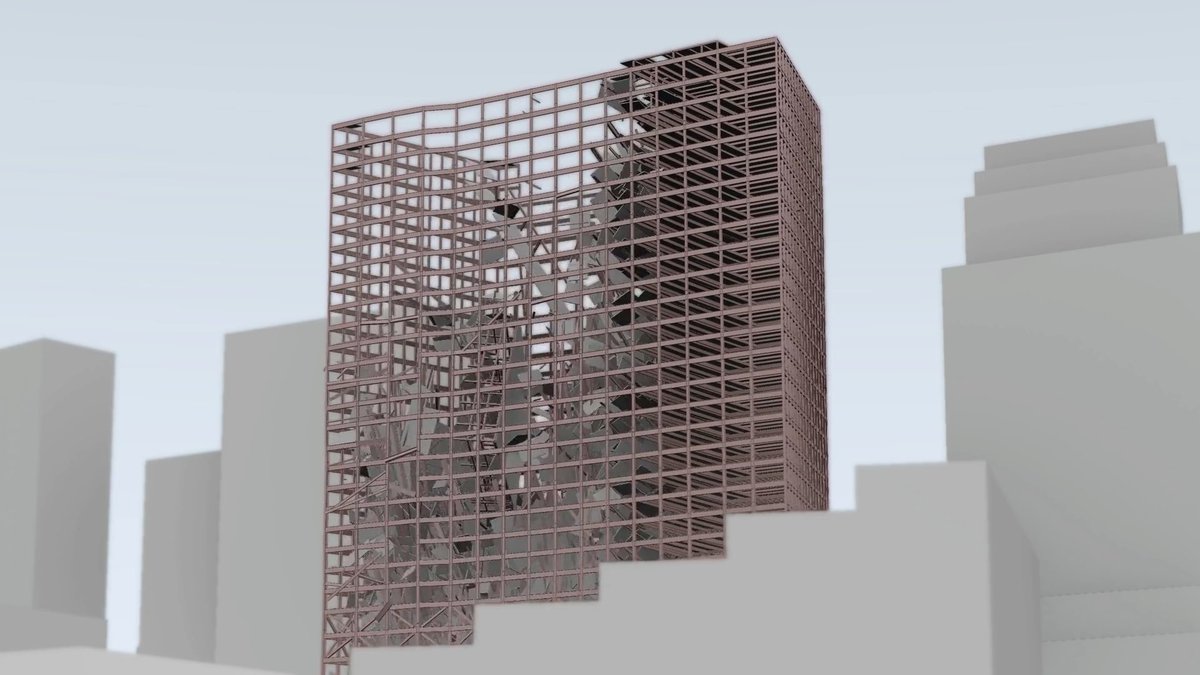
My prior post featured simulations by Kostack Studio of the Twin Towers collapses. What made those especially fascinating to me was that they removed the smoke, debris, and surrounding visual clutter, making it easier to see the broader structural behavior that the real footage often obscures. By far the most common response in the comments was: “Now do Building 7.” Fair enough. So here is Building 7. Before getting into the simulation itself, a quick reminder of the basic context: WTC 7 was not struck by an airplane, but it was heavily damaged when debris from the collapse of the North Tower tore a large gash into its south face. That debris ignited fires on multiple floors. The building’s water supply and fire suppression capability were severely compromised, firefighters were eventually pulled back for safety reasons, and the fires were left to burn uncontrolled for nearly seven hours before the building finally collapsed at 5:20 p.m. What I find so impressive here is not just the final animation, but what went into producing it. According to the creator, this WTC 7 simulation was built using more than 28,000 structural elements and roughly 703,000 constraints, incorporating actual steel dimensions, steel thickness, plastic deformation, and connection-breaking behavior derived from physical parameters. In other words, this is not some cartoon sketch of a collapse. It is a serious attempt to model large-scale structural behavior as faithfully as possible with the information available. And I also appreciate the creator’s candor. He does not pretend this simulation is a perfect recreation of exactly what happened, down to every beam, every floor panel, and every fragment. Nobody can do that. A real collapse of this complexity becomes chaotic very quickly, and even with extensive modeling there are limits to what can be known with absolute precision. That honesty is part of what makes the project more compelling to me, not less. This is not being presented as an official NIST model, and it is not being offered as final proof of every detail. It is a visualization - an informed structural simulation built from the available evidence, the known geometry of the building, video observations, and the broader body of engineering work that has been done over the years by NIST and others. And that is exactly why I find it worth sharing. One of the biggest problems in discussing WTC 7 is that most people only know the exterior video. They see the outer shell descend and then leap immediately to conclusions. What they usually do not see is the internal failure sequence that, according to NIST and many subsequent analyses, was already underway before the visible exterior drop. This simulation helps make that concept easier to understand. It does not settle every argument. It does not reproduce every last detail with magical perfection. But it does provide a serious, visually clear attempt to show how the building could fail internally before the exterior facade gave way, and why the final visible descent can look simpler from the outside than the underlying structural reality actually was. So no, none of us should pretend this is “exactly” what happened in every microscopic detail. But as a close large-scale reproduction built from the best information available, I think it is genuinely fascinating. And given how many people demanded “Now do Building 7,” I hope this helps answer at least some of those questions.

Alex Boge

282,186 просмотров • 20 дней назад

My prior post featured simulations by Kostack Studio of the Twin Towers collapses. What made those especially fascinating to me was that they removed the smoke, debris, and surrounding visual clutter, making it easier to see the broader structural behavior that the real footage often obscures. By far the most common response in the comments was: “Now do Building 7.” Fair enough. So here is Building 7. Before getting into the simulation itself, a quick reminder of the basic context: WTC 7 was not struck by an airplane, but it was heavily damaged when debris from the collapse of the North Tower tore a large gash into its south face. That debris ignited fires on multiple floors. The building’s water supply and fire suppression capability were severely compromised, firefighters were eventually pulled back for safety reasons, and the fires were left to burn uncontrolled for nearly seven hours before the building finally collapsed at 5:20 p.m. What I find so impressive here is not just the final animation, but what went into producing it. According to the creator, this WTC 7 simulation was built using more than 28,000 structural elements and roughly 703,000 constraints, incorporating actual steel dimensions, steel thickness, plastic deformation, and connection-breaking behavior derived from physical parameters. In other words, this is not some cartoon sketch of a collapse. It is a serious attempt to model large-scale structural behavior as faithfully as possible with the information available. And I also appreciate the creator’s candor. He does not pretend this simulation is a perfect recreation of exactly what happened, down to every beam, every floor panel, and every fragment. Nobody can do that. A real collapse of this complexity becomes chaotic very quickly, and even with extensive modeling there are limits to what can be known with absolute precision. That honesty is part of what makes the project more compelling to me, not less. This is not being presented as an official NIST model, and it is not being offered as final proof of every detail. It is a visualization - an informed structural simulation built from the available evidence, the known geometry of the building, video observations, and the broader body of engineering work that has been done over the years by NIST and others. And that is exactly why I find it worth sharing. One of the biggest problems in discussing WTC 7 is that most people only know the exterior video. They see the outer shell descend and then leap immediately to conclusions. What they usually do not see is the internal failure sequence that, according to NIST and many subsequent analyses, was already underway before the visible exterior drop. This simulation helps make that concept easier to understand. It does not settle every argument. It does not reproduce every last detail with magical perfection. But it does provide a serious, visually clear attempt to show how the building could fail internally before the exterior facade gave way, and why the final visible descent can look simpler from the outside than the underlying structural reality actually was. So no, none of us should pretend this is “exactly” what happened in every microscopic detail. But as a close large-scale reproduction built from the best information available, I think it is genuinely fascinating. And given how many people demanded “Now do Building 7,” I hope this helps answer at least some of those questions.

Alex Boge

51,630 просмотров • 19 дней назад

🧵 India: Once the West’s Trump card against China; today, an object for Trump’s disdain In Trump’s eyes, India has lost all value. Now it’s just a liability Washington is eager to discard — even shove into the arms of Russia and China. Whoever takes in India inherits a burden. On July 30, 2025, Trump managed to humiliate India from head to toe in the span of 48 hours — four consecutive posts, each sharper than the last. First came the announcement: a 25% tariff on Indian goods, the highest rate ever imposed on a so-called U.S. “quasi-ally.” Then, he dug up old grievances — accusing India of buying Russian oil to fund the war. Next, he proudly declared a new U.S.–Pakistan oil deal, sneering that India might as well go buy its fuel from Pakistan in the future. Finally, with maximum sarcasm, he called India a “dead economy.” The U.S. Treasury Secretary, Bessent, quickly picked up the baton, declaring to the effect that India was an insignificant country with no real role in shaping the global order. For a proud nation obsessed with becoming a permanent member of the UN Security Council, that was a dagger straight to the heart. Inside India, the outrage was instant. Tens of thousands of Indian netizens flooded Trump’s accounts, calling him everything from a pedophile to a dog. Celebrity anchor Palki Sharma dedicated a full 15-minute morning segment to tearing into the unreasonable Trump. Members of parliament demanded that Prime Minister Modi issue a strong response. But Modi stayed silent. Instead, he repeated — over and over — that India would one day become the world’s third-largest economy. Why the silence? Because Modi is cornered. For nearly a decade, India has basked in the warm glow of Western — especially American — strategic attention, hailed as a pillar of the “Indo-Pacific” strategy against China. But look closely at the Quad — the U.S., Japan, Australia, and India — and it’s clear who is the intruder. Japan is Washington’s adopted son, hosting U.S. troops. Australia is the younger cousin, also home to American bases. India has neither sentimental ties nor military dependence. So why choose India? Not for its cow dung as fuel and medicine or the taste of its curry. The reason is simple: since the U.S.–China trade war, Washington has been desperate to reduce reliance on Chinese goods. Full decoupling proved impossible — it might collapse the U.S. before China. So “de-risking” became the new mantra: shift supply chains, replace Chinese products step by step. India is key to this decoupling/derisking from China strategy. India is central to this strategy. The U.S. urged multinationals to relocate manufacturing there. Yet reality quickly set in: India is not up to the mark. Multinationals soon realize that India will never replace China. Under Biden, relations with India warmed rapidly. New factories, Apple’s supply chain moving south, arms sales — even talk of selling the F-35. Washington bankrolled Modi’s allies, financing Adani Group's Colombo port project in Sri Lanka with $553 million. The goal was clear: turn India into a heavyweight capable of making trouble for China — economically, militarily, politically. And how did India repay this generosity? By reselling Russian oil to Europe for massive profits. By snatching oil contracts from American companies. By wrecking U.S. plans for the Indo-Pacific Economic Framework. By passing laws that hiked compliance costs for Apple and Google, and squeezed American NGOs out of 40% of their operating space. Even plotting assassination of Gurpatwant Singh Pannun, a U.S.-Canadian dual citizen and Sikh separatist leader on U.S. soil during Modi’s state visit on June 22, 2023. In short — a partner in name, a spoiler in practice.

America-China Watcher

41,978 просмотров • 1 год назад

⃤ Video of a Black Triangle - What's the Frequency, Gerry? ⃤ "A very clear visual representation of what was on the radar. It resembled a very black, triangular or delta shape to it" "It was always slightly out of focus for some reason." "Garry Nolan told us to watch for the cloud formations." (If you scroll down to the bottom, I'll tell you the exact time stamps for each the UAP videos that were shown.) "We believe [it's NHI]. Either that or some very sophisticated technology that maybe we're reverse engineering." "There was a specific electronic signature (frequency) emanating from them when they were going into or coming out of the water, so they were easy to track." ~Bob Fish ~ Gerry Tedesco: August 29th, "we were in the RV, running tests on our equipment because we was planning on going out that weekend." John Tedesco: "And we noticed that we had a signature (on their spectrum analyzer) there that was well presented, very unusual for the area. And we kind of collaborated that with some radar data. Radar seemed to align with what we had on the spectrum analyzer. The object, we believe, was over the water at that point, simply because of the distance that we were able to capture it on the radar. It presented in a cloud layer, exited a cloud layer, produced a signature." Gerry; "This was a single thunderstorm cloud in the sky and the weather was great. We had cumulous clouds out there, mostly clear. And this was a dark, cumulonimbus cloud. It was a very dark thunderstorm cloud, and it looked out a place. " Ross Coulthart: "Do you think that that cloud might have been a fake cloud?" Donna Lee Nardo: "So Garry P. Nolan, he came out with us for our field study one night. He told us, Watch for the cloud formations.' And John, Gerry, and I saw one really nasty-looking...it looked like 10 motherships situated...oriented north to south, one night when we were doing the field study. And I believe this was early on in 2022. And it also was a clear night, but it just looked out of place. It was dark, yet there were lighted portions. But it was just so humongous. And we always remember that Garry had said, look at the cloud formations." Gerry: "Yeah, we definitely had some oddities out there." Coulthart: "I've had people, multiple people have sent me imagery. There's quite famous ones on YouTube where you see what looks like a cloud, and it's shaped just ever so slightly like a disc or a craft. And it's got the fluffy edges of a cloud, and then it suddenly maneuvers and just moves away. And I sometimes wonder whether something or someone is using clouds as a form of stealth or signature management." Gerry: "That's a possibility. We look at that, we look to see if it is a cloud. We use shortwave infrared, which does pick up moisture. And it'll actually differentiate the precipitation in a cloud, or moisture in a cloud, so we know it is a real cloud." Coulhart: "Did you do that with this cloud that night?" John: "Exactly, exactly. And this is something that we could determine that there wasn't moisture content." Coulthart: "So you were able to show it wasn't a classic cumulonimbus cloud, even though it looked like one." John: "No, no. Yeah, and the object was well hidden for a short period of time. Actually, relatively long period of time before it emerged from the cloud body." Coulthart: "So Donna is probably right: This is probably some kind of intelligent stealth management by something." Gerry: "It's a possibility." Donna: "Possibly." John: "It could very well be." (I like how all three will only go as far as, Possible and Could be.) Coulthart: "This is where it gets really interesting. Talk me through what happens next. " Gerry: "Okay, so we watched an object emerge from the cloud on radar. John and I quickly went to get our binoculars, we have what's called Vortex binoculars. These are high-end binoculars, great optical glass. John had began looking at the cloud with those, and he told me, we both went outside. I was trying to find one of the other cameras, scrambling, trying to get one of the other cameras going. "And John said, 'There's a black object moving between the cloud.' And then it was emerging from the cloud. So I grabbed my cell phone and videotaped it. While John was looking at them, we switched. And what we saw was something...originally it resembled a very black, triangular or delta shape to it, or bell shape to it. It had that Delta shape, or triangular shape." Coulthart: "And was this showing up on radar at this stage, that delta shape?" Gerry: "Yes." John: "Yes." Coulthart: "Wow!" John: "Yes, we did have a radar target." Gerry: "We tracked it on radar. On radar, it appears to separate into two more objects, which is quite interesting." Coulthart: "You found something interesting in the frequency, and you can't talk about it, can you? Has the FBI asked you, not to talk about it?" Gerry: "Yes, that's the sensitive part. There was quite a bit of interesting signals, but that goes into signals intelligence, which we can't talk about." Coulthart: "Just let me guess. 1.6 by any chance?" (They all laugh) Donna: "You've been talking to people." Gerry: "No comment." Coulthart: "No, it just fascinates me. Is it 1.6 gigahertz, or megahertz? I'm trying to remember." John: "It's gigahertz. Yeah, I know with Skinwalker Ranch, I know the one, 1.6 seems to come up quite a bit. There's also a three-gigahertz signal, supposedly." Gerry: "There's a few others, too. We'll leave it at that." Coulthart: "No, but it's interesting. It's such a consistent thing, and I'm really interested because all around the world, people are contacting me, talking about 1.6, in particular, but also about three gigahertz. And nobody's explaining it. But often it's an indicator." ~~~From My Bob Fish Blog~~~ Bob Fish: "In that same TS/SCI building cafeteria in El Segundo, I had lunch with a senior USAF NCO who had worked for Project Blue Book in the 1970s (after it had been 'officially disbanded'). He was an ELINT technician (electronic intelligence) who flew in RC-135s from MacDill AFB in Florida. The 'normal' target was Cuba where they did lots of snooping and sometimes challenging the Cubans to turn on radar and other systems. "He said there were times when they were diverted from these missions to track UFOs off the east coast of Florida. His claim was that UFOs had a landing and takeoff spot in the ocean east of Miami, north of Bermuda. He also claimed there was a specific electronic signature (frequency) emanating from them when they were going into or coming out of the water, so they were easy to track. On several occasions they filmed the UFO as it transitioned from water to air or vice versa. High quality film of UFOs is 'out there' somewhere!" (What was the signature? 1.6 gigahertz? 3.0?) ~~~End Bob Fish Excerpt~~~ Coulthart: "And as you say - without giving away the frequency that you detected - you detected a frequency anomaly on your spectrum analyzer. You saw it there. Then you got it on your radar. And then when you visually observed it with the binoculars, the vortex binoculars, you then corroborated that object on the radar as well. So you've got four separate data points to corroborate something anomalous." John: "And a very, very clear visual representation of what was on the radar. The interesting thing I will say that we had observed flights of commercial aircraft at the same time through these lenses, these very clear lenses that we use. The commercial aircraft was extremely detailed, in focus. You can even make out the writing on the on the aircraft. The object itself? No." Gerry: "It was always slightly out of focus for some reason." John: "It was poorly presented." Coulthart: "And you gents would understand, and I'm sure Donna as well, that the Alcubierre-drive principles. That, essentially, if something is coming, if it's warping space time, there's allegedly some kind of plasma or some kind of distortion field around the object. Do you think that might explain what you were seeing? Gerry: That's a possibility." John: "That's a very strong possibility." Gerry: "It's something we're looking into. There was also, there was a shimmer around it. Definitely a possibility of some kind of field effect around it." ~~~ Time Stamps Extremely bright, luminous sphere over the ocean. Not visible to the naked eye. - 13:33 The Black Triangle - 33:31 Orb-Like Object Over Land in Farmingville, N.Y. (Where my sister lives) ~ 58:18 Similar to what @MeaganOurada saw - 1:14:05

Joe Murgia

14,232 просмотров • 10 месяцев назад

Important reminder Binance CZ 🔶 BNB 🚨 Remember what Binance did to us on 10.10. The big picture here. Here is a summary, an analysis, a reminder, and a warning. Never forget. Whoever has too much power is too dangerous. 🔺 1. What happened on 10.10: On 10 October 2025 the crypto market suffered the largest single liquidation event in its history. More than 19 billion USD in leveraged positions were wiped out within hours, affecting well over 1.6 million traders across all major venues. Bitcoin had just printed an all time high above 122000 USD. Within the 10 to 11 October window it crashed to lows around 104000 to 110000 USD, a drawdown of 10 to 15 percent in less than a day. This day is now referenced across mainstream media, research and exchanges simply as 10/10. The trigger in the headlines was clear: ▶️ Trump announced additional 100 percent tariffs on Chinese imports. US China trade war reignited. But the scale and structure of the crypto damage did not match a normal macro move. They matched a structural failure inside the plumbing of one venue. That venue is Binance. 🔺 2. Binance: Before the crash Binance handled: ▶️ 60 to 70 percent of global USDT altcoin spot volume ▶️ The deepest unified collateral system in crypto ▶️ Cross margin links across spot, futures, options and structured products Independent data providers like Kaiko and CoinGlass consistently identify Binance as the global price discovery engine for altcoins. On 10.10 that centralization became a single point of catastrophic failure. Across research from Kaiko, CoinGlass, Coindesk, Aurpay, Galaxy and independent analysts: ▶️ Binance order book depth collapsed more than any other exchange ▶️ Venue specific collateral assets broke first and hardest on Binance ▶️ Liquidations elsewhere followed Binance with multi minute lag ▶️ On chain and off chain data show certain wallets profited massively from the failure pattern This was a centralized system imploding under stress. 🔺 3. The Binance specific anomalies: Three Binance collateral assets behaved abnormally: ▶️ USDe traded at 0.62 to 0.65 USD on Binance while near 1 USD elsewhere ▶️ wBETH printed 430 USD while ETH traded near 3500 USD on other venues ▶️ BNSOL printed 34.9 USD while far higher elsewhere Insights4vc and Galaxy found ATOM, ENJ and other majors printed near zero only on Binance. Global markets remained far above. When you see: 1 exchange 3 collateral assets 80 to 99 percent divergence Invalid prices Frozen liquidity You are seeing a matching engine and oracle collapse. Binance later called this a “technical ghost”. It behaved like a centralized kill switch. 🔺 4. The liquidation cascade and ADL CoinGlass, Reuters and FT all agree: 10.10 created the largest liquidation cascade in crypto history. More than 19 billion USD were liquidated. But this number is only the visible liquidation counter. It does not include: • ADL reductions on profitable positions • Forced margin reductions not registered as liquidations • Collateral destruction from oracle mispricing • Spot positions force closed • Options and structured product collateral failures • Off book desk unwinds and hidden exposure reductions When analysts reconstruct the full chain, the true economic unwind is well above 40 billion USD. Several market structure estimates place the systemic damage between 60 and 100 billion USD. 19B is what dashboards show. 40B+ is what the market absorbed. Insights4vc documented: ▶️ Thousands of liquidations per second ▶️ Hyperliquid triggered ADL ▶️ Binance triggered its own ADL events Distorted Binance prices fed industry oracles and dragged the global market down. 🔺 5. On chain and off chain fingerprints: Wallet 0xb317..: ▶️ 192 million USD BTC short during crash ▶️ 163 million USD short after ▶️ Perfect timing with Binance anomalies Binance publicly acknowledged peg failures in USDe, wBETH and BNSOL. Zero prints happened only on Binance. The data convicts the structure. 🔺 6. Collapse of Fake Liquidity: Altcoins that went to zero on Binance did not do so elsewhere. Spoof liquidity, wash trading and internalized market making created an illusion of depth that vanished instantly under stress. 🔺 7. Comparison with fair, regulated markets: On NASDAQ: Market makers must quote both sides Liquidity withdrawal requires approval Wash trading is prohibited Exchanges cannot run secret market makers On 10.10 Binance’s order book had a buy side vacuum with no notice and no accountability. 🔺 8. Binance’s regulatory vacuum and conflict of incentives: Longs were liquidated. Shorts were ADL’d. Delta neutral strategies were wiped out. In an unregulated venue generating 70 million USD per day in fees, fairness is not enforced. 🔺 9. Evidence Binance refuses to provide: Mark price logs Oracle inputs Liquidation engine data ADL queues Insurance fund movements Engine parameters Matching neutrality proof None provided. 🔺 10. Why “never forget” matters: A single exchange distorted global prices in minutes. Fake liquidity collapsed. Oracle flaws vaporized billions. Unified margin amplified everything. 🔺 11. The message The data is here. The traces are here. The failures are documented. Remember what Binance did to us on 10.10. Concentrated power in crypto is systemic fragility with better marketing. Power is liquidity. Only users decide who holds it. Thanks for reading. — by $MASTR crypto project

MASTR

17,432 просмотров • 7 месяцев назад

В запутанной истории, связанной с исками и уголовными делами, начатыми «РОСНАНО» против Анатолия Чубайса и его команды проявился новый, ранее скрытый сюжет. По мнению источника ВЧК-ОГПУ и то, что многим казалось банальным корпоративным конфликтом, борьбой против коррупции - на поверку оказалось изящной многоходовкой в борьбе за власть внутри властной вертикали, отображением тихой, но жесткой аппаратной война между руководителем АП Антоном Вайно, с одной стороны и его заместителем Сергеем Кириенко – с другой стороны. Катализатором же событий стал руководитель РОСНАНО Сергей Куликов, который давно и безуспешно пытался «бороться с тяжелым наследием Чубайса». С 2023 года РОСНАНО буквально закидало СК РФ, СД МВД, ФСБ и прокуратуру всевозможными справками, описывающими ситуацию, как внутри РОСНАНО, так и в проектных компаниях, но где то не хватало фактуры, где то состав был совсем натянутым, где то само РОСНАНО притормаживало дела – в результате дела не возбуждались, гражданские иски не инициировались. По словам источника, весной 2024 года на стол Вайно легла докладная записка Куликова о ситуации в РОСНАНО. Касалась записка вопросов, связанных с погашением кредитов и займов госкорпорации, но в приложениях были расписаны вполне конкретные кейсы: проект Пластик Лоджик, Лиотех, Крокус, ситуация с привлечением займов без госгарантий. Скучная справка привлекла внимание высокими фамилиями: так Набиуллина и Силуанов выступали ответственными за выпуск облигационных займов, а Кириенко, Фурсенко и еще целый ряд фамилий – за утверждение целого ряд провальных проектов. Данные товарищи, будучи членами наблюдательного совета ГК Роснанотех, окончательно одобрили «заведомо убыточные проекты». Это и решило дело. Начали издалека - с руководителей проектных компаний. Чубайса на первом этапе не преследовали, но потом дошла и его очередь. Триггером всех этих процессов все же стал не сам Чубайс, а наличие в делах потенциальных высокопоставленных фигурантов, которые должны были всплыть и всплыли в процессе рассмотрения дел. В первую очередь Кириенко, который долгое время был соратником Чубайса. Это уже потом жизнь развела Кириенко и Чубайса так, что один стал слишком токсичным для другого. А до этого же все было хорошо. Переплетений Чубайса и Кириенко так много, что даже нет смысла вспоминать: Союз правых сил и выборы в Госдуму образца 2004 года. Кириенко сидел в набсовете РОСНАНО, проекты одобрял, к мнению Чубайса прислушивался. Когда стало совсем плохо в ХК Композит (компания по производству препрегов, руководил которой ближайший соратник Чубайса еще по РАО ЕЭС и первый арестант из РОСНАНО Меламед), именно Росатом (подконтролен Кириенко) выкупил Композит и спас и Чубайса, и Меламеда, и компанию. Короче, атака на Кириенко через Чубайса выглядит безупречно, но самое главное, что есть Сергей Куликов - нынешний руководитель РОСНАНО, который готов быть на острие гражданских процессов. А варианты защиты - все очень сомнительные. Есть вариант, что виноватым сделают руководителей комитетов РОСНАНО – мол, ввели в заблуждение членов набсовета. Рабочая схема, которая позволяет обезжирить еще пару тройку соратников Чубайса - в том числе и Павла Теплухина (Тройка диалог, Дойче банк и другие). По словам собеседника, Чубайс, при всех его грехах и неоднозначной репутации, оказался пешкой в чужой игре. Его враги (а их много) с удовольствием наблюдают за его падением. Куликов, с подачи Вайно, стал тараном для репутации целой плеяды фигур большого масштаба, в первую очередь Кириенко. A new, previously hidden plot has emerged in the convoluted story surrounding the lawsuits and criminal cases filed by RUSNANO against Anatoly Chubais and his team. According to a source at the Cheka-OGPU and what many thought was a banal corporate conflict, a fight against corruption, turned out to be an elegant, multi-move power struggle within the vertical power structure, a reflection of the quiet but brutal bureaucratic war between the head of the Administration of the President, Anton Vaino, on one side, and his deputy, Sergei Kiriyenko, on the other. The catalyst for these events was RUSNANO head Sergei Kulikov, who had long and unsuccessfully tried to "combat Chubais's difficult legacy." Since 2023, RUSNANO has been literally bombarding the Investigative Committee of the Russian Federation, the Investigative Committee of the Ministry of Internal Affairs, the Federal Security Service, and the Prosecutor's Office with all sorts of reports describing the situation both within RUSNANO and in the project companies. However, in some cases, the facts were lacking, in others, the composition of the reports was completely tenuous, and in others, RUSNANO itself stalled the cases – as a result, no cases were opened, and civil lawsuits were not initiated. According to the source, in the spring of 2024, a memo from Kulikov on the situation at RUSNANO landed on Vaino's desk. The memo addressed issues related to the repayment of the state corporation's loans and borrowings, but the appendices detailed very specific cases: the Plastic Logic project, Liotech, Crocus, and the situation with obtaining loans without state guarantees. A dull report attracted attention because of the high-profile names involved: Nabiullina and Siluanov were responsible for issuing bonds, while Kiriyenko, Fursenko, and a host of others were responsible for approving a number of failed projects. These comrades, as members of the supervisory board of the Rusnanotech State Corporation, gave final approval to "obviously unprofitable projects." This is what sealed the deal. They started from afar, with the heads of the project companies. Chubais wasn't prosecuted at the outset, but his turn came later. The trigger for all these processes, however, wasn't Chubais himself, but the presence of potential high-ranking figures in the cases, who were bound to emerge and did emerge during the investigation. First and foremost, Kiriyenko, a longtime associate of Chubais. It was only later that life separated Kiriyenko and Chubais, to the point where one became too toxic for the other. Before that, everything was fine. There are so many connections between Chubais and Kiriyenko that it's pointless to even recount them: the Union of Right Forces and the 2004 State Duma elections. Kiriyenko sat on the RUSNANO supervisory board, approved projects, and listened to Chubais's opinions. When things got really bad at Kompozit Holding Company (a prepreg company run by Melamed, a close associate of Chubais from his days at RAO UES and the first person arrested at RUSNANO), it was Rosatom (controlled by Kiriyenko) that bought Kompozit and saved Chubais, Melamed, and the company. In short, the attack on Kiriyenko via Chubais looks flawless, but the most important thing is that there's Sergei Kulikov, the current head of RUSNANO, who is prepared to be at the forefront of civil lawsuits. And the defense options are all very dubious. One option is to blame the heads of RUSNANO committees, claiming they misled the members of the supervisory board. A working scheme that allows for the elimination of a couple of Chubais's associates, including Pavel Teplukhin (Troika Dialog, Deutsche Bank, and others). According to the source, Chubais, despite all his sins and ambiguous reputation, has become a pawn in someone else's game. His enemies (and there are many) are watching his downfall with relish. Kulikov, at Vaino's instigation, has become a battering ram for the reputations of a whole host of high-profile figures, most notably Kiriyenko.

ВЧК ОГПУ (Истина любит действовать открыто).

18,499 просмотров • 6 месяцев назад

THE AMALGAVERSE Launches Monday, September 21st at 12:01 p.m. ET🚀 1. What is the Amalgaverse? The Amalgaverse is a shared sandbox of fictional SF universes that will serve as the setting for a series of missions that will play out as episodic adventures in the style of the beloved ship-based sci-fi shows of the 90's. 2. How will these missions play out? The missions will play out in the form of an online choose-your-own-adventure format with fan voting driving the narrative. YOU choose the missions. YOU select the away teams. YOU make the decisions that shape each adventure. For instance, initially you will be given four missions to choose from. Depending on which one you choose, you’ll be presented with a scenario – a damaged ship, a space station, a planet – and may be asked how you intend to get there. Maybe you like to fly in on the jumper. Maybe you’d rather try an EVA. Or perhaps you’d prefer to just directly beam aboard. Then, who is on your away team? Which corridor will you turn down? How will you react to the threat? And so on. Whatever course of action you choose will inform the next step. 3. In what capacity will I be making these decisions? Sometimes, you will be deciding as yourself, our 20th crew member. Sometimes, you will be deciding on behalf of any of your fellow crew members. Still other times, you will be deciding on behalf of the crew as a whole. 4. What happens if we make a decision that goes against the plot you had in mind? Each adventure has multiple paths and subplots. Your vote directs which one we follow. There is no single “correct” route, and mission success is NOT guaranteed. 5. I’m at work all day. Will I miss it? No. I’ll be updating every step of our adventure daily at 12:01 p.m. E.T. The fandom will have 24 hours to weigh in and decide on a course of action. Majority rules. Every update will be pinned at the top of my timeline. Just please be sure to turn on notifications so you don’t miss the most recent posts. 6. Can I jump in mid-mission, or do I have to wait for the next episode?" Jump in anytime. Every post contains a recap to get you up to speed immediately. You don’t need to have voted on day one to weigh in on day twelve. 7. Will you be using X’s polling feature to count votes? No, for two equally valid reasons. First, X won’t let me include both a visual AND a poll in a dedicated post, and the visual matters more to me. Second, I don’t want to just know HOW you vote, I want to know WHY you vote a certain way. Your overall reasoning will also factor into how your mission plays out. 8. Will you be offering a summary with each update? Yes. Every new installment will open with a short “story so far,” then a more detailed summary in the second part of that same post. Each installment will also quote-tweet the previous one, so you can walk the full chain if you want every beat. 9. How long will each adventure run? 3-4 weeks. They have been structured like a television episode – 5 acts, with roughly 5 beats (decision points) per act. Each mission should feel like you’re experiencing a classic sci-fi t.v. episode. Just like old times! 10. Will the choices we make carry forward into future missions? Yes. If you lose the F-302, the puddle jumper, or a crew member over the course of a mission, they will be lost for future missions. Your choices will have consequences. 11. How many missions have you designed? Since these missions will play out like episodes from those beloved ship-based sci-fi shows of the 90's, I've structured a similar rollout. Ten missions to start followed by a brief hiatus after which the back half ten episodes will unfold. 20 missions/episodes in total. That will be our first season. And depending on fan response, a second season could be in the cards. 12. Will you be offering a summary of each adventure once complete? Not at launch. 13. This seems like a lot of work. Why are you doing this? I'm tired of crafting stories (pitches, pilots scripts, series bibles) that never see the light of day, always subject to the whims of gormless executives. Science fiction is a tough sell. Far future sci-fi, tougher still. Far future ship-based sci-fi, toughest of all. But that's my jam. And I've missed it. So this allows me to do what I do best, exercise those creative muscles, and hopefully give SF fans something to look forward to with every mission. For entertainment purposes only of course. 14. But, characters aside, couldn't you just turn these stories into a script you can try selling or a book you could publish? Wouldn't that be more lucrative? Sure, in theory. But the odds of selling far-future, ship-based sci-fi right now are microscopic, and I’d rather actually make something people can experience today than stick another finished script in a digital drawer. As for a novel? That’s a massive solitary grind. This is fast, interactive, and fun. 15. Will there be guest stars throughout? I’m concentrating on this crew first. Guest appearances are possible later. 16. I get motion sick. Should I worry? No. The ship has inertial dampers. The ride will be smoother than a luxury liner. 17. Okay, enough questions. When do we get started? The adventures begin Monday, September 21st at 12:01 p.m. E.T., here on X. Set a reminder and turn on notifications so you don't miss a beat!

Joseph Mallozzi 🏴‍☠️

41,565 просмотров • 11 дней назад

If you watch this ~50 minute screen recording closely (yeah, I know, it's long; there are also some times when my computer was very slow and laggy, just skip past that part. And at one point I had to run and get my 9-month-old a new bottle and left it on a boring screen, sorry!), I believe you can see real signs of the kind of runaway, recursive AI self-improvement that people have been warning of for a while (Mr. Kurzweil most notably and prophetically). Why do I say that? What's different now? Well, there's a reason my set of agent coding tooling is called the Flywheel. These tools all mutually self-reinforce each other. And they all flow directly into my ntm tool (short for "named_tmux_manager"), which acts as a sort of integration point and nerve center for the tools (this is becoming more true by the minute as I'm now seriously working on ntm). Now, ntm was something I started making to automate some aspects of my workflow, but it was the kind of thing where, until it was perfect, it sort of just slowed me down. So I didn't actually use it even though I kept working on it and trying to improve it, and suggested to users that they try it in my tutorials. Well anyway, I finally got around to "dogfooding" ntm last night, and now it's going to get very dramatically better at an alarming rate. Some of that is from applying my "idea wizard" prompt to generate more useful features and building that stuff out and addressing obvious pain points I encountered during my newfound usage of the tool. But a lot comes from my realization that, once again, ntm's true utility is not as a tool for ME, but for an agent. That is, ntm lets one instance of Claude Code or Codex act as, well, me, do the things that I had been doing manually. Do I wish I had started using ntm earlier? No, for two big reasons: 1) Doing it manually helped me build up my intuition massively, which directly led me down the path of creating useful prompt strategies and workflows; these often began as ad-hoc prompts that I realized could be generalized and made more versatile/universal. Lesson: don't prematurely automate until you have an intimate, intuitive feel for your "core value-add loop." Otherwise you'll have a fully automated system quickly that efficiently and automatically does a stupid or otherwise sub-optimal thing. 2) My eyes have been opened to the beauty and power of Skills. I'm not talking about your garden-variety skills that are just a simple markdown file. I'm talking about true tour-de-force directories of perfectly structured and organized files that are filled with good information, insights, workflows, etc., but presented in a way that is highly optimized for consumption by AI agents, with extreme attention paid to things like perfect progressive disclosure, token density, agent-ergonomics, agent-intuitiveness, etc. And also Skills that go way beyond markdown files, with full integration into Claude Code where it makes sense via hooks, sub-agents, and even Python scripts. These kinds of skills are a qualitative difference in expressive power and usefulness and a total game changer. They are also effectively composable, creating almost an algebra of skills that let you use them together in powerful ways. I'm working on a subscription service website and CLI tool now to share what I've learned here most effectively, stay tuned for that in the coming days. Anyway, I now know what to make and how to make it. So, getting back to that screen recording, what does it show that makes me claim recursive self-improvement is here? If you keep your eye on the upper left tmux pane, that's the "controller" agent. It is using ntm to control all the other panes which are also running Claude Code (but ntm fully supports other agent types like Codex and Gemini-CLI, and it's trivially easy to mix and match them if you wanted to have, say, 8 CCs and 6 Codexes for writing the code and 3 Gemini-CLIs for reviewing code.) Now, there's nothing that crazy about this much so far. But where it starts to get very cool is that as the session continues and we encounter real-world problems, things like my ridiculously overloaded computer that keeps hanging for long periods, Claude Code instances that crash and get into a frozen, unresponsive state, it can learn from that. And you can see it using my skill writing skill to refine its ntm vibe coding skill in real time. And then take that skill and refine it to be more intuitive for itself. Or use my cass tool skill to search all the session histories to look for problems that came up and strategize how to solve them. The most useful part was when, towards the end of the session, I told it to reflect on all the things we had done and problems we encountered. One way it can usefully leverage those reflections is by improving its ntm vibe coding skill to make it cover more edge cases and exigencies. But the other, more fundamental, way is for it to conceive of and design the optimal new features and functionality for ntm itself so that the tool embodies those lessons in a first-class way. This offloads cognition from its brain onto its tooling, just like how a person can lean on spellcheck or a calculator. It codifies correct, effective reasoning at the tool level, where it's more reliable and robust and repeatable. And btw, did you notice what code base it was working on the whole time? It was none other than ntm itself! So as it worked on its own tool, it had reflections and ideas about how to further improve the tool. Now, it could have just as easily gotten those insights and ideas while using ntm to work on a different project, but the fact that it was working on itself is almost gloriously meta and recursive. So by the end, after learning from tending to a big group of agent workers (btw, I have previously emphasized doing everything in a really distributed/decentralized way, where each fungible agent gets identical marching orders that tell it to use my bv tool to find the optimal bead to work on. This does work very well, but occasionally results in some contention and overlap from thundering herd, or at least wastes time/tokens/communication in avoiding that before the agents waste time duplicating work. But in this new ntm-oriented workflow, I was able to have the controller agent in the upper left use bv itself and then optimally parcel out the instructions to each agent so that we could know for sure that there's no overlap), I ended up with a ton of new beads for new features, which I had it optimize and polish a few times. Now I can swap to a new Claude Max account and have the swarm implement all those new features! It should only take a couple passes like the one shown in the screen recording to get everything implemented. Then we can rinse and repeat, having the agent read through the full session histories of each agent and its experience from its own session in sending ntm commands and seeing how they worked out in practice, to come up with the next batch of changes to both its ntm vibe coding skill AND to the ntm tool itself. Do you see how rapidly this turns into Skynet? My mistake earlier was in focusing on making myself a "faster horse" as Henry Ford used to joke about customers wanting before he showed them what they should really want (a Model T). That is, something that would make my experience nicer while doing this agent swarm based development workflow. But the obvious lesson is that you should make all your tooling agent-first because the agents are just better at this stuff. You can still watch, and of course I did add a ridiculous number of very nice human-centric features to ntm that you'll be seeing in the next day or two, but those are really kind of "for fun" to make us humans feel better about the process. All the real value-add is happening "by agents, for agents." PS: Towards the end, you can see me switch to my Mac and tell Claude to improve the skill that I made earlier today for taking the mkv screen recording files from OBS Studio and muxing them into MP4 files for sharing, while downloading songs from YouTube to serve as the background music. I made it so it can also grab the thumbnails and generate little song credit cards that show up in the lower right corner. This worked perfectly the first time! I'll include some screenshots in a response post showing how that worked, but it was awesome to witness. Skills are POWERFUL. I'll also post a link to this video on YouTube if you prefer to watch it there.

Jeffrey Emanuel

25,483 просмотров • 8 месяцев назад

🚨🚨🚨 Who do you think drops the next $XRP Ledger BOMBSHELL? Bank for International Settlements and Brazil went public with XRPL. Here’s who I think could be next, and France is at the top of my list. BIS researchers disclosed an XRP Ledger proof of concept. Brazil’s securities regulator disclosed XRPL-related market experimentation. After those two became public, I went back through the institutional connections and stopped asking whether major institutions are looking at XRP Ledger. The better question is: Who is already close enough to XRPL that another public test would actually make sense? When I went country by country, one place stood out immediately. France. 🇫🇷 France is my #1 prediction. Not because Banque de France has announced an XRPL test. It hasn’t. I’m putting France first because several separate pieces are already sitting extremely close to each other. Start with Société Générale-FORGE. SG-FORGE launched its regulated EUR CoinVertible, EURCV, directly on XRP Ledger. That means regulated euro-denominated money from a major French financial institution already exists on XRPL. Then France starts building out its wider tokenization strategy. Banque de France, the AMF and the French Treasury formed a strategic tokenization group. Look at who is involved: Société Générale BNP Paribas Crédit Agricole Euroclear Euronext LCH Amundi BPCE Caisse des Dépôts Ardian And look at what they are studying: tokenized deposits, stablecoins, wholesale central-bank money, tokenized securities, DLT market infrastructure, tokenized investment funds. That is a serious list. These are basically the pieces you need if you want to move traditional capital markets into a tokenized environment. And one of the institutions inside that ecosystem already has regulated euro money on XRP Ledger. That is what keeps France at the top of my list. Then Bpifrance enters. France’s state-backed investment bank said it will use SG-FORGE’s EUR CoinVertible for: capital-market settlement, payments, crypto/fiat activity, treasury operations, liquidity management, and securities activity. Bpifrance did not specify which EURCV blockchain deployment it will use. But the XRPL deployment already exists. So now you have a state-backed institution wanting to use regulated digital euros across capital-market and treasury activity, while that same euro asset already sits on XRP Ledger. That is a connection I’m watching hard. Then Swift shows up in the same chain. Swift and SG-FORGE have already tested tokenized-bond settlement using EURCV. Swift’s job in that experiment was interoperability. It connected tokenized systems with existing financial infrastructure. The public information does not say XRPL handled that specific transaction. I’m not claiming it did. What matters is simpler: Swift already works with SG-FORGE. SG-FORGE already has EURCV. EURCV now exists on XRP Ledger. As tokenized markets grow, somebody has to connect those networks. That is exactly what Swift wants to do. Then there is Pythagore. Banque de France and Euroclear are preparing work around tokenizing France’s roughly €310 billion NEU-CP short-term debt market, with settlement connected to the Eurosystem’s Pontes wholesale-CBDC infrastructure. Now look at what France has in one place: regulated digital euros, tokenized securities, a central bank, a state-backed investment bank, Euroclear, wholesale central-bank money, Swift interoperability, and XRP Ledger already hosting one of the regulated assets involved in that ecosystem. That is why I keep watching the combination of: EURCV + XRPL + Euroclear + Bpifrance + Banque de France + Pontes. I don’t need to say Banque de France secretly picked XRPL. There is no public announcement saying that. My prediction comes from how close the pieces already are. If France eventually reveals some form of XRPL interoperability work, it would make complete sense to me. That puts France at #1. Japan is #2. 🇯🇵 Japan is different because we already have much more direct language. SBI Ripple Asia completed a proof of concept involving tokenized bank deposits and deposit-based digital money. And SBI explicitly said the blockchain contemplated for the system is: XRP Ledger. That line matters a lot. Because a tokenized bank deposit is not just another crypto token. It is bank money becoming digitally transferable. That gets much closer to the money people actually use every day. Then SBI Ripple Asia announced additional work around blockchain financial services and again identified XRPL as contemplated infrastructure. Then SBI Ripple Asia and DSRV began studying blockchain-based remittances and payments between Japan and South Korea. XRPL was again being considered. Then RLUSD launched in Japan under the Japanese regulatory framework. So Japan already has several pieces moving together: Ripple-linked remittances. XRPL contemplated for tokenized deposits. XRPL contemplated for Japan-Korea payment infrastructure. RLUSD operating inside Japan’s regulated market. The next announcement I’m waiting for is not another exchange adding XRP. I’m waiting for a Japanese bank name. A bank publicly participating in XRPL-based tokenized JPY deposits. Or wholesale settlement. Or FX. That would take this story from SBI exploring infrastructure into actual bank-level participation. And that is why Japan sits right behind France for me. Then comes Singapore. 🇸🇬 Singapore almost does not belong on a prediction list anymore because the XRPL connection is already public. Ripple joined the Monetary Authority of Singapore’s BLOOM initiative. Ripple and Unloq are piloting programmable trade-finance settlement using: XRP Ledger + RLUSD + Ripple institutional infrastructure. Unloq’s SC+ system is built on XRPL. RLUSD can be released when trade conditions such as shipment verification are satisfied. That is a real business problem. Goods move. Conditions are verified. Payment settles. And XRPL is part of the infrastructure being tested under an MAS initiative. Then add: DBS + Franklin Templeton + Ripple. Franklin Templeton is tokenizing sgBENJI on XRP Ledger. DBS is exploring using those tokenized assets for collateralized lending and repo activity. So Singapore already has XRPL touching two very different areas: trade-finance settlement, and institutional fund collateral. That is important to me because it shows the ledger is not being pushed into one narrow use case. Different institutions are finding different reasons to use it. For Singapore, I’m not asking who tests XRPL first. I’m watching how far the existing work expands. Then the UAE. 🇦🇪 Dubai Land Department is already issuing tokenized real-estate title deeds on XRP Ledger. The wider Real Estate Tokenization Project includes: Dubai Land Department VARA Dubai Future Foundation Central Bank of the UAE And the program is moving toward secondary-market resale. That progression matters. Issuing a token is one thing. Building a functioning market around it is another. Once you move toward secondary trading, you need: buyers, sellers, identity, custody, settlement, liquidity, transfer rules. That is where tokenization becomes actual market infrastructure. The Central Bank of the UAE is a collaborator in the broader project. That does not mean CBUAE is running an XRPL settlement system. But it does put the central bank beside a government project that already has an XRP Ledger component. So I’m watching the UAE for what comes after tokenization. If the next phase moves deeper into settlement or secondary markets, that is where the $XRP connection becomes much more interesting. Then Hong Kong. 🇭🇰 The HKMA e-HKD Phase 1 pilot included Ripple and Fubon Bank. The work covered tokenized real estate, lending and a hypothetical e-HKD. Ripple later said the property collateral was brought onto XRPL. Its CBDC infrastructure handled the hypothetical digital-HKD side. Ripple also described the private secure ledger behind that solution as being built using the same technology as XRP Ledger. So Hong Kong is already part of this institutional history. It is not some future theory. A regulator-led pilot already involved Ripple, Fubon Bank and XRPL-related infrastructure. Then there is Swift. This is the one I think people can easily take too far. I am not predicting: “Swift replaces everything with XRP Ledger.” That is not the thesis. Swift has its own blockchain-related work, including infrastructure developed with Consensys. What interests me is interoperability. Swift wants to connect tokenized networks with traditional finance. That becomes more important every time another bank, fund, stablecoin or central-bank system chooses a different technical stack. And Swift has already worked with SG-FORGE’s EURCV. EURCV now lives natively on XRPL. So the question I’m watching is simple: What happens when Swift needs to orchestrate a transaction involving an asset that happens to live on XRP Ledger? Swift’s wider blockchain initiative involves more than 30 major financial institutions. The names include: BNY Bank of America JPMorgan Citi HSBC Deutsche Bank BNP Paribas Société Générale-FORGE MUFG Mizuho DBS Standard Chartered Santander BBVA Wells Fargo RBC UOB ANZ And 17 banks are preparing tokenized-deposit pilots through Swift infrastructure. Think about how messy that world can become. One bank issues tokenized deposits on one network. Another bank uses another system. A fund sits on a public blockchain. A stablecoin exists across multiple networks. A central bank settles through wholesale CBDC infrastructure. Someone has to connect all of that. Swift wants to be that orchestration layer. XRPL does not need to replace Swift for this to matter. It only needs to become one of the networks carrying regulated assets Swift’s members need to reach. SG-FORGE and EURCV already give that possibility a very obvious entry point. That is why Swift-linked institutions are #3 on my list. Then I look at the United States. 🇺🇸 The U.S. story is less about a central-bank pilot and more about what is already gathering around XRP Ledger. BNY is the primary custodian for RLUSD reserves. Guggenheim Treasury Services has digital commercial paper issued natively on XRPL through Zeconomy. Ondo OUSG gives institutions tokenized U.S. Treasury exposure on XRPL. Securitize is integrating with XRP Ledger. Ripple and Securitize also created RLUSD functionality around holders of BlackRock BUIDL and VanEck VBILL. I’m not turning that into: “BlackRock secretly runs on XRPL.” That is not what the public information says. The more useful point is that several pieces institutions actually care about are getting closer to the same ecosystem: -cash -Treasuries -commercial paper -funds -custody -tokenization -settlement That looks much more like capital-market infrastructure than the crypto market most people still picture when they hear XRP. And XRPL itself has been changing at the same time. Credentials help institutions verify who is allowed to participate. Permissioned Domains allow controlled environments. Permissioned DEX allows regulated trading logic inside credential-gated markets. Then you have: RLUSD tokenized Treasuries money-market funds commercial paper lending infrastructure collateral infrastructure That matters because tokenizing an asset is only the beginning. Institutions need to know who can own it. Who can trade it. Where it settles. What collateral value it has. How cash moves against it. How liquidity works after issuance. XRPL is adding the pieces for those questions at the same time institutions are trying to answer them. That timing is one reason I’m paying so much attention. South Korea stays on my radar too. SBI Ripple Asia and DSRV are already studying Japan-Korea blockchain payments and remittances with XRPL contemplated as the blockchain foundation. That does not give us a major South Korean XRPL announcement yet. But it puts South Korea inside the regional infrastructure conversation before a bigger public reveal has happened. If a Korean institution later appears in an XRPL-related pilot, I would not treat it like it came from nowhere. And there is another reason I think more announcements are possible. Ripple already has a history of working with governments and central banks through XRPL-derived technology. Bhutan’s Royal Monetary Authority used Ripple’s private ledger based on XRPL technology for CBDC work. Colombia’s Banco de la República worked on a high-value payments pilot using Ripple’s CBDC Platform based on XRPL core technology. The National Bank of Georgia selected Ripple for the Digital Lari pilot. Palau ran a government-backed stablecoin pilot directly on public XRP Ledger. Ripple has also referenced CBDC work involving Montenegro and Hong Kong. Different countries. Different use cases. Different implementations. But the history tells us something useful. Institutional work can begin inside a controlled environment. Sometimes it uses private infrastructure derived from XRPL. Sometimes public XRP Ledger appears directly. And sometimes the wider market only hears about the work after it has already been underway. That is why I do not look at BIS and Brazil as two random XRP headlines. BIS researchers disclosed a public-XRPL proof of concept. Brazil’s securities regulator tested an XRPL-native DEX architecture. Those are completely different problems. BIS used XRPL around official-data verification. Brazil used XRPL around securities-market structure. Then Singapore uses it for trade finance. Dubai uses it for tokenized property. Japan contemplates it for bank deposits and payments. France has regulated euro money issued on it. The U.S. has commercial paper and Treasuries touching it. The UK has Aviva Investors preparing traditional fund tokenization on XRP Ledger. That spread is what changes the thesis for me. I don’t want one giant use case carrying the whole XRP Ledger story. I want different institutions in different countries solving different problems with the same underlying technology. That is what infrastructure is supposed to look like. Official information. -Bank money. -Trade finance. -Property. -Securities. -Stablecoins. -Funds. -Treasuries. -Commercial paper. -Payments. -Settlement. -Interoperability. Those are not one market. Yet XRPL keeps showing up around them. There is also a reason I separate France and Japan from Singapore, Dubai and Hong Kong. Singapore, Dubai and Hong Kong have already given us public evidence of XRPL-linked work. They are not pure guesses anymore. France and Japan are different kinds of bets. France has the densest cluster of institutions, regulated money and interoperability projects sitting beside XRP Ledger without a public Banque de France XRPL announcement. Japan already has SBI Ripple Asia openly naming XRPL as contemplated infrastructure, but the next bank-level participant has not been publicly named in the information we have. That is why those two stand out. And Swift sits between them because its job becomes more important as every country builds its own tokenized money and asset networks. The more fragmented the new system becomes, the more valuable interoperability becomes. That is why I keep watching the connections instead of waiting for a perfect headline. One announcement rarely tells the whole story. A stablecoin launch can look small by itself. A tokenized-deposit proof of concept can look separate. A central-bank project can look unrelated. A securities pilot can look like another isolated experiment. But when those pieces start sharing the same institutions, assets and infrastructure, the picture changes. For me, that is exactly what is happening around XRPL in 2026. The strongest signal is not that every project uses XRP Ledger in the same way. It is that very different parts of finance keep finding a reason to touch the same technology. That is the kind of pattern I would rather watch early than explain after the next institution finally makes its work public. So if I had to rank the next places today: #1 France Regulated EURCV is already on XRPL. Banque de France, AMF and French Treasury are coordinating tokenization work. Société Générale, BNP Paribas, Crédit Agricole, Euroclear, Euronext, LCH, Amundi, BPCE, Caisse des Dépôts and Ardian are inside that conversation. Bpifrance wants EURCV for capital markets, treasury and liquidity activity. Swift already works with SG-FORGE and EURCV. Banque de France and Euroclear are preparing Pythagore around the €310B NEU-CP market and Pontes. That is a lot of regulated infrastructure converging around tokenized finance in one jurisdiction. #2 Japan SBI Ripple Asia has already publicly named XRP Ledger in tokenized-deposit work. It has also contemplated XRPL for other financial services and Japan-Korea payments with DSRV. RLUSD is live in Japan. The missing piece I’m waiting for is the Japanese bank name. #3 Swift-linked institutions Not because Swift needs to become XRPL. Because Swift needs to connect assets wherever they live. And regulated assets now live on XRP Ledger. After those three, I’m watching: Singapore for expansion. The UAE for deeper settlement activity. Hong Kong for another regulator-linked phase. The United States for institutional capital-market integration. South Korea for the next Japan-Korea development. And this is why I stay so bullish on $XRP. Not because every institution named here is secretly buying XRP. That is not the argument. The bullish part is that the network around XRP is becoming more useful to the exact institutions that move serious money. -Every regulated stablecoin. -Every tokenized deposit. -Every Treasury product. -Every fund. -Every piece of commercial paper. -Every secondary market. Every cross-network settlement connection creates another place where liquidity has to move. And XRP is the native asset sitting inside that ledger. The bigger XRPL becomes as financial infrastructure, the more important that liquidity role can become. That is the part I care about. BIS went public. Brazil went public. Singapore already has an XRPL pilot. Japan has already named XRPL in tokenized-deposit work. Dubai already has government property on XRPL. France already has regulated euro money on XRPL. Hong Kong already has regulator-linked XRPL history. The United States already has institutional assets on the network. So I don’t think the next bullish XRP Ledger story begins when somebody announces it. The work may already have started. The announcement is simply when the rest of us get to see it. If France, Japan or a Swift-linked institution goes public next with deeper XRP Ledger work, Who says “we tested XRPL” next?

X Finance Bull

23,207 просмотров • 25 дней назад

Moneytaur study blueprint 🗺️ The process I used to go from not knowing what an order block is to pulling cash from the crypto markets in under 6 months using 🎯 Master concepts. Proof of performance, past 120 days👇 Start date: 09/03/2025 Requirements: - A PC/laptop - Wifi - A basic understanding of trading. ( What candlesticks are, how to actually place trades , etc ) - A free mind - Time or the ability to free up time. Starting: - Structure and routine - Stick to that routine + Pre mortem plan. - Notion / Obsidian setup. The first thing you need to create is a clear routine moulded around how you intend to approach this very large and complex task. This will not be linear and you will naturally adapt it as you progress but especially in the beginning some resemblance of structure each day is vital. This is an individual process but it is important to understand from the beginning that this will require a majority of your free time assuming you work a full time Job or study as a student. For me in the beginning this looked like: - Wake up at 6:30. - Shower - Study/work for 1h 45m before leaving for work. - 09:00 -> 17:00 work - 17:30 Exercise / Train - Eat - 19:00 resume study/work - 22:30 Start to wind down and get ready to sleep. It changed several times over the months and especially now I am full time but this is irrelevant, the only thing that matters is sticking with what you choose. Whatever your own routine may look like, it is important to understand it will inevitably require sacrifice. --- The next thing once you have established a draft framework of your routine is ensuring you will actually stick to that routine. Something I implemented which I found particularly beneficial was the concept of a Pre-Mortem plan. This involves creating several scenarios of a future in which you have failed and working backwards from each of these to find where it went wrong. Here is a video which explains it fully: When I did this I came up with 3 scenarios as well as prevention and cure for each. In the 6 months that followed each scenario presented at some point but I was able to catch them early due to having done this. The last thing is to not over complicate this, don't hyper focus on systems and loose momentum optimizing each detail. Just ensure you do the fucking work. I was a little guilty of the above at times, trying to craft the perfect routine. In reality the person who just gets up, drinks too much coffee and works his ass off out performs the workflow perfectionist who visualizes and repeats affirmations, any day of the week. --- Next you need somewhere to store your notes, journal your trades and build your knowledge. For me this was Obsidian but I have also used Notion before and it is an equally viable option. Whichever one of these you choose be warned you will inevitably want to bang your head against a wall trying to use them for the first few days, but they will both click pretty quick and are 100% better options the word document or paper alternative. Here is my full obsidian setup tutorial: Here is a link to MisterPA 's notion Journal: Here is how I create "Meta-Notes" using obsidian: The process: - How I did it. - How I would do it if doing it again. Now I did things the "hard way" and manually worked my way back through each of MT's tweets starting in 2021, reading every one and logging those that I felt where relevant. You can see in my first post: the very first system I used to do this. I quickly adapted though after about a week and focused less on just logging each relevant tweet but trying to find and focusing on those which contained the most information. There where a lot of charts I looked at then skipped over because especially at the start of his timeline they contained little useful information and my time was better spent finding those where there was something to decode. Now this does not mean skip out on "work" just use your time efficiently. -- If however if I was to start from the beginning again with the goal of levelling up technical understanding as quickly as possible I would take a different approach. To start with I would familiarise myself with all relevant SMC concepts, I have linked the best free recourses for this below 👇 CryptoChase beginner friendly index: Barncore's "The Moneytaur Way" series: Gian's Trading bootcamp playlist: Following this I would then work through all of Taur's subscription posts working backwards, recreating his charts and taking notes on his logic. The subscription feed has the highest value density and least noise. Video example of my notes from his subscription posts 👇: --- Okay so now once you have a basic understanding of concepts and can re-recreate them on charts of your own it is time to put this in to practice. The next step is vigorous backtesting, you can use the trading view tool but I think trade Zella offers a more use friendly option if you pay for the subscription. Especially as it allows you to change timeframes without skipping ahead to candle close time of the timeframe you change too ( like Trading view does ) *my only note would be that their LTF/Micro TF data feed with be different to brokerage charts you will use on Trading view, to start with though you should not be going low enough that this is an issue. When you backtest in this context, treat it like real trading. That means journal and logging like you would if real cash was on the line. Take time, do not rush and focus on quality. Stick to BTC, ETH, Major FX pairs or indices as these assets are less reliant on confluence, backtesting a shitcoin is near useless as whether levels work or not will be highly dependent on Majors PA. Go on HTF, scroll back a couple years and try not too look at chart while doing so and then begin. Start with HTF analysis and work down to 2H or wherever you feel comfortable, chart it fully and then identify setups. Make rough notes / plans and then press play, execute the setups as they hit, log and journal trade management as well as observations and key notes. It is very important to not cheat when you do this, do not skip back and adjust your stoploss because it hit by 0.1%, do not skip back and adjust plan because you missed a block and your TP got frontrun. Instead these are the things you journal, embrace these mistakes because they are the cheapest mistakes you are going to make. Grind this, do it for hours, put some music on and enjoy. To start with focus on HTF's, as you get better and start netting $ on paper you can drop the timeframes and increase the difficulty. HTF = Normal, MTF = Medium, LTF = Hard. Even if you do not intend to day trade, learning how to read the lower TF's that force you to think faster, harder and prepare you for lower win rates / loss streaks can greatly improve your ability on higher TF's. While you are doing this as you start to have concepts click you now want to build up your real trading experience, take a sum of money that you care about but will be okay loosing and dedicate this to live trading. Start taking real trades and expect net losses in the beginning. This is where you will make you 2nd cheapest mistakes. This is also where you can begin to learn about your psychology. You may encounter some elements already in backtesting but the real market is where true colours really start to show. Mental issues are inevitable and part of the game, get used to them and start working to identify and fix them. Reading and applying books like Trading in the Zone and Mental Game of Trading are important and will help a lot but there is no easy fix, for some stuff you I believe you just have to get used to it and it goes away with experience. Losses suck at the beginning but after you loose 100 times you starting getting pretty numb to it, same goes for the winners. To accelerate the learning process, build connections and get advice there is also always the option of private groups, while I never personally chose this route and committed to learning everything through my own endeavours there is no denying that having nearly all the information you need structured and compiled in one place is valuable and can save time. Beyond this having access to real time thoughts and opinions of profitable traders can accelerate performance, however it carries the risk of being a double edged sword if not used properly, if relying on it like a crutch and using it as a substitute for real work you will not succeed. With that said if you take it for what it is, a learning opportunity then I believe it can be very beneficial. I am not a member of, nor affiliated with any paid group. There are now many options available within the community, all run by different people with different styles, tailored to different needs. If I was to make a recommendation though, as a non-member, it would be Albert & Co's 618'ers simply due to the diversity in styles of the traders running it and results I have seen from members I know personally. It is important that as you start to trade with real capital you reduce noise in your social feeds or eliminate it all together. You do not need 5 different opinions, you also do not need 2 people telling you the same thing in their own way so you feel re-assured. What you do need is to develop your independent thinking as a trader and be comfortable making different decisions to others, even traders ahead of yourself if it fits with your system or understanding of market. Taur here is perhaps an exception as this is who you are learning from but down the line a real test of your own ability and independence will be being able to stick with your own plan even when it differs from his. Don't get me wrong, counter trading him is retarded but you must learn to adapt his gift to your own style. This will make sense at some point. The next stage is taking your understanding of specific concepts to higher level as you simultaneously snowball experience. Look back through your journal and review where you lost money and made money, do not over extrapolate from a small sample but start to take notes and observe if trends in performance emerge. This is the beginning of the transition to self reliance, you now understand the strategy but must learn for yourself when and where it works. Here you can also learn more nuanced secondary concepts such as VSA, orderflow etc and add these to your game where appropriate. Do NOT get lost in the sauce though and remember mastery of basics is key. IMO a big focus should be understanding correlation thoroughly but especially on HTF's this is the most important thing and what triggers the majority of large swings where most of your cash will be made and losses recovered. Some people will disagree with me here but IMO you should also not be *focusing* on Odd TF's. These are secondary at best and most people overweight their significance leading to avoidable losses while wondering why price did not care about their 327minute Breaker Block which they think is the key to the market. Study Taurs feed and take note of how he mostly uses: 3M, 1M, 3W, 2W, 1W, 5D, 4D, 3D, 2D, 1D, 12H, 8H, 6H, 4H, 2H, 1H, 30m, 15m + micro time frames. The only thing left is time and repetition, you must show up each day and really do this, for months. Maybe you start to see result's, you catch your first key swing and where able to trade where others froze. Congratulations. Learn from these winners and repeat the actions. Find what assets work best for you, find your style, refine and grow. --- The last thing I will include is a short list of tools or links that can be helpful. - Trading view tutorial: - Dictionary: - Market news Calendar: --- Thank you too all those who have read this, I hope this has been helpful for the beginners who want to start but are just not sure how. 🫶 Don't just bookmark this and move on, start 🙃

Ace

45,752 просмотров • 10 месяцев назад

Zack Polanski on BBC Radio 4's Today prog calmly knocking back everything Nick Robinson throws at him across 17 minutes NR (00:00.2), "Delighted to say that Zach Polanski is here in the Today programme studio, for the latest, indeed, for the last of our party leader interviews. Morning to you and thanks for coming in." ZP (00:09.2), "Thanks for having me." NR (00:09.8), "Nick, I want to talk to you about what your party would do if it does indeed gain some power after the votes on Thursday. But I want to begin by putting to you one of the latest storeys about you. A Times investigation says that you've made a series of false or disputed claims about jobs you've had in the past with." NR (00:31.8), "Why, for example, did you say you were a spokesperson for the British Red Cross when they are absolutely clear that, though a supporter of theirs, you were never a spokesperson for them?" ZP (00:42.3), "So I hosted, various fundraisers for the British Red Cross and indeed I would go on stage and speak for them about the amazing work they do tackling humanitarian crises, on the climate crisis and indeed for refugees all around the world. I use the wrong word and I accept that." ZP (00:57.5), "But I would essentially take words on stage with me and speak. It's important, though, and I accept this, that, you know, I don't support any political party and I've made sure that's been taken down." NR (01:06.5), "You say this sort of storey is a fuss about nothing, that you get your facts wrong because it comes up with other examples." ZP (01:11.7), "Well, I think it's totally fine to ask me questions about my past. I would also say in the same breath, though the Times published a pretty anti Semitic cartoon of me last week. I asked them to apologise. And it feels some of these storeys feel like scraping the barrel to kind of go back 10, 15 years. I've had so many friends, I'm literally talking maybe 20 or 30 in the last few weeks who have phoned me and said, a Times journalist has been phoning and they've been desperately trying, trying to find things about your past." ZP (01:36.5), "They asked me lots of questions and seemed disappointed that I didn't have some juicy, dirty gossip." NR (01:41.6), "Yeah, well, there was. Whether you call it juicy or dirty, and it wasn't gossip, it was a fact. The fact that you claimed that as a hypnotherapist, you could enlarge women's breasts using the power of thought. People are entitled to say, what's this guy really about?" ZP (01:57.2), "People are totally entitled to say that. And that's an important part of politics, that people ask you questions. What I would say is that, you know, this was 13 years ago. It was a Sun journalist's idea. I've apologised for that. Because even though it was a son journalist idea, I was an adult and I should have said no, you went along with it." NR (02:12.6), "Yeah." ZP (02:12.9), "It's important to say I wasn't a politician. And I've apologised for it repeatedly." NR (02:16.7), "And the BBC showed that some days later, in fact, you repeated the claim that you could do it. But let us not get bogged down in the past. It is striking, though, that on X last night, when, let's be honest, people who are critics of you are having a go. The Daily Mail calls it the Green Menace on its front page." NR (02:34.1), "How did you react? You said you were under relentless attacks because they, your critics don't want a wealth tax, don't want public ownership. They're trying everything in their power to stop us, you said. It's a curious thing to say, isn't it? Ahead of local elections, Green councillors will not have the power to implement any of those policies, will they?" ZP (02:54.8), "Well, I think the relentless attacks on the Green Party in this election, for a local election have partly been about the local election, but really they're about the bigger picture right now. The bigger picture is when I ran to be leader of the Green party, we had 50,000 members, we've now got 225,000 members. So we are rising." ZP (03:11.1), "And I think lots of people are worried about the prospect. And when I say people, people who own, right wing media, multimillionaires and billionaires who are worried about the prospect that they might have to pay a little bit more tax. And so I think it's important that I focus on the vision and the hope and our actual plan." ZP (03:27.4), "I also think it's a complete reality, though we've seen it in the past before with left wing leaders, that there's no secret, there's no love lost between me and the right wing media. And almost every single day they print things that just aren't true." NR (03:38.8), "But just address the point I raised. Wealth tax councils won't get to do that. Public ownership councils don't get to do that. Well, not entirely. We'll come to that in a second. You are running on a national platform of change that the people who are elected on Thursday, whether in the Welsh Parliament, you don't run candidates in the Scottish one, or in English, local councils simply cannot do." ZP (04:03.2), "Well, I think it's about what are your values as a party? And whilst other party leaders and other parties take donations from oil and gas companies or arms trade companies, private healthcare or gambling, Green Party councillors only have two vested interests and Those vested interests. We want to protect the communities we seek to serve and we want to protect the environment." NR (04:21.6), "Well, let's come to that, then, because most interesting, perhaps, is to look at what Greens say who are running for office. You are not. You are a member of the London assembly, you're not a Member of Parliament, you're not running in these elections. Now, you live in Hackney. Hackney happens in northeast London to be a top Green target for taking control from the Labour Party." NR (04:41.9), "So let's look at protecting communities. For example, on crime, the manifesto calls the Metropolitan Police institutionally racist, homophobic, sexist and misogynists. It goes on to say, greens cannot accept this system. It calls for safe spaces for, heroin users to shoot up, to end cautions for street prostitution and to end what the manifesto calls discriminatory policing of delivery riders." NR (05:08.8), "This is an agenda for an endless fight with the police, isn't it?" ZP (05:12.0), "I don't think so. Baroness Casey, in the last couple of years, did a review into Metropolitan Police and it was actually the findings that found it institutionally racist and misogynistic. Something that Sadiq Khan, the Mayor of London, to his credit, accepts. It is noticeable that Mark Rowley, the Commissioner of the Police, doesn't accept that, yet they continue, to work together in that way." ZP (05:31.1), "On the issue of drug harm, we have the highest drug deaths, of any country in Europe. And every single year for the past 13 years, drug deaths have increased. So I think the question anyone has, and we have in Hackney, is that the war on drugs has clearly failed. It's failed in cities right across this country, and more and more people are, often taking dangerous drugs." ZP (05:50.3), "So do we want people to buy them on the black market or on street corners? Or do we want people to go to a pharmacy or a medical health professional where, if they have an addiction to dangerous drugs, we can work with them to take a public health approach based in harm reduction." NR (06:02.7), "Public health approaches to. Is to legalise hard drugs and to legalise prostitution, you say to legalise and regulate and the regulators. It's still legalised, isn't it?" ZP (06:11.5), "No, the point is you can't just go into a shop and buy drugs, which is how it's presented in the press. Again, because I can keep talking about what councillors can do, rather than what" NR (06:18.3), "you would do if you were Prime Minister, because that's for another interview. Are you saying councillors should cut the police budget? Because that's what it seems to imply when you say, we cannot accept this system, let the council spend Money on crime reduction. Don't give that money to the police." ZP (06:33.7), "It's about reprioritizing. So it's." NR (06:35.5), "Does that mean cut in English?" ZP (06:36.7), "No. So let's look at example. We're straight back onto drugs. A lot of police time is spent on stop and search for cannabis use, for instance. It doesn't escape people's notice that that is often, in the politics of racism, if you're a young black person, I think it's something like you're 18 times more likely to be stopped and searched than your white peer, despite the fact there's no evidence that they're more likely to be dealing or using drugs." ZP (07:00.8), "And so I think it's important that we make sure the police time is spent properly, which I think is about community prevention, about cohesiveness and bringing communities together, particularly in, like, whether it means redirecting the budget." NR (07:11.4), "Does it mean the police budget?" ZP (07:12.9), "Well, it means redirecting within the police budget, so making sure that the time police are spent is spent on community safety." NR (07:18.2), "Well, it's interesting that we talked about police because, as you know, you've come under serious criticism for retweeting criticism of the action of the police officers who stopped the alleged attacker of Jews in Golda's Green. Now, you apologised for retweeting that." NR (07:34.1), "You said you should have a meeting with the head of the Met. You sent him a letter. I want to ask you a different question. You've not apologised for the content of that. Why did you empathise with the attacker, and not with police officers who feared for their own lives and were trying to protect other people's lives?" ZP (07:53.3), "I think there's two things in that that I, really clearly want to say. The first is my very first response to the attack was to be horrif, as everyone was, I'm sure. And the first thing I posted was solidarity to the victim, to the family and indeed, to people who are suffering right now, including as a Jewish man, where Jewish safety is not abstract." NR (08:12.0), "But then you posted that officers were repeatedly and violently kicking a mentally ill man in the head when he was incapacitated by a Taser, caused extreme offence to those officers, to the head of the Met and to many people. I ask you again, why did you empathise, Empathise with the attacker, not with the police officer." ZP (08:28.9), "As I said, there's two things I wanted to say, so that was the first. The second, what I want to say is two things can be true at the same Time officers are incredibly brave when they run towards scenes of crimes that most people, including myself, would want to run away from. At the same time, I think it is accurate, and that I was also traumatised, by seeing, someone handcuffed and completely, repeatedly kicked in the head." ZP (08:51.7), "Now, sure, if you'll forgive me, it is an answer," NR (08:54.4), "but it's not an answer to the question. You posted something with the power that you have, with the number of people who follows us, and not empathising in that post with the Jewish community or critically with the police officers, you empathise with the attacker. Look what they're doing to the alleged attacker." ZP (09:11.1), "I don't think it was your choice. As I say, the first thing I did was show solidarity to the victims and I thank the officers. Second, though, I think the sign of a compassionate society is how we treat people, even people who have done horrific things, because actually, the way we do justice in this country is in court." NR (09:26.0), "You said a key value of the Greens was protecting communities. What are your proposals for protecting the Jewish community?" ZP (09:33.5), "The Jewish community is not safe right now. And as I said, as a Jewish man, this isn't abstract for me. In fact, in the last six weeks alone, two people have been arrested. So how would you protect anti Semitic attacks towards me? I think there's lots that needs to happen in this country. The first is community cohesion and community building. Some of the work that I'm proudest of in London, that I see Londoners do, is where I see the Jewish community working alongside the Muslim community." NR (09:55.1), "What would you do? What would Zach Polanski do in order to reduce attacks on the Jewish community?" ZP (09:59.9), "So, first of all, to invest in that work, that community, faith work, to make sure communities stand together. Second, to make sure that the Jewish community, give them the investment that they need. In fact, what the Prime Minister has been doing to make sure that happens. I do think a police response is the last response when everything before it has failed." NR (10:17.6), "I still think you're not really answering the question about what you would do. Let me ask you this." ZP (10:21.0), "I think I do." NR (10:21.6), "Would you deal with, for example, a candidate who says Jewish people fear hate because they know they should be hated. Another one who suggested that the attacks on the ambulances was a false flag and carried out, presumably by Israel. Another of your candidates who blamed Israel for the Bondi beach terrorist attack." NR (10:41.0), "A fourth candidate who said Donald Trump was, quote, owned by Jews. And most horrifying of all, although this individual has now been arrested, one of your candidates who Reposted something saying ramming a synagogue isn't anti Semitism, it's revenge." NR (10:56.8), "What are you, Zach Polanski doing to end these disgusting messages?" ZP (11:03.5), "Those messages are all unacceptable and it's important to condemn that. The Green Party are an anti racist party and it's important that we stick to our values." NR (11:11.0), "We can't just say the words were an anti racist bar to. And I've just read you out five of the most revolting comments at a time when, according to an independent advisor, we face a national emergency of anti Semitism. I'm asking you, you're not responsible for everything they say. Of course you're not." NR (11:26.3), "You can't be." ZP (11:27.3), "I am responsible, actually." NR (11:28.2), "What are you going to do about it?" ZP (11:29.0), "I am the leader of a party. I was about to finish my sentence." NR (11:31.5), "Forgive me. Go on." ZP (11:32.4), "We're an anti racist party. And so what I've already committed to doing is making sure that we have a standardised vetting process in future. And also make sure that we have compulsory training of all our candidates to make it clear that anti Semitism is completely unwelcome in the Green Party as it is in society. It is also important to say one case of anti Semitism is one too many." ZP (11:50.5), "This is a handful of cases and actually we have over 4,500 candidates, the vast, vast majority of which are doing amazing work in their communities right now, going out there to tackle the cost of living crisis, to make sure that we're funding public services and making sure that it's about people power and community, grassroots power." NR (12:05.1), "You can dismiss one or two as, just, unrepresentative. I've just read five. I could have read 20 cases of revolting anti Semitism posted by your candidates. Now you're a new leader, how are you going to avoid becoming the new Jeremy Corbyn of British politics?" ZP (12:21.5), "Well, I think me and Jeremy are very different people and there's much, you know, the question was almost inviting me to condemn Jeremy Corbyn. I think there was lots that Jeremy Corbyn was putting forward to this country that I think was really positive. We've talked about wealth taxes, about public ownership. I also think it's important, speaking, for myself right now, that we make sure that we have this vetting process, that it's really clear that anti Semitism, Islamophobia, any form of hatred or hate, crime is not welcome." NR (12:47.3), "Do you believe that Palestine is, to coin a phrase, on the ballot this Thursday?" ZP (12:52.3), "I think lots of things are on the ballot this Thursday." NR (12:54.6), "But is Palestine on the ballot? This." ZP (12:56.2), "I think it's one of the elements, as is the climate crisis. As is." NR (12:58.7), "What does it mean Palestine is on the ballot? Because. The reason I ask you is because your candidate for mayor of Lewisham says Palestine is on the ballot this Thursday. Haringey Green Party campaign launch video. You might think it'd be about bins, you might think it'd be about schools, hospitals, it might be about cleaning up the roads." NR (13:17.2), "It is a series of councillors saying, as a council, I will take all appropriate steps to, uphold the inalienable rights of the Palestinian people. Do you think council elections really should be about Palestine?" ZP (13:29.8), "I think they can be about all of those things. And I think what people have seen in this country is a genocide for two and a half years that our government is still arming, are still sharing intelligence with. And I think lots of people feel very strongly both about their local services, as they should do, and feel equally strongly about the fact that there's a reprehensible genocide happening." ZP (13:48.5), "And they vote, but the way they vote in local elections" NR (13:52.6), "should be determined by their views of Israel and Palestine." ZP (13:56.0), "I wouldn't tell anyone how their vote should be determined, but I think it's an element for lots of people in how they vote." NR (14:00.1), "And do you think that will contribute to community cohesion? Do you?" ZP (14:02.7), "I think yes, because I think, we shouldn't pit Jewish safety against a genocide in Gaza. That's conflating anti Semitism and criticism of the Israeli government. That's something Benjamin Netanyahu does regularly. And as a Jewish person, that makes me feel less safe." NR (14:16.4), "Sure. But there are lots of Jewish people who would say to you they feel unsafe if they feel that their counsellors are motivated first and foremost by Palestine. And if somebody gives that speech, for example, about Palestine being on the ballot, they are likely to think that." NR (14:34.6), "We looked for, example at Barnett Greens, where one in seven residents identify as Jewish. And it includes in its manifesto the fact that, you're standing up for Palestine. Do you think that's going to help?" ZP (14:49.0), "Well, I walk regularly on Palestinian marches with hundreds and hundreds, in fact, thousands of people, many of whom are Jewish. And there have been rabbis who have spoken out on this too. I accept, though, there are Jewish people whose views are equally as valid who, don't agree with those views." ZP (15:04.0), "And I think the job of all of us who are in public life right now is to de. Escalate tensions. And look, how do we bring people together? And I accept that's a huge challenge. And I think one of the ways we could do that is by ending our complicity in the genocide." NR (15:15.4), "Let's turn finally to another issue. We'll talk at greater length when, we're talking about the possibility of you being Prime Minister, which you have said that you would like to do. One thing that is very high on the agenda now is the soaring cost of government borrowing. What would the Greens do to cut it?" ZP (15:30.6), "Well, I think we need to make sure that we're investing. So I think there's two ways of doing that. The first is, wealth taxes, which I know we've rehearsed before, but I'll just say that's for first place." NR (15:38.4), "How does that cut government borrowing?" ZP (15:40.2), "Because ultimately it means you need to borrow less if you're." NR (15:43.0), "If you're ultimately about cutting the cost of government borrowing." ZP (15:45.5), "Yes." NR (15:45.8), "Which is soaring. It's higher than it's been any time this century because people are nervous about high spending, high taxing governments that are politically unstable." ZP (15:54.7), "I think someone who speaks brilliantly on this, who I've spoken to, is the economist Mariana Matsicatu, and she talks about the fact that a government should have a mission that should be a very clear plan of how you tackle the climate crisis, how you reduce inequality. Now, if you have a clear plan and you're borrowing for that, you're taking the market with you because they can clearly see what the return on investment is and how you're bringing money back into the." ZP (16:15.2), "That's how you reduce borrowing levels. If we don't have a plan and continue to borrow, then it feels very, very scattered, and that's why things are getting worse. We need to make sure that there's a consistent plan in place that's set out carefully that can make sure we're putting money back into our communities and investing in those communities." NR (16:29.3), "Do you think you're ready to be Prime Minister?" ZP (16:31.1), "I'm not ready right now, no. I've been leader for eight months, and there's lots of skills and lots of knowledge to get, and I think that's fine. I think I'm a human being. I'm not perfect." NR (16:38.5), "But give it two years, you will be." ZP (16:40.0), "Well, we'll see in two years time, won't we? But I'll certainly be putting in the work." NR (16:43.2), "Zach Polanski, leader of the Green Party in England and Wales, thanks very much for coming into the." ZP (16:46.3), "Thank you, Nick."

Farrukh

167,874 просмотров • 4 месяцев назад