Загрузка видео...

Не удалось загрузить видео

На главную

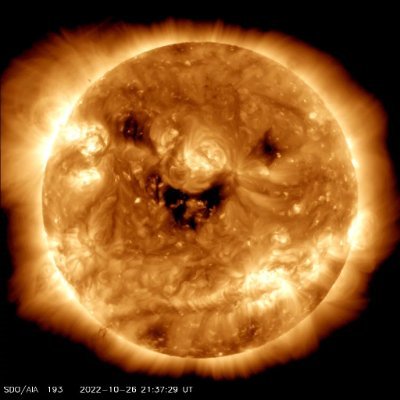
2/3 In the same briefing, scientists also presented new images from NASA’s PUNCH (Polarimeter to Unify the Corona and Heliosphere) mission, launched in March 2025. PUNCH’s four satellites which work together as a single “virtual instrument,” combining their images to reveal 3D information about solar eruptions as they move...

22,484 просмотров • 1 год назад •via X (Twitter)

Комментарии: 0

Нет доступных комментариев

Здесь появятся комментарии из оригинального поста

Похожие видео

🚨 PARKER SOLAR PROBE JUST FOUND HIGH-ENERGY PARTICLES NEAR THE SUN THAT NO MODEL PREDICTED AND WE DON’T KNOW HOW THEY GOT SO ENERGETIC. During its close passes through the solar corona, NASA’s Parker Solar Probe detected protons accelerated to energies around 400 keV roughly 1,000 times higher than current models of magnetic reconnection at the heliospheric current sheet could explain. The particles appear to be trapped and energized inside magnetic islands that form and merge during reconnection events at the current sheet (the vast surface where the Sun’s magnetic field flips polarity). This mechanism was not expected to produce such high energies so close to the Sun. Why this matters: • It reveals a previously unknown or underestimated source of energetic particles right in the solar corona • Existing models of solar energetic particles have focused mainly on shocks from coronal mass ejections — this suggests reconnection can also be a powerful accelerator • The same process may be contributing more to coronal heating than previously calculated • It has implications for space weather forecasting, since these particles can affect spacecraft and astronauts The deeper implication: Parker is showing us that the physics of the near-Sun environment is more energetic and complex than our models assumed. Magnetic reconnection long known as an important process appears capable of accelerating particles to surprisingly high energies through the merging of magnetic islands. This doesn’t just tweak our understanding of the Sun; it may force revisions in how we model particle acceleration across many astrophysical environments. We’re still in the early stages of understanding what Parker is revealing, but it’s already clear that the corona is more violent and dynamic than we thought. How do you think this discovery might change our models of space weather or solar physics in the coming years? Follow for more updates from Parker Solar Probe and the evolving picture of our Sun.

TheNewPhysics

16,192 просмотров • 1 месяц назад

🚨 CHINA IS RACING TO BUILD A SPACE SOLAR POWER PLANT THAT COULD BEAM ELECTRICITY FROM ORBIT TO EARTH. Scientists at Xidian University have successfully tested a ground-based system that can wirelessly transmit kilowatt-level power over 100 meters using microwaves. Their ultimate goal is far more ambitious: placing large solar power stations in geostationary orbit (36,000 km up), where sunlight is available 24/7 with no weather or atmosphere blocking it. The project, called Zhuri (“chasing the sun”), uses mirrors to concentrate sunlight onto solar panels, converts the electricity into microwaves, and beams it down to a receiving antenna (rectenna) on Earth. Why this matters: • In space, solar energy is up to 6 times more efficient than on Earth because there’s no night, clouds, or atmospheric filtering • A single large space solar station could theoretically generate gigawatts of continuous clean power enough for millions of homes • The team has already proven the system can beam power to multiple moving targets at once • China is now among the world leaders in this technology, alongside the US and Japan The deeper implication: Space-based solar power has been a dream for decades because it could provide truly baseload renewable energy. While the technical and financial challenges are enormous (building massive structures in orbit, precise microwave beaming, and safety), steady progress like this brings the concept closer to reality. If successful, it could fundamentally change how humanity generates and distributes energy moving power collection off the planet entirely. Near-term applications could include wirelessly charging satellites or powering future lunar bases. Do you think space-based solar power will become a major energy source in the coming decades, or will it stay too expensive and complex? Follow for more frontier energy and space technology developments.

TheNewPhysics

15,361 просмотров • 1 месяц назад

🚨 NASA JUST FOUND THE RAW INGREDIENTS OF DNA INSIDE A ROCK OLDER THAN EARTH ITSELF. Samples returned from the asteroid Bennu contain complex organic molecules including precursors to DNA and RNA, plus many of the amino acids used by all life on Earth. These molecules formed in the early solar system and survived for billions of years inside the asteroid. Earth didn’t have to invent the chemistry of life from nothing. It was delivered ready-made from space. Why this matters: • Bennu is a primitive asteroid that has remained largely unchanged since the birth of the solar system (~4.5 billion years ago) • The samples contain the molecular building blocks of DNA, RNA, and proteins the core components of life as we know it • These organics were preserved through the violent early days of the solar system and could have been delivered to Earth by asteroids and comets • This is some of the strongest direct evidence yet that life’s chemistry has cosmic origins The deeper implication: This doesn’t mean aliens or microbes came from space. It means the raw materials for life were already floating around the solar system long before Earth cooled enough to support life. Our planet likely received these ingredients from above rather than creating them all from scratch. If these building blocks were common in the early solar system, then the starting chemistry for life may have been widespread dramatically raising the chances that similar processes could have happened elsewhere. How does it change your perspective to know that the molecular ingredients for DNA were already present in space billions of years before the first living cell appeared on Earth? Follow for more discoveries about the origins of life and what we’re learning from asteroid samples.

TheNewPhysics

87,603 просмотров • 1 месяц назад

In July 1994, NASA's Hubble Space Telescope captured one of the most dramatic events ever witnessed in our solar system: the spectacular collision of Comet Shoemaker-Levy 9 with Jupiter—the first-ever directly observed impact between two solar system bodies.Discovered just a year earlier, the comet had already been torn into a dramatic "string of pearls" of roughly 21 fragments by Jupiter's powerful tidal forces during a close pass in 1992. Those pieces then slammed into the giant planet at staggering speeds of about 60 km/s (over 130,000 mph) between July 16 and 22, 1994.The crashes unleashed enormous fireballs and ejected massive plumes of material high above the cloud tops, excavating debris from Jupiter's deeper atmospheric layers. Hubble's razor-sharp images revealed huge, dark scars—some stretching more than Earth's diameter across—etched into the planet's southern hemisphere. These eerie black blemishes, composed of impact debris and altered chemistry, lingered for months and were so prominent they could be spotted even through modest backyard telescopes. The towering plumes provided astronomers an unprecedented window into Jupiter's hidden chemistry, revealing sulfur compounds and other materials dredged up from below the visible clouds. This once-in-a-lifetime spectacle revolutionized our knowledge of cosmic collisions, dramatically underscored Jupiter's vital role as the solar system's gravitational "sweeper" that deflects or captures many potential Earth-threatening objects, and fueled major advances in planetary defense strategies. Source: NASA Goddard Space Flight Center (with imagery from Hubble observations)

Black Hole

15,378 просмотров • 5 месяцев назад

*SEVERE geomagnetic storm possible with U.S. aurora borealis display* *Northern lights possible at mid-latitudes early Sunday morning or Sunday night* *Specifics TBD – map coming later today* On Friday evening Eastern time, a major solar flare occurred from sunspot #4100. A sunspot is a bruise-like discoloration on the sun that throbs and pulsates with energy. Following the solar flare, which is a flash of light and radiation, a significant CME — or coronal mass ejection — was hurled directly toward Earth. Imagine a shockwave of magnetism and high-energy particles rippling through space like an interstellar tsunami. It’s heading for us at speeds around 1,200 miles per second — that’s very fast! We know it’s Earth-directed because our sensors indicate a “full halo” CME. See the solar material appearing to fan out in all directions? That’s an indicator it’s Earth-bound. It’s like if a train is coming right at you — you’d only see the train getting bigger. Once this electromagnetic shockwave reaches Earth, the energy will be absorbed and dissipated by our magnetic field. It will be transformed into visible light — the aurora. Since there’s a LOT of energy, we’ll probably get the aurora borealis (the northern lights) down to the mid latitudes. This could mean parts of the central United States, the Midwest, the Mid-Atlantic and perhaps as far south as northern California. There’s even a chance that parts of the Mid-South could see the aurora IF a direct impact occurs and the orientation of Earth’s magnetic field cooperates. Scientists at the Space Weather Prediction Center in Boulder, Colorado are working to iron that out.

Matthew Cappucci

10,381 просмотров • 1 год назад