正在加载视频...

视频加载失败

3 reasons economics will never fix itself: 1. No controlled experiments (unlike physics) 2. Crises are transient; economists forget what they got wrong. 3. They're ideologically wedded to a belief system that serves no one but themselves. The evidence is everywhere. Diminishing marginal productivity doesn't exist in the real...

15,954 次观看 • 6 个月前 •via X (Twitter)

0 条评论

暂无评论

原始帖子的评论将显示在这里

相关视频

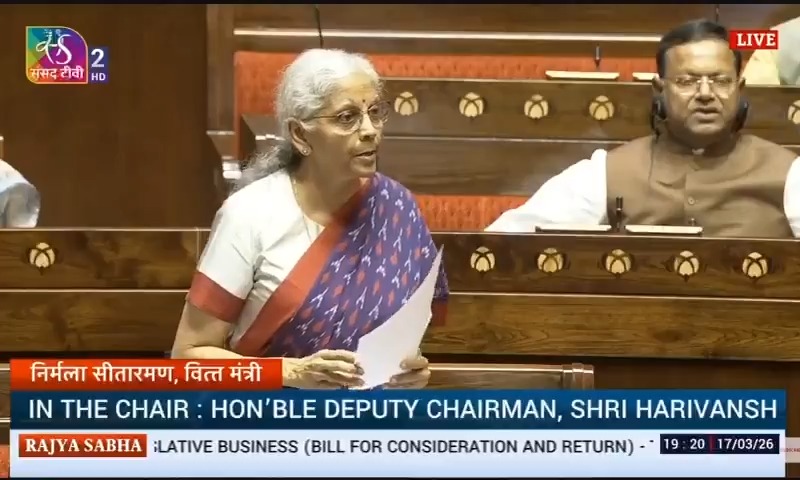
The twin balance sheet, the fragile five economy, they're all as a result of the way in which the economy, the banks were treated. Our fiscal headline numbers would have been healthier, if we hadn't been burdened by that sin. UPA left behind, ₹2.92 lakh crores in oil bonds and the broken economy, the banking system. I told you about the oil bonds which we cleared now. I'm now telling you about the broken banking system which required ₹2.8 lakh crores for recapitalization. The health of the banks today is that they are paying returns to the government and with that money we are able to do more meaningful welfare projects. But when you left in 2014, you left the banks in such a fragile situation that I had to give ₹2.8 lakh crores for recapitalizing them. If that money was available, our fiscal deficit would have been better. Then you can showcase what my fiscal deficit was and compare it with yours. You have pushed everything under the carpet and say, "You never will match that period. Your growth is not good enough now." If I do those sort of things, it will be three times better. We don't do any of that. The proposed Economic Stabilization Fund will provide fiscal headroom to allow India. How am I able to do? Having created the fiscal headroom, I'm able to allow India to respond to the global headwinds such as the recent crisis. We are able to mobilize that kind of money because the headroom is available. Imagine in 2014, would I have had the comfort? No, because I'm recapitalizing banks, I'm paying loans, I'm lifting the economy from where they have left the fragile five. So economy today, is a totally different thing. - Smt Nirmala Sitharaman in Rajya Sabha

Nirmala Sitharaman Office

10,443 次观看 • 4 个月前

Starbucks is the largest unregulated bank in America. They are hoarding almost $2 billion of your money. And it's completely by design. They don't just sell coffee. They've built one of the largest legal money schemes in history... Right now, Starbucks is holding $1.85 billion in gift card and app balances. Money that customers loaded but never spent. To put that in perspective: 85% of US banks have less than $1 billion in total deposits. Starbucks holds more customer cash than most actual banks. But here's the difference: Banks pay you interest to hold your money. Starbucks pays you nothing. Banks have to keep cash reserves in case you want to withdraw. Starbucks just needs to stock coffee and muffins. Banks are regulated by the federal government. Starbucks answers to no one. The CEO of South Korea's third-largest bank said it publicly: "Starbucks is an unregulated bank, not a coffee company." So how did they build this financial empire? It started with gift cards in 2001. Simple idea: load money, buy coffee later. But Starbucks noticed something interesting. People weren't redeeming all their gift cards. A $25 card might have $3.47 left on it forever. That leftover money? Pure profit. They call it "breakage." In 2024 alone, Starbucks made $207 million from money people loaded but never spent. Free money. No coffee served. But they didn't stop there. They engineered the entire system to maximize breakage. First, they made gift cards year-round items instead of just holiday gifts. Then they launched the Starbucks app. The app forces you to pre-load money before ordering. You can't just pay $6.84 for your latte. You have to load $10 minimum. Now you've got $3.16 sitting in their system. That's not a bug. That's the business model. Then they added auto-reload. Set it up once, and Starbucks automatically charges your card whenever your balance drops. Money is flowing in constantly. Most people forget it's even happening. Then they added rewards. You earn more points by paying with your Starbucks balance than with a credit card. So you're incentivized to keep money locked in their system. The trap is airtight. A consumer complaint filed in Washington State called it an "involuntary subscription." Their exact words: "This Catch-22 traps customers in a cycle that resembles an involuntary subscription." You load money to buy coffee. You have a leftover balance. You come back to use it. You load more money. The cycle never ends. Think about what Starbucks actually built: They collect billions in deposits. They pay no interest. They have no withdrawal obligations. They keep 10-13% of all deposits as pure profit. They're not regulated as a financial institution. Any bank would kill for this model. But they'd go to prison for trying it. Starbucks does it in plain sight....

Zyan

269,491 次观看 • 7 个月前

🧠PROFOUND: Former hedge fund manager David Rogers Webb describes how the central banks are "the true seat of power" and have aimed to "sever [us] from understanding that our minds create reality" "The mind is very powerful. And the people that are controlling this system, they are using their minds to manifest what is happening to us" "[they want us to think that] you can't know anything beyond the material world. So don't bother your pretty little head with that. Just focus on output and numbers and determinism" "But... I believe people in deep time knew that the material world is actually benevolent. The material world is not going to destroy you. What will destroy you and your family is what is created by people's minds" This clip of Webb (David Rogers Webb), who's also the author of a book dubbed The Great Taking, is taken from a FrihetsNytt interview posted to Rumble in May 2026. ---------------Partial transcription of clip--------------- "We have been severed from understanding that our minds create reality. Beginning with Marx and dialectical materialism in the 19th century. This is very important that, prior to that, in Hegelian dialectics, the point of Hegelian dialectics was to know the truth, to know reality through argumentation. "And the understanding was that those participating in the argumentation desired to know the truth and the good and the reality. Marx could not have that. The dialectical materialism says the only good is that the material, material world. "And you can't know anything beyond the material world. So don't bother your pretty little head with that. Just focus on output and numbers and determinism. "It caused people to feel, Yeah, I can't know anything about, I'm a realist. I'm a realist. I'll be rooted in hard reality. It goes along with ideas of determinism and materialism. But the point is that, I believe people in deep time knew that the material world is actually benevolent. "The material world is not going to destroy you. What will destroy you and your family is what is created by people's minds. Now, how powerful is the mind? Literally everything [including what] we're sitting [on] in here was created by the mind. Everything we're wearing, all our surroundings. And anyone watching this, look around where you are, unless you're out in a field somewhere. "The mind is very powerful. And the people that are controlling this system, they are using their minds to manifest what is happening to us. And they're using our minds as well.... "[And] clearly the seat of power is the central banks. It's as simple as that. The Bank for International Settlements is the— On their webpage they say that they are the central bank of central banks. "So what is the Bank for International Settlements? So the City of London, probably this began in the City of London. And the Rothschilds are involved with that. "And there are other banking, ancient banking families. But, the Bank for International Settlements was formed after World War I to collect all the reparations from Germany. So they sucked all that out of Germany. "But when you think about it, what had also just happened? The collapse of the Romanov dynasty. The collapse of the— Habsburg The Habsburg Empire. The Turk Ottoman Empire collapsed. So what happened to all of that wealth? Where did that go? It just kind of disappeared. Well, it's in the— It is controlled by the people who control the central banks."

Sense Receptor

40,132 次观看 • 8 天前

The Rothschild Central Banking Hidden Money Matrix: How Big Banks and Big Government Steals Your Wealth Through the Federal Reserve Scam A 30 min documentary on how the Rothschilds, Rockefellers, and Globalist Elites created the U.S. Federal Reserve to enslave American citizens and bankrupt our nation to destroy it from within. People are finally waking up to the realization that our modern monetary system is nothing more than a massive fraudulent parasitic scheme designed to siphon wealth from hardworking citizens to banks and government elites and they've been rising up to fight back. The Federal Reserve, despite its official-sounding name, is a private banking corporation owned by major central bankers who live in England, it is NOT a government agency. Created in 1913, the same year the income tax amendment was passed (no coincidence), this system enables the continuous theft of your purchasing power through a complex web of Treasury bonds, Federal Reserve checks written from empty accounts, and fractional reserve banking. When the government needs money, it issues bonds — IOUs — that banks purchase. These banks then sell these bonds to the Federal Reserve, which creates currency out of thin air by writing checks on accounts with zero balances. This newly created currency is multiplied through fractional reserve banking, where banks can lend out up to 90% of depositors' money while still showing the full amount in accounts. This results in a monetary system requiring ever-increasing debt, with more debt in existence than currency to pay it off - a mathematical impossibility designed to enslave us through perpetual taxation. Our founding fathers fought against central banking for this very reason, which is why the Constitution specified only gold and silver as money. Today's system violates these principles, robbing us of our LIBERTY and transferring wealth to bankers who, as a former Bank of England director allegedly stated, "own the earth" and "with the flick of a pen will create enough money to buy it back again" if it's taken away. The worst part, our system was ALL created and owned by disgusting satan worshipping cannibalistic child trafficking pedophiles. This is the system you're all assimilating together to help President Trump fight against and abolish.

Bridgett Fertig

183,084 次观看 • 6 个月前

The financial system is creating the same risk patterns that caused the 2008 crisis—just in a different market. Private credit is that market. It's grown to $1 trillion in loans made by hedge funds and asset managers instead of regulated banks. Here's how it works: → Banks lend money to hedge funds. → Hedge funds use that capital to make risky loans. → Banks claim they have no direct exposure to the borrowers. But the risk doesn't disappear. The loans bypass traditional banking oversight, but the funding still originates from the regulated banking system. When private credit deals go bad, the losses flow back to banks through their hedge fund lending relationships. We're already seeing cracks. BlackRock lost 19% of their private credit fund in one quarter. Subprime auto loans are defaulting at accelerating rates. Overleveraged companies are filing bankruptcy. Nobody's watching the full picture. No transparency requirements mean regulators can't see the scope of interconnected exposures. No one knows which banks are most exposed through which hedge fund relationships. When private credit markets seize up, the connected banks will face losses just like they did with subprime mortgages. The legal framework for "bail-ins" already exists—allowing governments to access depositor funds to recapitalize banks rather than using taxpayer bailouts. This explains why diversification matters. When credit markets experience stress, assets outside the banking system—like precious metals—historically maintain value independent of financial institution health. The pattern repeats: Risk transfer, regulatory gaps, interconnected exposures, and inevitable systemic stress when the cycle reverses. -- This is just scratching the surface of the brewing financial crisis. In a 45-minute video, I also covered: • Why mining stocks give 3-5x leverage to gold price moves (costs stay fixed, profits multiply) • How CME margin hikes force leveraged traders to sell and crash prices •The US has legal framework for bail-ins (Orderly Liquidation Authority) Just comment "CRISIS" and I'll DM you the full video.

Felix Prehn 🐶

19,064 次观看 • 5 个月前

"If you go back to 9/11, when Wesley Clark said, 'We're going to invade 7 countries in 5 years,' ...[those] were the countries [whose] central banks were not on board to do programmable money... I think one of the reasons we're seeing so much tension around Iran is because Iran right now is the big leakage in the system." This clip of Catherine Austin Fitts, a former Assistant Secretary of Housing and Urban Development, investment banker, and founder of the Solari Report (The Solari Report | Catherine Austin Fitts), is taken from a conversation with Tucker Carlson (Tucker Carlson) posted to YouTube on February 27, 2026. ---------------Partial transcription of clip--------------- Fitts: "Since 1913, the United States has had a governmental structure where the central bank, the Federal Reserve, which is the Board of Governors in Washington, and the 12 central banks, manage monetary policy. So they basically, working with the banks, run the financial transactions. The New York Fed runs the governmental accounts, they control the government bank accounts. "And their policies of fed funds, interest rate and money onto the reserve tracks affects the money supply and basically the money supply and how the money works, okay? So it's more complicated than that because they have lots of regulatory functions, but the people vote for their representatives. "So whether it's the State House or the Congress, they vote for elected representatives from their jurisdiction and area. And those people decide fiscal policy, which is what taxes do we collect, what tariffs do we collect, what bonds do we sell and raise money, and how does that money get spent? "So my representatives, your representatives, are determining fiscal policy, and the bankers are determining monetary policy. And it's a balance of power between the people and the bankers. Now with the digital control grid and programmable money, the bankers can assert control of fiscal policy and they can just decide what the taxes are and take them out of your account. And they can essentially determine the rules of how it all gets spent. "And so it's a very— it's sort of a financial coup d' etat that over time they want to assert complete control of fiscal and monetary policy. And essentially the legislatures will go to being sort of show and tell or go out of business. We're moving quickly in that direction where the legislatures in every country are becoming less powerful, in many cases irrelevant. "So here's my theory though. If you go back to 9/11, and when Wesley Clark said, 'We're going to invade seven countries in five years,' what you were talking about were the countries where those central banks were not on board to do programmable money, and their governance structures were not on board with essentially because of Epstein, I'll call it the Rockefeller–Rothschild model, there was an effort to say, okay, we're gonna basically assert control of the central banks in those countries. That's my interpretation. "And I think one of the reasons we're seeing so much tension around Iran is because Iran right now is the big leakage in the system." Carlson: "How? Wait, it's not about their nukes?" Fitts: "No. Well, Iran's central bank counts. One of the reasons it counts is because their oil and energy is very important, including for China. And that's very important in the BRIC system. What the BRIC system is trying to do is to create independent payment systems. "But if you're going to come out with programmable money with digital IDs that are interoperable globally and programmable money that that controls in each jurisdiction centrally. You can't afford leakage, and so you've got way too much leakage in the system to proceed with what they're trying to do. "And Iran is, and the BRIC nations are a sticking point and certainly Iran's oil feeding China gives China greater independence."

Sense Receptor

21,162 次观看 • 4 个月前