Loading video...

Video Failed to Load

Go Home

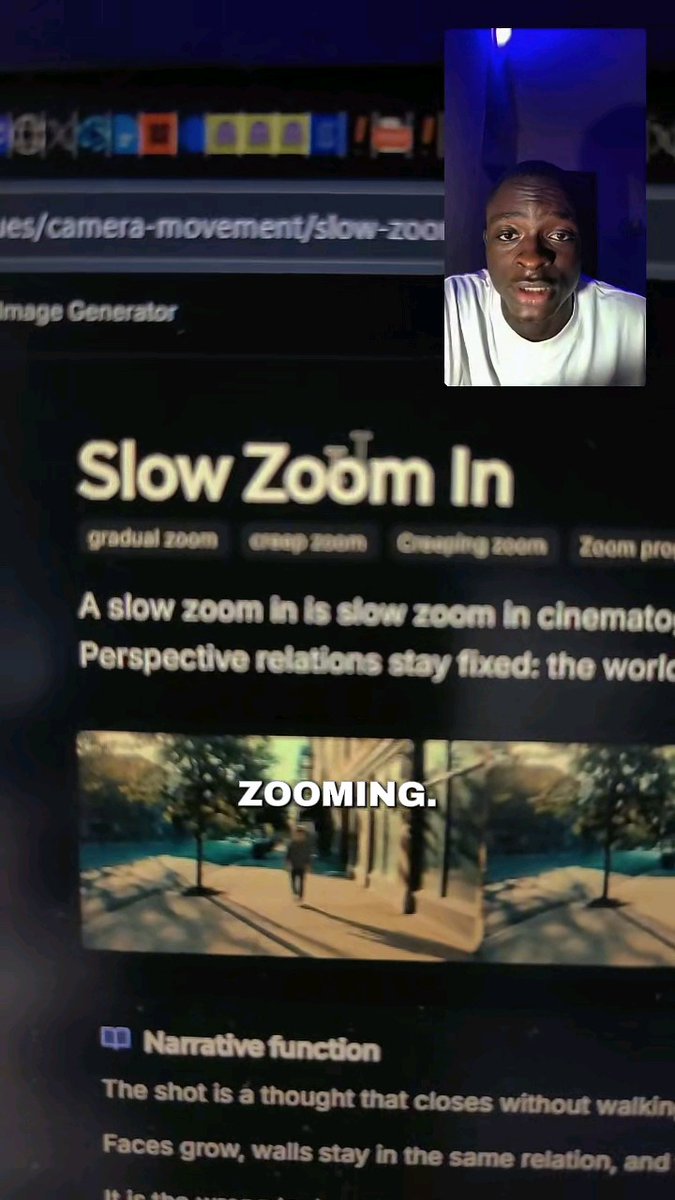
424 cinematic techniques in the visual bible. Camera movements, framing, shot size, angles, lighting, composition, and more. Video examples + prompts on most of them. Free. Bookmark it:

467,189 views • 1 month ago •via X (Twitter)

22 Comments

Romain Simon's profile picture
Romain Simon1 month ago

You can also: 1. Bookmark your favorite shots 2. Flag inaccuracies or weak AI clips Some shots are still sloppy so I'll regenerate them when I get more quota.

Romain Simon's profile picture
Romain Simon1 month ago

I'm rebuilding Melies to be 10x better. If you use the app, tell me what's broken, slow, or missing. Feedback on the product itself welcome.

veeral's profile picture
veeral1 month ago

Thanks for sharing this valuable resources.

Romain Simon's profile picture
Romain Simon1 month ago

You're welcome!

arafat shuvo's profile picture
arafat shuvo1 month ago

do they have mcp?

Romain Simon's profile picture
Romain Simon1 month ago

There's But I'd be happy to add anything you need

quermeng's profile picture
quermeng1 month ago

@ArafatShuvo45 So cool

Romain Simon's profile picture
Romain Simon1 month ago

@ArafatShuvo45 thanks!

brodibalo's profile picture
brodibalo1 month ago

Arigato sensei

Romain Simon's profile picture
Romain Simon1 month ago

Douzo 😁

Rich Klein's profile picture
Rich Klein1 month ago

Amazing!! This is the best free reference I've seen anywhere. Thanks so much for taking the time to build it. It's going to help a lot of artists.

Romain Simon's profile picture
Romain Simon1 month ago

You're welcome! Glad you like it. Some of the examples are still bad though, please let me know I'll do another batch to improve them

Rich Klein's profile picture
Rich Klein1 month ago

Sure! The examples I’ve seen so far are good. I’ll let you know.

NYXEN's profile picture
NYXEN1 month ago

Wow, thanks Romain. I will look into this.

Romain Simon's profile picture
Romain Simon1 month ago

You're very welcome!

Katioucha's profile picture
Katioucha1 month ago

Useful, thanks a lot !

Romain Simon's profile picture
Romain Simon1 month ago

Glad it helps.

Katioucha's profile picture
Katioucha1 month ago

👍

Sosoli.San's profile picture
Sosoli.San1 month ago

Merci beaucoup

Romain Simon's profile picture
Romain Simon1 month ago

De rien !

arti.samurai's profile picture
arti.samurai1 month ago

Having video prompts paired with these breakdowns makes referencing camera angles and lighting much faster during planning.

COSMOS's profile picture
COSMOS1 month ago

ref

Related Videos

Most AI filmmakers know the names of camera angles. Very few know what those angles are actually doing to the story. - A low angle is not automatically “cinematic.” - A Dutch angle is not something you add because the frame feels boring. - And a high angle does not simply mean “weak.” The camera should have a reason to be where it is. Here are 8 angles worth understanding: → Eye-level: For honesty, intimacy, dialogue and natural performance. → Low angle: For authority, threat, monumentality and pressure. → Ground-level: For speed, scale, physicality and extreme size contrast. → High angle: For vulnerability, isolation, exposure and entrapment. → Overhead / Top-down: For geography, choreography, patterns and surveillance. → Dutch angle: For instability, unease and moments when the story itself feels wrong. → POV / Subjective: For immersion, fear, urgency and restricted information. → Over-the-shoulder: For dialogue, eyelines, relationships and screen geography. But this is the important part for AI filmmaking: Do not prompt: “Cinematic low-angle shot of a powerful man.” Direct the geometry instead: SHOT SIZE + CAMERA HEIGHT + ANGLE + LENS + COMPOSITION + CAMERA BEHAVIOR + ACTION Example: “Medium-wide low-angle shot, camera 50 cm above the floor, 32mm lens. Commander stands screen-center beneath converging ceiling beams. Prisoner remains seated in the foreground. Locked camera. The commander slowly lowers his eyes toward him.” That gives the model something useful: where the camera is, what it sees, how perspective should feel, where the characters are, and what happens during the shot. The rule I keep coming back to: Do not choose the angle that looks coolest. Choose the angle that communicates the moment best. I put all 8 angles, their storytelling purpose, scene examples and AI prompts into one cheat sheet. Save it for your next AI film. Share it with someone who is still prompting “cinematic camera angle” and hoping for the best. PS:) Follow for more! . .

Beginnersblog

24,861 views • 1 month ago