Загрузка видео...

Не удалось загрузить видео

На главную

A $100K/year customer gets white-glove treatment while a $10/year customer gets a help center. Decagon's bet is that AI closes that gap, and enterprise is buying it. Co-founders Jesse Zhang and Ashwin Sreenivas sit down with a16z's Kimberly Tan and Sarah Wang to discuss what they've learned running agents...

131,728 просмотров • 1 месяц назад •via X (Twitter)

Комментарии: 0

Нет доступных комментариев

Здесь появятся комментарии из оригинального поста

Похожие видео

Inside Nemotron and NVIDIA's AI lab: my conversation with Bryan Catanzaro (Bryan Catanzaro). NVIDIA is a chip company. So why does it put hundreds of researchers on building AI models - and then give them away for free? We go deep into the Nemotron models, what it takes to build a top AI lab, and the future of frontier AI. 01:33 - Is open source AI catching the frontier? 05:29 - Do closed labs blocking distillation slow open source down? 07:42 - Is the US falling behind China? 10:30 - Why companies actually choose open models 12:39 - A "crazy" 2008 bet: machine learning on GPUs 15:33 - Working with Andrew Ng and Dario Amodei at Baidu 17:41 - Coming back to NVIDIA: DLSS and the birth of Megatron 21:55 - The real reason NVIDIA builds its own models 24:28 - Is Moore's Law really dead? 33:37 - The Nemotron family: Nano, Super, Ultra 35:09 - Built for agents: why NVIDIA bets on speed 36:02 - How you train a 550B model in 4 bits 39:25 - Hybrid Mamba-Transformer, explained simply 42:31 - Mixture of experts, and why NVIDIA built NVL72 around it 47:26 - Why a 1-million-token context window matters 49:26 - Multi-token prediction: how the model predicts 5 tokens at once 52:47 - Multi-teacher distillation: teaching one model from many 58:01 - Where reinforcement learning goes next 01:00:16 - Inside NVIDIA's research org: "the mission is the boss" 01:04:03 - How NVIDIA decides who gets the GPUs 01:10:53 - Why NVIDIA still feels entrepreneurial after 33 years 01:12:58 - Why Bryan doesn't believe in the singularity 01:17:50 - The AI backlash 01:19:18 - The controversial case: open AI is safer than closed

Matt Turck

56,903 просмотров • 1 месяц назад

Mark Zuckerberg is explaining one of the most misunderstood dynamics in AI and it has direct investment implications (Save this). The concept he's describing is model distillation, and it's one of the most important techniques to emerge in AI over the past year. Here's how it works. You train a massive, enormously expensive model, in Meta's case, Llama 4 Behemoth, a 2 trillion parameter teacher model and then you use that model to teach a much smaller, cheaper model. The smaller model inherits roughly 90 to 95% of the intelligence of the giant while running at 10% of the cost and on a fraction of the compute. Meta already did this with the Llama 4 family and Behemoth serves as the teacher. Llama 4 Scout and Maverick, the publicly released open-source models were distilled from it. Scout runs on a single H100 GPU with a 10 million token context window and outperforms models that cost far more to operate. Maverick, at 17 billion active parameters, rivals DeepSeek V3 in coding at half the parameter count and beats GPT-4o on multimodal benchmarks. Both are completely free for commercial use. What Zuckerberg is pointing at is a structural shift in how AI gets deployed in the real world. Companies aren't taking a frontier model off the shelf and running it as-is but rather taking open-source models, fine-tuning them on their own proprietary data, distilling them into even smaller custom models tailored to their specific use case, and running them on infrastructure they control at a fraction of the cost of a closed frontier API. The investment implication of this is significant and runs in two directions. For Meta specifically, this is a strategic masterstroke. Every company that builds on Llama, fine-tunes it, distills it, or deploys it through their infrastructure is pulling into Meta's orbit while Meta builds the most powerful open teacher model. The ecosystem of companies using it grows and that ecosystem generates commercial activity across Meta's platforms and data services. Meta's AI research benefits from billions of real world deployment signals and it's a flywheel that closed model providers cannot replicate because their strategy requires charging per token, which is now a 65x cost disadvantage against the open-source alternative. For the broader market, distillation changes the economics of inference in a way that has barely been priced in. As intelligence becomes extractable into smaller and cheaper models, the absolute demand for compute doesn't decline but rather it explodes, because now the number of applications that are economically viable expands by orders of magnitude. Every task that was previously too expensive to automate at $3.25 per call becomes viable at $0.05 that means more total token usage, more total GPU utilization, and more demand for the infrastructure companies, the Nebiuses, the GE Vernovas, the Constellation Energies that supply the underlying compute and power.

Milk Road AI

27,908 просмотров • 1 месяц назад

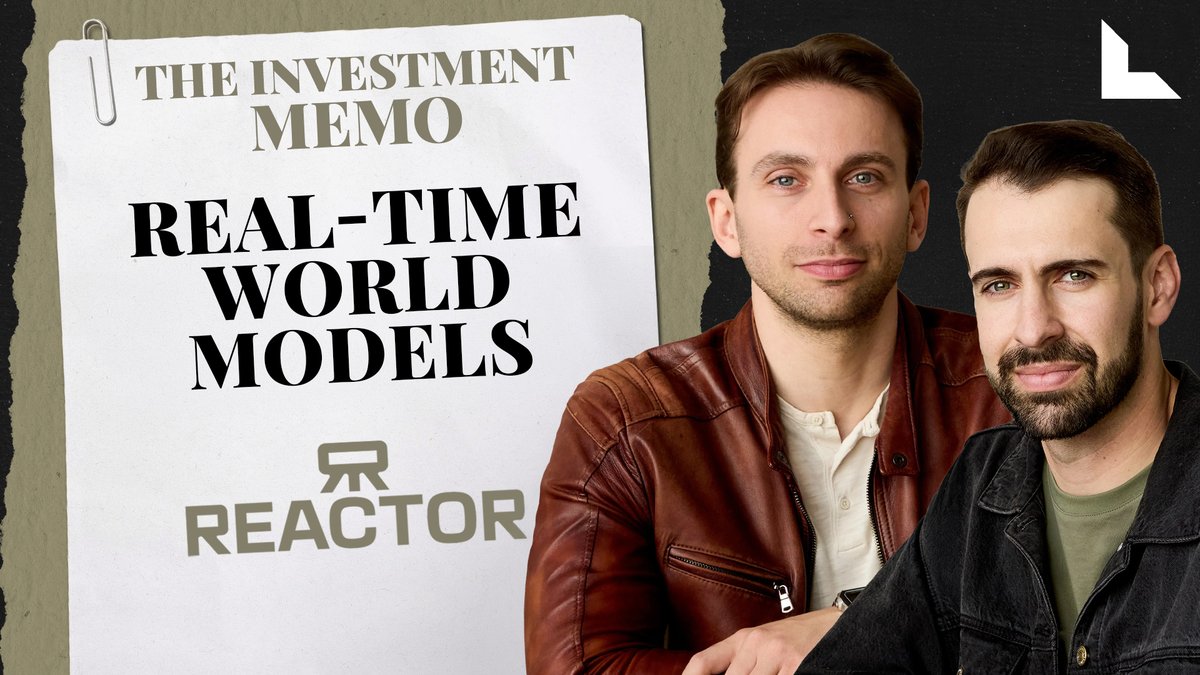
Real-time world models represent a fundamental shift in AI. reactor is building the platform for real-time generative video infrastructure, supporting developers who need the tech for use across entertainment, physical AI, and robotics. Co-founders Alberto and Bryce Schmidtchen joined us last week on The Investment Memo, hosted by Partners Bucky Moore and Amber Yang, to talk about the era of world models. The conversation centered around the infrastructure Reactor is building, why real-time models are the edge right now, and current use cases for the product. Alberto and Bryce agreed that world models are shaping the way simulations are created, and that developers need a streamlined platform that can support their ideas. We believe Reactor is positioned to be at the frontier of research into real-time generative models. We look forward to seeing how these models apply across industries. Chapters 00:00 Introduction & Overview of Reactor 01:08 Meet the Hosts & Founders 02:18 The Origin Story: From 3D Assets to World Models 05:07 Real-Time Video Applications Across Industries 06:55 The Open Source World Model Explosion 07:23 Why Infrastructure Is the Opportunity 08:42 Parallels to Past Technology Waves 09:51 Bridging the Research-to-Production Gap 13:13 What Developers Are Building with World Models 16:41 Lessons from Luma AI 18:23 What Apple Vision Pro Taught Bryce About Real-Time Systems 20:48 Company Values & Team Culture 22:40 Series A: What the Capital Unlocks 24:13 Reactor's Five-Year Vision 26:09 Closing Remarks

Lightspeed

144,942 просмотров • 2 месяцев назад

Interview with Nebius Co-Founder Roman Chernin Please like & share this video so that all $NBIS investors on X will see it! :) If you prefer watching on YouTube: Timestamps: 00:00 - Why AI Infrastructure Is So Hard to Understand 00:24 - Market Fragmentation and What Actually Differentiates Providers 01:30 - Consolidation, Segmentation, and the Future AI Cloud Landscape 02:56 - What Analysts and VCs Still Get Wrong About AI Infrastructure 05:34 - Nebius Cloud: Product Readiness and Customer Proof Points 07:42 - Why Inference Workloads Are Exploding 09:11 - Training vs. Inference: How AI Models Actually Reach Production 10:10 - Why Inference Market Share May Concentrate Around a Few Winners 12:36 - Customer Use Cases: Coding, Enterprise AI, and Real-World Adoption 14:01 - Why Integrated Training and Inference Matter Strategically 16:01 - Building Scalable AI Infrastructure With High Utilization 18:24 - Token Factory: Inference as a Managed Service 20:24 - Revolut Case Study: AI-Driven Product Enhancements 22:56 - Token Factory Performance Optimization and Competitive Advantage 25:07 - Scale, Capacity, and Efficiency as Growth Drivers 28:36 - Why Inference Capacity Could Become the Next Major Bottleneck 30:10 - How Nebius Benchmarks Performance Across Providers 33:14 - The Future Size and Shape of the Inference Market 36:38 - Value-Based Pricing: Moving Beyond Cost per GPU Hour 40:55 - How Nebius Wins Deals: Quality, Performance, and Customer Experience 44:53 - Autonomous AI Platforms and the Rise of Agent-Based Models 47:28 - Tavily, Agentic Applications, and the Next Layer of the AI Stack 50:45 - Strategic Trade-Offs: Scaling, Product Roadmap, and Customer Relevance 55:40 - Final Thoughts: Adapting to the Next Shift in AI Workloads Nebius Roman Chernin

Daniel Koss

203,706 просмотров • 4 месяцев назад