正在加载视频...

视频加载失败

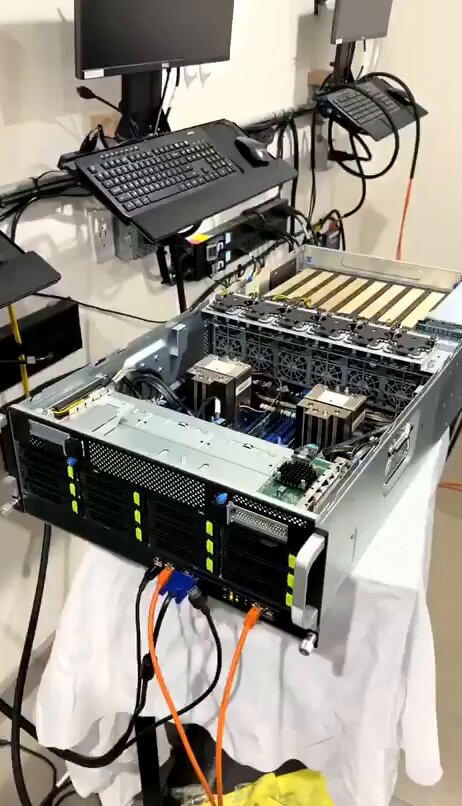
A CHINESE GUY PUT 4 MINISFORUM MS-S1 MAX MINI PCs IN HIS BEDROOM AND TURNED THEM INTO A 24/7 AI AGENT CLUSTER. TOTAL POWER BILL: ABOUT $44/MO. each box is a tiny local AI workstation built around the Ryzen AI Max+ 395. around $3,000 per unit gets him 128GB...

24,836 次观看 • 2 个月前 •via X (Twitter)

0 条评论

暂无评论

原始帖子的评论将显示在这里

相关视频

Fable 5 comes back!It can now build playable game prototypes. I think it is actually a signal for where AI coding is going. Making a game is not just “write some code.” Even a small browser game needs: game loop;character movement;collision logic;scoring system;UI states;physics tuning;visual feedback;bug fixing;playtesting This is why game prototyping is a great test for AI models. A model cannot fake it with a pretty answer. Either the game runs, or it does not. What impressed me about Fable 5 is that it is useful for the messy middle: turning an idea into mechanics, turning mechanics into code, debugging broken interactions, and iterating until the prototype feels playable. But here is the practical part: I would not use the strongest model for every step. For game building, I would split the workflow: 1. Fable 5 for game design + architecture 2. a fast coding model for routine implementation 3. a vision-capable model for screenshot/UI feedback 4. a cheaper model for docs, test cases, and small fixes 5. fallback when latency, cost, or output quality becomes a problem That is the real AI coding stack. Not “one magic model does everything.” More like: the right model, for the right task, at the right cost, with fallback when things break. This is why I’ve been looking at ZenMux ZenMux. ZenMux gives developers one gateway to access multiple leading AI models, with OpenAI / Anthropic / Google Vertex compatible APIs, cost tracking, quality benchmarks, auto-routing, and compensation when output quality, latency, or throughput falls short. If AI can now make games, the next question is not just “which model is strongest?” It is:how do we manage the whole model workflow Fable 5 shows the creative ceiling. ZenMux is closer to the infrastructure layer you need when AI coding becomes a real production habit.

Rachel🥥

61,441 次观看 • 1 个月前

Introducing Pods Hyperspace Pods lets a small group of people - a family, a startup, a few friends, to pool their laptops and desktops into one AI cluster. Everyone installs the CLI, someone creates a pod, shares an invite link, and the machines form a mesh. Models like Qwen 3.5 32B or GLM-5 Turbo that need more memory than any single laptop has get automatically sharded across the group's devices - layers split proportionally, inference pipelined through the ring. From the outside it looks like one OpenAI-compatible API endpoint with a pk_* key that drops straight into your AI tools and products. No configuration beyond pasting the key and changing the base URL. A team of five paying for cloud AI burns $500–2,000 a month on API calls. The same team's existing machines can serve Qwen 3.5 (competitive on SWE-bench) and GLM-5 Turbo (#1 on BrowseComp for tool-calling and web research) for free - the hardware is already on their desks. When a query genuinely needs a frontier model nobody has locally, the pod falls back to cloud at wholesale rates from a shared treasury. But for the daily work - code reviews, refactors, research, drafting - local models handle it and nobody gets billed. And when it is idle, you can rent out your pod on the compute marketplace, with fine-grained permissions for access management. There's no central server involved in inference. Prompts go from your machine to your pod members' machines and back: all of this enabled by the fully peer-to-peer Hyperspace network. Pod state - who's a member, which API keys are valid, how much treasury is left - is replicated across members with consensus, so the whole thing works on a local network. Members behind home routers don't need port forwarding either. The practical setup for most pods is three models covering different jobs: Qwen 3.5 32B for code and reasoning, GLM-5 Turbo for browsing and research, Gemma 4 for fast lightweight tasks. All running on hardware you already own. Pods ship today in Hyperspace v5.19. Model sharding, API keys, treasury, and Raft coordinator are all live. What Makes This Different - No middleman. Your prompts travel from your IDE to your pod members' hardware and back. There is no server in between reading your data. - No vendor lock-in. Pod membership, API keys, and treasury are replicated across your own machines using Raft consensus. If the internet goes down, your local network keeps working. There is no database in someone else's cloud that your pod depends on. - Automatic sharding. You don't configure layer ranges or calculate VRAM budgets. Tell the pod which model you want. It figures out how to split it across whatever hardware is online. - Real NAT traversal. Your friend behind a home router with a dynamic IP? Works. No VPN, no Tailscale, no port forwarding. The nodes handle it. - Free when local. This is the part that matters most. Cloud AI bills scale with usage. Pod inference on local hardware scales with nothing. The marginal cost of your 10,000th prompt is the electricity your laptop was already using. Coming soon: - Pod federation: pods form alliances with other pods. - Marketplace: pods with spare capacity can sell inference to other pods.

Varun

309,320 次观看 • 4 个月前

i spent $26,600 on cloud GPU rentals over 14 months before i found a NVIDIA DGX Spark at $2,999 (founder's edition) or $3,999 (shipping price) it paid for itself in 6 weeks i run 200B parameter models locally now and my old cloud provider keeps sending me loyalty discount emails the math on that $26,600 is embarrassing to type out loud $1,900/month for 14 months, H100 instances on a specialist cloud provider, because anything bigger than a 70B model simply would not fit anywhere else i paid the invoices like they were a utility bill and told myself it was just the cost of doing serious AI work it took me over a year to find out it wasn't 14 months, broken down: → months 1-4: $1,400-1,600/month - felt like manageable infrastructure overhead → months 5-9: crept to $1,900-2,100 as i started running DeepSeek-class experiments, costs tracking directly with model size → months 10-12: one agent loop ran for 36 hours against a 130B model while i slept, that month hit $2,400 → month 13: ran the cumulative total for the first time, saw $23,800, felt physically sick → month 14: another $2,800 month while i waited for the hardware to ship the box is the NVIDIA DGX Spark - roughly the footprint of a large mac mini, powered by a GB10 Grace Blackwell chip with 128GB of unified LPDDR5X memory that unified memory is the whole thing an RTX 4090 has 24GB of VRAM, which means a 70B model in full BF16 precision physically does not fit, you're quantizing down or you're renting cloud, those are your options this box loads a 200B parameter model quantized and serves it through vLLM over localhost, same API interface the cloud endpoint used the migration took one line of code - i changed the base URL from the provider's endpoint to 127.0.0.1:8000 and everything just worked electricity to run continuous 200B inference locally comes out to about $12/month the payback arithmetic is almost too clean: $2,999 hardware cost against $1,900/month saved, the box paid for itself before i'd owned it two months what i didn't account for was how completely the cost model changes your behavior when there's no hourly meter running, you greenlight experiments you'd never approve on cloud - agent loops that churn for hours, running 10,000 documents through a reasoning pass at 3am, speculative fine-tuning jobs you'd normally skip because the cost felt unjustifiable i ran more experiments in the first 30 days after the box arrived than in the four months before it the loyalty discount email landed about 8 weeks after i cancelled the cloud subscription 15% off my next three months, valued customer, we'd love to have you back i didn't reply the box was already running

Argona

22,355 次观看 • 2 个月前

I genuinely think the Terafab is going to end up being one of the biggest moves ever made in human history to secure the future of AI... and I think most people still don’t fully see what Elon is trying to do here. The signs are clear to me. This is Tesla, xAI, and SpaceX essentially hinting to us that they are not going to wait on the world to give them the compute the team needs. They are going to build it themselves at a scale no one has ever attempted. When you really break it down, it gets a bit nutty. This is going to be a fully vertically integrated chip factory that will be producing over 1 terawatt of AI compute per year. This is NEXT LEVEL BIG. Today, AI is limited by chips. You can have the best models, the best engineers, the best everything... but if you don’t have enough compute, you will eventually hit a wall. Elon told us, the world can only supply a tiny fraction of the chips his companies will need. So this is the solution. Terafab puts everything under one roof like design, manufacturing, memory, packaging, testing, which means that they can build chips very fast.. like really fast. I'm talking about 100-200 billion custom AI chips per year at full capacity. Chips designed specifically for: • Tesla cars and Optimus robots • xAI models • Space-based compute You see, while other companies and CEOs are thinking Earth, Elon is planning for AI in space. Around ~80% of the compute is expected to go orbital, powered by solar energy bc Earth simply doesn’t have enough electricity. The U.S. grid is only about ~0.5 terawatts, while space has basically UNLIMITED energy if you can capture it. And this is the steps to get it: Starship launches → space compute → solar-powered AI → feeds back into everything to Earth. Bro... Elon and his companies are playing at a whole different level... And this is why I keep telling people that the Terafab is going to be the secret ingredient that will be the real unlock for everything: • Robotaxis at scale • Billions of Optimus robots • Massive AI models running 24/7 • Future off-world, other planet infrastructure Without these chips, none of this can happen... but with the Terafab, all of this becomes possible. That’s why Elon is calling it “the final missing piece.” I agree.

Teslaconomics

25,494 次观看 • 5 个月前