Загрузка видео...

Не удалось загрузить видео

На главную

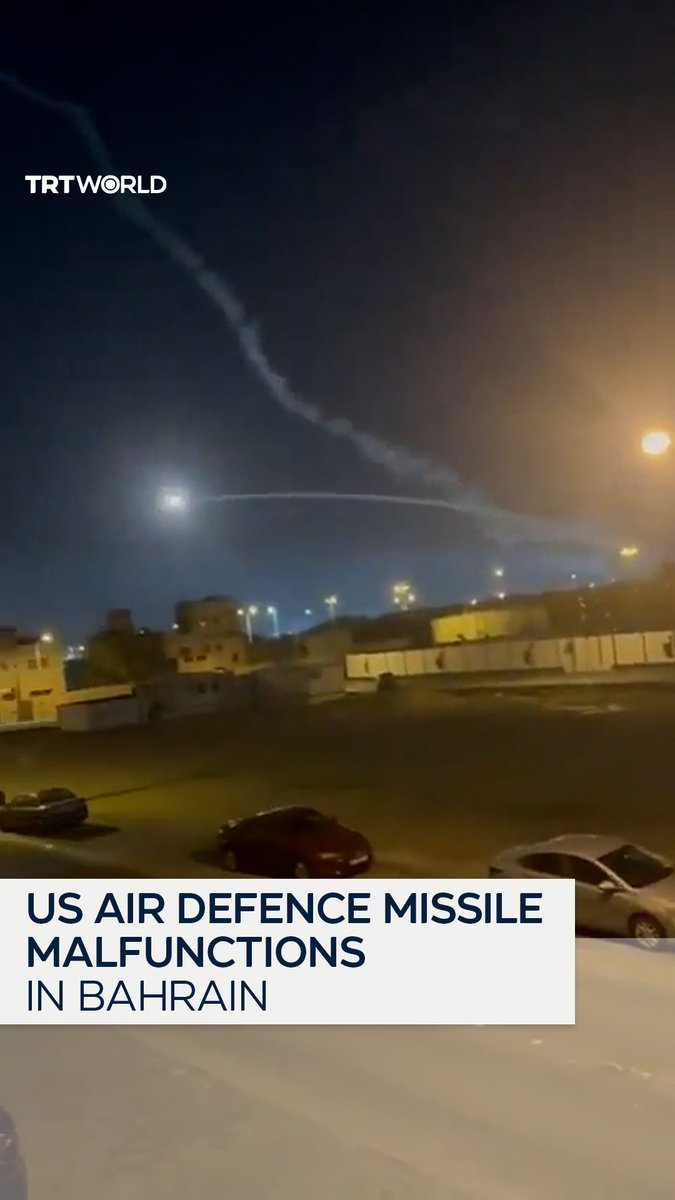
🚨🇧🇭 🇮🇷 A failed Patriot interceptor reportedly crashed into a Bahrain neighborhood. -Alleged footage shows a U.S. Patriot interceptor malfunctioning and coming down in a residential area of Bahrain, with nothing verified on casualties or damage -It follows tonight's sirens across the kingdom and unconfirmed footage of a ballistic...

57,046 просмотров • 20 часов назад •via X (Twitter)

Комментарии: 0

Нет доступных комментариев

Здесь появятся комментарии из оригинального поста

Похожие видео

BREAKING: Iran has reportedly struck the BAPCO oil refinery in Bahrain while launching missile and drone attacks against U.S. military assets in Qatar, Bahrain, Kuwait, Jordan, and Iraq. Iranian drones also reportedly destroyed a $5 million U.S. HIMARS launcher in Kuwait, marking Tehran's largest coordinated assault since the collapse of the MoU. The offensive follows heavy U.S. strikes across southern Iran, where Iranian state media says American forces targeted six civilian bridges, a major railway station, a telecommunications tower, and a civilian airport in Hormozgan Province and Chabahar. The strikes reportedly killed and injured civilians and severed key transport links around Bandar Abbas. The attacks came just hours after the IRGC warned that any U.S. strike on Iranian infrastructure would be met with the destruction of "every last piece of infrastructure" across the region, while the Houthis reiterated threats to shut the Bab al-Mandab Strait. Reports indicate the U.S. military base in Kuwait is on fire following the strikes. In Qatar, reports claim Iranian missiles struck Al Duhail Camp on the outskirts of Doha, with loud explosions reported across the capital. In Bahrain, reports also claim missiles hit Hamala Camp, which houses U.S. forces, as well as another U.S. military installation. Two U.S. AH-64 Apache helicopters were seen operating over Bahrain during the latest drone attacks. Arabic media further reports an Iranian missile struck the King Fahd Causeway linking Bahrain and Saudi Arabia, with ambulances and emergency crews dispatched to the scene. 1. Smoke rises from Bahrain's BAPCO refinery following reported Iranian strike 2. U.S. strikes damage bridges and transport infrastructure in southern Iran 3. Reported Iranian missile strike on Al Udeid Air Base, Qatar 4. Heavy reported Iranian strikes target U.S. military sites in Bahrain

The Hormuz Report

44,947 просмотров • 8 дней назад

BAPCO Energies confirmed on April 5 that a storage tank at its Sitra facility in Bahrain caught fire “as a result of a hostile Iranian drone attack.” The fire was extinguished. No injuries. Damage under assessment. That is the official statement, repeated verbatim across Bahrain News Agency, Gulf News, Al Arabiya, and Xinhua. It is clean, attributable, and consistent with the pattern of Iranian drone and missile strikes on Gulf energy infrastructure that has continued daily since February 28. Then the videos appeared. Footage circulating on social media, shared by Drop Site News and multiple Arabic-language accounts, appears to show two sequential impacts at the facility: one from the incoming drone, and a second moments later from what the accounts describe as a Patriot interceptor missile that failed to intercept the drone and instead struck the oil storage tanks directly. The videos have not been independently verified. The trajectory analysis has not been forensically confirmed. BAPCO’s statement does not mention air defence involvement. The Bahrain Defence Force reported 13 successful drone interceptions in the preceding 24 hours and made no acknowledgement of a misfire. This has happened before. On March 9, an explosion near BAPCO in Sitra injured dozens and was attributed to an Iranian drone. Reuters and the Middlebury Institute subsequently concluded with moderate-to-high confidence that a US-operated Patriot interceptor caused the blast. Drone fragments were absent at the impact site. The damage pattern matched a Patriot warhead detonating at low altitude after losing its target. Bahrain later acknowledged Patriot involvement without formally correcting the original attribution. The March 9 precedent is what makes the April 5 videos significant. Not because they prove the interceptor hit the tank. They do not prove that. But because they introduce a documented pattern: in saturated airspace where dozens of Iranian drones arrive simultaneously, Patriot systems operating at the edge of their engagement envelope against small, slow, low-altitude targets can produce outcomes where the defence causes the damage it was deployed to prevent. The drone is the threat. The interceptor is the response. And the oil tank does not distinguish between the two when the impact arrives. BAPCO operates a 405,000 barrel per day refinery at Sitra. It was struck by confirmed Iranian missiles on March 5, triggering force majeure. It was struck by what was later assessed as friendly fire on March 9, injuring residents. It was struck again on April 5 by what officials call a drone and what videos suggest may have also involved an interceptor. Three incidents in five weeks at the same facility. No force majeure was declared for April 5. The fire was contained rapidly. But the question the videos raise is not about this fire. It is about what happens when Patriot systems engage small, slow, low-altitude drones in saturated airspace directly above the infrastructure they are positioned to protect. Iran does not need to penetrate the shield. It needs to force the shield to fire in conditions where the shield’s own projectiles become the threat. The defence and the attack converge on the same target. And the oil burns either way.

Shanaka Anslem Perera ⚡

21,810 просмотров • 3 месяцев назад