Video wird geladen...

Video konnte nicht geladen werden

Zur Startseite

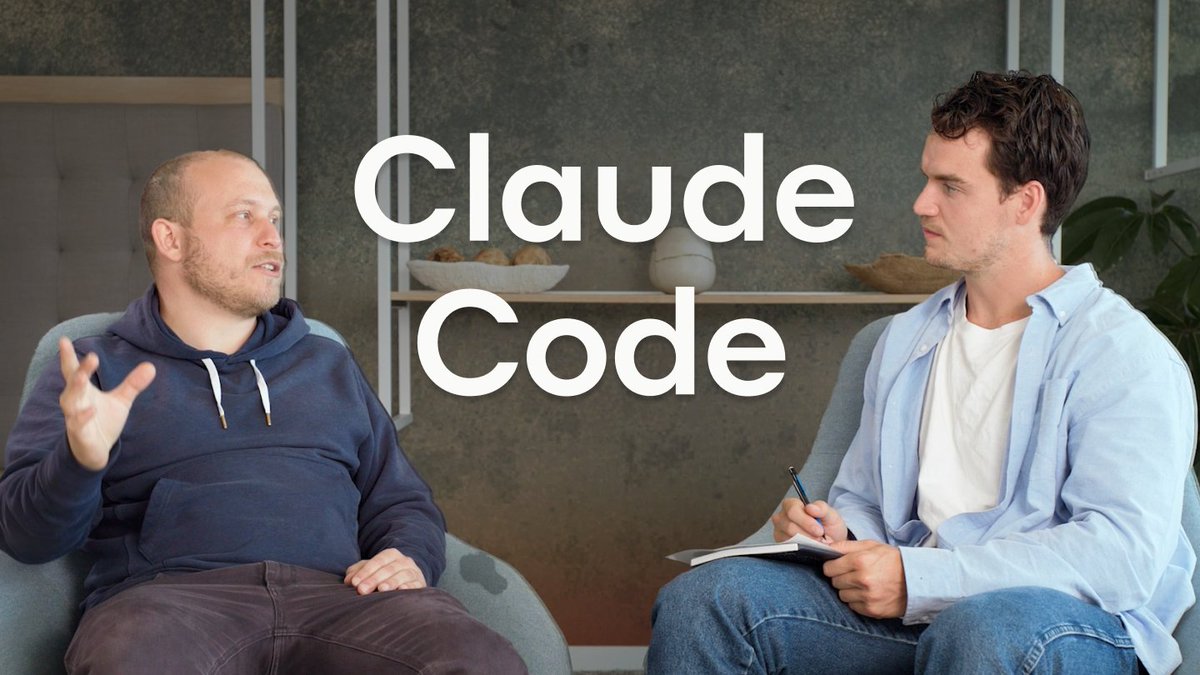
A new short course, Claude Code: A Highly Agentic Coding Assistant, is live! Claude Code is currently one of the most capable coding assistants. It can explore your codebase, plan features, write tests, refactor code, and even collaborate across multiple sessions—with surprisingly minimal input. In this course, you’ll learn...

32,513 Aufrufe • vor 10 Monaten •via X (Twitter)

0 Kommentare

Keine Kommentare verfügbar

Kommentare vom Original-Post werden hier angezeigt

Ähnliche Videos

New course: MCP: Build Rich-Context AI Apps with Anthropic. Learn to build AI apps that access tools, data, and prompts using the Model Context Protocol in this short course, created in partnership with Anthropic Anthropic and taught by Elie Schoppik Elie Schoppik, its Head of Technical Education. Connecting AI applications to external systems that bring rich context to LLM-based applications has often meant writing custom integrations for each use case. MCP is an open protocol that standardizes how LLMs access tools, data, and prompts from external sources, and simplifies how you provide context to your LLM-based applications. For example, you can provide context via third-party tools that let your LLM make API calls to search the web, access data from local docs, retrieve code from a GitHub repo, and so on. MCP, developed by Anthropic, is based on a client-server architecture that defines the communication details between an MCP client, hosted inside the AI application, and an MCP server that exposes tools, resources, and prompt templates. The server can be a subprocess launched by the client that runs locally or an independent process running remotely. In this hands-on course, you'll learn the core architecture behind MCP. You’ll create an MCP-compatible chatbot, build and deploy an MCP server, and connect the chatbot to your MCP server and other open-source servers. Here’s what you’ll do: - Understand why MCP makes AI development less fragmented and standardizes connections between AI applications and external data sources - Learn the core components of the client-server architecture of MCP and the underlying communication mechanism - Build a chatbot with custom tools for searching academic papers, and transform it into an MCP-compatible application - Build a local MCP server that exposes tools, resources, and prompt templates using FastMCP, and test it using MCP Inspector - Create an MCP client inside your chatbot to dynamically connect to your server - Connect your chatbot to reference servers built by Anthropic’s MCP team, such as filesystem, which implements filesystem operations, and fetch, which extracts contents from the web as markdown - Configure Claude Desktop to connect to your server and others, and explore how it abstracts away the low-level logic of MCP clients - Deploy your MCP server remotely and test it with the Inspector or other MCP-compatible applications - Learn about the roadmap for future MCP development, such as multi-agent architecture, MCP registry API, server discovery, authorization, and authentication MCP is an exciting and important technology that lets you build rich-context AI applications that connect to a growing ecosystem of MCP servers, with minimal integration work. Please sign up here!

Andrew Ng

141,930 Aufrufe • vor 1 Jahr

New short course: Vibe Coding 101 with Replit! Learn to build and host applications with an AI agent in this course, built in partnership with Replit ⠕ and taught by its President Michele Catasta and Head of Developer Relations . Coding agents are changing how we write code. "Vibe coding" refers to a growing practice where you might barely look at the generated code, and instead focus on the architecture and features of your application. However, contrary to popular belief, effectively coding this way isn't done by just prompting, accepting all recommendations, and hoping for the best. It requires structuring your work, refining your prompts, and having a systematic process that lead to a more efficient and effective workflow. I code frequently using LLMs, and asking an LLM to do everything in one shot usually does not work. I'll typically take a problem, partition it into manageable modules, spend time creating prompts to specify each module, and use the model to produce the code one module at a time, and test/debug each module before moving on. A process like this is making me and many other developers faster and more efficient. In this video-only course, you’ll learn how to use Replit’s cloud environment--with an integrated code editor, package manager, and deployment tools--to build and deploy web applications. Along the way, you’ll learn strategies for working effectively with agents and improve your development skills. In detail, you’ll: - Understand principles of agentic code development such as being precise, giving agents one task at a time, making prompts specific, keeping projects tidy, starting with fresh sessions for each new feature, and how to approach debugging. - Learn how to get started with Replit, and key skills for vibe coding: Thinking, using frameworks, checkpoints, debugging, and providing context. - Create a product requirement document (PRD) and wireframe for your agent to build a prototype of a website performance analyzer. - See how to use an agent to make your prototype more visually appealing, and deploy it application others to access . - Learn to build a head-to-head national park ranking app, from a sample dataset, with voting capabilities and persistent data storage, and refine further ask the assistant to recap and explain what it built to find room for improvement and reinforce your learning. By the end of this course, you’ll have a solid foundation in building with coding agents, and a process you can use to keep vibe coding effectively. Please sign up here:

Andrew Ng

751,992 Aufrufe • vor 1 Jahr

Claude Code is a major (and accidental!) hit for Anthropic that surprised even its creator, Boris Cherny. Claude Code, an Agentic AI coding product that lives in the terminal. Most of the new code at Anthropic is created through it today. And in the last 5 months since it was launched publicly, Claude Code went from $0 to $400M in revenue run rate (as per The Information). 00:00 – Intro 01:15 – Did You Expect Claude Code’s Success? 04:22 – How Claude Code Works and Origins 08:05 – Command Line vs IDE: Why Start Claude Code in the Terminal? 11:31 – The Evolution of Programming: From Punch Cards to Agents 13:20 – Product Follows Model: Simple Interfaces and Fast Evolution 15:17 – Who Is Claude Code For? (Engineers, Designers, PMs & More) 17:46 – What Can Claude Code Actually Do? (Actions & Capabilities) 21:14 – Agentic Actions, Subagents, and Workflows 25:30 – Claude Code’s Awareness, Memory, and Knowledge Sharing 33:28 – Model Context Protocol (MCP) and Customization 35:30 – Safety, Human Oversight, and Enterprise Considerations 38:10 – UX/UI: Making Claude Code Useful and Enjoyable 40:44 – Pricing for Power Users and Subscription Models 43:36 – Real-World Use Cases: Debugging, Testing, and More 46:44 – How Does Claude Code Transform Onboarding? 49:36 – The Future of Coding: Agents, Teams, and Collaboration 54:11 – The AI Coding Wars: Competition & Ecosystem 57:27 – The Future of Coding as a Profession 58:41 – What’s Next for Claude Code

Matt Turck

82,151 Aufrufe • vor 10 Monaten

I'm teaching a new course! AI Python for Beginners is a series of four short courses that teach anyone to code, regardless of current technical skill. We are offering these courses free for a limited time. Generative AI is transforming coding. This course teaches coding in a way that’s aligned with where the field is going, rather than where it has been: (1) AI as a Coding Companion. Experienced coders are using AI to help write snippets of code, debug code, and the like. We embrace this approach and describe best-practices for coding with a chatbot. Throughout the course, you'll have access to an AI chatbot that will be your own coding companion that can assist you every step of the way as you code. (2) Learning by Building AI Applications. You'll write code that interacts with large language models to quickly create fun applications to customize poems, write recipes, and manage a to-do list. This hands-on approach helps you see how writing code that calls on powerful AI models will make you more effective in your work and personal projects. With this approach, beginning programmers can learn to do useful things with code far faster than they could have even a year ago. Knowing a little bit of coding is increasingly helping people in job roles other than software engineers. For example, I've seen a marketing professional write code to download web pages and use generative AI to derive insights; a reporter write code to flag important stories; and an investor automate the initial drafts of contracts. With this course you’ll be equipped to automate repetitive tasks, analyze data more efficiently, and leverage AI to enhance your productivity. If you are already an experienced developer, please help me spread the word and encourage your non-developer friends to learn a little bit of coding. I hope you'll check out the first two short courses here!

Andrew Ng

1,223,306 Aufrufe • vor 1 Jahr

New short course: Building Code Agents with Hugging Face smolagents! Learn how to build code agents in this course, created in collaboration with Hugging Face, and taught by Thomas Wolf, its co-founder and CSO, and m_ric, Hugging Face’s Project Lead on Agents. Tool-calling agents use LLMs to generate multiple function calls sequentially to complete a complex sequence of tasks. They generate one function call, execute it, observe, reason, and decide what to do next. Code agents take a different approach. They consolidate all these calls into a single block of code, letting the LLM lay out an entire action plan at once, which can be executed efficiently to provide more reliable results. You’ll learn how to code agents using smolagents, a lightweight agentic framework from Hugging Face. Along the way, you’ll learn how to run LLM-generated code safely and develop an evaluation system to optimize your code agent for production. In detail, you’ll learn: - How agentic systems have evolved, gaining greater levels of agency over time—and why code agents are a next step. - How code agents write their actions in code. - When code agents outperform function-calling agents. - How to run code agents safely in your system using a constrained Python interpreter and sandboxing using E2B. - To trace, debug, and assess the code agent to optimize its behaviours for complex requests. - How to build a research multi-agent system that can find information online and organize it into an interactive report. By the end of this course, you’ll know how to build and run code agents using smolagents, and deploy them safely with a structured evaluation system in your projects. Please sign up here!

Andrew Ng

124,382 Aufrufe • vor 1 Jahr