Загрузка видео...

Не удалось загрузить видео

На главную

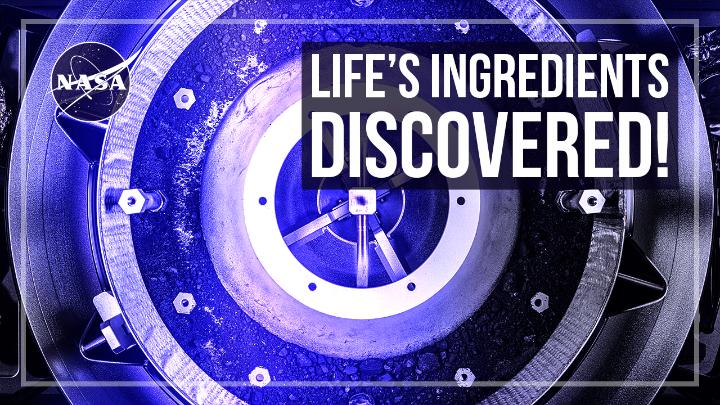
A new study has provided compelling evidence that Earth, shortly after its formation, was initially dry and lifeless, lacking the essential building blocks for life, such as water and organic compounds. Using precise measurements of the radioactive decay of manganese-53 into chromium-53 in meteorites and terrestrial rocks, the researchers...

44,966 просмотров • 9 месяцев назад •via X (Twitter)

Комментарии: 0

Нет доступных комментариев

Здесь появятся комментарии из оригинального поста

Похожие видео

6 Astonishing Irregularities That Are Evidence of a Hollow Moon Space Station. The majestic natural satellite has been the source of curiosity of countless people. It brightens up our dark nights and provides a way to navigate for our ancestral fathers. But over the years, as our understanding of the space has increased, we found some astonishing information about the moon that led to more questions than answers. Is the moon actually Earth's natural satellite? The new information has led to speculation that it might actually be an extraterrestrial technology transported here to survey mankind's progress and the impact we have on planet Earth, or maybe something entirely different. The reason why the moon was brought here remains to be a huge source of speculation, something we will hopefully find out in the near future, but for now we have the following information that dispels the previous notion that it is a natural planetary body: 1. The Moon Predates the Earth It was initially believed that the moon was formed when an external body crash-landed on Earth. A part of the debris from the crash accumulated into what we now know as the moon. There is yet another theory stating that when Earth was formed, the remaining dust came together to form a heavenly body that revolves around the Earth. However, when surface materials from the moon were brought back to Earth by the astronomers, the results led to startling discoveries, as the moon rocks and dust predated our planet, which is around 4.53 billion years old. The material comprising the moon turned out to be around 5.3 billion years old and the dust even older, dating to about 6.3 billion years. Hence, the moon must have originated somewhere else. 2. The Moon’s Density We know for a fact that the Earth’s density is 5.5 gm/cm3. Surprisingly, the moon’s density was found to be 3.34 gm/cm3, around 3.34 times the density of an equal volume of water. This was explained by the renowned NASA scientist, Dr. Gordon Macdonald in 1962. He stated that if our astronomical data is to be deduced, we come to the conclusion that the interior of the natural satellite is hollow. 3. Moonquakes A few years after Dr. Gordon Macdonald’s theory came to be, in 1969, the team of Apollo 12 landed on the moon. During their decent, they landed in a rough manner onto the moon’s surface, around 40 miles from their intended destination. The crash resulted in an artificial moonquake, which had startling characteristics. Upon impact, the moon started to reverberate just like a bell would, which we all know is hollow. The reverberations lasted for more than an hour. The same phenomenon was again witnessed when Apollo 13 landed on the moon and its impact caused an even greater seismic activity, which lasted for more than three hours. This led to the conclusion that the moon is unnaturally light for its size and possibly doesn’t even have a core, which would otherwise significantly increase its weight. 4. An Unnaturally Perfect Orbit We all know that the moon orbits around our planet in an almost perfect circular orbit, but still technically elliptical. This unnatural orbit couldn't have been captured by Earth’s gravitational force, as we can clearly see in the substantially elliptical orbits of the other satellites in our solar system. This further fuels the speculations that the moon was placed in its current position and orbit by an intelligent mind. 5. A Stationary Orbit Another weird thing about our moon is that its orbit around the Earth is completely stationary. Meaning that it doesn’t spin on its own axis as all of the other moons in our solar system do. This is why every time we look up at the moon, we see the same side of it — the side that faces Earth. 6. Unexplainable Center of Mass and Geometric Center Another thing about the moon we have been unable to scientifically understand is the discrepancy in its center of mass, which is around 6,000 feet closer to our planet than its geometric center. This discrepancy should, according to our understanding, cause the moon to constantly wobble — yet, it remains steady. Conclusion Since we have discovered all of these discrepancies with the moon, we have been constantly trying to figure out how it maintains its uniquely circular orbit, without a spinning axis and without wobbling. However, despite all of our efforts to understand these anomalies, we have yet to come up with a conclusive answer. The hypothesis that highly advanced extraterrestrials have hollowed out the moon and placed it in an almost perfect orbit around our planet, gives birth to even more wild speculations. We know for a fact that the moon is primarily responsible for the tides, seasons and even some earthquakes. The moon is also known to influence our sleep and even our mood. So we can draw the conclusion that the aliens that brought it here knew exactly what they were doingand it was part of their agenda to influence life on Earth via the moon space station. It has also been speculated that Earth is now a prison planet and the moon a space station for alien guardians. Even more interestingly, author David Icke has speculated that the moon is an important part of the matrix deception that kept mankind enslaved for millenia.

UFO mania

13,383 просмотров • 1 год назад

✅Explanation of Meaning (by parts): 1. “During the inception of our Universe, fortuitously arose a small possibility” : The author begins by noting that at the Universe’s origin, a slight chance emerged for the potential development of intelligence, framing this as a fortunate but improbable event inherent to cosmic conditions. 2. “that under certain circumstances there might come into existence at least a single primitive intelligent being” : This possibility hinged on specific conditions allowing for the emergence of even one basic intelligent entity, emphasizing the delicate and rare circumstances required for intelligence to arise. 3. “The planet upon which this would occur remained a mystery” : The author highlights that the specific location for this emergence was unknown, suggesting that no particular planet, including Earth, was predestined to host intelligence, reinforcing the randomness of the event. 4. “and the emergence of intelligence on Earth is not miraculous” : The development of intelligent life on Earth is presented as non-miraculous, a natural outcome of cosmic processes rather than a divine or extraordinary occurrence, grounded in chance. 5. “This could have materialized on another celestial body” : The author notes that intelligence could have arisen elsewhere in the Universe, on another planet or moon, underscoring the non-exclusive nature of Earth’s role in hosting intelligent life. 6. “and a thinking being similar to us would likewise ponder: why us, why here?” : If intelligence emerged elsewhere, those beings would ask the same existential questions as humans, reflecting on their own existence and location, highlighting a universal curiosity among intelligent life. 7. “It’s a matter of chance, you’re simply fortunate, your planet won the cosmic lottery” : The author concludes that the emergence of intelligence is purely a matter of luck, with Earth’s success likened to winning a cosmic lottery, emphasizing the role of random chance in our existence. 🗝️Main Idea (refined version): The author posits that the Universe’s inception held a faint chance for intelligence to emerge under rare conditions, with Earth’s hosting of intelligent life being a non-miraculous outcome of cosmic chance. This could have occurred elsewhere, and any intelligent beings would question their existence, as we do. Our presence is a fortunate accident, Earth having won the cosmic lottery, prompting humility and curiosity about our place in a random, vast Universe. This perspective challenges us to embrace the improbability of our existence, fostering a sense of awe and responsibility to explore and understand the cosmos.

Zafar Mirzo | Quotes

1,649,342 просмотров • 1 год назад

Yes, the Universe possesses a high degree of self-organization, which under certain conditions can give rise to life and, eventually, to intelligent beings. However, when we consider the history of the Solar System’s formation and the subsequent emergence and evolution of life on Earth, it is difficult to escape a sense of profound improbability in this process. This gives rise to the thought that the Universe may not be unique. We know the age of our Universe, its vast scale, and the immense number of planets it contains. And yet, it is hard to believe that such a complex and finely tuned sequence of events leading to the emergence of human beings occurred for the very first time precisely here. It seems more plausible to assume that such cosmic scenarios did not arise immediately, but became possible through a long process of repetition and selection, before eventually becoming a relatively natural outcome. All of this suggests that the Multiverse may indeed be real, and that within its framework, long before our own Universe, Earth-like planets may have already emerged — complete with the rich conditions necessary for life and intelligence. : The author observes that the Universe exhibits strong self-organization, capable under the right conditions of producing life and eventually intelligent beings. Yet when we examine the detailed history of the Solar System’s formation, Earth’s emergence, and the intricate evolutionary path to humanity, the entire sequence feels profoundly improbable. Given the known age of the Universe, its enormous scale, and the countless planets it contains, it becomes difficult to accept that such a finely tuned cascade of events leading to conscious life occurred only once, right here. The more plausible explanation is that these conditions did not appear immediately or by chance in a single attempt. Instead, they emerged through countless repetitions and variations across vast cosmic time, gradually becoming a relatively common outcome. This reasoning strongly supports the reality of a Multiverse. In its immense framework, countless universes would have preceded our own, many of them giving rise to Earth-like planets with the precise conditions required for life and intelligence long before ours. What seems miraculous in isolation becomes almost inevitable when viewed across an ensemble of possibilities. The improbability of our existence in a single universe dissolves into the natural probability of many. The Multiverse is not a retreat from explanation. It is the logical extension of the same self-organization we already observe.

Zafar Mirzo | Quotes

2,119,331 просмотров • 4 месяцев назад

I think the best argument for Catholicism and Christianity in general is the fact that the world is too precise in its systems to exist out of nothing or by pure coincidence. Scientists agree that something doesn’t come from nothing and the universe clearly has a beginning. The conditions that allow life to exist are so finely balanced that even the smallest change would make everything fall apart For example, if the Earth were just a little closer to the sun, temperatures would rise to the point where life couldn’t survive. If it were slightly farther away, everything would freeze. Even gravity itself has to be incredibly precise. If the force of gravity were off by even about 1 part in 10⁴⁰ (that’s a 1 followed by 40 zeros), the universe as we know it wouldn’t exist. If it were slightly stronger, everything could collapse in on itself, if it were slightly weaker, galaxies, stars, and planets might never have formed at all On top of that, even our solar system seems uniquely set up for life. Jupiter, because of its massive size and position, acts like a kind of shield for Earth. Its gravity pulls in or deflects many comets and asteroids that would otherwise collide with us. Without Jupiter acting in that role, the rate of catastrophic impacts would be so high that complex life on Earth would likely never have had the chance to develop and survive over long periods of time. Then there’s our moon. Moon plays a crucial role in stabilizing Earth’s tilt, which is what gives us stable seasons. Without it, Earth’s axis could wobble chaotically, causing extreme and constantly changing climates that would make long-term life very difficult, if not impossible. What’s even more shocking is how the moon formed. Sscientists believe a Mars-sized body, often called Theia, collided with Earth at just the right angle and speed. If that collision had been slightly different, the moon might never have formed, and without it, Earth could be largely uninhabitable The same kind of precision shows up anywhere and everywhere, in the laws of physics, in the structure of atoms, even in the way life itself is coded and sustained. The probability of all the necessary conditions for life coming together by chance is so insanely, astronomically low sometimes cited as something like 1 in 10¹⁰⁰ or even smaller, if ONE singular variable would to change we as humans could not exist on this planet at all. Just because something is technically statistically possible it does not mean its probable. Same way you could run into a wall and all your atoms could realign to phase through it, its possible, but is it probable? To me, that level of order and balance points to intention rather than accident. It suggests that there is something behind it all something that designed or set these conditions in motion. And once you start considering that possibility seriously, it becomes harder to see reality as random, and easier to believe that there is a purpose and a source behind everything we experience Some people believe that nothing created the universe while others thing a creator, God created it, which one sounds more believable?

Rock Solid

38,022 просмотров • 2 месяцев назад

“There are ruins of an ancient civilization on Mars.” “Our solar system was inhabited by an extraterrestrial race of angelic beings.” “Ancient humans believed that the gods descended from Mars.” “And from this other planet that was destroyed.” Timothy Alberino just broke down the wild theory that there was an ancient “cosmic war” in our solar system. It left colossal ruins on Mars. It destroyed the planet “Rahab,” which we now know as the asteroid belt. And then, these beings came to Earth and lived among humanity in a “golden age” before a great cataclysm. Watch him break down this incredible theory with Jesse Michels: “The universal testimony of our antecedents is that there was an age previous to a great flood … in which the gods were dwelling on Earth among men.” “And that those beings came from somewhere.” “This is what the late researcher extraordinaire David Flynn unfolds in his book Cydonia.” “What Flynn proves, I would say definitively, is that not only did the ancients believe that the gods descended to the Earth in the antediluvian world during the golden age.” “But that they came from … a planet in our solar system.” “There’s a planet that Flynn talks about which is, in popular culture, referred to as Krypton.” “And one of these planets, Flynn believed, and I believe this as well … is actually named in the biblical text, cryptically.” “It’s called Rahab.” “There was this conflict that erupted in the cosmos long before the creation of mankind.” “Most of us are familiar with the Cydonia region of Mars, the alleged face on Mars.” “Richard Hoagland was instrumental in publicizing … the idea that on the planet Mars, there are ruins of an ancient advanced civilization.” “You have the remote viewer McMoneagle.” Michels: “He was tasked by the CIA to remote view Mars a million years ago, and described … 8 to 12 foot tall beings and pyramid structures.” “And then you allegedly have this guy John Brandenburg as well, who’s a PhD in physics who worked at Lawrence Livermore and Sandia.” “He believes that Argon 40 and Xenon 129 exist in excess of what you would ever see just based on natural decay.” “And this is proof of a nuclear cataclysm that occurred on Mars.” Alberino: “Hoagland and Flynn were talking about this back in the 90s and early 2000s.” “And then NASA released the early photographs that looked like a face on Mars.” “It looked like a pyramid.” “Then they released new higher resolution photographs, which seemed to debunk the whole thing.” “I have no proof of this … but I personally think that the images from the first mission of the surface of Mars were correct … and that NASA released those second higher resolution images to quell the firestorm that had erupted.” “I am extremely persuaded that there are ruins that dwarf anything on planet Earth.” “What’s so fascinating about this is that the ancients believed that the gods descended from Mars and from this other planet that was destroyed.” Timothy Alberino Jesse Michels American Alchemy

Holden Culotta

143,788 просмотров • 2 месяцев назад