Video wird geladen...

Video konnte nicht geladen werden

Zur Startseite

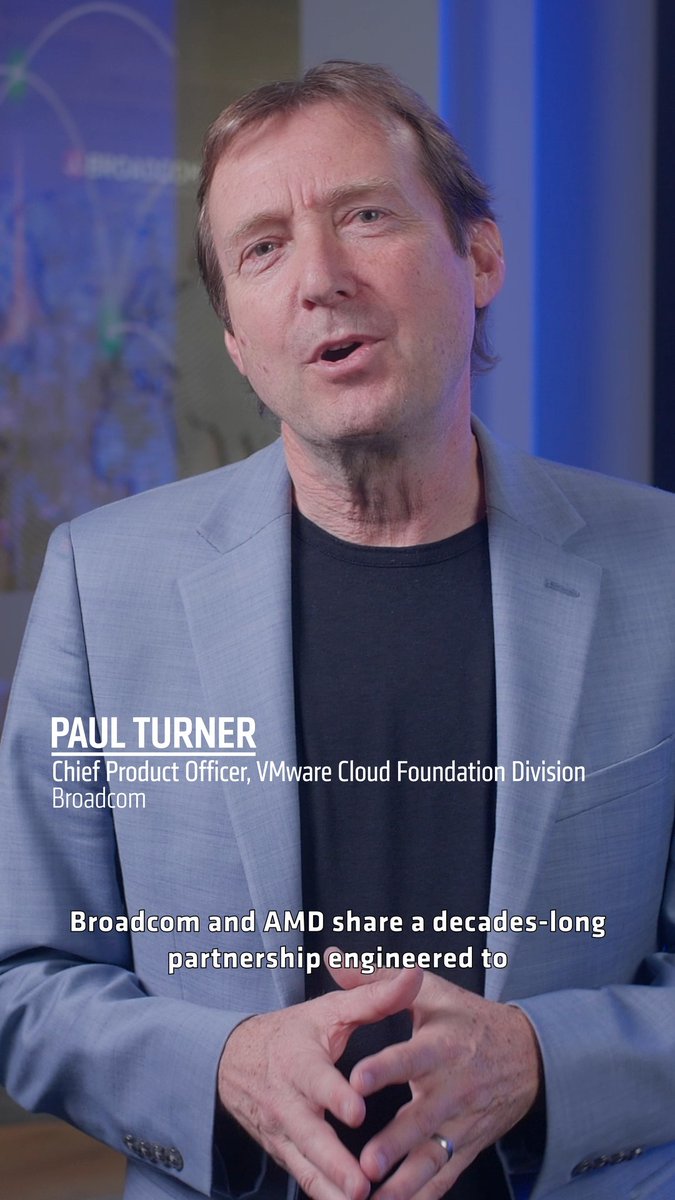
A recent Broadcom study of 1,800 IT professionals found an 8:1 cost gap between running an AI agent through a frontier model and running it on-prem. At VMware Explore 2026, Patrick Moorhead and Daniel Newman spoke with Broadcom's Paul Turner on how VMware's AI Factory is closing that gap. $AVGO

49,529 Aufrufe • vor 12 Tagen •via X (Twitter)

1 Kommentare

Profilbild von why
whyvor 12 Tagen

@Broadcom @VMware @PatrickMoorhead @danielnewmanUV An 8:1 gap is substantial, though the real tradeoff probably depends on utilization, latency requirements, and the operational cost of running on-prem.

Ähnliche Videos

Chamath is making one of the most important business arguments of 2026. Half of large US companies right now cannot generate returns that exceed their cost of capital, which has normalized back to its long run average of 8 to 11%. Another one in seven companies globally is stuck generating persistent returns between 1 and 5% and most businesses don't have room for error and in this environment walks every frontier AI lab saying the same thing, give us your data, your workflows, your processes and our model will make everything better. And companies by the millions said yes. What they didn't fully account for is what happens on the other side of that door. Every time an employee runs a query through a frontier model API, the prompt goes through external servers, workflows, customer data, pricing logic, internal processes, all of it transmitted through a third party. As Alex Karp said companies are spending on tokens while handing over the exact proprietary advantages that make their business worth owning. Microsoft blocked internal use of Anthropic's Claude Fable 5 but over its 30-day data retention policy and the largest software company in the world decided a frontier model's data handling was too risky for its own employees. A US government action revoked access to another frontier model for foreign nationals overnight. Now here's where the cost math becomes impossible to ignore. Deutsche Bank calculated a roughly 65x cost gap between frontier models like Claude Fable 5 at ~$3.25 per task and open-source alternatives at ~$0.05. For 90% of everyday enterprise tasks, performance is comparable. Open-weight models now match closed frontier systems on core agent tasks at roughly one-tenth the cost, a high-volume deployment that costs $250/day on Claude runs at $12/day on an open-source equivalent. Chamath Palihapitiya tested this directly by running a standard enterprise code migration task through an orchestration layer wrapping an open-source model came in 16.4x cheaper than using a frontier model directly.

Milk Road AI

281,771 Aufrufe • vor 2 Monaten

The teams shipping AI agents right now are bleeding money on the dumbest possible expense: teaching a 400B-parameter model to read a file name. Every time an AI agent needs to "see" something today, it routes an image through a frontier model. OCR, object detection, checking if a button exists on screen. You're paying GPT-4o or Claude pricing for tasks that require perception, not reasoning. One agent workflow processing a few thousand screenshots per day can burn through more on vision calls than on the actual thinking. Perceptron's Isaac is 2B parameters. Built by the team that created Meta's Chameleon multimodal models. On perceptive benchmarks, it matches or beats models 50x its size. The VQA, OCR, and object detection scores are competitive with models running on infrastructure that costs orders of magnitude more. The MCP wrapper is the distribution play. One install command and every Claude Code agent can offload vision tasks to a model that runs on a single consumer GPU. The agent keeps its reasoning in the frontier model and routes perception to a specialist. That split is how you get vision-heavy agent workflows from "technically possible but expensive" to "cheap enough to run on everything." This is the same pattern that won in every other compute-intensive stack. General-purpose handles orchestration. Specialists handle the heavy lifting. Graphics went through it. Audio went through it. Video encoding went through it. Vision in AI agents is next. The teams building agents that see 10,000 images a day will care about this before anyone else does.

Aakash Gupta

55,978 Aufrufe • vor 5 Monaten