Video wird geladen...

Video konnte nicht geladen werden

Zur Startseite

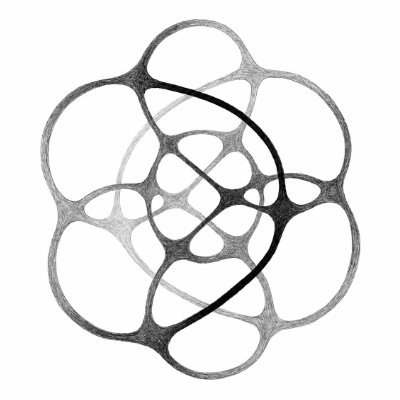
A string fixed at both ends vibrates in standing waves sin(nπx/L), with frequencies fₙ = n·f₁ = (n/2L)√(T/μ). On the A string, f₁ = 110 Hz, the first eight are A2, A3, E4, A4, C#5, E5, G5, A5. Six sit within 2 cents of a piano key; the 5th...

26,780 Aufrufe • vor 10 Tagen •via X (Twitter)

2 Kommentare

Profilbild von Calculover
Calculovervor 9 Tagen

In this model, the same pluck also removes the 10th, 15th, and every fifth harmonic: sin(nπ/5) = 0 whenever n is a multiple of 5. With a 110 Hz fundamental, the first missing frequencies are 550, 1,100 and 1,650 Hz.

Profilbild von Chill🌴Bill's🧋•°○• 🥥°☆•🌴•☆°Paradis🌞°☆•🌴
Chill🌴Bill's🧋•°○• 🥥°☆•🌴•☆°Paradis🌞°☆•🌴vor 10 Tagen

Da kriegst schon fast ein Orgasmus beim Zuschauen.

Ähnliche Videos

String Theory Lecture 1 A String Does Not Move Like a Point A point particle traces a line through spacetime. A string traces a surface. This is the first geometric shift in String Theory. Particle mechanics asks where one object is at time t, so its history is a curve. String Theory asks where every point of an extended object is at worldsheet time τ, so we need another coordinate telling us where we are along the string. For a point particle x(t) So, for one input of time we get a position in Spacetime. For a string Xᵘ(τ,σ) Here τ plays the role of time on the worldsheet, while σ labels position along the string. Freeze τ and vary σ, and you see the string at one instant. Let τ move, and that curve sweeps out a two-dimensional surface... the worldsheet. The same comparison appears in the action. For a relativistic point particle, the geometric action measures worldline length S = −m ∫ ds If we parameterize the path by t, the action has one integral, one parameter, and one tangent vector dxᵘ/dt For a string, the same idea grows by one dimension. The action measures area, not length. In Nambu-Goto form, S = −T ∫ dτ dσ √[−det hₐᵦ] Here T is the string tension. It plays a role similar to mass, but for an extended object. It weights the area of a surface rather than the length of a line. The particle action has ∫ dt because the history is one-dimensional. The string action has ∫ dτ dσ because the history is two-dimensional. We are no longer summing along a path, we are summing over a surface. The geometry changes for the same reason. For the particle, one derivative is enough dxᵘ/dt For the string, the geometry is built from two derivatives: ∂τXᵘ and ∂σXᵘ The first tells you how the string changes as worldsheet time flows. The second tells you how the embedding changes as you move along the string. Together they define the induced worldsheet metric hₐᵦ = ∂ₐXᵘ ∂ᵦXᵤ In plain terms, hₐᵦ measures tangent lengths and tangent angles on the worldsheet. From it, the area element is dA = dτ dσ √[−det hₐᵦ] This, the Nambu-Goto action is the direct analogue of the point-particle length action. The point particle extremizes length and the string extremizes area. For calculations, people usually switch to the Polyakov action: S = −(T/2) ∫ dτ dσ √[−γ] γᵃᵇ ∂ₐXᵘ ∂ᵦXᵤ This describes the same classical string dynamics, but the algebra is cleaner. After choosing conformal gauge, varying with respect to Xᵘ gives (∂²/∂τ² − ∂²/∂σ²) Xᵘ = 0 This is the first real dynamical payoff... a two-dimensional wave equation on the worldsheet. For a point particle, the equation of motion tells you how one position evolves along one path. For a string, it tells you how an entire curve evolves, with waves traveling along it. The term ∂²Xᵘ/∂τ² measures acceleration in worldsheet time, while ∂²Xᵘ/∂σ² measures curvature along the string. The time evolution is balanced by how the string bends along its own length. This is why strings have oscillation modes. A point particle has one trajectory. A string has many possible vibration patterns, each one a normal mode of the worldsheet wave equation. For a closed string, σ wraps around the loop Xᵘ(τ, σ + 2π) = Xᵘ(τ, σ) For an open string, one standard free-end condition is ∂σXᵘ = 0 at the endpoints. Solving the wave equation gives waves moving in opposite directions along the string Xᵘ(τ,σ) = Fᵘ(τ + σ) + Gᵘ(τ − σ) A function of τ + σ moves one way. A function of τ − σ moves the other. Therefore, a particle has a worldline, its action measures length, and its geometry uses one tangent. The string has a worldsheet, its action measures area, and its geometry uses two tangent directions. #StringTheory #TheoreticalPhysics #MathematicalPhysics #Physics #Spacetime

Mathelirium

32,127 Aufrufe • vor 5 Monaten

String Theory Lecture 2 In Conformal Gauge, the String Becomes a Wave Equation Episode 1 showed the geometric jump point particle -> worldline string -> worldsheet Episode 2 is the dynamical jump. The Nambu-Goto action measures the area of the worldsheet, S = −T ∫ dτ dσ √[−det hₐᵦ] but the square-root determinant is awkward to work with. So we usually rewrite the same classical theory in Polyakov form, S = −(T/2) ∫ dτ dσ √[−γ] γᵃᵇ ∂ₐXᵘ ∂ᵦXᵤ Here Xᵘ(τ,σ) tells us where each point of the string’s worldsheet sits in spacetime, and γₐᵦ is the metric we put on the worldsheet. The power of this form is that we can choose a convenient gauge. In conformal gauge, the equations of motion simplify to (∂²/∂τ² − ∂²/∂σ²) Xᵘ = 0 So the string’s spacetime coordinates behave like waves living on the worldsheet. The τ-derivative measures how the string changes in worldsheet time. The σ-derivative measures how it bends along its own length. For a closed string, σ is periodic Xᵘ(τ, σ + 2π) = Xᵘ(τ,σ) and the wave equation splits into two traveling pieces, Xᵘ(τ,σ) = Fᵘ(τ + σ) + Gᵘ(τ − σ) One family moves one way around the string and the other moves the opposite way. These are the left-moving and right-moving modes. In the render, the bright loop is the string at the present moment. The glowing cylinder behind it is the worldsheet it has swept out. The cyan curves trace one traveling family, and the gold curves trace the other. They are the visual version of τ + σ and τ − σ. Therefore, the theory has an internal wave equation, and its normal modes are the raw material for the string spectrum. #StringTheory #TheoreticalPhysics #ConformalGauge #Worldsheet #WaveEquation #Physics #Mathematics #MathematicalPhysics #QuantumGravity #ScienceVisuals

Mathelirium

15,607 Aufrufe • vor 5 Monaten

HOLY SH*T this guy buys a dollar for 98 cents on Polymarket EVERY TIME. his bot's been doing it all night and it's up $4,293 now. total PnL is over $294k thanks to one rule: buy only when YES + NO < $1 public wallet: [ here's how it works: every 15 minutes bitcoin gets an up market and a down market. up on one pan, down on the other. when the window ends, one pan is worth a dollar and the other is worth nothing, so a fair price for the pair is exactly one dollar. buy up at 54 cents and down at 46 and you paid a dollar for a dollar. pointless. but the scale doesn't always sit at a dollar. every so often up is 54 and down is 44, and the pair only costs 98 cents. that's the scale breaking. you buy both pans for 98, one of them settles at a hundred, and the 2 cents is yours no matter which way bitcoin moved. you never guessed. you weighed two numbers and bought only when they came up short of a dollar. why does the scale break? because up and down are priced by two different crowds that never look at each other. a buyer leans on the up pan, its price rises, and the down pan hasn't moved yet. for a few seconds the pair is cheap. the bot lives for those seconds and does nothing the rest of the time. now the honest part, because this clip doesn't sell you a fantasy. it's not a moonshot. look at the equity line, a slow staircase, not a rocket. 63% hit rate. real losses sitting right in the log, minus 109, minus 21, a flat one at minus 71. it wins about six times out of ten, the wins are two and three cents, and the bank grinds from 683 to 4,293 while it sleeps. boring and up. that's the whole personality. the losses come from one thing: the scale tips before you get both pans. you buy up, and down runs off before your second order lands, and now you're holding one side, a real bet on bitcoin you never wanted. that's the only wound. get both pans or get out. the strategy end to end is this small: weigh up against down, buy when they're under a dollar, bail if you only catch one side. that's it. a scale and a stopwatch. and the people already running it will never point at a live scale, because the second they do, everyone leans on it and it stops breaking. so they stay quiet and the boring staircase climbs in private. the full build + one rule that stops a half-fill from becoming a real loss is in the article below. good luck.

Oracle Boar

93,698 Aufrufe • vor 1 Monat

My dad looked at my screen and said what is this, a hacker game? It was a Polymarket bot making $400 while he was standing behind me. He sat down. I explained. Polymarket runs on one equation. Softmax. The same math Claude uses to pick the next word. C(q) = b · ln Σ e^(qi/b) 93% of traders do not know this formula exists. They look at 40 cents and think cheap. My bot looks at 40 cents and calculates the theoretical price is 58 cents. That is an 18-cent edge per share. Two more formulas do the rest: f = (p·b − q) / b. Kelly Criterion. P(H|E) = P(E|H)·P(H) / P(E). Bayes. I gave Claude all 4 and said find every contract the market has wrong. $600 to $10,190. 425 trades. Still running. 61.2% win rate. Wrong 39% of the time. Does not matter. The sizing formula makes sure wins pay more than losses cost. 87% of wallets lose money trading against this math. The 4 formulas are on Wikipedia. The code fits in one file. The only edge: my bot reads them at 3 AM when the market is mispriced and nobody is looking. My dad still calls it a hacker game. But he stopped asking when I am getting a real job. I built the entire framework: Softmax arbitrage detection layer Kelly Criterion position sizing Bayesian probability recalibration Claude integration for autonomous execution 3 AM mispricing scanner The system runs 24/7. Finds where the math disagrees with the crowd. Executes before the edge compresses. No prediction. No gut feel. Just formulas. You only need Claude + device + 1 hour per day. Giving this free for 24 hours. To get it: 1. Comment the word money 2. Like and retweet this 3. Follow me Himanshu Kumar so I can DM you Save this post. Deploy the formula system this week. Start with $600. Scale on evidence.

Himanshu Kumar

13,365 Aufrufe • vor 3 Monaten