Video yükleniyor...

Video Yüklenemedi

Ana Sayfaya Dön

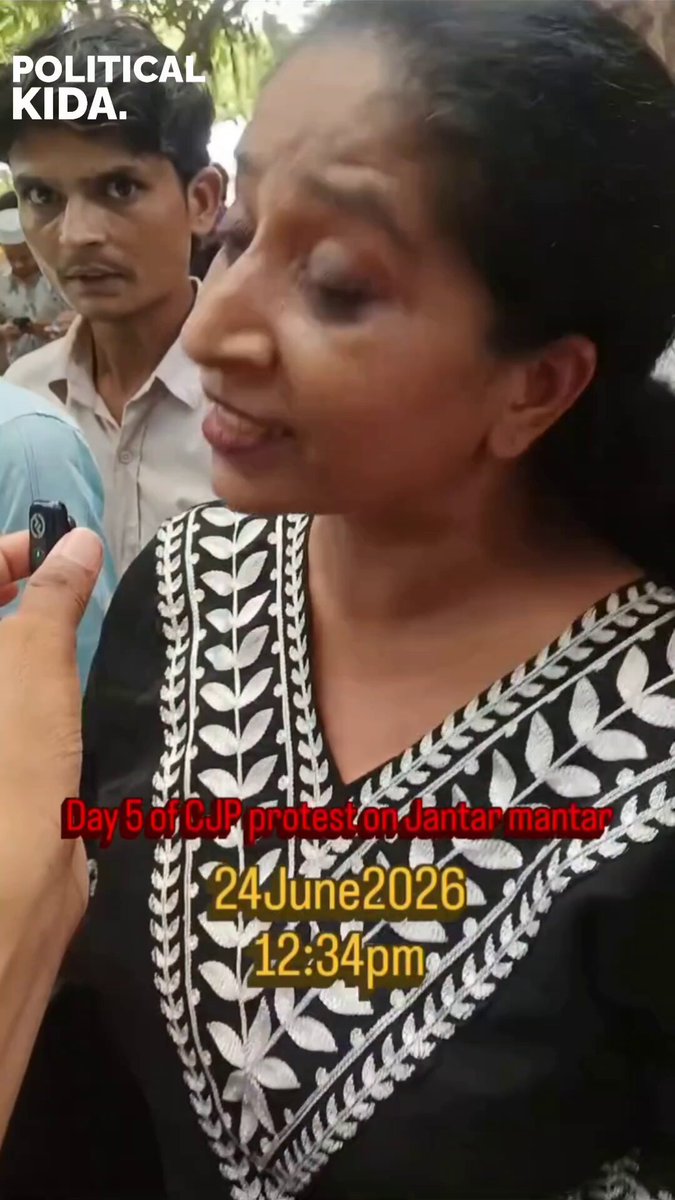
ABHIJEET EXPLAINS HOW STUDENT ANGER FORCED MODI TO DROP PRADHAN 🚨 ROFL: Modi rarely accepts resignations. Why remove Dharmendra Pradhan? ABHIJEET 🔥: To save his own chair. ROFL: Why? ABHIJEET: They thought the crackdown had ended us. We returned stronger and the anger went national. When students demanded “Pradhan’s...

27,649 görüntüleme • 25 gün önce •via X (Twitter)

0 Yorum

Yorum bulunmuyor

Orijinal gönderinin yorumları burada görünecek
Benzer Videolar

Open Letter to Union Home Minister Amit Shah Shri Amit Shah avare, First, let me congratulate you for finally speaking the truth by openly revealing the BJP's real opinion about Dr. Babasaheb Ambedkar. Your statement in Parliament (18-12-2024) didn’t surprise us; we already knew your party’s true mindset. But now, the entire country has seen your lack of respect for the architect of the Indian Constitution. Standing in the very Parliament that runs under his Constitution and calling his memory a "habit" shows your arrogance. Congratulations, Mr. Shah, for this shameless act! Do not attempt to mislead the nation by saying, "I have immense respect for Babasaheb, and my words were twisted." We are not gullible. Own up to your words and face the nation. For us, Ambedkar is not a "fashion" but an eternal inspiration. As long as we breathe, as long as the Sun and Moon shine on this Earth, Ambedkar's legacy will endure. The more you try to diminish his memory, the stronger it will rise to guide us forward. While your sycophants might have clapped at your arrogance, remember this: millions across this country, who have gained equality and dignity because of Babasaheb, are condemning you. Had Dr. Ambedkar not been born, I wouldn't have had the privilege of becoming the Chief Minister today—I might have been herding cattle in my village. Our senior leader, Mallikarjun Kharge Ji, wouldn't have risen to lead the AICC; he might have been working in a factory in Kalaburagi. We owe every step of our progress and dignity to Babasaheb and the Constitution he gave us. Not just me—without Ambedkar's contributions, you too wouldn't be the Home Minister today. Instead, you might have been running a scrap business in your hometown. Prime Minister Narendra Modi, your colleague, might still be selling tea at a railway station. Babasaheb’s vision is what elevated us all. Even the Prime Minister might admit this, and so should you. Your hatred for Ambedkar is not new to those who know history. Why did your ideological parent, the RSS, reject the Constitution written by Babasaheb during his lifetime? Historical records document the statements of RSS leaders like Hedgewar, Golwalkar, and Savarkar against the Constitution. You may try to suppress these truths, but they cannot be erased. Your remarks in Parliament are just an extension of that long-standing RSS ideology. Let me respond in your tone. Your party and its ideological family have now developed a fashion to chant "Modi... Modi... Modi." If only you had invoked the name of God as many times as you chant Modi’s name, you might have secured a place in heaven—not just for seven lifetimes, but for a hundred. Perhaps even your sins, committed solely for clinging to power, might have been forgiven. Sincerely, Siddaramaiah Chief Minister, Karnataka

Siddaramaiah

428,371 görüntüleme • 1 yıl önce

Visiting Venice changed Claude Monet's life By 1908, he had spent forty years teaching the world to see light. He was 68, in poor health, and losing faith in his own work. He had just abandoned his water lily paintings, discouraged after a trusted advisor questioned whether anyone would even want them. The man who had founded Impressionism, whose 1873 canvas "Impression, Sunrise" had given the entire movement its name, was convinced his best days were behind him... His wife, Alice, suggested a trip to Venice. Monet resisted. The city had been painted to death by Canaletto, Turner, and Whistler, and he had always insisted, "I will not go to Venice." It was, he said, "too beautiful to be painted." He went. And the moment he arrived, standing before the light on the water, he exclaimed: "It is too beautiful to be painted! It is untranslatable!" Within days he could not stop working. He fell into a fierce daily rhythm, painting the Doge's Palace, the churches, and the palazzos along the Grand Canal at the same hours each day, chasing the shimmer of Venetian air on stone and water. In just over two months he began 37 canvases. His wife wrote home that she was overjoyed to see him so impassioned again, doing beautiful work, and something other than "those same old water lilies." In a letter to a friend, Monet wrote: "My enthusiasm for Venice continues to grow, and it saddens me that the moment is coming when I must leave this unique light." He never returned. His beloved Alice died a few years later, and for a long time he could not bring himself to finish the Venice canvases. But when he did, and when they were finally shown in Paris in 1912, they were a triumph. And the trip had given him back something he thought he had lost: the discouraged old man who had walked away from his water lilies went home and took them up again, and spent his final years creating the enormous, luminous Nymphéas, the paintings the world now loves most. Sometimes the thing that revives us is an unexpected encounter with beauty we almost talked ourselves out of. He nearly didn't go. It turned out to be the doorway to his greatest work...

James Lucas

38,281 görüntüleme • 2 ay önce

When History Warns Us, We Must Not Ignore It We never expected the Chief Minister of Keralam to take such a position under any circumstances. But on this issue, we need to look back at history. Because the people of Keralam have every right to ask: whose political pressure is behind this decision of the Chief Minister? When we examine the history of Vande Mataram, one thing becomes clear. This is not a political issue that emerged yesterday. During India’s freedom struggle, Vande Mataram became a symbol of national consciousness and the spirit of freedom for millions of Indians. The Muslim League was formed in 1906. During the 1930s, opposition to certain portions of Vande Mataram became increasingly prominent among sections of Muslim political leadership, including the Muslim League. In 1937, the Congress moved towards adopting the first two stanzas of Vande Mataram for official occasions. This remains an important episode in our history. But one thing must be made absolutely clear. This is not an allegation against the Muslim community. Many Muslims participated wholeheartedly in India’s freedom struggle and sang Vande Mataram as part of the national movement. Therefore, today’s debate is not against any religion. It is a debate about political positions concerning nationalism. But history also raises another important question. In 1937, political opposition emerged over the use of Vande Mataram. Subsequently, the politics demanding the partition of India became stronger, and ultimately, in 1947, the country was divided. That is why, when in 2026 a position is being taken in Keralam that Vande Mataram need not be sung, a natural question arises: Where will such political compromises take us? What will the state of Keralam’s national consciousness be ten years from now? If we begin making political compromises over one national symbol today, what will prevent similar compromises on other national symbols tomorrow? That is the question Keralam needs to debate today. We have even witnessed situations where a teacher faced serious consequences merely because a question about Veer Savarkar was included in a quiz competition. When a historical figure, an idea, or a national song becomes subject to political pressure, it should concern every democratic society. That is why the BJP is bringing Muhammad Ali Jinnah into this discussion today. This is not a discussion about one individual. It is not a discussion about one religion. Nor is it a discussion against any community. It is a discussion about the future of nationalism. If we want to ensure that history does not repeat itself, we must learn from history. Those who say today that Vande Mataram need not be sung—who can guarantee that tomorrow they will not question another national symbol? If we continue surrendering our national values to political pressure, what we ultimately stand to lose will not merely be the words of a song—it will be our sense of national unity. Therefore, our message to the Chief Minister of Keralam is very clear: Do not surrender nationalism to political pressure. No one needs anyone’s permission to sing Vande Mataram in Keralam. Every Indian has the right to embrace this national song, which inspired the freedom struggle of our country. Even if you do not sing it, Keralam will sing it. Even if you exclude it from government programmes, the BJP will ensure that Vande Mataram and the National Anthem are sung across Keralam. Because the Bharatiya Janata Party will stand at the forefront to protect the national consciousness of this land. As long as Narendra Modi leads this country, we will not allow politics opposed to India’s unity and integrity to take root on this soil. There will be no compromise on nationalism in Keralam. When history warns us, we must not ignore it. We must learn from history. We must not allow history to repeat itself. My greetings and congratulations to the Yuva Morcha for organising this programme.

Rajeev Chandrasekhar 🇮🇳

13,916 görüntüleme • 1 ay önce