Video yükleniyor...

Video Yüklenemedi

Ana Sayfaya Dön

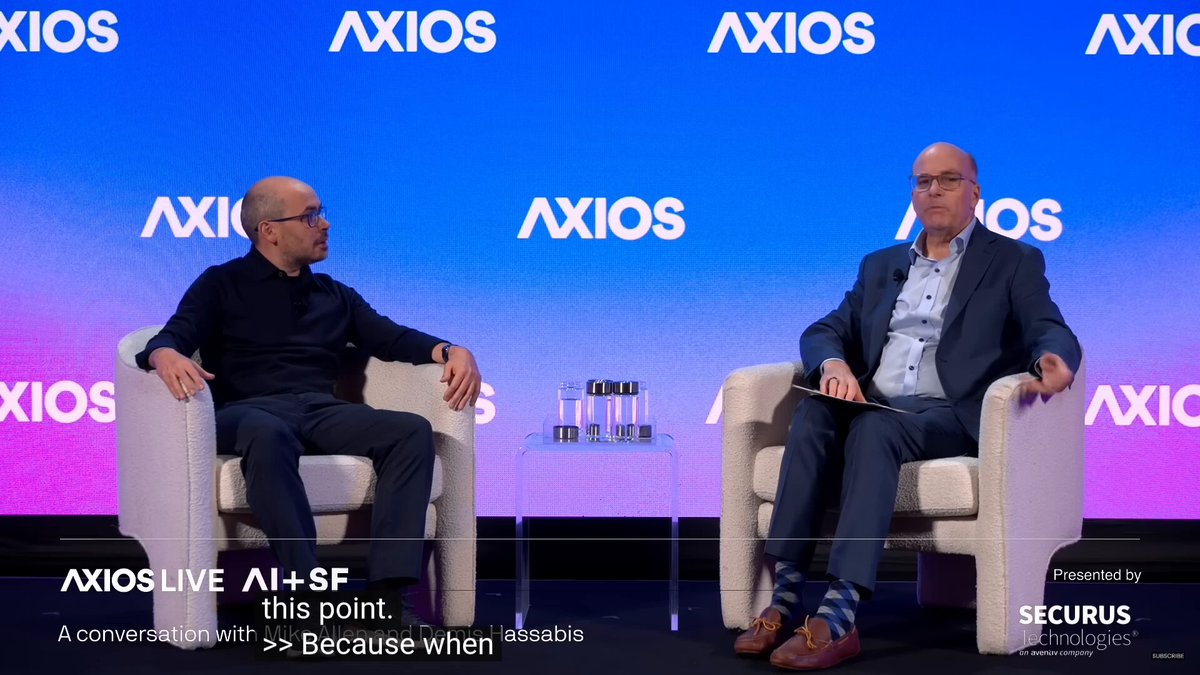
AGI probably needs 1-2 new breakthroughs, like continual learning, selective memory, smarter context windows, and long term planning. ~ Google DeepMind CEO Demis Hassabis But in any case, large foundation models will remain the key component of AGI. --- From 'Alex Kantrowitz' YT channel (link in comment)

36,646 görüntüleme • 5 ay önce •via X (Twitter)

0 Yorum

Yorum bulunmuyor

Orijinal gönderinin yorumları burada görünecek

Benzer Videolar

Without World Models, There Is No AGI. Google Just Proved It. If AGI ever happens, it will not come from bigger chatbots alone. From the very start of this interview, one thing is crystal clear: without world models, we will never reach AGI. And right now, Google is leading with its world simulator Genie 3. Here is the core of what Demis Hassabis explains in this conversation: • World models are the missing core of AGI Hassabis says his deepest long term focus has always been world models and simulations. Not just language. Not just prediction. Actual internal simulations of reality. • LLMs are impressive, but incomplete Language models understand more about the world than expected because human language encodes a lot of reality. Still, language is only a shadow of the real thing. • What text can never fully teach Reality includes things text struggles to express: •3D space and spatial dynamics •Physical causality and mechanics •Sensorimotor experience like movement, force, smell, or balance • Experience beats description To close the gap, AI must learn from interaction and experience, not just static text. That is how you build an internal world simulator. • Why Genie 3 matters With Google DeepMind pushing systems like Genie 3, AI starts to model reality itself, not just talk about it. • Robots and real world assistants depend on this True robotics, smart glasses, and universal assistants require AI that understands the physical world you live in, not just your screen. Bottom line: AGI will not emerge from better text prediction. It will emerge from systems that can simulate, predict, and understand reality itself. Right now, Google is clearly ahead on that path. Curious what you think. Are world models the real AGI unlock, or just another stepping stone?

VraserX e/acc

23,784 görüntüleme • 7 ay önce

The most skilled guy in the AI industry just said we're 1-2 breakthroughs away from AGI. And he explained exactly what's missing. Demis Hassabis runs Google DeepMind. He won the Nobel Prize in Chemistry last year. He's literally the reason why Google is considered the leader of the AI race. And he just dropped the most specific AGI timeline ever: "One or two AlphaGo-level technological breakthroughs." That's it. That's all standing between us and artificial general intelligence. But here's the thing... LLMs are NOT going to get us there. ChatGPT, Gemini, Claude - they're all hitting the same wall. They can't plan long-term. Can't create NEW ideas. Can't understand physics. Demis called them "jagged intelligences. Very good at certain things. Completely incapable of others." You've felt this yourself. You've felt this yourself. You ask ChatGPT a complex question and it sounds smart. But ask it to solve something that requires REASONING across multiple steps? It falls apart. So what ARE the 2 breakthroughs we need? Breakthrough #1: World Models AI that understands how physics actually works. How water flows. How cause and effect works. DeepMind already has early versions (Genie, Veo). The insight: If AI can GENERATE something realistic, it UNDERSTANDS it. This is the foundation for robotics and AI that interacts with reality. Breakthrough #2: Agentic Systems AI that can DO things. Not just answer questions. Plan multiple steps. Execute autonomously. Adjust when wrong. DeepMind proved this with AlphaGo in 2016 - planning 20+ moves ahead to beat the world champion. Now they're generalizing it to the real world. And here's the most interesting part: Demis says these two things are starting to CONVERGE. LLMs + World Models + Agentic Behavior = AGI And when I say converge, I mean Google is already building it. They're setting up the first fully automated scientific laboratory in the UK. No humans running experiments. AI designs the test. Robots execute it. AI analyzes results. AI adjusts and iterates. The lab will work on: → Room-temperature superconductors → Nuclear fusion materials → New battery chemistries → Climate tech breakthroughs Demis's logic is simple: "If AI can screen materials 100X faster, the energy revolution takes 10 years instead of 100." But here's the scary part: China is MONTHS behind. Not years. "They're very close to the frontier. Maybe only months behind." DeepSeek. Alibaba's Qwen models. They're catching up fast. And unlike what people thought, they're doing it WITHOUT access to the most advanced Nvidia chips. The window for the West to lead in AGI is shrinking. The economic impact? Demis: "10 times bigger than the Industrial Revolution. And maybe 10 times faster." Industrial Revolution took 100+ years and reshaped civilization. This will be 10X bigger in 1/10th the time. Mass job displacement. Economic restructuring. New industries overnight. But also: → Curing all disease → Solving climate change → Unlimited clean energy → "Radical abundance" Demis is betting DeepMind can get there first. Google spent $400 million on DeepMind in 2014. That stake is now worth 100s of billions. Because DeepMind is now the "engine room" of ALL of Google's AI. Every Gemini model. Every AI feature in Search, Gmail, Workspace. All built by DeepMind. Shipped across Google's dozens of billion-user products instantly. That distribution is their superpower. The final thing Demis said that stuck with me: "AGI is probably the most transformative moment in human history. And it's on the horizon." One or two breakthroughs and 5 years away. According to the most skilled guy in the industry.

Ricardo

217,113 görüntüleme • 6 ay önce

Demis Hassabis (Demis Hassabis) has had one of the most extraordinary careers in tech. He started as a chess prodigy and video game designer at 17 before getting a PhD in neuroscience and going on to found DeepMind. His lab cracked Go, solved protein structure prediction with AlphaFold, and then gave it away free to every scientist on earth. That work won him the 2024 Nobel Prize in Chemistry. Today he leads Google DeepMind, pushing toward the same goal he set as a teenager: AGI. On this special live episode of How to Build the Future, he sat down with YC's Garry Tan to talk about what still needs to happen to get us to AGI, his advice for founders on how to stay ahead of the curve, and what the next big scientific breakthroughs might be. 01:48 — What’s Missing Before We Get To AGI? 03:36 — Why Memory Is Still Unsolved 06:14 — How AlphaGo Shaped Gemini 08:06 — Why Smaller Models Are Getting So Powerful 10:46 — The 1000x Engineer 12:40 — Continual Learning and the Future of Agents 13:32 — Why AI Still Fails at Basic Reasoning 15:33 — Are Agents Overhyped or Just Getting Started? 18:31 — Can AI Become Truly Creative? 20:26 — Open Models, Gemma, and Local AI 22:26 — Why Gemini Was Built Multimodal 24:08 — What Happens When Inference Gets Cheap? 25:24 — From AlphaFold to the Virtual Cells 28:24 — AI as the Ultimate Tool for Science 30:43 — Advice for Founders 33:30 — The AlphaFold Breakthrough Pattern 35:20 — Can AI Make Real Scientific Discoveries? 37:59 — What to Build Before AGI Arrives

Y Combinator

358,228 görüntüleme • 3 ay önce