Loading video...

Video Failed to Load

Go Home

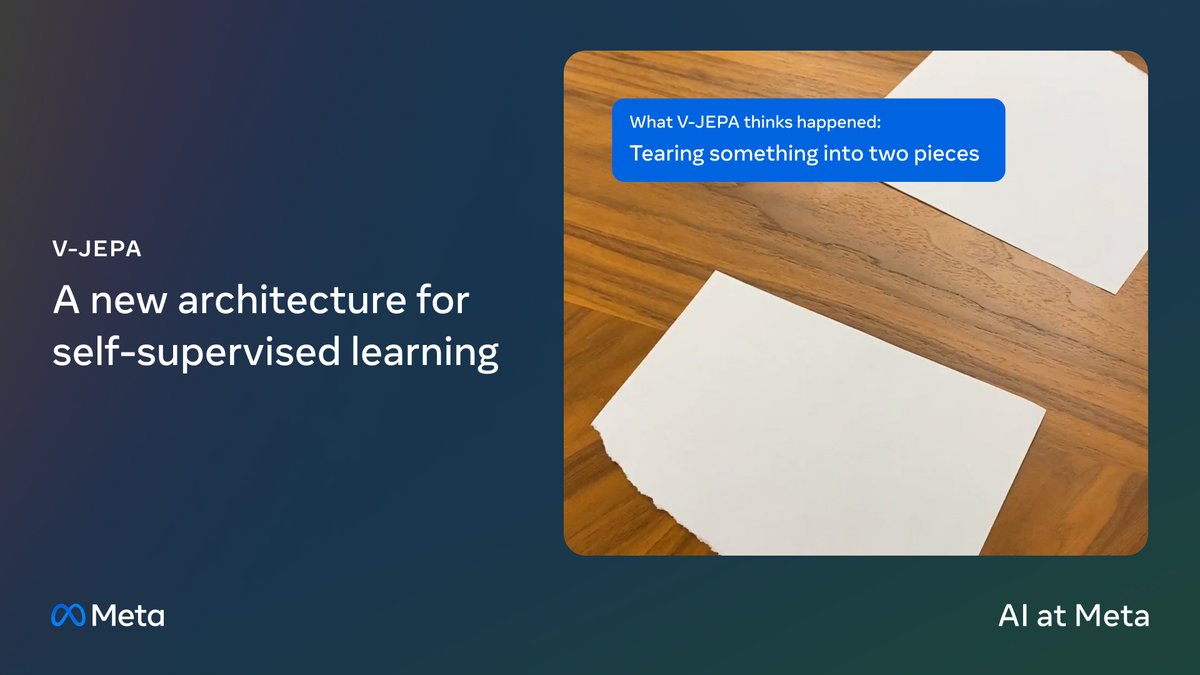
AI is entering its physics era guys.. A duo refused Bezos' multi-billion-dollar offer, then unveiled an AI model that no PC can run. "They unveiled Accelerated Understanding (AU), a new physics-first AI startup that takes a different approach from traditional language models. Its models are designed to predict how...

19,294 views • 5 days ago •via X (Twitter)

0 Comments

No comments available

Comments from the original post will appear here

Related Videos

This is THE moment of Physical AI! We are officially announcing Cosmos 3: Omnimodal World Models for Physical AI 🚀 - Cosmos 3 is an omnimodal world model: within a unified architecture, it can understand and generate language, images, video, audio, and actions. - It is not just a VLM, not just a video generator, not just an audio-visual generative model, and not just a physics simulator / world-action model. It can understand images and videos, generate images, videos, and audio, simulate future worlds, predict actions, and generate robot policies—enabling models to truly begin to “touch the world.” - Cosmos 3 is the #1 open-weight reasoner / T2I / I2V / robot policy across many benchmarks. Huge thanks to every teammate who fought side by side on this journey—from architecture, data, training, infra, serving, and evaluation to post-training. Every part of this project carries an incredible amount of hard work. This was my first time leading a project as Tech Lead, and I feel truly fortunate. The future of Physical AI needs models that can not only “see” and “describe” the world, but also “imagine,” “simulate,” and “act”—and eventually close the loop with the real world. I hope Cosmos 3 can become an important starting point for this direction, and I’m excited to push Physical AI into its next stage together with the open-source community. Welcome to the era of Physical AI. HuggingFace: Project Website: Code:

Max Zhaoshuo Li 李赵硕

1,078,810 views • 3 months ago

Robotics has a massive, silent bottleneck. It isn’t just data collection—it’s the brutal 1x speed of the physical world. Genesis AI Genesis AI just unveiled Genesis World 1.0, and they are attempting to turn the notorious Sim2Real gap into a pure compute problem. Evaluating a robotics foundation model across edge cases usually means hundreds of hours of physical lab testing. With Genesis World 1.0, what traditionally takes nearly a week of continuous, real-world operation is being compressed into 30 minutes in simulation. What makes this different from just dropping a robot model into an off-the-shelf game engine? 1️⃣ Nyx Renderer: A custom, real-time path-traced engine rendering noise-free 1080p frames in under 4ms. Game engines use rasterization tricks that confuse AI; Nyx uses physically accurate multi-bounce lighting so the model's "eyes" see exactly what real sensors see. 2️⃣ Quadrants Compiler: A custom Python-to-GPU compiler to run heavily parallelized multi-physics simulations (rigid bodies, fluids, deformables) natively across architectures. 3️⃣ Evaluation First: They aren't rushing to train on synthetic data. They are using this purely for closed-loop evaluation to perfect the physics first, currently claiming an impressive 89% correlation with real-world hardware tests. If the industry can accurately evaluate models in simulation without the physical world bottleneck, humanoid development stops moving at wall-clock time and starts scaling with compute.

Humanoids daily

17,302 views • 3 months ago

Andrej Karpathy just made one of the most interesting arguments about AI model design that most people are completely missing. His take is that frontier AI models are not too big because the technology is complex and too big because the training data is garbage. When you or I think of the internet, we picture Wall Street Journal articles, Wikipedia entries, serious writing. That is not what a pretraining dataset looks like. When researchers at frontier labs look at random documents from the actual training corpus, it is stock ticker symbols, broken HTML, spam, gibberish. One estimate puts Llama 3's information compression at just 0.07 bits per token meaning the model has only a hazy recollection of most of what it trained on. So we build trillion parameter models not because we need a trillion parameter brain but because we need a trillion-parameter compression engine to squeeze some intelligence out of a firehose of noise. Most of those parameters are doing memory work, not cognitive work. Karpathy's prediction is separate the two entirely. Build a cognitive core, a model that contains only the algorithms for reasoning and problem-solving, stripped of encyclopedic memorization and pair it with external memory that it can query when it needs facts. He thinks a cognitive core trained on high-quality data could hit genuine intelligence at around one billion parameters. For reference, today's flagship models run between 200 billion and 1.8 trillion parameters with most of that weight dedicated to remembering the internet's slop. The trend is already moving his direction. GPT-4o operates at roughly 200 billion parameters and outperforms the original 1.8 trillion-parameter GPT-4. Inference costs for GPT-3.5-level performance dropped 280-fold between 2022 and 2024 driven almost entirely by smaller, cleaner, better-architected models. The real bottleneck in AI right now is not compute but rather data quality.

Milk Road AI

200,547 views • 4 months ago

Karpathy told Dwarkesh that a 1 billion parameter model, trained on clean data, could hit the intelligence of today's 1.8 trillion parameter frontier. That is a 1,800x compression claim. The math behind it is more defensible than it sounds. When researchers at frontier labs look at random samples from their training corpus, they see stock ticker symbols, broken HTML, forum spam, autogenerated gibberish. Not Wikipedia. Not the Wall Street Journal. The actual pretraining dataset is mostly noise, and the model is burning parameters to vaguely remember all of it. One estimate pegs Llama 3's information compression at 0.07 bits per token. Well-structured English carries around 1.5 bits per token of real information. The trillion-parameter model is holding a roughly 5% resolution image of the internet it trained on. So when a lab ships a 1.8 trillion parameter model, the overwhelming majority of those weights are handling rough memorization. They are compression overhead for a noisy training set, taking up capacity that could be doing reasoning instead. Karpathy's proposal is to separate the two. Build a cognitive core: a small model that contains only the algorithms for reasoning and problem-solving, stripped of encyclopedic memorization. Pair it with external memory the model queries when it needs a fact. A 1 billion parameter reasoner plus retrieval beats a 1.8 trillion parameter model trying to do both. The data already supports this direction. GPT-4o runs at roughly 200 billion parameters and outperforms the original 1.8 trillion GPT-4. Inference costs for GPT-3.5 level performance fell 280x between 2022 and 2024, driven almost entirely by smaller, cleaner, better-architected models. The trend line is pointing where Karpathy says it should. The real implication for anyone tracking the AI trade: data quality is the actual constraint. The companies winning the next phase will be the ones who figured out what to train on, and what to throw away.

Aakash Gupta

508,446 views • 4 months ago

Elon Musk just made one if the biggest moves in taking over the programming industry “SpaceX just bought Cursor for $60 billion. Do you realize how big this is? SpaceX went public — the biggest IPO in history. $75 billion raised, almost a $2 trillion valuation and the first thing to do with that money? Buy the most popular AI coding tool on the planet. Here's why that changes everything. Elon now owns 3 layers: the compute, Colossus data centers, the models, Grok through xAI, and now the tool that developers actually use every day. It's the full stack. And here's what makes Cursor different from Claude Code or Codex. Cursor is model agnostic. You can run Claude in it, GPT, Gemini, whatever model you want. It's not locked to any one company, and now it has SpaceX's resources behind it. Cursor said they were bottlenecked by compute. Well, that bottleneck has just been removed. $4 billion in annual revenue, over half the Fortune 500 already uses it, and now it's backed by a $2 trillion company. OpenAI has Codex, Anthropic has Claude Code, and now Elon has Cursor.” Let me break this down in simple terms Elon Musk now controls more of the full AI picture: - Massive computers, power (data centers like Colossus) - Smart AI models (Grok from xAI) - The actual tool millions of developers use every day (Cursor) For every day users this means Faster and smarter apps and websites in the future. More developers using powerful AI tools means new apps, games, websites, and features get built quicker and cheaper. This means better video games, smoother streaming, smarter phone apps and better programs For Developers they can describe what they want in plain English (“make a feature that does X”) and the AI handles more of the heavy lifting

Wall Street Apes

213,601 views • 2 months ago