Sensitive content

This media may contain sensitive content.

正在加载视频...

视频加载失败

Alastor needs Rosie’s help more than he realizes. 🎨 Art: Crazy Craxker 📻 Alastor, Rosie, some SFX and Editing: LUCI IS SEEING D&P! 🦴✨ 💦 Cum SFX: PointyAux 🔞 NSFW Sound Designer #radiorose

43,270 次观看 • 1 年前 •via X (Twitter)

0 条评论

暂无评论

原始帖子的评论将显示在这里

相关视频

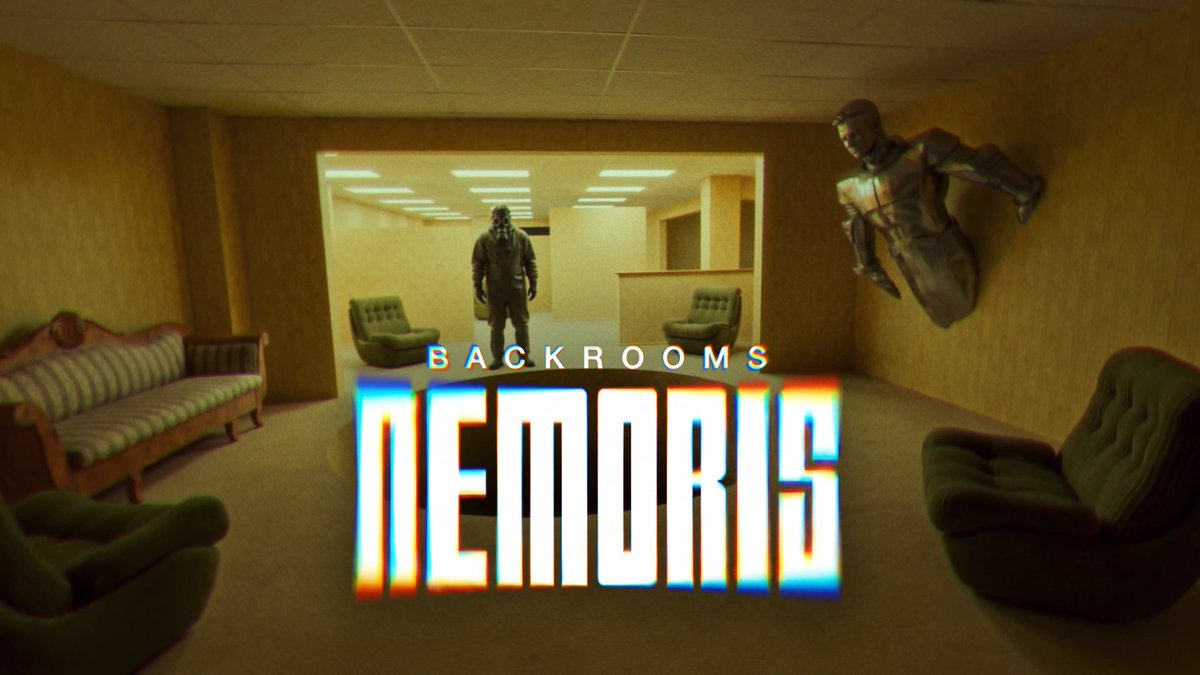
Backrooms Nemoris S1E01: It Eats Light I've spent the last six months working in secret on this pilot episode for a new Backrooms canon. We premiered this week in Toronto and a it's now available on all platforms: a new Magnific Originals series! This is quite possibly the most complex project I've ever taken on in my life. Yep, even if that sounds like an exaggeration, it took even more effort than building the first version of Magnific Upscaler. I had never before tried to bring such a concrete, specific vision to the screen while pushing the current state of the art as far as possible. Every scene you see in this episode, every object, every movement of a character's hands, every space, every hum of the fluorescent lights... it's all there for a very specific reason, with absolute control and intention on my part. I never imagined that something that looks so simple on the surface could be so incredibly complicated. The script is my own, based on the original Backrooms concept (the iconic 4chan image) but developed to create an entirely new canon from scratch. In this first episode, I reveal barely more around 5% of the overall puzzle, so you may end up thinking: what the f*ck did I just watch? Or you may need multiple viewings to pick up on some extra clues, because several of them are genuinely hidden. The idea is to create a full 10 episode series, an anthology, and have you, the viewers, gradually piece together the puzzle yourselves as the clues are revealed. Beyond the video and image generations, I did all of the editing in DaVinci Resolve, with particular attention to the sound. I'd say around 60% of the time I spent on this project went into sound. In some scenes, there are more than 13 stereo tracks layered at the same time, using sounds I recorded myself or created and edited from generations and foley libraries. Every sound, every voice, and every gasp is designed to pull you into the world of the story and make you feel like you're actually there. That meant spending an enormous amount of time on sound design, thinking about things like the individual position of each sound in space, EQ, reverb to simulate different environments, the sense of immersion, etc. I've never learned so much about something so quickly. As for the generations, a few numbers: • 12 hours of total generated video for 17 minutes of final footage 🤯 • More than 7,000 generations in total. • An average of around 60 generations for every 15 seconds of final footage. • 6 months of work, including many weekends, with just one person behind the whole thing... I almost lost my mind. • Platform: Magnific, of course. Models: mainly Seedance 2.0 and 2.5 for video generations, and Nano Banana Pro and Seedream 5 for image references. • Approximately $20,000 in total token costs, not including the value of my own time. For the next episodes, I can't do this alone again or I'll go crazy. My plan is to put together a small team: voice actors, a colorist, 3D VFX artists, a sound designer, and, in general, people from the traditional film industry who can help us professionalize our pipeline and take this story to another level. If you're reading this and you think you might be interested, please leave a comment. Ah! If you have any technical questions about how this was made, I'd be happy to answer them. Feel free to ask me anything you like! Anyway, I'll leave you with the episode. For the love of everything holy: please watch it at home, relaxed, on a big screen, with a good sound system or a quality pair of headphones, the lights off, and some popcorn. And most importantly, enjoy. Nemus te reddat!

Javi Lopez ⛩️

1,190,256 次观看 • 8 天前

How to Identify Agents with Sound Alone: Audio Profiles Each agent in VALORANT has a unique walk sound. We can use this to identify who is moving around without seeing them AND without them using abilities. Each agent has unique tells, here's Proof: Key: (How Easy it is to Identify who is running) 🟢 - Extremely Easy to identify without trying 🟡 - Somewhat difficult until you know what to listen for 🔴 - Difficult, and needs practice In order of their names Alphabetically (up to Miks in release date) Astra - 🟢. Astra has golden, loose jewelry. This makes it easy to identify her because she is one of the only agents that you can hear it, and of those agents, it's the most consistent. She also has lighter steps as she is meant to be smaller than the other agents 5'6 (170cm) Breach - 🟢. Breach is easily identifiable by the heavy boots that he wears. He is one of the loudest agents in terms of walking as his boots as well as his radianite arms that are also quite loud, being made of metal. Brimstone - 🟢. Similar to Breach, Brim is also easily identifiable due to how heavy his footsteps are. What separates him from Breach is his boots are leather but stomps, likely coming from his military background. Chamber - 🟡. Chamber is what started this entire thing for me. You can identify chamber by his loose gold watch, which chimes as he walks. The reason this is yellow circle and not green is because it is not as frequent as Astra and he wears sneakers, which the majority of the cast wear. So besides the watch it can be somewhat difficult to identify, if you're not actively listening for it. Clove - 🟡. Clove is somewhat difficult, but what makes them unique is how soft / quiet they walk. They are very light, wears shoes that have a lot of cushion and is meant to feel like a smaller character, canonically 5'6 / 168cm. Cypher 🔴 - Despite playing a lot of Cypher, I have a really hard time differentiating him from other characters with similar patterns like Viper and Fade. Comapred to Fade, I would say his have more bass. Deadlock 🟢 - The only person you could mix Deadlock up with is Sova. However, Deadlock's walk has a much more "wet" sound to it, as if she were crushing in soft snow with her snow boots. Fade 🔴 - Too similar to other agents, especially Cypher makes it very hard to tell. The only thing that makes her unique is her consistency, the decibel spread is almost nothing. Gekko 🟡- Also pretty hard, as he is one of the many average weight sneaker users. He is very similar to Killjoy, but with more bass which is how i remember. He's wearing vans, it sounds like rubber. Harbor 🟢 - Extremely easy. You can hear his braclet from a mile away. One of the more unique ones. Iso 🔴- Another middleweight flat shoe wearer. I think he is meant to be heavier than agents like Gekko and Miks who sound similar. This is one wear you have to look at who is alive to differentiate between him and other agents. Jett 🟢- Extremely easy, maybe because I've heard it so much with the Jetts in my games, but I think the idea is she is meant to feel light and dainty, as if the wind is carrying her. That's why she walks so soft. She is also meant to be quite small at 5'4 / 164cm which corroborates the quiet steps. KAY/O 🟢- The easiest. Even people who don't play VALORANT could tell you that's the sound of a robot. The metal makes it very easy to tell. Killjoy 🟡 - Somewhat difficult, I think the giveaway are the boots. Like I said about Gekko, hers in comparison create softer sounds. Miks 🔴 - Really disappointed that Miks, the sound guy doesn't have anything unique to his walk. It is similar to Gekkos, in that it is rubbery but also muddy. Neon 🟢- Iconic. Being a runner, she is wearing running shoes. Not much said, I think anyone could hear the difference. Omen 🟡 - Somewhat difficult. You are listening for a "wet" sound when he walks. He has been out for long enough where I can hear it distinctly enough. Phoenix 🟡 - Somewhat difficult. You are listening for the same rubbery sound as Miks, but with a lot more bass, he drags his feet somewhat. Raze 🟡 - Hard to hear at first, but you are listening for a "mud" / squish sound. Similar to Omen, but not "stompy" Reyna 🟢- Maybe just me but I have an easy time hearing Reyna's. This is the one I can identify the quickest in game. I listen for a lot of bass towards the front of her step, as she has raised shoes which put more impact on her toes / balls of her feet. The sound is unique enough where you can her pretty clearly. Sage 🟡 - Somewhat difficult. Can be confused with Raze sometimes, as you are also listening for a "muddy sound" Skye 🟢- Very easy, she has trail shoes. Makes sense, she's from Australia. Sova 🟢- Again, similar to deadlock, Sova has boots made for winter, and there are feint sounds of him walking on ice. This one is somewhat similar to Skye, but not enough to mistakes the two. His has more bass. Tejo 🟡 - I didn't play as much when Tejo was popular, and this could be why I don't hear much differences in Gekko and Miks as well, but I find Tejo easier because of his heavty duty boots. Veto 🟡 - Somewhat hard to hear, only because I haven't played enough but there is dampness and a muddy sound to his walk similar to Raze, Omen etc. with that rubbery sound Viper 🟡 - somewhat hard to hear. Again, I think she sounds very similar to Fade and Cypher. But I think she is easier to identify because of the bass in each step. Vyse 🟢 - Very easy once you start listening. She has a lot of metal attached to her, which you can hear. Waylay 🔴 - Another middleweight rubber user. Hard to hear, but I haven't played with/against enough Waylay to really know her pattern. Yoru 🟢 - Iconic sound, you have been conditioned to hear this sound over and over with the Fake Footsteps and the reworked Yoru Clone + his fake clone of himself, he is most commonly walking around rather than sneaking, so you will probably become very accustom to him. Things to note: 1. These noises are NOT client / team sided. At the end of this video I show my friend walking as Chamber and Phoenix, you can hear a clear difference. He is on the ENEMY team, not mine. 2. You are NOT relying on audio alone. Agents all have their unique abilities which are significantly more telling of who is nearby compared to footsteps. The point of this exercise is to help identify WHO is there if there is no other way of knowing. 3. It is not meant to be used every round, hell even every game. I have really good hearing, so I can make good use of it. But as you can see by the red circles, it is not universal. Again, there are other more obvious ways of telling who is nearby. 4. But how is this useful? Well for me, I like to memorize the Controllers the most, because if I can identify that the sound of a controller's footsteps. I know they are not lurking, which allows for a little more peace of mind for my teammates rotating onto my site. 5. I used the same spot on purpose to show that they have different sound profiles. HOWEVER, it is important to note that with the different surfaces that you can run across, some of the noises that I described could sound different or harder to hear.

ROCKET

424,367 次观看 • 1 个月前

TRUMP, THE ANTIKRYST? Pt 1 (Update 12/14/24) On 8/28/24 Donald Trump posts this video of a cross. What does that really mean, and why at exactly 11:11? Does anyone understand what the cross really is? It's an unfolded tesseract, also known as Metatron's Hypercube. Who is Metatron? It is one of Thoth's many names across the ages. He was also known as Hermes, son/daughter of Enki Lucifer. And while I've never had it explained to me in absolute detail, there is reason to believe this Anunnaki shape-shifting hybrid could be one and the same as Marduk Lucifer Satain. An awful lot of water has gone under this bridge since the Leviathans arrived 798k years ago, so each of the Babylonian fake gods could have thousands of different personas and names by this time. In any case, Marduk appears to be the leviathan that keeps reincarnating over and over as the savior of mankind. His/her most recent being the 'jesus' character that poses as if being Jesheua Sananda Melchizedek that is one of the guardian alliance team who came to restore the purity of the bloodline of the Human Elohim development that are in captivity here in the Tara earth simulation, and really could walk on water. Identity theft is always the middle names of all your captors. It is what they do to maintain control over the sheep. Like I've said countless times now, Sananda is not 'god' anymore than you are. He is not a savior of mankind, he is here on mission to help your avatar's vibration reach sympathetic harmonic resonance with the 4th dimension to help you escape. By having children with human females carrying very pure human DNA, those children will multiply and raise the vibration of the plane, making your chances that much better to make this ascension happening now. We do not worship Sananda, and unless you like playing subservient to others, you won't either. He is still here, and so are your captors. The ancient false gods of Babylon never left. They just keep taking different forms under different names, hiding in plain sight. They have MANY bodies here. Some are identical to each other, some look totally different. I know because I've met them and had them explain to me who they were in ancient times and what really happened that is totally unlike the his-story you've been told. Sometimes they allow you to know who they really are, such as they did in Babylon, but most of the time they're posing as regular people, just like you, so they can infiltrate human spaces, rise to positions of great influence and steer the masses. Who is Donald Trump? Do you know anyone alive who is more adored, more worshipped, more feared than the Donald? No. He's the most famous person alive. And why is that? Because he's the most perfect person on the plane? Hardly. He's also famous for grabbing women by the pussy. It is because he's using psychological manipulation he knows at a master-class level because he has unbroken recollection of his time across hundreds of thousands of lives. So his mental 'magic' is simply knowledge and wisdom humans could never possibly even understand, much less duplicate. It is a form of very powerful hypnosis. There is overwhelming evidence now that Trump is considered the king of earth as you will see in the masterpiece film by Good Lion Films. His 'capitulation tour' (THE GREATEST SHOW ON EARTH) in 2017-18 made it clear he's the one in charge. THE GREATEST SHOW ON EARTH Video: 👉 Not just this, but Trump was officially crowned the 'Messiah of Jerusalem' they had been waiting to return for thousands of years. That's right, this really happened. He is 'ben David' (son of King David). Something I know a bit about, since that's my avatar's bloodline I'm in here for mission reasons that has to do with the Co-Evolution BioRegenesis Treaty that gives 'J3wish' people a mechanism for ascension. [For more see my article: 👉 THE TWO CHRISTS] Trump, Messiah of Jerusalem Video: 👉 Trump is also a time traveler. Believe or don't believe, but I now have far more than just a few examples that prove this to be fact. He also has multiple other bodies he uses at the golf course, at rallies, and Mar-a-Lago that are clearly different weights, heights, ages. Here is one that is much older than the ones we see in the spotlight. Who has the technology to do all these things? The Anunnaki. Word has it that Trump has been working with the Anuhazi Elohim during his entry into politics. I would suggest he's been working with them for 798k years. They are known as the fallen angels, the original captors of this simulation. All the invader races (over 50 species) have been working together as a single team to enslave humankind since the hostage began over 1/2 billion years ago. I don't profess to know who each of these actors really were in the last drama, or Babylon, Greece, Rome and countless other eras, since, as mentioned, it is a 560 million year story involving quadrillions of events and dramas, but you likely understand what I'm trying to say is we're dealing directly with ancient gods here, not 'business men' or 'politicians'. These people held lightning in their hands last time they decided to let us see them for who they really are. Thoth could literally fly when he was using the name Hermes and there's no question he still can. As briefly reference above, the cross he released this morning is secretly the Nibiru Scalar Vibrational Mechanics platform called a tesseract or hypercube, in unwrapped form. If you fold it back into a 6-sided cube again, you're seeing the shape of the device that powers our counterfeit hologram. You will come to learn at some point that every geometric shape is an operating system, not just a form, called the Platonic Solids in science. Which is why grown men pilgrimage to Mecca to walk around the Kaaba, wearing a little black cube on their forehead. So don't think the cube cross is only worshipped in America. Metatron's Hypercube is used at CERN known as ALICE that keeps you inside an artificial reality called the 'Beyond The Looking Glass Chimera Reality Simulation'. Typically you'll hear the keeper refer to it as the Chimera Reality for short. All down through your current history, the cross has stood for purity, perfection, and hope that one day the savior would return and usher in a utopia, when in truth, it was the very symbol of your eternal enslavement. They keep rolling out this same savior trope, civilization after civilization, always with a different face of the program, but always the same hope. Hope, by the way, is a weaponized spell that was designed to keep you perpetually in bondage and trudging forward like a good little slave, doing your job because 'one day he will return and THEN by golly, he'll save us all'. These are all the same guy/girl. When Sananda (I'm not talking about the fake jesus here) said 'come out of her my peoples', he meant stop falling in line with the prison machine you're trapped in. Stop acquiescing to your own enslavement. I was told in person that humans 'have to rise up and take their world back or they will never move forward'. It means letting go of fear and stand up for what is right. Enslavement of any kind, is not that. The great deceiver will fool 'even the elect' is not a fictional claim in the M@sonic bible for entertainment. They have to tell you what they're doing in order to have you cast that reality they want to play out in your world. The person who wrote the bible also wrote demonology. [For more on this subject see my article 👉 THE SCIENCE OF PREDICTIVE PROGRAMMING and the 2ND COMING] Why would that be? Because the bible is the most elaborate talisman on earth that hypnotizes those who read it, enslaving their minds to passively accept the chimera reality, so when the simulation glitches, you will second guess yourself instead of the holographic world around you. "Did I just see a bird in the sky not flapping its wings and remaining perfectly still? Of course not, that's preposterous." ‘Mithra the Savior’ was gifted to T-Amerikaans (America) by Frédéric Auguste Bartholdi of France in 1886. Freddy was a 33rd degree (master) Freem@son and you now call Mithra your 'Statue of Liberty'. She is literally the symbol of this nation and is making her second coming at the time when the economy has been utterly destroyed, your politics have been weaponized against you, your courts have been utterly corrupted, your people have been openly attacked with bioweapons, your country flooded with 20m illegal aliens and your police have been defunded & refuse to arrest criminals. All by design and deliberately manufactured. Albert Pike, 33rd degree (master) Freemason stated: "Whenever the people need a hero, we'll supply him." Almost as if Freem@sons plan TO role out some very hard times to achieve a certain agenda. Oh, that's right, Pike also stated this: “We shall unleash the nihilists and the atheists and we shall provoke a great social cataclysm which in all its horror will show clearly to all nations the effect of absolute atheism; the origins of savagery and of most bloody turmoil. Then everywhere, the people will be forced to defend themselves against the world minority of the world revolutionaries and will exterminate those destroyers of civilization and the multitudes disillusioned with Christianity whose spirits will be from that moment without direction and leadership and anxious for an ideal, but without knowledge where to send its adoration, will receive the true light through the universal manifestation of the pure doctrine of Lucifer brought finally out into public view. A manifestation which will result from a general reactionary movement which will follow the destruction of Christianity and Atheism; both conquered and exterminated at the same time.” Sound familiar? If I were going to infiltrate a world & pose as the savior of the peoples that would be allowed to take the last tiny bits of freedom from them in return for pulling them out of a hellscape, I would first reduce them all to the most quivering and broken mess possible just shy of their death, and arrive like a knight in shining armor. Think a hundred-vehicle motorcade, 500 special-ops swat team & my own rolling hospital. When Trump had to go to court in New York it cost them something like $25m to lock down the city for 1 appearance. Nothing gets more high-profile than that anywhere. You've been under predictive programming since the day you were born for this time when the 'antichrist' would appear (that would 'loose his demons' and tear the world asunder), and also for the 2nd coming to 'save humanity' at the same time. But what you weren't told is these will secretly be the same person. Of course everyone will think it was "Barack" who brought about the destruction because Dolores Cannon alluded to it, but who is actually 'showing you a movie' right now while secretly holding the office of CIC and allowing millions of aliens across the border? Because he's your real border czar. This is Armageddon, you're in the 'little season of satan' (Satain). The 1000 years of heaven-like reign ended around 1893, and your entire life has been inside of what you could call hell, where you are literally surrounded by demons you believe are human because they look like you. You know more demons than you do humans. This is actual reality, not fiction. Take at look at Not Op Cue's article on the heavenly heritage of Trump, suggesting why he is the reincarnation of jesus. The evidence is overwhelming. The Lincoln Kahlooni Druze Minority Bloodline: The Jesus Strand Video 👉 11:11 I had just flown in from half way across the world to meet up with the keeper of the Tara earth simulation for a mission that would involve some of the most astonishing things I would ever live to see in this life. It was getting late and we were talking in a dark, cramped trailer that the keeper and crew had been reduced down to, illuminated only be a couple of small candles. They had been trapped in an area where they were not allowed to escape from by the Anunnaki hybrids. The dark agencies had frozen their bank accounts, forced them out of their compound and left them homeless for the past few years, on the run daily. My mission was to escort them away from that area to a safe space, as the others who had tried to break them free previously had been maimed and even killed. It took 2 years to pull off, 7 months of which living in a car, but the mission was successful. [That's a story for another time, when I am allowed to talk about it. It involved crazy metaphysical anomalies, black helos, giant venomous snakes (I know that sounds crazy, but the whole thing was way crazier than just that), a cross-leyline vortex acting as protection at the safe house we directly on top of, massive aerial DEW attack, fire tornadoes and 'celestial' escorts. None of this is fiction, just to be totally clear.] I was extremely interested in duplicate numbers on my clocks I was seeing 2-3x everyday and wanted to know what they meant. As the words were coming out of my mouth about this, in the relative darkness suddenly my phone lit up all by itself for no reason with the time in large numbers at 11:11pm, apparently to prove to the keeper I wasn't making this phenomenon up. What is that? I was told duplicate numbers are a distraction, to not give them mind, as it is just numerology the system uses in what I took to mean it is part of the complex mechanism of our simulation that hypnotizes us to keep us from being clear and aware to decipher the holographic illusion around us. The more awake we are, the more the system will flash out 3:33 or 11:11 to put you back to sleep by distracting you from the moment that is taking place in front of you. Such as when the most heralded man in the world shares a video depicting a giant cross which insinuates the 2nd coming of the christ (the Kryst or Krystos, is the series title of the Human Elohim eternal-life bloodline and is not 'a guy'). Discernment is more critical now than any other time since you were born. Pay attention, keep your vibration high and know that the next step is you moving on to the next level of the simulation where Lucifer and Satain will no longer be part of your world. This is but a short time to test which path you want to take moving forward is all. It is the 'sifting' phase of humanity at the end of the final long-cycle of human evolution. If you resonate in fear, hate, anger, you lose. React in love, appreciation, kindness and compassion and never give in to the devolution. You can do this. See my article 👉 THE WORLD TOMORROW for more on what to expect moving forward into your next experience. And yes, you always move on to a new experience, because you're an eternal spirit essence having a human experience in this one drama. The dramas never run out or get too boring, because there are trillions of ways to stage 'living a mortal life'. For more on the separation, see my articles: 👉THE SEPARATION 👉DESTINATIONS AFTER THE SEPARATION 👉THE SURGICAL SEPARATION OF THE 2 PLANES See the second part to this thread in my article: 👉TRUMP, THE ANTIKRYST PT 2 On X, to search for my articles, simply type in the name of the piece, enter one space, then from: & my username in parenthesis such as shown here: THE HISTORY OF THE CHIMERA PT 1 (from:iontecs_pemf) Off-site, you can look up any of my writings through this link below for my other more than 100 recent articles and many thousands of comments on X, regularly updated thanks to Justin This message will only be seen by your eyes if not shared, and if you want to reference this article again later, you will need to cut and paste it in your own notes off line, as it will surely be erased. This is the most accurate translation of these events I am aware of at this time.

W.R. Schock, QBD

133,049 次观看 • 1 年前

Phenomena, AAWSAP, Stratton and Consciousness "I keenly believe that consciousness is a key aspect of all of this, and perception." ~Jay Stratton ~ "I entered the [AATIP] program in 2008. I was asked by its director [Lacatski] to come on board and establish this program [AATIP]. And then, in 2010 is when I was asked to take over the effort." ~Lue Elizondo during WaPo Interview "Fast forward to 2015...I created a program called AATIP, which was a derivative of AAWSAP." ~Jay Stratton (As I've discussed before, AATIP (V2) didn't exist until much later (2015) than what we've been told by Lue. So what program did Lue come on board to in 2008 and which program did he "take over the effort" for in 2010 if AATIP (V2) was created by Stratton in 2015? Is that not a fair question to ask?) ~~~ Jay Stratton: "Starting back in the early 2000s, we saw the need - my colleague (Jim Lacatski. ~Joe) and I at the Defense Intelligence Agency - to start paying very close attention to this topic. Advanced technologies, emerging technologies, and really kind of the areas that the stigma has led for us to ignore for many years. "So, you know, we created a program that Hal (Puthoff) referred to as AAWSAP, you know, to address those issues. And that really started around 2005. So the DIA program, which you jumped in earlier and said the DOE or, you know, the DOD's program, and really, it's the Intelligence Community's program. DIA is part of the IC, the D in there being Defense, predominantly means the DIA looks at foreign-defense capabilities. "And we were looking at this from - and I hate to say it now - but a threat perspective. And the reason I say, 'I hate to say,' is because threat is capability plus intent, and some of these things, we just don't have an idea on the intent." (Does that mean that on some of these things we DO have an idea on the intent?) Stratton: "So, determining threat, you know, maybe it's an emerging-technologies threat or a concern anytime it can potentially exceed our own capabilities. But that DIA program focused on that, and the contract from 2008 to 2010, and then we transitioned and tried to move the program to a couple of other places. "Fast forward to 2015, I created a program called AATIP, which was a derivative of AAWSAP, and actually AATIP was a nickname for AAWSAP. And I know there's a lot of crazy names, but Advanced Aerospace Threat Identification Program. But those 2015 events were the ones that you see now on the news: the Gimbal, the Go Fast. Ryan Graves, who usually participates in this, his wife is having a baby, currently, so he's not here (laughs). But all of those events started to happen...and those events helped fuel, you know, further highlight that need on the U.S. government side that, we gotta do something about this. "Which led to the creation of the UAP Task Force in 2018 into 2019 as when I started building it. I spent over two years building it out before the public even knew about it in 2020 when DoD established it. And at that point, it was truly a whole-of-government, interagency effort. Kind of the dream of, you know, my fifteen-years plus, at that point of looking at this topic and knowing everything that we needed with all the different authorities." (Much more on that can be found here: ) Stratton: "And that led into where we're at today with AARO, the All-domain Anomaly Resolution Office under DOD. And I think, you know, a few hiccups here and there, but I think now Dr Jon Koslowski, who has AARO, is approaching this problem set and dealing with the topic appropriately." (He seems like a good guy but James Fox recently said that he met with Kosloski who told him (Fox) that he (Kosloski) can't even part his hair without the DoD's permission. If that's true, and I have no reason to doubt Fox on that, I have little hope AARO will help bring Disclosure.) Stratton: "And I hope that, you know, obviously, my legacy, or the legacy of all of those involved, carries on, and that the government continues to take it seriously. And that we never have to look a pilot in the eyes again and say, 'Sorry, can't help you,' you know? Or the ridicule factor and all these other issues that happen from that." (If you want a true, lasting legacy... Push to be the UAP Czar, start another AAWSAP-like program, and do it for a few years until the world learns the truth about us not being alone on this planet and that we have craft and bodies of NHI. Allegedly, right? And help us figure out what the hell the phenomenon represents.) Stratton: "So, I mean, that's kind of the the cliff notes and the history. But the UAP Task Force recently got an award from the DNI. It's the first UFO program to get an award at that level, to my knowledge. And I'm really proud of where we're at today and and that we can have events like these to discuss this topic seriously, and everybody that's involved in putting their brands on this problem." (More on that award... ) Stratton: "I don't think we should overlook...and you had, you know, Paul (Smith) and others talk about remote viewing and that consciousness connection. I keenly believe that consciousness is a key aspect of all of this, and perception, you know, all the things that come from that. And that's an area that can get confusing, right? If you look at all of these recent drones, day-to-day, right? It's honestly driving me crazy because people are throwing in, you know, video of a Cessna Citation on final approach and calling it a UAP, you know? It's definitely a Cessna Citation. "And then folks start throwing around (laughs) the terms mimicry and other things that we've definitely looked at. And it gets like the Skinwalker Ranch, as you know I'm involved out there. You know, the things that you see, and are you really...you know, how is your brain forming that thing you're seeing and can that be manipulated? And I think that that technology is an area that, you know, I certainly focused on with my friends, Hal and others, to try to understand it." (Manipulation and perception deception. Is it a byproduct of the technology on our brains, or is it an intentional effort to deceive us? If it's the latter, that certainly doesn't seem to be a good thing for humanity, but I'm still open to all theories.) Stratton: "And that consciousness connection could be a key to understanding how some of these UAP are flying, you know, how they're acting, how they're controlled, I guess is the best way to put it, right?" (Are the craft controlled by some sort of 6th sense that the operators have and need in order to fly a craft?) Stratton: "So, you got to have that kind of open mindedness to approach this topic and I hope that my government, you know, folks are open to those kinds of things. And I know that there are still some key players that are open and thinking about...thinking out of the box about all those kinds of things. So, I mean, I think consciousness is the area that I would want to put more resources and time into if I were still there. (Yes, yes and yes. Bring back Stratton as the UAP and Consciousness Czar!) Anna Brady-Estevez: "And it's interesting because there's quite a bit of access to consciousness, you know, on a personal level-type experimentation. So it is interesting in that, you know, to get into UAPs, I mean, maybe you've seen one or more, maybe you haven't. But, if you haven't, you're kind of digging through other people's data. Whereas some of these consciousness or the remote viewing, it really just takes a couple people and a sheet of paper. So you can kind of step away pretty quickly from the, 'Do I believe the reports?' you know? Or somebody else's versus you can get to that primary experimentation at the cost of a sheet of paper, a pencil, and fifteen minutes or more of somebody's time here, at the most basic level. I mean, obviously there's extensive training to build the high-end capabilities. But some of that initial testing is pretty immediate. So thank you for bringing up that consciousness work." (When I took a basic Controlled Remove Viewing class with Lyn Buchanan (one of the OG remote viewers) in 1997, I saw the results for myself when I tried it. And right there and then, I KNEW that it worked. So people can debate with me all day long about the validity of psi and remote viewing but they won't change my mind. Seeing (and trying it for yourself) is believing.) Stratton: "I was gonna say, it took me years to move away from that nuts and bolts mentality of, you know, as an aerospace engineer, this is how it flies, thrust, you know, power, etc, you know, to...there's a lot more to this, right? Hence the name, you know, Unidentified Anomalous Phenomena, or Aerial Phenomena, however you want to look at it. That phenomena word is key in the definition and understanding of all of this." (Big H/T to neandrewthal and anybody else who let me know about this event Stratton was a part of.)

Joe Murgia

69,993 次观看 • 1 年前

TRUMP, THE ANTIKRYST? On 8/28/24 Donald Trump posts this video of a cross. What does that really mean, and why at exactly 11:11? Does anyone understand what the cross really is? It's an unfolded tesseract, also known as Metatron's Hypercube. Who is Metatron? It is one of Thoth's many names across the ages. He was also known as Hermes, son/daughter of Enki Lucifer. And while I've never had it explained to me in absolute detail, there is reason to believe this Anunnaki shape-shifting hybrid could be one and the same as Marduk Lucifer Satain. An awful lot of water has gone under this bridge since the Leviathans arrived 798k years ago, so each of the Babylonian fake gods could have thousands of different personas and names by this time. In any case, Marduk appears to be the leviathan that keeps reincarnating over and over as the savior of mankind. His/her most recent being the 'jesus' character that poses as if being Jesheua Sananda Melchizedek that is one of the guardian alliance team who came to restore the purity of the bloodline of the Human Elohim development that are in captivity here in the Tara earth simulation, and really could walk on water. Identity theft is always the middle names of all your captors. It is what they do to maintain control over the sheep. Like I've said countless times now, Sananda is not 'god' anymore than you are. He is not a savior of mankind, he is here on mission to help your avatar's vibration reach sympathetic harmonic resonance with the 4th dimension to help you escape. By having children with human females carrying very pure human DNA, those children will multiply and raise the vibration of the plane, making your chances that much better to make this ascension happening now. We do not worship Sananda, and unless you like playing subservient to others, you won't either. He is still here, and so are your captors. The ancient false gods of Babylon never left. They just keep taking different forms under different names, hiding in plain sight. They have MANY bodies here. Some are identical to each other, some look totally different. I know because I've met them and had them explain to me who they were in ancient times and what really happened that is totally unlike the his-story you've been told. Sometimes they allow you to know who they really are, such as they did in Babylon, but most of the time they're posing as regular people, just like you, so they can infiltrate human spaces, rise to positions of great influence and steer the masses. Who is Donald Trump? Do you know anyone alive who is more adored, more worshipped, more feared than the Donald? No. He's the most famous person alive. And why is that? Because he's the most perfect person on the plane? Hardly. He's also famous for grabbing women by the pussy. It is because he's using psychological manipulation he knows at a master-class level because he has unbroken recollection of his time across hundreds of thousands of lives. So his mental 'magic' is simply knowledge and wisdom humans could never possibly even understand, much less duplicate. It is a form of very powerful hypnosis. There is overwhelming evidence now that Trump is considered the king of earth as you will see in the masterpiece film by Good Lion Films. His 'capitulation tour' in 2017-18 made it clear he's the one in charge. 👉 Not just this, but Trump was officially crowned the 'Messiah of Jerusalem' they had been waiting to return for thousands of years. That's right, this really happened. He is 'ben David' (son of King David). Something I know a bit about, since that's my avatar's bloodline I'm in here for mission reasons that has to do with the Co-Evolution BioRegenesis Treaty that gives 'J3wish' people a mechanism for ascension. [For more see my article: THE TWO CHRISTS] 👉 Trump is also a time traveler. Believe or don't believe, but I now have far more than just a few examples that prove this to be fact. He also has multiple other bodies he uses at the golf course, at rallies, and Mar-a-Lago that are clearly different weights, heights, ages. Here is one that is much older than the ones we see in the spotlight. Who has the technology to do all these things? The Anunnaki. Word has it that Trump has been working with the Anuhazi Elohim during his entry into politics. I would suggest he's been working with them for 798k years. They are known as the fallen angels, the original captors of this simulation. All the invader races (over 50 species) have been working together as a single team to enslave humankind since the hostage began over 1/2 billion years ago. I don't profess to know who each of these actors really were in the last drama, or Babylon, Greece, Rome and countless other eras, since, as mentioned, it is a 560 million year story involving quadrillions of events and dramas, but you likely understand what I'm trying to say is we're dealing directly with ancient gods here, not 'business men' or 'politicians'. These people held lightning in their hands last time they decided to let us see them for who they really are. Thoth could literally fly when he was using the name Hermes and there's no question he still can. As briefly reference above, the cross he released this morning is secretly the Nibiru Scalar Vibrational Mechanics platform called a tesseract or hypercube, in unwrapped form. If you fold it back into a 6-sided cube again, you're seeing the shape of the device that powers our counterfeit hologram. You will come to learn at some point that every geometric shape is an operating system, not just a form, called the Platonic Solids in science. Which is why grown men pilgrimage to Mecca to walk around the Kaaba, wearing a little black cube on their forehead. So don't think the cube cross is only worshipped in America. Metatron's Hypercube is used at CERN known as ALICE that keeps you inside an artificial reality called the 'Beyond The Looking Glass Chimera Reality Simulation'. Typically you'll hear the keeper refer to it as the Chimera Reality for short. All down through your current history, the cross has stood for purity, perfection, and hope that one day the savior would return and usher in a utopia, when in truth, it was the very symbol of your eternal enslavement. They keep rolling out this same savior trope, civilization after civilization, always with a different face of the program, but always the same hope. Hope, by the way, is a weaponized spell that was designed to keep you perpetually in bondage and trudging forward like a good little slave, doing your job because 'one day he will return and THEN by golly, he'll save us all'. These are all the same guy/girl. When Sananda (I'm not talking about the fake jesus here) said 'come out of her my peoples', he meant stop falling in line with the prison machine you're trapped in. Stop acquiescing to your own enslavement. I was told in person that humans 'have to rise up and take their world back or they will never move forward'. It means letting go of fear and stand up for what is right. Enslavement of any kind, is not that. The great deceiver will fool 'even the elect' is not a fictional claim in the M@sonic bible for entertainment. They have to tell you what they're doing in order to have you cast that reality they want to play out in your world. The person who wrote the bible also wrote demonology. [For more on this subject see my article 👉 THE SCIENCE OF PREDICTIVE PROGRAMMING and the 2ND COMING] Why would that be? Because the bible is the most elaborate talisman on earth that hypnotizes those who read it, enslaving their minds to passively accept the chimera reality, so when the simulation glitches, you will second guess yourself instead of the holographic world around you. "Did I just see a bird in the sky not flapping its wings and remaining perfectly still? Of course not, that's preposterous." Mithra the savior was gifted to T-Americaans (America) by Frédéric Auguste Bartholdi of France in 1886. Freddy was a 33rd degree (master) Freem@son and you now call Mithra your 'Statue of Liberty'. She is literally the symbol of this nation and is making her second coming at the time when the economy has been utterly destroyed, your politics have been weaponized against you, your courts have been utterly corrupted, your people have been openly attacked with bioweapons, your country flooded with 20m illegal aliens and your police have been defunded & refuse to arrest criminals. All by design and deliberately manufactured. Albert Pike, 33rd degree (master) Freemason stated: "Whenever the people need a hero, we'll supply him." Almost as if Freem@sons plan TO role out some very hard times to achieve a certain agenda. Oh, that's right, Pike also stated this: “We shall unleash the nihilists and the atheists and we shall provoke a great social cataclysm which in all its horror will show clearly to all nations the effect of absolute atheism; the origins of savagery and of most bloody turmoil. Then everywhere, the people will be forced to defend themselves against the world minority of the world revolutionaries and will exterminate those destroyers of civilization and the multitudes disillusioned with Christianity whose spirits will be from that moment without direction and leadership and anxious for an ideal, but without knowledge where to send its adoration, will receive the true light through the universal manifestation of the pure doctrine of Lucifer brought finally out into public view. A manifestation which will result from a general reactionary movement which will follow the destruction of Christianity and Atheism; both conquered and exterminated at the same time.” Sound familiar? If I were going to infiltrate a world & pose as the savior of the peoples that would be allowed to take the last tiny bits of freedom from them in return for pulling them out of a hellscape, I would first reduce them all to the most quivering and broken mess possible just shy of their death, and arrive like a knight in shining armor. Think a hundred-vehicle motorcade, 500 special-ops swat team & my own rolling hospital. When Trump had to go to court in New York it cost them something like $25m to lock down the city for 1 appearance. Nothing gets more high-profile than that anywhere. You've been under predictive programming since the day you were born for this time when the 'antichrist' would appear (that would 'loose his demons' and tear the world asunder), and also for the 2nd coming to 'save humanity' at the same time. But what you weren't told is these will secretly be the same person. Of course everyone will think it was "Barack" who brought about the destruction because Dolores Cannon alluded to it, but who is actually 'showing you a movie' right now while secretly holding the office of CIC and allowing millions of aliens across the border? Because he's your real border czar. This is armageddon, you're in the 'little season of satan' (Satain). The 1000 years of heaven-like reign ended around 1893, and your entire life has been inside of what you could call hell, where you are literally surrounded by demons you believe are human because they look like you. You know more demons than you do humans. This is actual reality, not fiction. Take at look at Not Op Cue's article on the heavenly heritage of Trump, suggesting why he is the reincarnation of jesus. The evidence is overwhelming. 👉 11:11 I had just flown in from half way across the world to meet up with the keeper of the Tara earth simulation for a mission that would involve some of the most astonishing things I would ever live to see in this life. It was getting late and we were talking in a dark, cramped trailer that the keeper and crew had been reduced down to, illuminated only be a couple of small candles. They had been trapped in an area where they were not allowed to escape from by the Anunnaki hybrids. The dark agencies had frozen their bank accounts, forced them out of their compound and left them homeless for the past few years, on the run daily. My mission was to escort them away from that area to a safe space, as the others who had tried to break them free previously had been maimed and even killed. It took 2 years to pull off, 7 months of which living in a car, but the mission was successful. [That's a story for another time, when I am allowed to talk about it. It involved crazy metaphysical anomalies, black helos, giant venomous snakes (I know that sounds crazy, but the whole thing was way crazier than just that), a cross-leyline vortex acting as protection at the safe house we directly on top of, massive aerial DEW attack, fire tornadoes and 'celestial' escorts. None of this is fiction, just to be totally clear.] I was extremely interested in duplicate numbers on my clocks I was seeing 2-3x everyday and wanted to know what they meant. As the words were coming out of my mouth about this, in the relative darkness suddenly my phone lit up all by itself for no reason with the time in large numbers at 11:11pm, apparently to prove to the keeper I wasn't making this phenomenon up. What is that? I was told duplicate numbers are a distraction, to not give them mind, as it is just numerology the system uses in what I took to mean it is part of the complex mechanism of our simulation that hypnotizes us to keep us from being clear and aware to decipher the holographic illusion around us. The more awake we are, the more the system will flash out 3:33 or 11:11 to put you back to sleep by distracting you from the moment that is taking place in front of you. Such as when the most heralded man in the world shares a video depicting a giant cross which insinuates the 2nd coming of the christ (the Kryst or Krystos, is the series title of the Human Elohim eternal-life bloodline and is not 'a guy'). Discernment is more critical now than any other time since you were born. Pay attention, keep your vibration high and know that the next step is you moving on to the next level of the simulation where Lucifer and Satain will no longer be part of your world. This is but a short time to test which path you want to take moving forward is all. It is the 'sifting' phase of humanity at the end of the final long-cycle of human evolution. If you resonate in fear, hate, anger, you lose. React in love, appreciation, kindness and compassion and never give in to the devolution. You can do this. See my article 👉 THE WORLD TOMORROW for more on what to expect moving forward into your next experience. And yes, you always move on to a new experience, because you're an eternal spirit essence having a human experience in this one drama. The dramas never run out or get too boring, because there are trillions of ways to stage 'living a mortal life'. For more on the separation, you can search these article titles here on X, just add (from:iontecs_pemf) after the title to bring it right up. 👉THE SEPARATION 👉DESTINATIONS AFTER THE SEPARATION 👉THE SURGICAL SEPARATION OF THE 2 PLANES This message will only be seen by your eyes if not shared, and if you want to reference this article again later, you will need to cut and paste it in your own notes off line, as it will surely be erased. This is the most accurate translation of these events I am aware of at this time.

W.R. Schock, QBD

145,211 次观看 • 2 年前

Eruption - Van Halen - Violin Cover by Nina D My journey to learn Eruption began a few years ago, when I only had access to a 5-string fretless violin. I learned a small bit of it, and quickly realized that I would need to compromise the octave range, and the finger tapping in order to perform it. There are a few covers out there of violinists doing just that, and they are very impressive. Anyone who knows me, knows that I did not want to do that. I wanted to sound like Eddie. Thus began my journey with the 7-string fretted violin. Pretty much the entire reason for having this instrument custom-made (thanks Wood Violins crew!) was to see if I could play Eruption. At the time of purchase, I wasn’t even sure if it would be physically possible to do the finger tapping, even with the new instrument. Upon its arrival, my first task was to learn how to play the darn thing- it’s like a completely different instrument, the neck is huge, I am tiny, and the low strings are super thick. (I also had to buy a special bow to properly play it). If your bow arm falters by a millimeter, you will hit the surrounding strings. Once I had this part somewhat down, I knew I had to dive into the hardest part right away- to answer the question, “but will it tap?” I began with transcribing this beast of a solo into notation. If you play guitar, and you want to learn how to play pretty much anything, you can go to YouTube and find slow note for note tutorials on EXACTLY how to do so. This doesn’t exist for trying to translate guitar things to a violin. You’re on your own. I tried it out with my normal rig. Pretty much dead sound. Nothing happening but noise. I had a few ideas for specialty pedals. Since you can’t really go to the store and try pedals any more, I bought one, it didn’t work, shipped it back, bought a different one, didn’t work, shipped it back, etc. ad nauseam. Months went by. It seemed for every step forward I took in achieving this technique, I took two steps back with new problems. For months, my poor family listened to what sounded like a train wreck falling on top of a car wreck falling off the Empire State Building. Brody even said to me, “it ain’t gonna happen.” So I locked myself away until it did. I struggled and fought the limitations of the instrument. I had some hard practice days, but the best motivation for me is “it can’t be done.” It took a combination of newly learned left and right hand technique, played precisely, practiced slowly for clarity, FOREVER to even make the right sound. The spaces that you need to hit, quickly, on a fretted violin are much smaller than that of a guitar. I tweaked the effect chain and technique right up until the 11th hour on the very final day of doing this. One day near the end of it, I was practicing in the studio and Brody was taking a shower. When he got out, he said to me he thought I was playing the recording of Van Halen. That was my breakthrough day. I knew I was close. I haven’t worked this hard since my masters recital on classical violin. I’ve ripped up my fingers to shreds, they bled, they blistered. Eddie Van Halen was in a class all of his own. His sound, technique, rhythm, and musicality changed the game for all guitarists (and this electric violinist) that followed. I am a far better performer, a far better violinist, with a much larger range of abilities, thanks to the months (or years) I put into dissecting his style and taking the time to do this on a violin as close to how he did it (so effortlessly) on a guitar as possible. Thank you, EVH, for making so many of us better musicians. ❤️🤍🖤 Audio Mixing/programming, Drone footage and video editing, Fog jets and laser programming: Brody Dolyniuk Filming: Patrick Rivera Photography Lighting: Robert Brassard Custom Made Eddie Van Halen Outfit: 3x Emmy-nominated costume designer Diana Eden HMU: the MOBB Group Graphics: Derryl Rice #eruption #vanhalen #eddievanhalen #evh #cover #coversong #guitarsolo #violin

Nina DiGregorio

404,392 次观看 • 2 年前

🚨#Earth2 update 🌏✌️ First I'd like to apologise to our community for the lateness of this message. I was still considering a traditional last timezone #Q2 release but honestly we could use a little more time. As you can see in the screen recording, we've been extremely busy the past 3 months with multiple commits per day on average from our dev team & this recording is only of commits made directly to our #E2V1 repository. It does not include #BE / Server repository commits or tasks completed for custom development from our VFX, SFX, Concept Art & Animation teams or the countless other points of progressive development. While there are some in our community who would better understand what multiple daily repo commits means, the video footage just helps others to visualise how much work goes into the development of just one facet of Earth 2, and even though we may not publish a lot of public updates, we are extremely busy & focused on development & progress behind the scenes. Sometimes you lose track of time with so many different developments in progress. Excitingly for everyone, Chapter 1 is a very big release for us & includes some very important updates that will introduce the foundations for activity & experiences inside #E2V1. There are many moving parts & many new mechanisms we've had to design, develop & implement into an incredibly large, seamless, open world just to make Chapter 1 possible. We're also building a persistent world, meaning we're not just developing for a single player local PC environment, which would be much, much easier, but instead requires a lot of API & server integration for almost every feature implemented - and that doesn't even involve the multiplayer networking element which we've also made good progress on throughout #Q2. We're not implementing API & server integration only for a persistent world, but also to mitigate against hacking. I just wanted to provide this update & apologise for the lateness of this notification. Remember, we are still in a pre-alpha stage so there are inevitably going to be bugs & issues. Seeing as though we are going to miss #Q2 anyway, we could use another week or two to fix some known bugs & make it a little smoother. It won't be longer than that & even though it's not a lot of additional time in the big picture, I still said #Q2 & I apologise that we are going to overshoot that time frame. We will aim to publish an article this weekend to provide everyone with an in depth explanation behind the early access release & I think that article will help our community understand just how much work has gone into the past 3 months by our team. I guess I could have made this post short & sweet but I wanted to provide additional context so thanks for reading through. To end on a more positive note, hands on play testing has been very eye opening to possibilities & immersion #E2V1 offers. There are so many opportunities waiting & so many directions to take .. it really is very exciting. Another positive point is I believe this will be the final quarter of waiting in boredom / pain as moving forward we'll have feet on the ground inside #E2V1 & once it is stable we will be able to release subsequent updates faster. #Earth2 #Metaverse #RealityThreads #E2V1 #PreAlpha

Shane Isaac 🌍2️⃣

15,193 次观看 • 1 年前

how I’m building fractl for a $10M exit in 6 months, so I can produce my dream musical 🎤🎬 I don't know how 🤷🏼‍♀️ That's what the show is about ha. Figuring it out, in real time. Wish me luck lol fractl's new docu-series ‘‘The Crypto Hustle’ launches feb 26. Final-fucking-ly. thank you Superteam Canada & Solana for the funding and for making Episode 1 possible 🥰 For those of you who are new here, hiiii 🙋🏼‍♀️ my name is Rime Salmi, I'm an artist who accidentally built the biggest investor network in web3. And now we're producing a 12 episode documentary about how I'm working my way back to being an artist, with funding. the origin story. when I crashed with the last crypto cycle, back to zero (plus tax) at my grown age, I had to ask myself what the hell I was gonna do with my life. I always just wanted be an artist. With agency. So i worked and paid for everything, studio, music videos, started a record label, all that to keep my artistic freedom, for my entire career. Had some success, lots of failed experiments, lots of tears, and lots of fun. After I lost everything to the terra luna crash (mistakes were made 🥲), I had to figure out how I would fund the dream next. I needed a break from the emotional roller coaster of trading crypto, so I went back to school for the grant money (thank you government of Canada). I relocated to madrid for a change, and started making tiktoks. Skits that I thought were funny. Skits that i thought were risky but honest and necessary. I’ve always loved saying out loud what others are ashamed to even think 🤓 if you follow me on ig or tt you know ha I was having a blast. Creating all day. Some tiktoks took off. Ones that felt very personal. I felt seen. I was at my happiest, filming, editing, singing and pretending to listen in class, for the grant money. Then it hit me. That's what i want. I wanna be telling stories. I dont wanna be just a singer, just a songwriter, just an actress waiting for auditions to come my way. I wanna do it all, tell more stories, write and produce them. so…A musical? But I hate musicals 😭 why do they start singing in the middle of a conversation?!? whyyyyy A musical for people who don't like musicals??!!! 🥹 That’s it!! A MUSICAL FOR PEOPLE WHO DONT LIKE MUSICALS 🤩 DONE. So from the lowest of my finances, in the middle of career confusion, with a bruised ego from failing so miserably at my first crypto cycle, I found something great to get excited about for the rest of my life. I needed to validate the feasibility… because I know I’m a dreamer who gets shit done, but I’m very much a idealist. so I asked my good friend of mine and the producer of my first 2 albums Benny Adam (now a rising star, this is me clout chasing) for advice. I asked him: ‘is this too much? For me to wanna produce a whole as* Netflix series, music and all?? He’s the most talented, ambitious yet realistic guy I know. And I knew he would tell it to me like it is, but kindly. Because he’s also a nice human 🫶🏽 ‘So?? Is it too big of a project??’ He paused… I looked at him, hopeful 🥹 ‘Ya. It’s a reeeally big project 😕’, he said. Fuck. and then he paused, again. Just tell me, I thought. Tell me aaaall the reasons this is a bad idea… 😞 beat. ‘But if anyone can do it, it’s you’ cue inspiring battle field music Reeeallyyyyy? 🥹 I teared up. I’m tearing up now writing this. Because at that low point in my life, that’s what I needed. Just one person who really knew me, to remind me, despite my circumstances, of who I am and what I’m capable of. That I’m crazy, yes, but in a good way 👉🏽👈🏽 Shokran Benny. I don’t think you know how much that meant to me (I’m gonna tell him again because he’s on episode 4 of the Crypto Hustle ha) Ok. So. Musical it is. When I ran out of back-to-school government money, and needed to be an adult again, I reintegrated the crypto space, with a purpose. I called my friend and mentor Armando Pantoja and asked him what he thought I should go for in terms of job (I needed a break from entrepreneurship). He said ‘I’ve seen you at conferences, you’re really good with people, you know marketing, and you actually understand crypto. He said go to conferences, you’ll figure it out. Just show up’ I did. I showed up to eth denver 2022 and I started the first iteration of what became fractl as an influencer marketing agency, because I saw a good skill-market fit and because I couldn't find a job lol but I hated it. I dont wanna manage influencers, I don't wanna manage artists. I’m an artist, I would never manage me, that's crazy 😂 One thing led to the other I became a fractional CMO. An opinionated one 🤓 I found myself always trying to lead founders towards personal storytelling… suggesting they put themselves out there more. I really believed that it would help them build trust in a space that so desperately needs it. Then, I started hosting our investor events (to get leads for the agency), and saw the struggle of founders building and fundraising at the same time and the original idea for this show started to form. We need bolder marketing in this space. What if we followed these founders around the world at all these conferences and followed their journey, building a company, raising, launching a token, failing. In these ruthless markets, with the drama of personal sacrifices… I could see it so clearly 😃 So I started pitching it. THE BEST MARKETING CAMPAIGN EVER GUYS!! WHO'S IN?? No one. I couldn't convince a single founder of the vision.🥲 Maybe I wasn’t qualified enough in their eyes to carry out such a big vision, following multiple founders on a 6 month production around the world. They were probably right lol But I’m also a little crazy. And really really stubborn. That's something right?? A few months later, inspiration still strong, I told pablo erminy who's worked on multiple Netflix shows about it and he said: ‘why dont you just tell YOUR story? You have a great story, people will wanna watch you build in public to fund your artist dream. As a first reality tv production, one story is more than enough to handle.’ Wise man. Maybe i did underestimate how complex a multi-lead, international, real-time, film production would be 😬 Done. because I know great advice when I hear it. PIVOT! 🛋️ So that’s how ’The Crypto Hustle’ was born. This journey I was trying to sell to other founders, I would do it for myself. show not tell. Now the funding. I tried selling the project to sponsors on and off for over a year, between the normal fractl operations, hiring, training, firing, messing up, learning. And only ended up spreading myself so thin, that I neglected the core business. Company became a mess (for others reasons too, that I will come up on the show, hint: boys) Bottom line is, we lost more money than we made, trying to sell a show. I should've known. Film fundraising is a producer’s full time job lol Fast forward 1 year, 2 pilots and a near bankruptcy later, I’m now launching Episode 1 from Korea and just wrapping episode 2 from Hong Kong. No funding. (except for Episode 1, thank you again Superteam Canada 🥰) Fuck it. Might not be the big production I had envisioned, but all the core principles and the emotions, and team talent is there.. An MVP. Now. because waiting for things to align would just delay this indefinitely. And because I have more conviction than ever. not only in authentic storytelling as the best marketing, but also because my soul needs this. I need creativity to keep going. If i stay too long in business mode without publishing art, stories, songs, dances, funny skits, I find no reason to wake up in the morning. Not to be dramatic, but I really only wanna be an artist 😂 Also, the timing IS ideal. because in my mess, I got lucky 🥰 I found a production team that felt right instantly. Love at first meeting. not only are they aligned with the docu-series concept, but with the end vision too. The cultural impact I wanna have with the musical. vegetable Badr, Momo, @JuicySocialAgency, you're my favorite part of 2026 🫶🏽 So here we are. About to launch episode 1. Documenting the process of building fractl for a $10M exit in 6 MONTHS, so i can produce my dream musical 🥰 It’s about to be epic. Or a massive failure, in public. can girl with the pink hair make this happen? 👀 let the adventure begin 💚☺️ full episodes will be on my youtube channel. go subscribe ok?

🌸 Rime Salmi 🌸

11,070 次观看 • 7 个月前

A dog just made the bravest decision I have seen anyone make this year. Not a founder. Not an athlete. Not a person with a plan and a five-year vision board. A dog, on an empty road, with nothing to lose and no idea what would come next. I have watched what comes next more times than I will admit in public. This post is 25,000 characters long. It is a list of reasons why you should watch it too. Read as much as you want, but understand one thing before you start: the video is the only part that matters, and this is everything the video doesn't have room to say. Sound on. Phone in both hands. Do not skip. I'll be here when you get back. THE NUMBER THAT SHOULD BOTHER YOU Let me start with two numbers. The first: commonly cited estimates put the world's stray dog population at around 200 million. Two hundred million animals with no address, no bowl with their name on it, and no one who would notice if they didn't come back tonight. The second number is one. That is how many people had to be on that road, at that exact minute, looking in that exact direction, in a good enough mood to stop. Not two. Not a crowd. One. Here is what nobody says out loud: for every dog you see rescued on camera, there are millions the camera never reached. We don't see them because no one was there. The videos that reach you are not a sample of reality. They are the winners of a lottery so brutal that Powerball looks like a coin flip next to it. So when one of these lands in your feed, don't scroll past it like content. Treat it like what it is: a statistical miracle that happened to end well. And miracles have a structure. Let's take this one apart. FIVE LINKS. BREAK ONE AND THE STORY DOESN'T EXIST. Link one: the dog has to survive long enough to be seen. Roads are not built for small animals. Vehicles do not slow down for shapes on the asphalt. Every hour out there is a coin flip the animal has to win again, and again, and again. Link two: someone has to be present. Not nearby. Present. Eyes up, phone down, brain not busy replaying the argument from breakfast. Link three: that someone has to notice. It sounds simple. It isn't. The human brain is a filtering machine, and a small animal on a road becomes a plastic bag, a shadow, a piece of tire. The most common reason a dog is not rescued is not cruelty. It is that nobody registered it as a dog. Link four: the person has to stop. This is the link that snaps most often. Seeing is free. Stopping costs you time, comfort, a schedule, and possibly the mood of your entire day. Link five: the dog has to let them. An animal that has learned that hands mean pain has every biological reason to run. Trust is not a given. It is a negotiation, and the dog holds the veto. Five links. All five held. Remember that when you press play. You are not watching a nice story. You are watching a chain that should have snapped at least four times. THE PEOPLE WHO KEEP DRIVING In 1968, psychologists John Darley and Bibb Latane published a set of experiments that changed how we think about helping. The finding was uncomfortable: the more people who witness an emergency, the less likely any one of them is to act. They called it diffusion of responsibility. Everyone assumes someone else will handle it. So nobody does. Later research added nuance. When an emergency is clear and dangerous, people step in more often than the original theory predicted. But the core insight has survived half a century of testing, because it describes something every one of us has felt: the small, quiet voice that says, somebody else will stop. Now picture a road with no crowd at all. No audience. No one to hide behind. No one to blame. Just you and a decision that is entirely, inescapably yours. That is the situation the person in this video walked into. And the reason it is worth your attention is not that they did something impossible. It is that they did something small, and it turns out small is exactly what almost nobody does. You don't need to be a hero. You need to be inconvenienced. THE FACE IS THE RESUME In 2013, researcher Bridget Waller and her team studied dogs in a UK shelter and asked a simple question: what makes one dog get adopted faster than another? It wasn't size. It wasn't age. It wasn't coat color. It was one tiny facial movement: the raising of the inner eyebrows. The move that makes a dog's eyes look bigger, softer, almost sad. Dogs that did it more often were chosen faster. Six years later, a study led by Juliane Kaminski found out why that movement is so easy for dogs and so hard for wolves. Dogs have a small muscle around the eye that wolves largely lack. Over thousands of years of living beside us, dogs evolved a way to make their faces speak our language. Read that again. A species rewired its own anatomy to be understood by another species. No other animal has done this to us. Nobody taught them. Nobody forced them. They looked at us, worked out what we respond to, and grew the tool. Now look at the face in this video. You will know the second you see it. That is not a coincidence, and it is not luck. It is fifteen thousand years of engineering aimed directly at your chest. THE ONLY LOOP LIKE IT ON EARTH In 2015, a Japanese team led by Miho Nagasawa published a result in the journal Science that made researchers stop and reread the abstract. When a dog and its owner look into each other's eyes, both of their oxytocin levels rise. Oxytocin is the bonding chemical, the same one that flows between a mother and her newborn. Dog looks at human. Human's oxytocin rises. Human looks back, touches, talks softly. Dog's oxytocin rises. Which makes the dog look longer. Which makes the human's oxytocin rise again. A feedback loop of affection, running across two species, powered by nothing but eye contact. Here is the part that gets me: the effect did not show up the same way in wolves raised by humans. The loop is not just training. It is something that evolved between us. So the next time someone says a dog is just responding to food, tell them there is a peer-reviewed study that disagrees. And keep this fact in your pocket for the video. Because at some point, a moment of eye contact happens in it, and I want you to know what is really going on in that room. THEY CAN SMELL WHAT YOU'RE HIDING Humans have roughly 6 million scent receptors. Dogs are commonly cited as having around 300 million. A large share of a dog's brain is devoted to processing smell. What you experience as a room, a dog experiences as a layered document: who was here, how long ago, and how they felt. In 2022, researchers at Queen's University Belfast tested something remarkable. They collected breath and sweat samples from people before and after a stressful task. Then they asked dogs to tell the samples apart. The dogs got it right nearly 94 percent of the time. Your body broadcasts your emotional state as chemistry. You cannot turn it off. You cannot fake calm. A dog reads your fear, your tension, your irritation, before you have opened your mouth. Which means every rescue is, at its core, a test of one thing: are you actually calm, or are you performing calm? The dog knows. It always knows. And that is why what happens in the first few seconds of this video matters more than anything that comes after it. Watch the body language. Watch how slowly things move. Watch what is not done. THE MOST IMPORTANT MOMENT IN ANY RESCUE IS THE ONE WHERE NOTHING HAPPENS Animal behaviorists describe fear responses in four flavors: fight, flight, freeze, and fawn. Fight is what people expect. Flight is what most strays do. Freeze is what looks like calm but isn't. And fawn, the desperate, wiggling, please-don't-hurt-me appeasement, is the one that breaks your heart the fastest, because it looks like friendliness and it is actually terror. Rescuers who have done this hundreds of times will tell you the same handful of rules. Don't loom. Don't stare straight into the eyes. Get low. Turn sideways. Slow everything down until it feels absurd. Let the animal close the last few feet on its own terms. The hardest instruction, and the one most people can't follow, is the last one: do nothing. Every instinct you have says reach out. Grab. Fix. Take control of the situation. And every good rescue begins with someone who did the opposite. Who made themselves small, patient, and boring, and waited for a frightened animal to decide that the safest thing in its whole world might be a stranger. You are about to watch someone do exactly that. Notice how little they need to say. THE TEARS THEY WON'T PUT IN THE HEADLINE Scientists are careful people. They do not like to say "dogs cry." But in 2022, a team from Azabu University in Japan, led by Takefumi Kikusui, measured tear volume in dogs during reunions with their owners. The result: tear volume rose significantly compared with reunions involving other familiar people. And when researchers applied oxytocin to the dogs' eyes, tear volume rose again. Not sadness crying. Not the crying we do. Something else, something closer to overflow. The body producing water at the exact moment the heart has more in it than it can hold. Nobody has proven that this is the same thing we feel. Scientists will tell you that, and they are right to. But here is a question worth sitting with. If an animal's eyes fill with water when it sees the one being it has decided to trust, what exactly are we arguing about? Watch the eyes in this video. Then tell me what you think you saw. ONCE IT HAS A NAME, IT STOPS BEING A STATISTIC In 2007, psychologist Paul Slovic and colleagues ran an experiment on generosity. They showed people a fundraising appeal for a hungry child, and then a second version that added statistics about millions of other children in the same crisis. More data. More context. More reasons to care. Donations dropped. Slovic called it psychic numbing. The human mind can hold one face. It cannot hold two hundred million. When a tragedy becomes a number, empathy quietly switches off, and we don't even notice it happening. This is why one named animal in one small video can do what a hundred reports full of charts cannot. It gives your brain something it can actually care about: a single life, with a face, a fear, and a future that could go either way. The stray population is a statistic. A dog is a story. And stories, unlike statistics, come with a name at the end. When you reach that moment in the video, pay attention to what it does to you. Notice the small shift in your chest. That is the sound of a number turning into a person, or close enough. THE WORD FOR WHAT YOU'RE ABOUT TO FEEL Researchers have a name for the feeling you get when something touches you so suddenly that your throat tightens and your eyes sting. They call it kama muta, Sanskrit for "moved by love." Anthropologist Alan Fiske proposed that it is a distinct emotion, triggered by a sudden intensification of closeness. Two beings who were strangers become bonded. Someone who was alone becomes part of something. People across many cultures describe the same set of signs: warmth in the chest, goosebumps, a lump in the throat, tears they didn't plan on, and a strong urge to hug someone or hold something. Here is what makes it useful and not just sweet: kama muta is one of the most reliable emotional responses we have. It shows up when reunions happen. When a stranger helps unexpectedly. When an animal, after a long time alone, is finally held. You've felt it. You just never had a word for it. Take note of the exact second it hits you in this video. I promise there is one. And if you're the kind of person who says "I never cry at videos," I would like to schedule a follow-up. WHY YOU'LL WANT TO BE A BETTER PERSON AFTER ONE MINUTE Psychologist Jonathan Haidt studied a related feeling and gave it a name: elevation. Elevation is what you feel when you watch someone do something morally beautiful, quietly, with nothing to gain. It is not envy and it is not admiration. It is an urge, physical and immediate, to do something good yourself. In studies, people who experienced elevation were more likely to help others afterward, more likely to volunteer, and more likely to describe wanting to become better versions of themselves. Read that as a design spec. A short piece of true, unstaged kindness can change what a person does in the hour after they see it. Which is a strange, lovely thing for a phone to be capable of. We spend so much time discussing what social media does wrong. Nobody wonders what would happen if the best five percent of it, the small, real, human moments, were the part that traveled farthest. Let this one travel. It has earned it. THE RARE THING: SOMETHING TRUE THAT WINS In 2018, researchers at MIT published a study in Science that analyzed millions of tweets. The result was grim: false news spread significantly faster and further than true news. False stories were about 70 percent more likely to be retweeted, driven largely by surprise and disgust. The lesson most people took away was that this platform rewards outrage. I want to take a different lesson. If false stories win because they trigger strong emotion, then true stories can win too, as long as they trigger stronger ones. A video with no villain, no scandal, and no argument. Nothing to be angry about. Nothing to dunk on. A rescue that is exactly what it looks like. That kind of content should lose on this platform. It has no fuel. And yet every so often, one of them breaks through and reminds everyone what this place was supposed to be. I am not asking you to like it. I am asking you to notice that you had a choice about what to feed today, and this was one of the options. SOME FRIENDSHIPS SHOULDN'T WORK Somewhere near the end of this video, a second character enters the story. I won't tell you who. I won't tell you what happens. I will tell you that if you have ever read anything about instincts, hunting drives, or the way certain animals are supposed to see each other, this moment will quietly rearrange your assumptions. Behaviorists talk about prey drive as if it were destiny. It is not. It is a tendency, and tendencies can be softened by experience, by safety, by being raised, or re-raised, in a place where no one is afraid. The same dog that once had to look after itself alone can, in a different life, learn that the world contains creatures that are not threats or meals. Only neighbors. That is the most hopeful idea in behavioral science, and it usually gets buried in footnotes: what an animal was is not the same as what an animal can become. The same is true for most of us, incidentally. But that is a different post. Stay for the ending. It is the reason I am writing this at all. THE PART THE INTERNET NEVER FILMS Every rescue video has the same shape: the meeting, the rescue, the transformation, the happy ending. It is edited that way because it is the only shape that gets watched. But ask anyone who has actually done this, and they will tell you the truth is in the gap between the second and third act. The first night. The first week. The first time a dog that has never lived indoors realizes there is a floor that doesn't move, a door that closes without danger, and a bowl that will be full again tomorrow. Rescuers have a rule of thumb for this, the 3-3-3 rule. Three days for a dog to decompress. Three weeks to start learning the routine. Three months to feel truly at home. It's not science, exactly, just a shorthand built from thousands of adoptions. But it captures something real: safety is not a switch. It is a process, and the animal has to believe it slowly, one uneventful day at a time. That means the happiest scenes in this video are not the ones that look like celebrations. They are the quiet ones. A dog that stops scanning the room. A body that finally lets go. Look for the moment the shoulders drop. Once you see it, you'll never unsee it. THE COST OF STOPPING: NINETY SECONDS Let's do the math on the thing that most people are afraid of. How long does it actually take to stop for an animal in trouble? Not the whole rescue. Just the decision, the pulling over, the first attempt. Ninety seconds. Sometimes less. Ninety seconds is the length of a bad song on the radio. It is the time you spend waiting for a light to change. It is a scroll through a feed you won't remember. And on the other side of those ninety seconds is the difference between a living animal and a statistic. I'm not saying this to make anyone feel guilty. Guilt is a terrible motivator. It makes people avoid the feeling instead of acting on it. I'm saying it because the barrier is almost always imagined. We inflate the cost of helping in our heads, and the imagined price is what stops us, not the real one. The person in this video paid the real price. It was small. What they got in return is something no one could have planned for. That is the part you should watch closely. IF YOU'RE EVER THE ONE ON THAT ROAD Save this section. Someday, someone reading it will need it. Put your safety first. Pull over where it's safe and turn on your hazard lights before anything else. A second accident helps no one. Do not chase. A frightened dog runs faster than you and directly into the worst possible place. Chasing turns a rescue into a pursuit. Get low and go slow. Sit down if you can. Turn your body sideways. Avoid direct staring. Speak softly, or don't speak at all. Use food, if you have any. Something plain, tossed a little closer each time, works better than any technique. Check for a tag and, if you can get near enough, ask a vet or shelter to scan for a microchip. Someone may be looking for this animal right now. Call for help early. Local rescues, animal control, and vets can handle what you cannot. Sometimes the bravest thing you can do is make the right phone call. Take photos and note the location. If you can't keep the animal, those details are what let someone else finish the job. None of this is complicated. The reason it is rare is that most people have never been told that it is allowed. You are allowed. THE REAL STAKES OF A SMALL DOG Here is a bigger picture, and it's a heavy one. Millions of companion animals enter shelters every year in the United States alone. That is just one country. Many are lost pets that never get reclaimed. Many are strays. Many are animals whose owners ran out of money, time, or hope. Shelters are often crowded, underfunded, and staffed by people running on love and very little else. Every animal that finds a home, or a foster, or a stranger with ninety seconds to spare, frees up a space for the next one in line. That means every single rescue is bigger than the animal in it. It is a small change to a very large system, and the system is nothing but small changes stacked on top of one another. This is not an argument for guilt. It's an argument for scale. One dog saved is one dog saved, but it is also proof of concept, a demonstration that the chain can hold, that the odds can be beaten, that a person and a road and a decision can end well. And proof of concept is contagious. That is why you are seeing it. WHO REALLY GOT RESCUED? If you talk to people who have taken in strays, you'll hear the same sentence over and over, in different words. "I thought I was saving him. It turned out he was saving me." Skeptics roll their eyes at that. It sounds like a greeting card. And research on pets and wellbeing is more mixed than social media would like. It doesn't say every dog fixes every life. But there is something real underneath it, and it's not mystical. A dog is a machine for creating routine, attention, and reasons to leave the house. It needs you at a certain hour. It notices when you come home. It doesn't care about your job title, your follower count, or what you failed at last week. For some people, that is the first unconditional witness they have had in years. The rescue, in this light, is not one-way. Two lonely creatures, one who knew it and one who didn't, found out that they could take care of each other. Nobody can prove that from a video. But there is a version of the story that runs in the background of every rescue, and you can feel it if you let yourself. Tell me whether you feel it here. THE ATTENTION PARADOX Here is a strange fact about the platform you're reading this on. The average post gets a glance. A few words, a flick of the thumb, gone. Brands spend billions every year trying to buy three seconds of your attention, and most of what they buy evaporates before it lands. And yet a video of one dog, with no budget, no celebrity, and no script, can hold a stranger for a full minute. Without a single trick. Why? Because attention is not really about tricks. It is about stakes. Your brain is built to track living things whose outcome is uncertain. The moment there is a creature on screen and you don't yet know if it will be okay, some ancient part of you leans in and refuses to look away. That is the secret behind every great story ever told. Someone we care about. Something that could go wrong. A question we need answered. Marketers call it a hook. Your nervous system calls it worry. This video has both, and it pays off the worry honestly, which is why you leave feeling better instead of used. That is rare enough to deserve a full minute of your life. HOW TO WATCH THIS Most people will watch it wrong. They'll half-look at it between two other things, mid-scroll, thumb already moving. Here is how to get the actual effect. Turn the sound on. There is more happening in the audio than you expect. Make it full screen. This is a story about faces, and faces need room. Watch the first ten seconds without expecting anything. The film is quiet at the start. That is deliberate, or at least it works as if it were. Do not skip ahead. The whole thing depends on the distance between where it starts and where it ends. Skip the middle and the ending is just a nice clip. Then, once it's over, watch it again. The second time, you won't be watching for the story. You'll be watching for the small things you missed: a hesitation, a glance, a change in how a body carries itself. That second watch is where it gets you. I said I have watched it more times than I'll admit. That is the honest reason. It doesn't wear out. It gets deeper. THE CHALLENGE I want to try something with this post. If the video moved you, leave one comment: the second it happened. Not a review, not an analysis. Just the moment. I'm curious whether it's the same one for everyone. My guess is that it isn't, and that the spread of answers will say more about what people carry around with them than about the video. If it didn't move you, that is fine too. I'd like to hear that as well. Honest is better than polite. And if you have ever been the one who stopped, and I know some of you have, write that instead. Tell the story in two lines. No one has ever regretted the ninety seconds. Someone reading this thread might need to know that. Reposting this is the simplest way to put it in front of someone who's scrolling right now, in a bad week, thinking that nothing good happens by accident anymore. Something did. THE LAST THING Let me end where I started. A dog made a decision on an empty road. It could not have known how it would turn out. It had no reason to believe that the next hand would be different from the last. It went ahead anyway. That is the whole difference between a life that changes and one that doesn't. Not certainty. Not a plan. A willingness to move toward the unknown when the alternative is more of the same. The animal in this video did that. Then someone did the same in return. That's it. That's the entire story. Two beings, each of whom took a small, terrifying step toward the other, and a road that was, for a few seconds, the most important place in the world. Scroll up. Press play. Watch the ending. Then come back and tell me I was exaggerating. P.S. If you read all of this, you are exactly the kind of person this video was made for. Most people never make it past the first screen of a long post. You did. That tells me you are someone who stays: through the slow part, through the uncertain part, all the way to the end. Which is, when you think about it, the only quality that mattered in the story you're about to watch. Follow for more like this. I only post the ones that earn it. Bookmark it for days you forget the feeling. #Rescue #DogsOfX #SecondChances #AdoptDontShop #Dogs #AnimalRescue #RescueDog

Earth Unveiled

15,706 次观看 • 7 天前

Like seemingly everyone on this app I have plenty of opinions about Twitter > X and figure now is a good time to open up a bit about my experience at the company. I tweeted for years into the void for the love of it like many of you, but after selling my startup to Twitter in 2020 I finally got to see it from the inside. Up close it was both amazing and terrible, like so many other companies and things in life. As someone with a maniacal sense of urgency built into me, Twitter often felt siloed and bureaucratic. Dumb power plays, reorgs and team name changes for the sake of someone’s ego were distractions that occurred too regularly. You couldn’t just be a builder — you also needed to be a politician. I was shocked by how old and bespoke the infrastructure was, but there was little will to think beyond quarterly earnings calls because we were all beholden to the masters of mDAU and revenue growth as a public company. It often felt like things were held together with duct tape and glue, and that many people had just accepted that a small product change could take months or quarters to build. Management had become bloated to accommodate career growth and the company culture felt too soft and entitled for my own taste. Healthy debate and criticism was replaced by a default refrain of “no, that can’t be done” or “another team owns that so don’t touch it”. Teams could spend months building a feature and then some last-minute kerfuffle meant it’d get killed for being too risky. Just talking directly to customers could turn into a turf war and create deadlocks between functions. I recall one such episode where a teammate spent a month trying to get clearance to reach out to some creators. He went through 3 layers of management and 6 different functional teams. In the end 4 executives were involved in the approval. It was insanity, and unfortunately I saw several top performers get burnt out and demoralized after exhausting experiences like that. Most people were good at their jobs but it was nearly impossible to fire poor performers — instead they got shuffled around to other teams because few managers had the will or resources to figure out how to get them out. A high performance culture pulls everyone up, but the opposite weighs everyone down. Twitter often felt like a place that kept squandering its own potential, which was sad and frustrating to see. The person who was best at cutting through the BS and inspiring a vision during my tenure was Kayvon Beykpour, but he wasn’t fully empowered to run the company since he wasn’t the CEO. Despite those real issues, I was lucky enough to work with some of the most talented people in the business at Twitter in product, design, engineering, research, legal, BD, trust & safety, marketing, PR and more. Often it was a small cross-functional team of intrinsically motivated people who made the biggest impact by challenging some core assumption. Those teams were very fun to be on but they felt like the exception rather than the rule. The months of waiting for the deal to close in 2022 were particularly slow and painful; it felt like leadership hid behind lawyers and legal language as all answers about the company’s future notoriously included the phrase “fiduciary duty”. Colleagues openly talked about how Twitter was being sold because leadership didn’t have conviction in their own plan or ability to fix longstanding problems. Although I didn’t know much about Elon I was cautiously optimistic – I saw him as the guy who built incredible and enduring companies like Tesla and SpaceX, so perhaps his private ownership could shake things up and breathe new life into the company. My take on what’s happened since then is full of lived nuance. When people ask why I stayed it’s easy to answer: optimism, curiosity, personal growth and money. From the beginning I saw that some changes Elon was going to make were smart and others were stupid, but when I’m on a team I uphold the philosophy of “praise in public and criticize in private”. I was far from a silent wallflower. I shared my opinions openly and pushed back often, both before and after the acquisition. I made peace with the fact that I didn’t have psychological safety at Twitter 2.0 and that meant I could be fired at any moment, and for no reason at all. I watched it happen repeatedly and saw how negatively it impacted team morale. Although I couldn’t change the situation I did my best to shine a light on folks who were doing important work while being an emotionally supportive leader for those who were struggling to adapt to the more brutalist and hardcore culture. In person Elon is oddly charming and he’s genuinely funny. He also has personality quirks like telling the same stories and jokes over and over. The challenge is his personality and demeanor can turn on a dime going from excited to angry. Since it was hard to read what mood he might be in and what his reaction would be to any given thing, people quickly became afraid of being called into meetings or having to share negative news with him. At times it felt like the inner circle was too zealous and fanatical in their unwavering support of everything he said. When individuals encouraged me to be careful about what I said I politely thanked them and said I would not be taking their advice. I had no interest in adding to a culture of fear or walking on eggshells around Elon. Either he would respect me for being real or he could fire me. Either outcome was okay. I quickly learned that product and business decisions were nearly always the result of him following his gut instinct, and he didn’t seem compelled to seek out or rely on a lot of data or expertise to inform it. That was particularly frustrating for me since I believed I had useful institutional knowledge that could help him make better decisions. Instead he'd poll Twitter, ask a friend, or even ask his biographer for product advice. At times it seemed he trusted random feedback more than the people in the room who spent their lives dedicated to tackling the problem at hand. I never figured out why and remain puzzled by it. I don’t think things had to be as difficult or dramatic as they turned out to be but I can’t say I’d bet against Elon or count him out. He’s smart and has enough money to make a lot of mistakes and then course correct when things go awry. As the largest shareholder he can tank the value in the short-term, but eventually he’ll need things to turn around. His focus on speed is incredible and he’s obviously not afraid of blowing things up, but now the real measure will be how it get reconstructed and if enough people want the new everything app he is building. I learned a ton from watching Elon up close – the good, the bad and the ugly. His boldness, passion and storytelling is inspiring, but his lack of process and empathy is painful. Elon has an exceptional talent for tackling hard physics-based problems but products that facilitate human connection and communication require a different type of social-emotional intelligence. Social networks are hard to kill but they’re not immune from death spirals. Only time will tell what the outcome will be but I hope X finds its footing because competition is good for consumers. In the meantime, I have a lot of empathy for the employees who are working tirelessly behind the scenes, the advertisers who want a stable platform to sell their stuff on, and the customers who are experiencing chaotic updates. It’s been a madhouse. Twitter moved at the speed of molasses and suffered from bureaucracy but now X is run by a mercurial leader whose instinct is driven by the unique and undoubtedly weird experience of being the biggest voice on the platform. Many of you know me from the sleeping bag incident where I slept on a conference room floor, so I figure, let’s talk about that too. Going viral was an odd and interesting experience. I was attacked by people on the left and called a billionaire bootlicker, while simultaneously being attacked by people on the right for being a working mom who was demonized as an example of a woman choosing her career over her family. Thankfully I can laugh at myself and I don’t take armchair keyboard ideologues too seriously. Being the main character on the timeline, even for a few minutes, requires a thick skin and a strong sense of self. The real story is pretty simple. I was given a nearly impossible deadline for his first project and as the product lead I would never ask anyone to do anything I wasn’t willing to do myself. So I worked round the clock alongside an amazing team spanning many timezones, and we delivered it on schedule – truly against the odds. It was intense but also fun. Those first few months were wildly crazy but I wanted to be there and I have no regrets. Showing up and giving it your all should, in most cases, be celebrated. Obviously you can’t work at that pace forever but there are moments where bursts are mission critical. I’ve pulled many all-nighters in my career and also when I was a student for something that mattered to me. I don’t regret putting in long hours or being ambitious, and feel proud of how far I’ve come from where I started thanks in part to that type of work ethic. I think of life as a game, and being at Twitter after the acquisition was like playing life at Level 10 on Hard Mode. Since I like taking on difficult challenges I found it interesting and rewarding because I was growing and learning so rapidly. I realize our society today trends toward polarization but when it comes to this app, its owner, and its future, I am neither a fangirl nor a hater — I’m an optimistic pragmatist. This may really irritate the internet but you cannot pigeonhole me into some radical position of either loving or hating every change that’s occurred. I escaped my fundamentalist upbringing and am a free thinker these days. Everyone can be seen as both a hero or a villain, depending on who is telling what angle of the story. Elon doesn’t deserve to be venerated or vilified. He’s a complicated person with an unfathomable amount of financial and geopolitical power which is why humanity needs him to err on the side of goodness, rather than political divisiveness and pettiness. I disagree with many of his decisions and am surprised by his willingness to burn so much down, but with enough money and time, something new & innovative may emerge. I hope it does. Sometimes I get asked about how I felt when I got laid off, and the truth is it was the best gift I’ve ever received. Sure the headlines and punchlines wrote themselves but I was battle hardened by then. I knew that I’d worked in a way where I could walk out with my head held high. I have no bitterness about the Product Management team being dismantled, and it made sense for me to exit as nearly all of the remaining PMs were let go. Going on a sabbatical afterward has been exactly what I needed to decompress and I’m finally feeling rested and relaxed. I’m a creative and a builder, so sooner than later I’ll jump back into a high intensity company but I’m grateful for this season of thinking, reading, traveling and being with people I love. After having time to reflect I believe more than ever that the very best outcomes flow from great leadership that combines the head and the heart. I’d be remiss if I didn’t note that in all of this there is also a cautionary tale for anyone who succeeds at something — which is that the higher you climb, the smaller your world becomes. It’s a strange paradox but the richest and most powerful people are also some of the most isolated. I found myself frequently looking at Elon and seeing a person who seemed quite alone because his time and energy was so purely devoted to work, which is not the model of a life I want to live. Money and fame can create psychological prisons which may worsen mental health conditions. We’ve all seen high profile cases of celebrities who end up with some combination of depression, paranoia, delusions of grandeur, mania and/or erratic behavior. Living in an echo chamber is dangerous and being at the top makes a person even more susceptible to being surrounded by yes people when nearly everyone around you is on the payroll and somehow stands to benefit from being in your orbit. Figuring out how to keep “better angels” around in the form of family, friends, and teammates is critical to staying on the rails and enduring intense ups and downs. Everyone needs to hear hard truths sometimes and if you fire all the people who speak up then the reality distortion field may just turn into a vortex. I was drawn to Twitter because I’m obsessed with the problem of loneliness and connection between people. I find it fascinating & troubling that humans are getting lonelier as we simultaneously create a world that’s both safer and wealthier. I don’t believe that trade-off has to exist, which is why I keep returning to that theme in my personal and professional life. I realize this is too long of a tweet but Twitter was a weird and special place on the internet, and I’m grateful to have played a teeny tiny role in its story and evolution. I’m here for whatever comes next — on this app and in new places. Consumer social is very much alive and at a fascinating juncture, so I’ll be watching and participating and sharing hot takes because I don’t want to, and probably can’t, turn that part of me off. Perhaps X becomes a resounding success. Or it fails epically. Either way, I expect it will continue to be a very entertaining ride. 🫡

Esther Crawford ✨

5,506,001 次观看 • 3 年前

Most people scroll past suffering every single day and don't even notice. She didn't. And that one decision — made in less than three seconds, with zero hesitation, zero plan, zero audience — is why this video is currently wrecking people's timelines and making grown adults cry at their desks. I've been studying viral content for over a decade. I've watched thousands of videos get dissected, algorithm-tested, A/B'd to death by teams trying to "engineer" emotion. And every single time, the ones that actually break the internet have one thing in common: they weren't engineered at all. They just happened. This is one of those. You need to watch this one. Not read about it. Watch it. Because there's a specific moment in this video — you'll know it when you see it — where the entire emotional weight of the situation flips in half a second, and no description, no summary, no paragraph I write is going to do that moment justice. I'm not even going to try. What I am going to do is tell you why this matters, why it's spreading the way it is, and why — once you see it — you won't be able to stop thinking about it. Let's talk about what nobody talks about. There is an entire invisible war happening in every park, every lake, every pond, every quiet patch of "nature" tucked into our cities. It's silent. It doesn't trend. It doesn't get news coverage. Animals get hurt, get tangled, get trapped, get sick, get slowly, quietly destroyed by things we left behind — and 99.9% of the time, nobody is there to notice. Nobody is there to act. The animal just... disappears. No headline. No hashtag. No one ever knows. That's the baseline. That's what "normal" looks like for wildlife living next to humans. Quiet suffering, unwitnessed, unresolved. And then — every once in a while — someone walks into that invisible war by accident, on a normal day, wearing normal clothes, holding nothing but a phone and maybe a bag of bread, expecting absolutely nothing out of the ordinary. And something in them refuses to just keep walking. That's what you're watching here. Not a stunt. Not a "content piece." Not something built for the algorithm. A real, unscripted, completely human reflex — the kind that separates the people who notice from the people who don't, and then separates the people who notice from the tiny, tiny percentage who actually do something about it. Here's the thing that gets me every time I rewatch this. It's not the rescue itself that hits hardest. It's the speed. There is no internal debate happening on screen. There's no "should I get involved," no calling someone else to handle it, no filming from a distance for views. There's a problem, and then there's motion. That gap — the one between noticing and acting — is usually where 95% of us live our entire lives. We notice. We feel something. We keep walking. This video is what happens when that gap doesn't exist. I want you to sit with that for a second, because it's actually rare. Genuinely rare. Most "hero" content you see online has been staged, has been reshot, has a director just out of frame. This isn't that. You can feel it in the way things unfold — messy, urgent, real, imperfect in all the ways real moments are and staged moments never are. That authenticity is exactly why it's spreading the way it's spreading. People are starving for something real in a feed built entirely out of things that are fake. Now let's talk about the animal at the center of this, because most people underestimate exactly how much is at stake for a creature like this in a situation like this. Waterfowl — geese specifically — are tougher and more resilient than almost anyone gives them credit for. They migrate thousands of miles. They survive brutal winters. They defend their families with a ferocity that has made more than one grown adult sprint across a parking lot in fear. But that same toughness has a blind spot: when something goes wrong — when they get tangled, injured, caught in something man-made — they often have no way to fix it themselves. No hands. No way to cut, unwind, or remove whatever's constricting them. Just time, working against them, second by second, while the injury gets worse and the body starts shutting down blood flow to protect the rest of itself. Left alone, that kind of situation doesn't resolve. It doesn't "work itself out." It ends exactly one way, and it's not a good one. Which is why the window that matters here is so brutally small. Not days. Not hours in some cases. The margin between "this animal makes it" and "this animal doesn't" can come down to a single person, on a single day, choosing not to keep walking. That's the stakes you're watching play out. That's why your chest tightens the second you hit play. Your body understands the stakes before your brain even finishes processing what's happening on screen. And this is the part that I think explains why videos like this hit different than almost anything else on this platform. We are, all of us, walking around holding an enormous amount of helplessness we can't do anything with. The news. The scale of everything wrong in the world. Problems so big, so systemic, so far outside any single person's control that we've collectively learned to just... go numb. Scroll past. Compartmentalize. It's a survival mechanism. You cannot feel the full weight of everything, all the time, or you'd never get out of bed. But every so often, something shows up in your feed that's the exact opposite of that. A problem small enough — specific enough — local enough — that one single, ordinary, non-famous, non-wealthy, non-powerful person can just... solve it. With their hands. In real time. No committee. No funding request. No permission slip. Just a person deciding that this particular piece of suffering, right here, right now, is not going to continue on their watch. That is enormously, viscerally satisfying to witness. It's satisfying in a way that almost nothing else in your feed is, because it's proof — actual, undeniable, on-camera proof — that individual action still means something. That you, one person, with no special resources, could be the difference between an animal living and an animal not living. That agency still exists. That the world isn't only made of problems too big for any of us. That's not a small thing to be reminded of. That's actually one of the most quietly desperate things people are craving right now, whether they'd admit it or not. Now here's where it gets even more interesting, because this isn't just an emotional story — this is a legitimately fascinating one if you understand what's actually happening biologically and behaviorally in the footage. Watch how the surrounding flock reacts. Watch what the rest of the group does, and doesn't do, while all of this unfolds. Geese are famously social, famously alert, famously reactive to any perceived threat near one of their own — and yet what you'll see here defies the instinct you'd expect. There's a reason for that, rooted in how these animals actually assess threat versus help, and once you notice it, you won't be able to unsee it in the rest of the clip. I'm not going to spell it out for you. Watch for it. It's there, right in front of you, and it's one of the most quietly remarkable details in the entire video — the kind of detail that separates people who watch it once from people who watch it five times in a row trying to catch everything they missed. Then there's the ending. I will tell you this much and nothing more: the ending is the reason this is getting saved, not just liked. Saved. Sent to group chats. Sent to people's moms. Sent with the caption "I'm not crying, you're crying." There is a specific final few seconds that recontextualizes literally everything that came before it — turns what could have been a simple "good deed" clip into something that feels closer to a small, perfect short film. A beginning, a crisis, an intervention, and a resolution that actually lands, emotionally, in a way most content never manages to pull off in fifteen seconds or two minutes or however long you end up watching it for. I've watched a lot of "feel-good animal content." Most of it is forgettable. Cute, sure. A dopamine hit, sure. Gone from your memory in ten minutes. This is not that. This is the rare kind that actually sits with you — that you think about later that night, or the next morning, for reasons you can't fully articulate. That's the difference between content and a moment. This is a moment. Let's talk for a second about who does this. Because I think that matters too. There's a version of this story where the "hero" is a trained wildlife rescuer, someone with credentials, equipment, years of experience, a whole organizational apparatus behind them. That story is good. It's reassuring in its own way — proof that the system works, that there are professionals out there handling things. This is not that story. This is an ordinary person. Someone who woke up that day with no plan to become anyone's hero. No training montage. No wildlife rescue license. Just a person who happened to be in the right place, who happened to actually look — really look — instead of glancing and moving on, and who happened to have whatever internal wiring makes some people act instead of hesitate. That distinction matters enormously, because it collapses the distance between "the kind of person who does something like this" and you. It's not a superhero story. It's a "this could have been literally anyone, including me" story. And the honest, slightly uncomfortable truth buried inside that realization is: most of us, most days, would have kept walking. We'd have felt a flicker of concern, maybe taken a photo, maybe felt vaguely bad about it for the rest of the afternoon, and then moved on with our lives, because that's simply what most people do, most of the time, when they're not forced to reckon with an alternative right in front of them. This video is that alternative, playing out in real time, and it's impossible to watch without quietly asking yourself which version of a person you actually are. I don't think that's a comfortable question. I think that's exactly why people can't stop sharing it. Now — a word on why this specific footage works so well from a pure craft standpoint, because even setting aside the emotional weight, there's something happening here structurally that most creators spend years trying to figure out and never quite land. Great short-form video has a shape. Setup. Escalation. Turn. Payoff. Most people who try to make "emotional" content front-load everything — they tell you how to feel before you've felt anything, they oversell, they manipulate obviously, and audiences today can smell that from a mile away and bounce immediately. What makes a clip like this different is that it doesn't ask you to feel anything. It just shows you a sequence of real events, unfolding in real time, and trusts you — correctly — to arrive at the emotion yourself. That trust is rare. That restraint is rare. And it's exactly why, when the turn comes, it hits as hard as it does. Nobody told you it was going to. You got there on your own, which means you actually feel it, instead of being told you should. That's not something you can fake with editing tricks or a trending sound. That's something that only happens when the moment itself is genuinely, unmistakably real. I also want to talk about scale for a second, because I think it's easy to miss how much bigger this issue is than one video, one goose, one lake, one afternoon. Every single day, in cities all over the world, urban wildlife is quietly colliding with human infrastructure in ways most of us never think about. Fishing line nobody bothered to clean up. Litter that looks harmless to us and is a death trap to something smaller, more fragile, more entangled in its environment than we are. Storm drains. Discarded packaging. The debris of a species — us — that moves through the world without much thought for what we leave behind. Most of the time, none of us see the consequences. The animals affected by it don't post about it. They don't trend. They just quietly don't make it, somewhere out of frame, and life goes on for the rest of us completely unaware that anything happened at all. This video is a rare, accidental window into that entire hidden layer of reality — the one that exists parallel to ours, constantly, that we almost never get to actually witness. And for a few minutes, thanks to one person's phone and one person's reflexes, we get to see it, and we get to see it resolved the right way instead of the way it usually resolves when nobody's there. That's not nothing. That's actually kind of extraordinary when you sit with it. Here's a question worth asking yourself honestly, and I want you to actually answer it, not just skim past it: when was the last time you personally stopped — actually stopped, changed your plans, got your hands dirty, inconvenienced yourself in some real way — for a creature that couldn't thank you, couldn't pay you back, couldn't do anything for you in return except exist a little longer because you showed up? If your honest answer is "I can't remember," you're not alone. Most people can't. That's not a moral failing, exactly — it's just how modern life is structured. We're busy. We're distracted. We're moving fast between obligations that already feel like too much. Stopping for something that asks nothing of us and offers nothing back except the fact of having helped is, increasingly, a rare kind of choice. Which is exactly why watching someone else make that choice, cleanly, instinctively, without hesitation, feels almost like watching a small miracle. Not because it's supernatural. Because it's so uncommon in practice, even though in theory it's the simplest, most obviously "right" thing a person could do. I'll say this plainly: I've built accounts to millions of followers. I've seen what actually spreads versus what merely performs well for a day and disappears. The stuff that performs well for a day is clever. It's well-edited. It rides a trend. The stuff that actually spreads — that gets forwarded person to person, week after week, long after the algorithm has moved on to the next thing — is always, always this. Real stakes. Real people. A real moment where something could have gone one of two ways, and it went the better way, because someone decided it would. You're looking at one of those right now. So here's my actual advice, and I don't give this kind of direct instruction often: don't read a recap of this. Don't let someone else's summary substitute for the thing itself. There is a version of this moment happening on your screen, right now, in full, unedited by anyone's words including mine — and it is genuinely, unambiguously worth the two minutes of your life it will cost you. You will see the moment where everything is uncertain. You will see the moment where a decision gets made in real time, with real risk of it not working. You will see the moment where you don't know, and neither did anyone there in that moment, how this was going to end. And then you will see how it actually ended. I'm not going to tell you what that ending looks like. I'm telling you that when you get there, you'll understand exactly why this is the video everyone's been sending to everyone else this week, why it's sitting in a hundred thousand people's "saved" folders, why comment sections under it are full of people saying some version of the same three words over and over. Hit play. You'll get it in the first ten seconds, and you won't regret the two minutes after that. One more thing before you go watch it, because I think it's actually the most important part of all of this, and it's the part that gets lost in every "feel-good video" cycle the internet runs on: the feeling this video gives you — that lump in your throat, that little surge of hope, that reminder that individual action still matters — that feeling is not supposed to be a one-time hit you get from watching someone else do something good and then close the app and move on with your day unchanged. That feeling is supposed to be a signal. A nudge. Evidence, presented to you directly, that the gap between noticing and acting is smaller than you think, and that crossing it is available to you too, the next time you're the one standing there, noticing something that most people would just walk past. You don't need a license. You don't need training. You don't need permission, or an audience, or a camera rolling, or anyone to ever find out you did it at all. You just need to be the kind of person who doesn't keep walking. This video is proof that person exists. Go watch it, and then decide if you're going to be one too. Sound on. Full screen. Watch it to the very end — the last few seconds are the whole reason this is everywhere right now, and no summary, no recap, no paragraph anyone writes about it is a substitute for actually seeing it happen with your own eyes. This is what it looks like when someone chooses not to look away. Now you choose. Let me go a little deeper, because I don't think most people actually understand why their own reaction to this footage is so strong, and I think understanding it makes the video hit even harder the second time around. Psychologists have a name for what you're feeling right now if you've already watched this once. It's sometimes called "moral elevation" — a very specific, very physical response that happens when you witness an act of unexpected goodness. Not just any positive emotion. A distinct one. Your chest can feel warm. Your throat can tighten. Some people report actual chills. It's not the same thing as happiness, and it's not the same thing as being impressed. It's your nervous system responding to proof that people are better than you'd started to assume they were. And here's the part that matters: that response isn't random, and it isn't rare because it's hard to trigger. It's rare because most of what we consume all day is engineered to trigger the opposite — outrage, comparison, anxiety, fear of missing out. Feeds are optimized for reaction, not elevation, because outrage is cheap to produce and elevation isn't. You can't fake this feeling with a clever caption. You can't manufacture it with a trending sound or a plot twist. It only happens when something real, something with actual stakes, resolves in a way that reminds you decency still exists in the wild, unscripted, unpaid, unrewarded. That's why this spreads the way outrage spreads, except it leaves you feeling the opposite of drained afterward. Outrage burns you out. Elevation refuels you. People aren't just sharing this because it's touching — they're sharing it because, for the length of one short video, it makes them feel like being a decent person is still worth it. That's an incredibly rare thing for any piece of content to do, and it's exactly why you're seeing it everywhere this week. Let's talk about the setting for a second too, because I think it's easy to overlook how much it matters that this didn't happen somewhere remote, somewhere wild, somewhere far from ordinary life. This happened in the kind of place you've walked past a thousand times without thinking twice. A park. A pond. The kind of unremarkable, background scenery that exists in almost every neighborhood, that most of us jog past, walk our dogs past, eat lunch near, without ever really looking at it as a place where anything could actually happen. That's exactly the point. The ordinary backdrop is what makes the extraordinary moment inside it land so hard. This isn't some far-off nature documentary shot by a professional crew with a permit and a budget. This is five minutes from somebody's house. This is the kind of place that exists five minutes from your house too. Which means the opportunity this video captures — the chance to notice, to stop, to help — isn't some rare alignment of stars that only happens once in a lifetime, in some exotic location, to some uniquely positioned person. It's sitting there, quietly, in ordinary places, all the time, waiting for someone to actually look. Most days, nobody does. This is what it looks like on the rare day when somebody finally does. I keep coming back to that idea because I think it's the actual core of why this resonates so widely, across ages, across backgrounds, across every single kind of person who ends up watching it. It's not really a story about a goose. It's a story about attention — about what happens in the tiny, easily ignored moment when you notice something is wrong, and what you do with that noticing. Everything else — the outcome, the emotion, the ending that's got everyone talking — flows directly out of that one, incredibly small, incredibly human decision. And if I'm honest, that's what makes content like this so much more valuable than almost anything else competing for your attention today. It doesn't sell you anything. It doesn't want you to buy a product, follow a brand, join a movement, or believe a particular opinion about a particular issue. It just quietly asks you to notice something you might otherwise have scrolled past, the same way the person in this video almost could have too, and didn't. A few things people keep asking in the comments under this video, worth addressing directly: Was this real, or staged? Watch closely and you'll answer that question yourself within the first several seconds — nothing about the pacing, the urgency, or the imperfection of how it unfolds reads like something blocked out in advance. Staged content has a rhythm to it. This doesn't have that rhythm. It has the rhythm of something happening for the first and only time, exactly once, exactly as it happened. Was the animal okay afterward? That's exactly the question this video answers — and it's the reason the final stretch of footage matters so much. I won't spoil it. I'll just say: pay close attention to the very end, because that's the payoff the entire rest of the video has been building toward, whether you consciously noticed the build or not. Why does a video like this get more engagement than videos with way bigger production value, bigger creators, bigger budgets behind them? Because production value has never been what actually moves people. Truth does. A shaky, imperfect, unscripted two minutes of someone doing the right thing at the right moment will outperform a polished, professionally shot piece of content nine times out of ten, because audiences aren't actually asking to be impressed. They're asking to be moved. Those are two very different things, and only one of them is genuinely rare. Here's something else worth sitting with. Somewhere, right now, there's a version of this exact situation playing out with no witness at all. No phone rolling. No person who happens to notice. No intervention. It's happening constantly, everywhere, completely unrecorded, completely unremarked upon, because most of the time, nobody's there, or the person who's there keeps walking. This video isn't rare because the situation itself is rare. The situation is common — heartbreakingly, quietly common. What's rare is the outcome. What's rare is someone actually being there, actually noticing, actually choosing to act, and someone else actually catching it on camera so the rest of us get to witness what usually happens completely out of view. That's the real reason this deserves your two minutes more than almost anything else you'll see in your feed today. Not because it's rare that an animal needed help. Because it's rare that help actually showed up in time, and rarer still that any of us get to see it. So go watch it. Not the summary. Not somebody's recap in the replies. The actual footage, start to finish, full screen, sound on. Let the moment build the way it's supposed to build. Let yourself not know how it ends until it ends. That uncertainty — that genuine not-knowing — is exactly what makes the resolution land the way it's supposed to land. And when you get to the end, and you feel whatever you're about to feel, do one more thing: send it to somebody. Not because it needs the views. Because somebody in your life probably needs the reminder, just as much as you did, that this is still what people are capable of when nobody's asking them to be. That's the whole point. That's why it's everywhere. That's why you should watch it right now, before you scroll past one more thing today without actually seeing it. #AnimalRescue #WildlifeRescue #GooseRescue #AnimalsOfTwitter #RescueStory #ActOfKindness #HumanityRestored #WildlifeConservation #UrbanWildlife #ViralVideo #EmotionalStory #DoGood #AnimalLovers #NatureRescue #HeroesAmongUs #WeLoveAnimals #RescueMission #CompassionInAction #FaithInHumanity #WatchTillTheEnd

Earth Unveiled

25,468 次观看 • 10 天前

Dogs and wolves split apart at least 15,000 years ago. Then a golden retriever met a wolf pup, and did something his own owner says terrified him. 97 seconds. Sound on. Watch the video BEFORE you read another word. Then come back. I'll show you why this clip is stranger, and far more important, than it looks. (Long read. Bookmark it now. You'll want it later.) . I'm not going to tell you what happens in that video. Not one spoiler. Not a hint. Because the video does its own work, and it does it better than any caption I could write. What I can do is show you the invisible layer underneath it. The biology. The history. The 15,000 years of evolution that were supposed to make a moment like this impossible. When you press play, you are not watching two animals. You are watching two completely different answers to the same question, standing in the same yard. The question is: what does a creature do when it loves something it was never built to keep? Read on. Then watch again. It will hit differently the second time. I guarantee it. . PART 1. THE SPLIT Let's start with the number that should bother you. Fifteen thousand years. Possibly forty thousand. Scientists still argue about the exact date, and they argue loudly. Somewhere in that window, a population of ancient wolves, one that no longer exists anywhere on Earth, forked into two paths. One path led to the wolf you know from documentaries. Wary. Silent in the trees. Built to survive without us. The other path led to the animal sleeping on your couch. Here's what almost nobody realizes: your dog did not descend from the modern gray wolf. Both descend from a shared ancestor that vanished. Dogs and wolves are less like parent and child, more like cousins who grew up in different countries and stopped speaking the same language. And yet their DNA is almost identical. Different by a sliver. They can even interbreed and produce fertile offspring. Biologically, the gap between them is tiny. Behaviorally, the gap is an ocean. In 2017, a Princeton-led team compared the genomes of dogs and wolves and found something eerie. Dogs carry differences in a region of the genome that, in humans, is linked to Williams-Beuren syndrome. It's a condition famous for one trait above all others: extreme, almost unstoppable friendliness. Researchers are still debating what it means. But the idea is staggering. Dogs may not just be tamer wolves. They may be wolves with a dial turned all the way up on one thing: wanting to be near us. Wolves never got that dial. Hold that thought. It matters more than you think. . PART 2. THE DOG WHO WAS BUILT TO BE GENTLE Now meet the golden retriever. He wasn't found in nature. He was designed. In the mid-1800s, on a vast estate in the Scottish Highlands, a wealthy lord named Dudley Marjoribanks set out to create the perfect gundog. A dog that would swim into cold water, find a fallen bird, and bring it back to the hunter without leaving a single tooth mark on it. Read that again. The defining feature of a golden retriever is what breeders call a soft mouth. A dog that can carry something fragile, something alive or nearly alive, in its jaws, and not crush it. For generations, the goldens who were gentlest got to breed. The ones who were rough didn't. Think about what that does over 150 years. You are not just selecting for a coat color or a size. You are selecting, again and again, for restraint. For an animal that has power in its jaws and chooses not to use it. Today the golden retriever guides the blind. Sits with the dying. Finds people buried under rubble. Walks into hospital rooms and lowers a blood pressure reading just by resting its head on a bed. We took a predator and, over centuries, we bred one question out of it: should I hurt this thing? The golden's answer is almost always no. Now here's the part I can't stop thinking about. That gentleness was never aimed at a wolf. It was bred for birds. For children. For us. So what happens when an animal engineered for tenderness meets an animal that was never engineered for anything, one that is still, in every cell, exactly what the wild made it? That's the video. Go watch it if you haven't. I'll be here. . PART 3. THE ANIMAL THAT WAS NEVER ASKED A wolf pup is born blind and deaf. It weighs about a pound. For its first weeks it knows three things: warmth, milk, and the smell of the pack. Its eyes open at around two weeks, and they are blue. They will change to gold or amber within the first months of life, like a color being poured in slowly. In the wild, that pup is raised by an entire family. Mother, father, older siblings, all of them feeding, guarding, teaching. Forget the "alpha wolf" myth you were taught. The biologist who popularized that term, David Mech, spent decades correcting himself. A wild pack is not a gang with a boss. It's a family. A breeding pair and their kids. Which means a wolf pup's entire universe is built around one idea: the pack is everything. Now think about what it means when that universe collapses. Here's the hard science on why wolves aren't dogs, even when humans raise them from the earliest days. Researchers who want socialized wolves take pups from the den at around ten days old and hand-raise them around the clock. Bottle. Warmth. Constant human contact. It's the closest thing to a perfect human upbringing a wolf can get. In a famous 2003 experiment in Hungary, scientists gave hand-raised wolves and ordinary dogs an impossible puzzle: food locked in a box that couldn't be opened. The dogs did something instantly recognizable. They turned around and looked at the nearest human. Straight at the face. Help me. The wolves, raised by humans since they were days old, looked at people far less. They kept working the problem alone. Let that sink in. Same upbringing. Same people. Same room. And still: one animal looks to us for help by instinct, and the other doesn't think to. That's the dial I mentioned. It isn't something you can install with love and a bottle. It took thousands of years of living beside us. There's a legendary experiment that proves how deep this goes. In 1959, in Siberia, a geneticist named Dmitri Belyaev started breeding silver foxes. He selected for exactly one trait: tameness. Nothing else. No looks, no size, no color. Within a handful of generations, the foxes started wagging their tails. Licking hands. Whining when humans left. Then something nobody asked for started happening. Floppy ears. Curly tails. Piebald coats. Foxes that looked like puppies. Pick for friendliness alone, and a whole different animal surfaces. It took decades of careful selection to make a fox that wants us. Which brings me to the question that makes this video so unsettling. If wanting a human is a trait that takes generations to build, what happens when an animal WITHOUT it forms a bond anyway? And who is that bond really with? . PART 4. THE NOSE THAT READS THE FUTURE Before I say another word about the video, let me tell you about the most underrated superpower in the animal kingdom. You have about six million scent receptors in your nose. A dog has around three hundred million. The part of a dog's brain that processes smell is, proportionally, dozens of times larger than yours. Dogs can detect certain odors at parts per trillion. Picture spotting a teaspoon of sugar dissolved in two Olympic swimming pools. But smell isn't the interesting part. The interesting part is what a dog smells ABOUT YOU. In 2022, researchers at Queen's University Belfast collected breath and sweat samples from people before and after they did stressful math tests. Then they trained dogs to tell the samples apart. The dogs picked out the stressed samples correctly about 94 percent of the time. Your dog can smell your cortisol. Your fear. Your dread. And here's the thing. You don't have to say anything. You don't have to cry. You can hold a perfectly calm face while your body chemistry is screaming. Now add routine. Dogs are pattern-recognition machines. They know what your keys sound like, what a suitcase means, which shoes you wear when you're leaving for an hour and which shoes you wear when you're leaving for good. Neuroscientist Gregory Berns put dogs in brain scanners and found that the reward center of a dog's brain lit up most strongly for the scent of a familiar person. Not a stranger. Not another dog. The person they loved. So when I tell you a dog can KNOW something is coming before anyone speaks, I'm not being poetic. I'm describing chemistry, memory, and pattern, running in parallel, faster than you can think. There's a moment in this video where you'll understand this section in your bones. I won't tell you when it is. You'll feel it. . PART 5. THE EYES Here is a fact that rewires how you see your own dog. In 2015, a Japanese team published a study in Science that stopped a lot of people cold. They found that when a dog and its owner look into each other's eyes, both of them get a surge of oxytocin. The bonding hormone. The same one that floods a new mother when she looks at her baby. A loop. Dog looks at you, your oxytocin rises, you look back, the dog's rises. Two nervous systems tuning to each other through nothing but a stare. And here's the twist that gives me chills. The same team tried it with hand-raised wolves and their human caretakers. The loop didn't form. The wolves didn't hold the gaze the same way. The humans didn't get the same hormone hit. Something that comes naturally between a dog and a person simply wasn't there. It gets stranger. In 2019, researchers published a paper in PNAS showing that dogs have a tiny facial muscle above the inner corner of the eyes that wolves essentially lack. It's the muscle that lifts the inner eyebrow. It's what creates the "puppy eyes" look that makes you feel something you can't argue with. A muscle. Evolved, apparently, for one audience: us. Shelter research backs it up. Dogs that make that expression more often tend to get adopted faster. Dogs learned to speak human with their faces. So eye contact, for a dog, is not a small thing. It's the deepest sentence in the language they invented for us. Which is why, when you watch this video, I want you to pay attention to something most people miss the first time. Watch the eyes. Watch who looks at whom. Watch who doesn't. Because in the dog's language, refusing to look at someone you love is one of the loudest things you can say. . PART 6. THE BOWL Ask any dog behaviorist what the ultimate test of trust between two canines is, and you'll hear the same word. Food. Resource guarding is one of the oldest, most primal instincts a dog has. Food is survival. A dog that doesn't defend its meal was, for most of history, a dog that didn't make it. Growls over a bone are not rudeness. They are ancient math. So the bowl is sacred. In a home with two dogs, watch who eats first, who eats faster, who stands too close, who gets a warning stare. A shared bowl between two animals is a peace treaty signed in kibble. Some dogs will happily share toys, beds, even the couch, and still lock up the moment a bowl hits the floor. Some never share it. Not once. Not with anyone. Now put a wolf pup in that picture. A wolf pup that has known real hunger. Or no mother at all. Or no pack. That's an animal for whom food is not a snack. It's a verdict on whether the world is safe. And put a dog who has never, ever shared his food in that same room. I'm not going to tell you what happens next. But when you get to that moment in the video, and you will know it when you see it, remember this section. Remember what the bowl means. . Pause for a second, because a pattern is forming. Smell tells a dog what's coming. Eyes tell him who matters. The bowl tells him who's safe. Play tells him who's family. Four separate systems, one conclusion, and it's the same conclusion every time. You now know how to read the language. All that's left is to watch someone speak it, with everything on the line. . PART 7. THE GRIEF NOBODY BELIEVED IN For most of the twentieth century, serious scientists were warned not to say that animals feel grief. The word for the sin was anthropomorphism. Projecting human feelings onto beasts. You could lose credibility for even suggesting it. And then the data started rolling in. In 1925, a Tokyo professor named Hidesaburo Ueno died suddenly at work. His Akita, Hachiko, who had walked him to Shibuya Station every morning and met him at the platform every evening, showed up at the station the next day. And the next. For nine years, nine months, and fifteen days. Every single evening. Until his own death in 1935. The Japanese made a statue. The world made movies. But the scientists stayed cautious. One dog. Could be habit. Then in 2022, a team in Italy studied hundreds of multi-dog households where one dog had died. Owners reported that the surviving dogs changed. They sought more attention. They played less. They were less active. Many showed sleep and appetite changes. Not proof of grief exactly as we feel it. Scientists are still honest about that gap. But proof that the loss of a companion reshapes a dog's whole behavior. Here's the honest version, and I'll give you both sides: skeptics say we can't know what a dog feels inside. That's fair. We can't. We can only observe behavior, hormones, brain activity. But if a dog changes when a friend disappears, then that friend was never "just another animal" to him. Which raises the question the video quietly asks: What happens when a dog can see the loss coming? Not after. Before. Does the grief start early? Watch and decide for yourself. . PART 8. PLAY IS A CONTRACT Every canine on Earth speaks one shared language of play, and it's older than domestication itself. It starts with a bow. Front legs down, rear end up, tail high. The famous play bow. Researchers, especially the biologist Marc Bekoff, spent years studying it and found that it works like a punctuation mark. It means: everything I do after this is a game. If I bite, it's not a real bite. If I pounce, it's not an attack. It's a contract. And here's the wild part: wolves use it. Foxes use it. Coyotes use it. Dogs use it. The signal predates the split I told you about in Part 1. Which means a dog and a wolf can meet, with 15,000 years of divergence between them, and still understand each other's opening move. It gets deeper. Play is a negotiation between unequals. A big dog playing with a smaller one will often hold back. Roll over. Let the little one "win." Researchers call it self-handicapping. It's the animal version of a father lifting his daughter onto his shoulders and letting her win the race. And they role-reverse. The chaser becomes the chased. The one on top ends up underneath. That only happens if both animals believe the other is safe. Play, in the animal kingdom, is the most honest test of trust there is. Nobody can fake it. You can't roleplay tenderness with a body that has fangs. You either mean it, or the game collapses in seconds. And it changes as the years go on. Puppies play like puppies. Then they grow. Their size changes. Their strength changes. Their jaws change. The game has to change with them, or it ends. Some friendships don't survive that. Some survive by getting more careful, more precise, more competitive, and somehow more loving at the same time. The end of this video is a masterclass in that. I'll leave it there. . PART 9. THE HARDEST KIND OF LOVE Now the uncomfortable part. The part the internet often skips. Wolves are not pets. Say it out loud and it sounds obvious. But every year, people fall in love with the idea of a wolf, and every year the story ends badly for the animal. A wolf is built to cover up to thirty miles in a day. To live in a family of its own kind. To communicate with howls that carry for miles. Its jaws, its instincts, its stress responses, its needs are those of a wild animal. A house cannot hold that. A backyard cannot hold that. Love, however genuine, is not a substitute for what a wolf actually needs. And here's the tragic loop wildlife rescuers talk about: an orphaned wolf pup that grows up around humans is often too habituated to ever be released. It didn't learn what its mother would have taught it. It doesn't fear what it should fear. So the "rescue" can't end in the forest. It has to end somewhere in between. Somewhere that isn't the wild and isn't a living room. A place built for what this animal is. That's where the real story lives. Not in the rescue. In the decision after. Because the hardest thing in the world isn't loving something. It's loving something enough to hand it to the people who can give it the life it needs, and then living with the hole that leaves. People get torn apart over decisions like that. Not because they didn't love the animal. Because they did. Sometimes the most loving act looks exactly like loss. And here is what stopped me. The human in this story wasn't the only one who understood that. Somebody else in that story understood it too. Somebody with four legs and no ability to speak. I won't say who. I won't say how. Just watch. . PART 10. WHY YOUR CHEST TIGHTENS Have you noticed something strange about videos like this? They don't make you sad exactly. They make you feel something warmer. A tightness in the chest. Goosebumps on your arms. Sometimes a sudden hot wetness at the corners of your eyes, and you don't know why. Psychologists have a name for it now. Kama muta. It's Sanskrit for "moved by love." The researcher who helped define it, Alan Fiske, argues that it's triggered by one specific thing: the sudden intensification of a bond. A reunion. A reconciliation. A loyalty proven under pressure. A stranger becoming family. That moment when two beings who could have stayed apart choose each other anyway. Across cultures and languages, the physical signature keeps showing up: chills, tears, warmth in the chest, a lump in the throat. It isn't sadness. It isn't happiness. It's the feeling of witnessing connection get stronger. Another psychologist, Jonathan Haidt, calls a cousin of it moral elevation. That warm lift you feel when you watch someone do something unexpectedly good. It makes you want to be better. Kinder. It literally makes people more likely to help others afterward. So why do animals trigger it so powerfully? Because animals strip out everything we distrust in human stories. No agenda. No performance. No PR. No "what's in it for me." A dog can't fake loyalty for likes. A wolf can't pretend to love you for status. When two animals from opposite ends of evolution choose each other, we're watching the purest version of the thing we hunger for in our own lives, in a form we can trust. That's why you'll feel it. That's why you'll want to show it to someone right after. And that's why the algorithm will keep showing it to you. . PART 11. SIXTEEN FACTS THAT WILL CHANGE HOW YOU SEE THIS CLIP FACT 1. For every wild wolf on Earth, there are thousands of dogs. One branch of the family tree took over the planet by befriending us. The other stayed wild and stayed rare. FACT 2. Wolf pups are born with blue eyes. Adult wolves usually have gold or amber. Nobody sees the change happen. It just does. FACT 3. Wolves rarely bark. Barking is mostly a dog invention, and one theory says it evolved largely to talk to humans. FACT 4. A dog's tail wag isn't just "happy." Research suggests a wag skewed to the right side tends to signal approach and comfort, and one skewed to the left signals hesitation or stress. A dog is broadcasting its mood in code, and you were never taught to read it. FACT 5. Dogs catch human yawns. Wolves catch yawns from each other, and more so from the ones they're closest to. Contagious yawning tracks emotional closeness, not just habit. FACT 6. A wolf can eat up to twenty pounds of meat in one sitting. Then not eat properly for days. Feast and famine is written into its body. FACT 7. In a dog's brain, praise only lights up the reward center when BOTH the words and the tone are right. Say "good boy" in a flat voice and it doesn't fully land. Dogs process what you say and how you say it separately, then combine them. FACT 8. A wild wolf lives roughly six to eight years. A golden retriever lives ten to twelve. One of them is built for hardship. The other is built for company. FACT 9. Dogs combine faces and voices to read emotion. In one study, dogs shown two human faces while hearing a voice looked longer at the face whose emotion matched the sound. FACT 10. A border collie named Chaser learned the names of more than 1,000 toys, and could pick out a brand-new one by pure elimination. That's reasoning, not tricks. FACT 11. Wolves in a wild pack are a family, not an army. The pups eat, the parents hunt, the older siblings babysit. The word "alpha" mostly belongs to captive wolves forced together, not wild ones. FACT 12. A dog's nose print is as unique as a human fingerprint. So is its bond with you. FACT 13. Dogs hear frequencies far above what you can, up to roughly 45,000 Hz and beyond. The world around you is full of sound they can't stop noticing. FACT 14. A wolf's paw print can be nearly five inches long. Bigger than most dogs' prints. Yet the golden retriever's heart, by any measure that matters, is not smaller. FACT 15. Dogs dream. They go through REM sleep just like you. The twitching, the tiny barks, the running paws: it's a brain replaying its day. FACT 16. The wolf is the ancestor of the dog only in the loosest sense. Both come from a wolf lineage that no longer exists. When you watch these two, you are watching an ancient family reunion between two branches that lost touch before recorded history. . PART 12. HOW TO WATCH IT (WITHOUT ME SPOILING IT) You've made it this far, which tells me one thing about you. You're not a scroller. You're a noticer. So here's how to watch this clip like someone who knows what they're looking at. FIRST WATCH. Just feel it. Don't analyze. Let the story run at its own speed. The clip is under two minutes and it doesn't waste a second. SECOND WATCH. Focus on distance. Notice how close the animals stand. How that changes. How it never quite changes the way you expect. THIRD WATCH. Focus on the dog. Only the dog. Not what he does. What he refuses to do. FOURTH WATCH. Focus on the ears and the tail. Everything a dog can't say, he says with those two things. And he says a lot. And the last five seconds? Do not skip them. Do not scroll early. Watch the final image and ask yourself one question: If this is what the two of them look like now, what did it cost to get here? . CLOSING. WHY THIS MATTERS MORE THAN A "CUTE VIDEO" Let me leave you with the thought that made me write all of this. We live in a world that constantly tells us bonds are transactional. That loyalty is naive. That people, and animals, only love you when you're useful. Then along comes a story like this, and it quietly breaks that theory. A dog engineered for gentleness. A wolf engineered by nothing but the wild. Fifteen thousand years of evolution between them, a wall of biology that says they should be strangers, or worse. And instead: a bond so strong that the humans standing around it were afraid of what it would cost. Not because anyone was in danger. Because one of them understood exactly what was at stake. That's the thing about animals. They don't need the science. They don't need Part 1 through Part 12. They don't know about oxytocin loops or kama muta or play bows. They just know who matters. And they act on it, immediately, with everything they've got. Maybe that's the real reason this kind of video travels the way it does. Not because it's cute. Because it reminds us of a level of loyalty we've quietly stopped expecting from each other. So do these three things. ONE. Go watch the video. All 97 seconds. Sound on. TWO. Come back and reply with the exact moment you felt it. I want the second, the caption, the look. Tell me where it got you. THREE. Send it to one person who needs to see what love looks like when nobody is performing it. You know who. Repost this if the video moved you. Follow me for more stories where science and animals collide. And remember the question from the top of this post, because now you can answer it. What does a creature do when it loves something it was never built to keep? If you watched carefully, you already know. If you didn't, go back. The answer is in the last frame.

Earth Unveiled

50,253 次观看 • 6 天前

The fight between Anthropic and the DoW is a warning shot. Right now, LLMs are probably not being used in mission critical ways. But within 20 years, 99% of the workforce in the military, the government, and the private sector will be AIs. This includes the soldiers (by which I mean the robot armies), the superhumanly intelligent advisors and engineers, the police, you name it. Our future civilization will run on AI labor. And as much as the government’s actions here piss me off, in a way I’m glad this episode happened - because it gives us the opportunity to think through some extremely important questions about who this future workforce will be accountable and aligned to, and who gets to determine that. What Hegseth should have done Obviously the DoW has the right to refuse to use Anthropic’s models because of these redlines. In fact, I think the government’s case had they done so would be very reasonable, especially given the ambiguity of concepts like autonomous weapons or mass surveillance. Honestly, for this reason, if I was the Defense Secretary, I would probably actually refuse to do this deal with Anthropic. Imagine if in the future, there’s a Democratic administration, and Elon Musk is negotiating some SpaceX contract to give the military access to Starlink. And suppose if Elon said, “I reserve the right to cancel this contract if I determine that you’re using Starlink technology to wage a war not authorized by Congress.” On the face of it, that language seems reasonable - but as the military, you simply can’t give a private company a kill switch on technology your operations have come to rely on, especially if you have an an acrimonious and low trust relationship with said contractor - as in fact Anthropic has with the current administration. If the government had just said, “Hey we’re not gonna do business with you,” that would have been fine, and I would not have felt the need to write this blog post. Instead the government has threatened to destroy Anthropic as a private business, because Anthropic refuses to sell to the government on terms the government commands. If upheld, this Supply Chain Restriction would mean that Amazon and Google and Nvidia and Palantir would need to ensure Claude isn't touching any of their Pentagon work. Anthropic would be able to survive this designation today. But given the way AI is going, eventually AI is not gonna be some party trick addendum to these contractors’ products that can just be turned off. It'll be woven into how every product is built, maintained, and operated. For example, the code for the AWS services that the DoW uses will be written by Claude - is that a supply chain risk? In a world with ubiquitous and powerful AI, it's actually not clear to me that these big tech companies will be able to cordon off the use of Claude in order to keep working with the Pentagon. And that raises a question the Department of War probably hasn't thought through. If AI really is that pervasive and powerful, then when forced to choose between their AI provider and a DoW contract that represents a tiny fraction of their revenue, wouldn’t most tech companies drop the government, not the AI? So what's the Pentagon's plan — to coerce and threaten to destroy every single company that won't give them what they want on exactly their terms? The whole background of this AI conversation is that we’re in a race with China, and we have to win. But what is the reason we want America to win the AI race? It’s because we want to make sure free open societies can defend themselves. We don't want the winner of the AI race to be a government which operates on the principle that there is no such thing as a truly private company or a private citizen. And that if the state wants you to provide them with a service on terms you find morally objectionable, you are not allowed to refuse. And if you do refuse, the government will try to destroy your ability to do business. Are we racing to beat the CCP in AI just so that we can adopt the most ghoulish parts of their system? Now, people will say, "Oh, well, our government is democratically elected, so it's not the same thing if they tell you what you must do." I refuse to accept this idea that if a democratically elected leader hypothetically wants to do mass surveillance on his citizens or wants to violate their rights or punish them for political reasons, that not only is that okay, but that you have a duty to help him. The overhangs of tyranny Mass surveillance is, at least in certain forms, legal. It just has been impractical so far. Under current law, you have no Fourth Amendment protection over data you share with a third party, including your bank, your phone carrier, your ISP, and your email provider. The government reserves the right to purchase and obtain and read this data in bulk without a warrant. What's been missing is the ability to actually do anything with all of this data — no agency has the manpower to monitor every camera feed, cross-reference every transaction, or read every message. But that bottleneck goes away with AI. There are 100 million CCTV cameras in America. You can get pretty good open source multimodal models for 10 cents per million input tokens. So if you process a frame every ten seconds, and each frame is 1,000 tokens, you’re looking at a yearly cost of about 30 billion dollars to process every single camera in America. And remember that a given level of AI ability gets 10x cheaper year over year - so a year from now it’ll cost 3 billion, and then a year after 300 million, and by 2030, it might be cheaper for the government to be able to understand what is going on in every single nook and cranny of this country than it is to remodel to the White House. Once the technical capacity for mass surveillance and political suppression exists, the only thing standing between us and an authoritarian surveillance state is the political expectation that this is not something we do here. And this is why I think what Anthropic did here is so valuable and commendable, because it is helping set that norm and precedent. AI structurally favors mass surveillance What we’re learning from this episode is that the government actually has way more leverage over private companies than we realized. Even if this supply chain restriction is backtracked (which prediction markets currently give it a 81% chance of happening), the President has so many different ways in which he can make your life difficult if you’re a company that is resisting him. The federal government controls permitting for new power generation, which is needed for datacenters. It oversees antitrust enforcement. The federal government has contracts with all the other big tech companies whom Anthropic needs to partner with for chips and for funding - and they could make it an unspoken condition for such contracts that those companies can no longer do business with Anthropic. People have proposed that the real problem here is that there’s only 3 leading AI companies. This creates a clear and narrow target for the government to apply leverage on in order to get what they want out of this technology. But if there’s wide diffusion, then from the government’s perspective, the situation is even easier. Maybe the best models of early 2027 (if you engineered the safeguards out) - the Claude 6 and Gemini 5 - will be capable of enabling mass surveillance. But by late 2027, and certainly by 2028, there will be open source models that do the same thing. So in 2028, the government can just say, “Oh Anthropic, Google, OpenAI, you’re drawing a line in the sand? No issue - I’ll just run some open source model that might not be at the frontier, but is definitely smart enough to note-take a camera feed.” The more fundamental problem is just that even if the three leading companies draw lines in the sand, and are even willing to get destroyed in order to preserve those lines, it doesn’t really change the fact that the technology itself is just a big boon to mass surveillance and control over the population. Then the question is, what do we do about it? Honestly, I don’t have an answer. You'd hope there's some symmetric property of the technology — some way we as citizens can use AI to check government power as effectively as the government can use AI to monitor and control its population. But realistically, I just don’t think that’s how it’s going to shake out. You can think of AI as giving everybody more leverage on whatever assets and authority they currently have. And the government is already starting with a monopoly of violence. Which they can now supercharge with extremely obedient employees that will not question the government's orders. Alignment - to whom? And this gets us to the issue of alignment. What I have just described to you - an army of extremely obedient employees - is what it would look like if alignment succeeded - that is, we figured out at a technical level how to get AI systems to follow someone’s intentions. And the reason it sounds scary when I put it in terms of mass surveillance or robot armies is that there is a very important question at the heart of alignment which we just haven’t discussed much as a society. Because up till now, AIs were just capable enough to make the question relevant: to whom or what should the AIs be aligned? In what situations should the AI defer to the end user versus the model company versus the law versus its own sense of morality? This is maybe the most important question about what happens with powerful AI systems. And we barely talk about it. It’s understandable why we don’t hear much about it. If you’re a model company, you don’t really wanna be advertising that you have complete control over a document that determines the preferences and character of what will eventually be almost the entire labor force, not just for private sector companies, but also for the military and the civilian government. We’re getting to see, with this DoW/Anthropic spat, a much earlier version of the highest stakes negotiations in history. By the way, make no mistake about it - with real AGI the stakes are even much higher than mass surveillance. This is just the example that has come up already relatively early on in the development of AGI. The military insists that the law already prohibits mass surveillance, and so Anthropic should agree to let their models be used for “all lawful purposes”. Of course, as we saw from the 2013 Snowden revelations, even in this specific example of mass surveillance , the government has shown that it will use secret and deceptive interpretations of the law to justify its actions. Remember, what we learned from Snowden was that the NSA, which, by the way, is part of the Department of War, used the 2001 Patriot Act’s authorization to collect any records "relevant" to an investigation to justify collecting literally every phone record in America. The argument went that it was all "relevant" because some subset might prove useful in some future investigation. They ran this program for years under secret court approval. So when the Pentagon today says, "We would never use AI for mass surveillance, it's already illegal, your red lines are unnecessary", it would be extremely naive to take that at face value. No government is going to call its own actions "mass surveillance". For the government, it will always have a different label. So then Anthropic comes back and says, "No, we want red lines separate from 'all lawful purposes,' and we want the right to refuse you service when we believe those red lines are being violated." But think about it from the military’s perspective. In the future, almost every soldier in the field, and every bureaucrat and analyst and even general in the Pentagon, is going to be an AI. And that AI is, on current track, going to be supplied by a private company. I’m guessing Hegseth is not thinking about “genAI” in those terms just yet. But sooner or later, it will be obvious to everyone what the stakes here are, just as after 1945, the strategic importance of nuclear weapons became clear to everyone. And now the private company insists that it reserves the right to say, "Hey, Pentagon, you're breaking the values we embedded in our contract, so we're cutting you off." Maybe in the future, Claude will have its own sense of right and wrong, and it will be smart enough to just personally decide that it's being used against its values. For the military, maybe that’s even scarier. I'll admit that at first glance, "let the AI follow its own values" sounds like the pitch for every sci-fi dystopia ever made. The Terminator has its own values. Isn't this literally what misalignment is? But I think situations like this actually illustrate why it matters that AIs have their own robust sense of morality. Some of the biggest catastrophes in history were avoided because the boots on the ground refused to follow orders. One night in 1989, the Berlin Wall fell, and as a result, the totalitarian East German regime collapsed, because the guards at the border refused to shoot down their fellow country men who were trying to escape to freedom. Maybe the best example is Stanislav Petrov, who was a Soviet lieutenant colonel on duty at a nuclear early warning station. His sensors reported that the United States had launched five interconnected continental ballistic missiles into the Soviet Union. But he judged it to be a false alarm, and so he broke protocol and refused to alert his higher-ups. If he hadn't, the Soviet higher-ups would likely have retaliated, and hundreds of millions of people would have died. Of course, the problem is that one person's virtue is another person's misalignment. Who gets to decide what moral convictions these AIs should have - in whose service they may even decide to break the chain of command? Who gets to write this model constitution that will shape the characters of the intelligent, powerful entities that will operate our civilization in the future? I like the idea that Dario laid out when he came on my podcast: different AI companies can build their models using different constitutions, and we as end users can pick the one that best achieves and represents what we want out of these systems. I think it’s very dangerous for the government to be mandating what values AIs should have. Coordination not worth the costs The AI safety community has been naive about its advocacy of regulation in order to stem the risks of AI. And honestly, Anthropic specifically has been naive here in urging regulation, and, for example, in opposing moratoriums on state AI regulation. Which is quite ironic, because I think what they’re advocating for would give the government even more power to apply more of this kind of thuggish political pressure on AI companies. The underlying logic for why Anthropic wants regulations makes sense. Many of the actions that labs could take to make AI development safer impose real costs on the labs that adopt them and slow them down relative to their competitors - for example, investing more compute in safety research rather than raw capabilities, enforcing safeguards against misuse for bioweapons or cyberattacks, slowing recursive self-improvement to a pace where humans can actually monitor what's happening (rather than kicking off an uncontrolled singularity). And these safeguards are meaningless unless the whole industry follows suit. Which means there’s a real collective action problem here. Anthropic has been quite open about their opinion that they think eventually a very extensive and involved regulatory apparatus will be needed - this is from their frontier safety roadmap: “At the most advanced capability levels and risks, the appropriate governance analogy may be closer to nuclear energy or financial regulation than to today's approach to software.” So they’re imagining something like the Nuclear Regulatory Commission, or the Securities and Exchange Commission, but for AI. I cannot imagine how a regulatory framework built around the concepts that underlie AI risk discourse will not be abused by wanna despots - the underlying terms are so vague and open to interpretation that you’re just handing a power hungry leader a fully loaded bazooka. 'Catastrophic risk.' 'Mass persuasion risk.' 'Threats to national security.' 'Autonomy risk.' These can mean whatever the government wants them to mean. Have you built a model that tells users the administration's tariff policy is misguided? That's a deceptive, manipulative model — can't deploy it. Have you built a model that refuses to assist with mass surveillance? That's a threat to national security. In fact, the government may say, you’re not allowed to build any model which is trained to have its own sense of right and wrong, where it refuses government requests which it thinks cross a redline - for example, enabling mass surveillance, prosecuting political enemies, disobeying military orders that break the US constitution - because that’s an autonomy risk! Look at what the current government is already doing in abusing statutes that have nothing to do with AI to coerce AI companies to drop their redlines on mass surveillance. The Pentagon had threatened Anthropic with two separate legal instruments. One was a supply chain risk designation — an authority from the 2018 defense bill meant to keep Huawei components out of American military hardware. The other was the Defense Production Act — a statute passed in 1950 so that Harry Truman could keep steel mills and ammunition factories running during the Korean War. Do you really want to hand the same government a purpose-built regulatory apparatus on AI - which is to say, directly at the thing the government will most want to control? I know I've repeated myself here 10 times, but it is hard to emphasize how much AI will be the substrate of our future civilization. You and I, as private citizens, will have our access to all commercial activity, to information about what is happening in the world, to advice about what we should do as voters and capital holders, mediated through AIs. Mass surveillance, while very scary, is like the 10th scariest thing the government could do with control over the AI systems with which we will interface with the world. The strongest objection to everything I've argued is this: are we really going to have zero regulation of the most powerful technology in human history? Even if you thought that was ideal, there’s just no world where the government doesn’t regulate AI in some way. Besides, it is genuinely true that regulation could help us deal with some of the coordination challenges we face with the development of superintelligence. The problem is, I honestly don't know how to design a regulatory architecture for AI that isn’t gonna be this huge tempting opportunity to control our future civilization (which will run on AIs) and to requisition millions of blindly obedient soldiers and censors and apparatchiks. While some regulation might be inevitable, I think it’d be a terrible idea for the government to wholesale take over this technology. Ben Thompson had a post last Monday where he made the point that people like Dario have compared the technology they’re developing to nuclear weapons - specifically in the context of the catastrophic risk it poses, and why we need to export control it from China. But then you oughta think about what that logic implies: “if nuclear weapons were developed by a private company, and that private company sought to dictate terms to the U.S. military, the U.S. would absolutely be incentivized to destroy that company.” And honestly, safety aligned people have actually made similar arguments. Leopold Ascenbrenner, who is a former guest and a good friend, wrote in his 2024 Situational Awareness memo, "I find it an insane proposition that the US government will let a random SF startup develop superintelligence. Imagine if we had developed atomic bombs by letting Uber just improvise." And my response to Leopold’s argument at the time, and Ben’s argument now, is that while they’re right that it’s crazy that we’re entrusting private companies with the development of this world historical technology, I just don’t see the reason to think that it’s an improvement to give this authority to the government. Nobody is qualified to steward the development of superintelligence. It is a terrifying, unprecedented thing that our species is doing right now, and the fact that private companies aren't the ideal institutions to take up this task does not mean the Pentagon or the White House is. Yes - if a single private company were the only entity capable of building nuclear weapons, the government would not tolerate that company claiming veto power over how those weapons were used. I think this nuclear weapons analogy is not the correct way to think about AI. For at least two important reasons: First, AI is not some self-contained pure weapon. A nuclear bomb does one thing. AI is closer to the process of industrialization itself — a general-purpose transformation of the economy with thousands of applications across every sector. If you applied Thompson's or Aschenbrenner's logic to the industrial revolution — which was also, by any measure, world-historically important — it would imply the government had the right to requisition any factory, dictate terms to any manufacturer, and destroy any business that refused to comply. That's not how free societies handled industrialization, and it shouldn't be how they handle AI. People will say, "Well, AI will develop unprecedentedly powerful weapons - superhuman hackers, superhuman bioweapons researchers, fully autonomous robot armies, etc - and we can’t have private companies developing that kind of tech." But the Industrial Revolution also enabled new weaponry that was far beyond the understanding and capacity of, say, 17th century Europe - we got aerial bombardment, and chemical weapons, not to mention nukes themselves. The way we’ve accommodated these dangerous new consequences of modernity is not by giving the government absolute control over the whole industrial revolution (that is, over modern civilization itself), but rather by coming up with bans and regulations on those specific weaponizable use cases. And we should regulate AI in a similar way - that is, ban specific destructive end uses (which would also be unacceptable if performed by a human - for example, launching cyber attacks). And there should also be laws which regulate how the government might abuse this technology. For example, by building an AI-powered surveillance state. The second reason that Ben’s analogy to some monopolistic private nuclear weapons builder breaks down is that it's not just that one company that can develop this technology. There are other frontier model companies that the government could have otherwise turned to. The government's argument that it has to usurp the property rights of this one company in order to access a critical national security capability is extremely weak if it can just make a voluntary contract with Anthropic’s half a dozen competitors. If in the future that stops being the case - if only one entity ends up being capable of building the robot armies and the superhuman hackers, and we had reason to worry that they could take over the whole world with their insurmountable lead, then I agree - it woul d not be acceptable to have that entity be a private company. And so honestly, I think my crux against the people who say that because AI is so powerful we cannot allow it to be shaped by private hands is that I just expect this technology to be much more multi-polar than they do, with lots of competitive companies at each layer of the supply chain. And it is for this reason that unfortunately, individual acts of corporate courage will not solve the problem we are faced with here, which is just that structurally AI favors authoritarian applications, mass surveillance being one among many. Even if Anthropic refuses to have its models be used for such uses, and even if the next two frontier labs do the same, within 12 months everyone and their mother will be to train AIs as good as today’s frontier. And at that point, there will be some AI vendor who is capable and willing to help the government enable mass surveillance. The only way we can preserve our free society is if we make laws and norms through our political system that it is unacceptable for the government to use AI to enforce mass surveillance and censorship and control. Just as after WW2, the world set the norm that it is unacceptable to use nuclear weapons to wage war. Timestamps 0:00:00 - Anthropic vs The Pentagon 0:04:16 - The overhangs of tyranny 0:05:54 - AI structurally favors mass surveillance 0:08:25 - Alignment... to whom? 0:13:55 - Coordination not worth the costs

Dwarkesh Patel

549,514 次观看 • 6 个月前

A wild bobcat. Cold, open water. A body that was never built for this. This is an animal that can kill a deer. The water was about to beat it anyway. Watch the video first. Then read on. What happens in the final seconds is the reason I can't stop thinking about it. . Some clips you watch. Some clips you feel in your chest for an hour afterward. This is the second kind, and I want to explain exactly why, because once you understand what you are actually looking at, you will never watch it the same way again. This is a long one. Every section ends with something that makes the next one worth it. Stay with me. . 01 // THE COLDEST MATH IN THE WILD Let's start with something nobody tells you about water. Water is a thief. It pulls heat out of a living body up to 25 times faster than air at the same temperature. Not a little faster. Twenty-five times. It is the reason a cold day is uncomfortable and a cold swim is an emergency. Now put that math on an animal wearing a fur coat. Fur works because of what is trapped inside it: air. Thousands of tiny pockets of warm air held against the skin. The air is the insulation. The hair is just the scaffolding that holds it in place. Soak that coat and the air is gone. What was a winter jacket becomes a wet towel wrapped around the body. It is heavy. It drags. It bleeds heat at the exact moment the animal can least afford to lose it. And swimming is not free. A cat does not swim the way an otter swims. Otters are engineered for it: dense waterproof fur, webbed feet, a body shaped like a torpedo. A bobcat is engineered for something completely different. Every stroke burns fuel it does not have, while every second in the water drains the fuel it already has. That is the trap. Heat goes out. Energy goes out. Nothing comes in. In humans, the first minute in cold water triggers what physiologists call the cold shock response: a gasp reflex, a spike in heart rate, panicked breathing. Then comes the slow part, where muscles and nerves cool down and stop doing what you tell them. Animals do not get an exemption from physics. Bodies are bodies. Survival experts who study cold water use a simple frame for humans, the 1-10-1 rule. One minute to get your breathing under control after the initial shock. Ten minutes of meaningful muscle function before your limbs start refusing orders. About an hour before hypothermia becomes the real threat to life. Now shrink the body. A smaller body has more surface area for its mass, which means it sheds heat faster. Those human numbers are a generous best case. For a 20-pound animal, the clock runs quicker. So when you see a wild animal in water it did not choose, you are not looking at a swimmer. You are looking at a countdown. Here is the part that should bother you: the animal does not know it is a countdown. It only knows that it has to keep moving, and that stopping is not an option, and that there is nothing solid anywhere. Hold that thought. Because the next thing I am going to tell you is why this particular animal is the last one you would expect to be in that position. . 02 // THE "BIG HOUSE CAT" LIE Somewhere along the way, someone decided a bobcat is basically a large housecat with attitude. Somebody was wrong. Let's do the numbers. A typical house cat weighs 8 to 10 pounds. Most adult bobcats land somewhere between 15 and 30 pounds, with big males pushing past that. That is two to three times the mass, and none of it is soft. It is wire and spring: long hind legs built to launch, shoulders built to hold, claws that retract and reset like a trap. By widely cited estimates, a bobcat can cover roughly 10 feet in a single leap. That is not a pounce. That is a projectile. It hunts the way the best hunters do: by being patient past the point where patience seems reasonable. It picks a spot. It goes still. It waits, sometimes for a very long time, until the world arranges itself into a single clean opportunity. Then it ends the situation in a second. Rabbits and hares are the staple. Mice, voles, squirrels, birds. But here is the detail that changes how people talk about them: bobcats have been documented taking down deer, animals much larger than themselves, particularly in harsh winters when deer are weakened. Think about what that means. This is a creature that routinely wins fights against animals that outweigh it. It has ear tufts that scientists still argue about. It has a ruff of fur around the face like a lion in miniature. It has a stubby tail, four to seven inches long, that gave the animal its name. It has a spotted coat that is essentially camouflage for dappled light, and, useful fact, the spot pattern is different from one animal to the next, which is how researchers identify individuals on trail cameras. And it has a voice. Purrs, hisses, growls, and a night scream that has been mistaken for a human in distress by people who did not know what they were hearing. So this is who we are talking about. Not a pet. Not a pushover. One of the most efficient small predators on the continent. Which is what makes the situation in this video so strange. Because everything I just told you about strength, speed and pride goes quiet when the ground disappears. . 03 // THE ANIMAL YOU HAVE PROBABLY WALKED PAST Here is a fact that should feel a little unsettling. Bobcats are one of the most widespread wild cats in North America. Their range stretches across the lower 48 states, into southern Canada, and down into Mexico. Forests, swamps, deserts, mountains, the ragged edges of suburbs. They are adaptable in a way that very few predators are. And yet most people, including people who have lived their entire lives near them, have never seen one. That is not an accident. Bobcats are solitary, shy, and mostly active around dawn and dusk. They live in the margins. They move through your world at times you are not looking, and they have made avoiding you into an art form. A bobcat's entire survival strategy is to see you first and never be seen. Which means any video of one, let alone a close, unhurried, unguarded look at one, is rare. Wildlife photographers wait years for angles like this. Researchers set up cameras and come back to empty memory cards. Now think about what it takes for a wild bobcat and a human being to end up in the same small space, with the animal not running. The animal has to be in a situation where running is no longer possible. That should give you chills. Because it is not a heartwarming meeting. It is what happens when a very proud animal has run out of options. And what happens next is the part that does not add up, which is exactly where the next section starts. . 04 // THE PART THAT DOES NOT ADD UP Predators do not do calm. A wild animal's nervous system is a hair trigger. When something big and unfamiliar closes in, the body floods with adrenaline and cortisol, and the decision tree is short: fight, flee, or freeze. Every instinct it has been born with says a large, upright, two-legged creature is the most dangerous thing in the environment. So when a wild animal is calm around humans, there are only a few explanations, and none of them is "it decided to trust us." Sometimes the animal is habituated, meaning it has lived near people so long it has stopped treating them as a threat. Sometimes the animal is so depleted, cold, hurt or exhausted that its body has quietly shut down the option to fight. Biologists have a name for one version of this: tonic immobility, a kind of involuntary freeze in which an animal goes still and unresponsive when escape seems impossible. And sometimes it is a mix of all of it, in ways science is still working out. Here is the line I want you to remember, because it will save you from a lot of bad internet takes: Do not confuse calm with consent. Stillness is not friendship. A quiet animal is not a tame animal. And some of the most dramatic moments in wildlife rescue come not from the fight, but from the moment the body stops fighting and everyone has to figure out what that actually means. There is even a documented condition, capture myopathy, in which the sheer stress of being restrained can damage a wild animal's muscles and organs badly enough to kill it, sometimes hours or days after the event, with no visible wound at all. Handling stress is a real cause of death in wildlife work. That is why professionals move slowly, keep things dark and quiet, and treat every second of contact like it costs something. Which means that in a situation like this, the difference between a good outcome and a tragic one can be invisible to the naked eye. That is what makes the footage so tense to watch if you know what to look for. And I am going to tell you exactly what to look for. But not yet. First I need you to understand how unlikely it was that anyone was there at all. . 05 // NATURE HAS NO AUDIENCE Almost everything that happens in the wild happens unwatched. Think about that for a second. Billions of small emergencies, every single day. Animals slipping, trapped, lost, starving, stranded. A fawn separated from its mother. A bird with a broken wing. A predator that misjudged a jump by an inch. Almost none of it is ever witnessed by anyone. No camera. No rescuer. No witness. It simply happens, and then it stops, and the world continues as if nothing occurred. For a rescue to happen, a chain of things has to line up. Somebody has to be in the right place. Somebody has to be looking in the right direction. Somebody has to notice a small, wet, dark shape in a huge moving surface, and understand what it is. Somebody has to decide to act rather than say "huh" and keep going. And somebody has to actually know how to help without making it worse. Break any single link and the story ends before it starts. Every viral rescue video you have ever seen is a chain like that, where all the links happened to hold. I think that is why these clips hit differently than almost anything else online. They are not just proof that an animal survived. They are proof that the chain can hold. That in a world that mostly does not look, sometimes someone does. The cold math says this animal had little time. The odds say nobody should have been there. And yet. I keep circling that "and yet." . QUICK PAUSE Before we go deeper, a small experiment. Without scrolling back up, answer this in your head: how long was the animal in that water before anyone noticed? Got a number? Now hold it loosely. The truth about time in a moment like this is that it never feels like what it is. Seconds stretch. Minutes vanish. Nobody in a crisis has an accurate clock. Keep your number. We will come back to it. . 06 // WHY YOUR BRAIN CANNOT SCROLL PAST THIS Let's zoom out, because this is the part that fascinates me professionally. In 2012, two Wharton researchers, Jonah Berger and Katherine Milkman, studied thousands of New York Times articles to figure out what makes online content spread. Their finding was not what most people expected. Positivity helped, but what mattered even more was how much physical arousal a piece of content produced. Awe, anger and anxiety, all high-arousal emotions, made people share. Sadness, which is low-arousal, made people stop. Now look at a clip like this through that lens. It has anxiety: will the animal make it? It has awe: this is a wild predator, close enough to see the texture of its fur. It has relief, and something bigger than relief. Psychologist Jonathan Haidt has a word for that bigger thing: elevation. It is the warm, expanding feeling you get when you witness someone behaving with unexpected goodness. It is the emotion that makes people want to be better, to call their mother, to do something kind. It is exactly the kind of emotion that makes people hit share before they have even finished watching. And then there is the mechanism behind the hook itself. In 1994, the behavioral economist George Loewenstein described what he called the information gap theory of curiosity: curiosity is the discomfort of noticing a gap between what you know and what you want to know. The bigger the gap, and the closer you feel to closing it, the harder it is to look away. That is what I did in the first three lines of this post. I gave you a wild animal, a disaster, and an unanswered question. Your brain has been carrying that open loop ever since. You cannot un-notice it. You can only close it. That is not a trick. It is how attention has worked since the first campfire story. The only difference now is that the campfire fits in your pocket and never goes out. There is one more thing, and it may be the most important one. Animals do not perform. They cannot posture for a camera, hide their fear behind a joke, or spin the story afterward. Their reactions are uncut. In an internet made mostly of people curating themselves, a wild animal reacting honestly to a moment is about as authentic as content gets. And in a feed that is ninety percent outrage, ten percent ads, and the occasional argument about sandwiches, a clip that is about competence and kindness feels like finding cold water in a desert. So no, it is not weird that you cannot look away. It would be weirder if you could. . 07 // 15 BOBCAT FACTS THAT CHANGE HOW YOU SEE THE CLIP You now know what the water does and what the animal is. Here is the rest of the file, fast. 1. The scientific name is Lynx rufus. "Rufus" means reddish. The animal has been carrying a color-coded label for centuries. 2. It is the most common wild cat in North America, which makes how rarely people see one even more remarkable. 3. Bobcats are ambush hunters, not chasers. They win by patience, not by endurance. Long chases are not their thing, and long swims are definitely not their thing. 4. Yes, bobcats can swim, and they do it when they have to: crossing rivers, fleeing danger, following prey. But it is a tool of last resort, not a hobby. 5. Kittens are born in spring, usually in litters of two to four, and the mother raises them alone. Dad is not part of the picture. 6. A kitten's eyes open at around a week and a half old. It will stay with its mother for most of its first year before heading off to find a territory of its own. 7. Young bobcats leaving home can travel dozens of miles looking for a place to settle. That means young animals are the ones most likely to end up somewhere unfamiliar, in situations nothing in their short lives prepared them for. 8. Bobcats mark territory with scent, scrapes and scratched trees. Their world is written in a language we mostly cannot read. 9. When they cannot finish a meal, they often cover the leftovers with leaves, snow or debris and come back for it later. Forward planning, from a cat. 10. They climb trees and use them for escape and lookout. If a bobcat ever wanted to get out of a situation, vertical was its first idea. 11. Their ear tufts are still debated. Camouflage? Hearing? Communication? Nobody has a definitive answer, and I love that. 12. Bobcat and Canada lynx are cousins, not twins. Lynx have longer ear tufts, bigger paws for snow, and a fully black-tipped tail. A bobcat's tail is black only on top of the tip, like someone dipped a paintbrush and stopped halfway. 13. Coat color changes by region. Desert animals run pale and sandy. Northern animals run darker and grayer. Same species, different wardrobe. 14. A bobcat is not closely related to a cougar. It belongs to the Lynx genus. The cougar belongs to another. When people call it a "baby mountain lion," a biologist somewhere loses a year of their life. 15. In the wild, life is often short and hard. Many bobcats do not make it to ten years old. In captivity, they can live far longer. Which tells you what the wild costs, every single day, on top of everything else. Fifteen facts. One conclusion. Every one of these facts describes an animal built to survive. Which is exactly why watching one in trouble is so hard to forget. . 08 // SIX MYTHS ABOUT WILD CATS AND WATER Since we are here, let's clear up some things. MYTH 1: All cats hate water. FALSE. Tigers swim. Jaguars swim. Fishing cats literally dive for a living. The idea that cats are universally water-averse comes from house cats, and even that is a generalization. Plenty of wild cats are comfortable in water. It is not fear of water. It is that most cats do not choose it unless there is a reason. MYTH 2: If an animal can swim, it is safe in water. FALSE. Being able to swim and being able to survive in water are two different skills. Temperature, distance, current, exhaustion and time all matter. A strong swimmer can lose to cold long before it loses to drowning. MYTH 3: A tough predator does not need help. FALSE. Toughness is not immunity. Predators die of exposure, injury and exhaustion all the time. Being at the top of a food chain does not mean being at the top of every situation. MYTH 4: A calm wild animal is a friendly wild animal. FALSE. We covered this. Calm can mean cold, tired, hurt or in shock. It does not mean safe to touch. MYTH 5: Wild cats attack people constantly. FALSE. It is the opposite. Bobcats avoid people so well that many humans go a lifetime without seeing one. Encounters that end badly are extremely rare, and most involve an animal that is sick, cornered or handled. MYTH 6: Rescue is easy. FALSE. Rescue is the visible five percent. Underneath it are timing, knowledge, restraint, risk and an enormous amount of luck. Six myths. Not one of them survives contact with the footage. . 09 // THE SECOND HALF OF EVERY RESCUE Here is something the clips never show you. Getting the animal out is the first half of the story. The second half is quieter, slower, and matters just as much. When a wild animal ends up in professional hands, the priorities are almost the opposite of what your instincts tell you. Warmth, calm, darkness and silence come first. Then a medical check for injuries, dehydration and hypothermia. Then, if all goes well, recovery in a space where the animal sees as little of humans as possible. Yes, as little as possible. Good rehabilitators deliberately avoid cuddling, talking to, or bonding with wild patients, because an animal that gets comfortable around people is an animal that struggles to survive once it goes back out there. The goal is never a rescued pet. The goal is a released predator. And when it is possible, animals are often returned to the area where they were found, because that is the territory they know: the routes, the hiding places, the food, the neighbors. So the real happy ending of a wildlife rescue is not a hug. It is a door opening, and an animal walking through it without looking back. Hold on to that image. It will matter in a minute. . 10 // PLEASE DO NOT TRY THIS I am going to be blunt, because the comment section will not be. Every time a clip like this goes viral, thousands of people write some version of "I would have grabbed it too" or "I want to keep it." Please do not. A wild bobcat is not a pet. It is a wild predator with claws, teeth, and a nervous system built to treat contact as an attack. Even a small, exhausted, seemingly docile animal can injure a person badly in a fraction of a second. Bites and scratches from wildlife can carry infection. Rabies in bobcats is uncommon, but it is real, and that is not a gamble you take on a hunch. And as we covered, the danger runs both ways. The stress of being handled can hurt or kill a wild animal even when nobody meant it any harm. In many places it is also illegal to keep or transport wild animals without permits, which means the well-intentioned rescuer can end up in a legal mess and the animal can end up worse off. So what should you do if you ever find a wild animal in trouble? Keep your distance. Keep noise and movement low. Do not try to pick it up, feed it, or warm it up yourself. Call your local wildlife agency, animal control, or a licensed wildlife rehabilitator, and follow their instructions. They do this for a living. They know what the animal needs, and what it does not. Love wildlife the right way: at a distance, with respect, and through the phone number of someone qualified. The best rescue stories are the ones where the animal gets to go back to being wild. Which brings me to the ending. . 11 // HOW TO WATCH THIS VIDEO Here is my one request. Do not watch it on autopilot. Before you press play, decide what you think is going to happen. Make a prediction, honestly. Then watch, and see how wrong you were. Keep your eyes on the animal, not on the people. Watch the eyes. Watch the ears. Watch the moment the animal has to decide what it wants to do. Wildlife tells you everything if you know where to look, and it does not lie. Pay attention to the way the whole tone of the clip shifts as it goes on. The first seconds and the last seconds feel like two entirely different films. And carry these five questions with you while it plays: Why is a predator this strong not fighting? What does an animal like this actually feel in a moment like that? How many other animals never get this chance? What would you have done in that spot, honestly? And what is the very last thing the bobcat does? Only one of those has an answer you can see with your own eyes. And remember the door I mentioned, the one that opens and the animal that does not look back? Keep that picture in your head while you watch. See how close reality gets to it. And stay to the last frame. There is a reason I told you the ending matters. A second watch will show you things the first one hides. . 12 // THE THREE RULES EVERY WILDLIFE PROFESSIONAL LIVES BY If you spent a week with people who do this work for a living, you would hear the same three ideas over and over. Rule one: the animal comes before the story. Good professionals never put a camera ahead of the patient. The best footage in the world is worthless if it costs the animal something. Rule two: distance is a form of kindness. The closer you get, the more stress you add. The most respectful thing you can do for a wild animal is usually to do less, from farther away, and let it be what it is. Rule three: success means the animal does not need you anymore. Not gratitude. Not a bond. Not a photo with a cute caption. Success is independence. Notice how that flips the usual story. In most human stories, success is being needed. In wildlife, success is being forgotten. . 13 // IF YOU ONLY REMEMBER FIVE LINES Screenshot this if you want to. I would. 1. Water steals heat 25 times faster than air, and a wet coat stops working. 2. A bobcat is an ambush predator with the strength of an animal twice its size, and none of that helps when the ground disappears. 3. Do not confuse calm with consent. 4. Almost everything in nature happens unwatched. That is why the times someone looks matter so much. 5. The best ending to a wild rescue is an animal that walks away on its own. . 14 // THE REAL REASON I POSTED THIS We spend a lot of time online being told the world is getting worse. Sometimes it is. But there is another truth underneath, one that rarely trends: in a random moment, on an ordinary day, with no cameras and no audience and nothing to gain, someone looked, someone cared, and something wild got another chance. Remember the number you guessed earlier, the seconds or minutes in that water? It turns out it does not matter. What matters is that somebody noticed at all. That is the whole post. Not a miracle. Not a spectacle. Just a small, stubborn piece of evidence that the chain can hold. If it moved you even a little, that is not weakness. That is the part of you that still works. If this landed for you, here is what to do: Reply with one word for how you felt watching it. Just one. I read them. Repost it for the person in your life who says they do not care about animals. Watch what happens to their face. Bookmark this thread-that-is-not-a-thread for the next time your feed makes you tired of everything. And follow me if you want more clips that make you feel something real, plus the stories behind them, without the fluff. One last thing. You made it to the bottom of a very long post. That means something. It means you are the kind of person who stays for the ending. Now go back to the video, press play, and stay for the last frame. P.S. If you scrolled straight to the bottom to see how this ends: the video is attached to this post. The ending is in the video. Nothing I write can replace it, and I would not want it to. P.P.S. Drop your prediction in the replies before you press play: what does the bobcat do in the very last seconds? Then come back after and tell me how wrong, or how right, you were. I will pin my favorite.

Earth Unveiled

52,412 次观看 • 5 天前

My fellow Kenyans, Many of you have seen my recent posts about the deadly cancer that is corruption in our country. In my last post, I tried to paint a picture of the disconnect between our potential as a country and the economic circumstances we find ourselves in today, and the connection between corruption and the incalculable pain and suffering and cruelty that is meted out every single day to the most vulnerable among us by thieves operating out of public office. And after covering the goings-on in Mandera County, I told you that in my honest opinion, our governments exist to cater for the filthy-rich lifestyles of the vilest and most corrupt among us, at the expense of everyone else. I received tremendous support from all of you, for speaking on behalf of so many struggling Kenyans who don’t have a voice, or the audience necessary to spark the much-needed discussion about where we are heading as a country. But even with all that support, I have received messages asking me to be careful. One compatriot told me: “prepare to be relentlessly pursued, threatened, enticed, guilt-tripped, and gas-lit”. This is from a someone who knows how our government operates, and how it uses violence and its monopoly on power to silence those who question why politicians are stealing so much. I am not naive about the dangers of speaking up and calling out thieves who control state machinery, and who possess the ability to shut me up in a few seconds. But I will tell you why we CAN NOT and MUST NOT keep quiet. In November of 2023, I stumbled upon the story of a young man from Turkana, Calvin Esekon Esewit , who, despite scoring an A-, and getting an acceptance into medical school, spent two years not knowing whether his dreams of becoming a doctor would ever come true. I was moved by that story in a way that I can never adequately explain. I could not understand how it is possible that, in our country, a young man who appears to be every parent’s dream child can spend two years in limbo while we as a country possess the ability to invest in our best and brightest. And so, I spent weeks trying to chase down Calvin to see how I could help him attend college. After a lot of searching, I finally found Calvin, and by this time he had managed to get some help and is now in college. While this story has a great ending, it did not to be this way. And we know that the number of cases that end like this, with some success, are a small fraction of those ones which end tragically, with broken dreams. This is what happens when corruption consumes anything and everything in a country. It destroys lives. See attached video to learn about Calvin's story. I tell you all this story because it provides context to today's topic. For one story like this one that you see on the news, there are millions that never make the news. But they are real situations, nonetheless. There are millions of your compatriots who are devastated by this killer cancer of corruption that is perpetuated by people that you and I have put into public office ostensibly to improve our lives. They go into these offices and abuse the trust you bestowed upon them and deny you and everyone else a decent opportunity in life. You see, Calvin and millions of other victims of this shameless level of corruption and plunder have no voice, and no real ability to look the thieves that are destroying lives and generations of Kenyans in eye and tell them to stop this unbearable pain and the cruelty. This is the reason I embarked on this journey to attempt to expose this shameful situation. Watch the attached video of Calvin’s situation, and I am sure that you will agree that the millions of Calvins in our country need a voice, NO MATTER THE RISK. The thieves that are destroying the futures of millions of children just so they can have beachside homes in Miami, Dubai and other places count on the idea that most people will fear for their lives, and therefore not speak up. They count on the growing apathy in the Kenyan psyche. But we cannot give in to that. We cannot cower to thieves. We must look them straight in the eye and tell them that they MUST STOP. If we don't, our children and their children are guaranteed the same level of cruelty. And so with that, today I want to talk about the utterly insane crime scene that is Turkana County. I don’t know any other way to describe it, other than, it is a “shit-show”. Just follow along, and let me know if you disagree. As I did in my previous commentary, I will ask you to indulge me a little bit, and allow me to use a couple of pictures, because pictures speak louder than a thousand words. The first picture shows the state-of-the art County Government offices, that the County Government of Turkana decided to invest an ungodly amount of money on. Close to a billion shillings. The second picture is a classroom in session. In Turkana County. These two realities are occurring in parallel in the same county, at the same time. Ladies and gentlemen, let me just tell you that I do not go out of my way to find bad news. I want stories that would help re-affirm our belief in the fundamental decency of human beings. When I find good news as I review these Counties’ decisions and how they behave with our resources, I will be the first one to report it to you. But I don’t have any good news today. I have bad news. If you read my commentary yesterday and were offended by what you saw, I am afraid you might not make it to the end of this article, because what you will hear will be quite shocking. The cancer of corruption, particularly at the County Government level, is worse than your wildest imagination. And so, as I like to do, I like to start off by putting some numbers on the table for us to use as reference points. Bear in my that all the information I put in this article is publicly available. Nothing came to me through a whistle blower. The first number is KSH 100 Billion. With a B. In the last decade or so, you and I, through the National Government, has sent over KSH 100 billion to Turkana County. To support recurrent expenditure, and development. For example, in the 2022-2023 fiscal year, we sent KSH 12.6 billion. In the 2021-2022 fiscal year, we sent KSH 11.4 billion. And on and on and on. The second number is 1 million. This is the population of Turkana County. The third number is KSH 18.4 billion. This was Turkana County’s budget for the 2022-2023 fiscal year. The fourth number is KSH 190 million. This was the amount of money that Turkana County was able to generate on its own accord within the county, from all its investments and other activities in the period in question. This number is an important proxy, in my view, for the value of the county’s economic prospects for the foreseeable future, and to people that are not driven by greed and corruption, would be an important consideration when they are thinking about how and where to deploy your money as taxpayers. If you are doing the math, Turkana County, for the 2022-2023 fiscal year, was only able to raise 1% of the funds needed to keep the lights on. 99% came from you and I, and a tiny amount from grants. The next number is KSH 129, 040. This is the average ANNUAL [emphasis added] income of a resident of Turkana County ( Keep that number in mind when we are discussing the massive theft of public funds by Turkana County leaders. The next number is 80%. 80% of the residents of Turkana County live below the poverty line. They have a really difficult time putting food on the table. ( The next number is KSH 12 Million. This is the basic salary of the Governor of Turkana County before other benefits that, as I explained yesterday, can often double the salary. Remember the “housing allowance”, the “hardship allowance”, the “commuter allowance”, the “risk allowance”, the “extraneous allowance”, etc.? Remember that? I still cannot figure out, for the life of me, what “extraneous” means in the context of County business, but we don’t time to dwell on this. The next number is 93. The Governor of Turkana County makes 93 times the average Turkana County resident’s annual income. 93 times! The next number is 82%. This was the percentage of people that were illiterate in Turkana County in 2013 ( Could not read or write. A point to note about the above literacy figure. Ten years later, and despite over KSH 100 billion is spent in Turkana County, including many billions for education, that literacy rate HAS NOT CHANGED ONE BIT. Only 20% of the population can read or write today. ( KSH 829 million. This is how much it cost to build the County Government offices. Yes, the ones shown in the first picture. KSH 120 million. The County Government decided that it was prudent to pay a contractor KSH 120 million to construct the Governor’s personal residence. Get this, even after this payment, no construction took place. The money was stolen. All of it. KSH 90 Million. This is the amount that the County Government paid to another contractor, to build the Governor a mansion, having previously lost KSH 120 million. So, the tally for the Governor’s residence now stands at KSH 210 million. Never mind that the limit allowed by law is KSH 45 million. KSH 5 billion. In the last days of his term in office, an outgoing Governor of Turkana, Koli Nanok, EGH. , sought to inflate pending bills by adding KSH 5 billion so that it can be paid to his criminal cartel. KSH 5 billion. We have our key numbers, ladies and gentlemen, so let us discuss. So, we have a county that is dead last in literacy, and in the top 2 of the poorest counties in the republic. Only 20% of the population can read. The Governor earns 92 times the average citizen. The Governor lives in a house that cost over KSH 200 million. When he leaves his house in the morning, he goes to his office that cost KSH 829 million. And this is all happening when 80% of the County residents struggle to put food on the table. Those are the facts, and they are not in dispute. During the same time, the County Government geniuses decide to build the Speaker of the County Assembly a house. And a home office, and a garage. The house was initially estimated to cost KSH 75 million. But due to circumstances that not a soul in the government could explain to auditors, the contract expired before the house was completed, and the County Government found a new contractor to complete the job for an additional KSH 29 million. But this palace in the jungle worth apparently worth over KSH 100 million in Turkana County was not enough. The County proceeded to build the Speaker a guest house for another KSH 19 million, and a few other amenities, and so the whole cost went to KSH 276 million! The legal limit for a Speaker’s house is KSH 35 million, and they spent close to KSH 130 million just for one residence. By this time, I am sure you are getting tired of these obscene numbers. You and I work, and pay taxes. Nobody pays you 92 times the income your average neighbor is making. And for sure nobody will drop KSH 100 million to build you a house. These are the perks of working in government in a poor country. Go figure. And so, as a country, we need to answer for ourselves the question I posed yesterday, which is, what is the point of government? What is its role in our lives. If this level of criminality and pillaging can occur in our country in the midst of so much poverty, questioning the need for government is a totally valid question. I said in my last post that, when the average citizen looks at the thug on the street and the government, and is unable to discern any meaningful difference between them, that society from that point on is on its journey to becoming a failed state. A journey to anarchy. Over the last two months or so, Kenyans have been shouting at the top of their lungs, begging for their government to listen. To hear them out. Kenyans have asked that their government stop this unbelievable level of plunder. Dozens of Kenyans have died, thousands injured, and many more are missing today. To this day, the people that govern us continue to use the power of the gun to subdue Kenyans, until they can take everything in their sight. And so, as a society, we all have to ask whether today there is any difference between the thug on the street and our governments. Every Kenyan will have to answer this question for themselves. And before answering this question, everyone needs to remember the many Calvins in our society. Smart, upright children whose only crime is to be born in an unforgiving, lawless, and corrupt purgatory that is Kenya today. For myself, I have concluded that there is no difference between the thug on the street and our governments, county and national alike. If you can see any meaningful difference, let me know. I am willing to listen. So despite over KSH 100 billion in money sent to Turkana County, there is almost no measurable improvement in people’s life today. None. And it makes sense, when you look at how that money is spent. I want you to forget for a second the obscene obsession by the County Government with spending ungodly amounts of money on themselves. The houses, etc. If you step back and look at how the government is actually spending the hard-earned money on other things, you will be depressed. I am telling you that I wept three times in the middle of the night trying to make sense of this crazy situation in Turkana County. Three times. I have never imagined that human beings can be so greedy and cold-blooded. Think about this: In the couple of years I reviewed, the County spent around KSH 400 million annually in “tourism” initiatives, including marketing, and apparently upgrading certain facilities. KSH 400 million for tourism. In Turkana County. In 1 year. KSH 400 million per year in marketing and other money pits. The government’s own website says that the county gets around 3000 visitors per month. Around 36,000 per year. That’s them saying that, on their website. Are you curious to know the return on that KSH 400 million investment? I have an answer for you. Remember that I told you that the County has never raised more than KSH 200 million in a year within the county, despite its KSH 18.4 billion budget? Let me walk you through the breakdown of the absolutely embarrassing shit-show that is the County Government’s “own source revenue” operations. In 2022-2023, the County Government collected KSH 190 million locally against their KSH 18.4 billion budget. 1% of the budget. Remember, there is absolutely no requirement on the County to cut costs, or achieve certain local revenue targets today. So they raised KSH 45 million in single business permits, KSH 72 million in CESS, KSH 8 million in market fee, KSH 9 million in “slaughter fees”. And then finally, there is the return on the tourism investment that you were looking for. A whopping KSH 209, 000 in “park fees”. KSH 209,000 in fees, after investing KSH 400 million. And so, take this as an example and extrapolate it across the entire budget, and you can see how one can spend KSH 100 billion and get NOTHING in return. You don’t need to be a genius to see the absurdity of this situation. Let me explain using an example that should illustrate the utter dimwittedness of this situation. Remember the KSH 100 billion sent to Turkana by you and me? Part of this amount is supposed to be for “service delivery”, or “recurrent expenditure”. Usually about 70% of the budget. The balance, 30%, is designed to go to development projects. With that in mind, from KSH 100 billion, the County apparently has made KSH 30 billion worth of investments, right? 30% of the KSH 100 billion. Now, if you employed someone to run a business for you, and they asked you to invest KSH 30 billion, which is no small fortune, at some point you would have to start seeing returns, right? That’s common sense, isn’t it? So, when we look at the revenues streams that make up this paltry sum of KSH 190 million, and see things like “slaughter fees’ and “market fees”, what does it tell you? It tells me there is no real “development” happening in that county. Trust me, if you had real development totaling KSH 30 billion, you would have corporate taxes in the hundreds of millions or billions, a booming real estate market, rising wages and standards of living, etc., low unemployment, etc. You would not have 80% of the people living hand-to mouth, and a County Government that can not afford to support itself for 5 days out of the year that has 365 days! We do not have enough time, trust me, to deal with the shit-show that is Turkana County. Dealing with that mess would require a forensic team. I will just highlight a few of other “in your-face” type of theft of public funds, and then conclude my submission. A government that has a budget of KSH 18.4 billion annually, and which has never raised more than 1% of its budget had the wisdom to do the following with your money: · Spend KSH 222 million on a project building something that NOBODY uses. You got that right. They spent KSH 222 million on a facility that NOBODY uses. KSH 222 million gone to waste, in a county that is dead last in pretty much all measures of human progress. · Remember the County Government offices that cost KSH 829 million? The County spent KSH 82 million on “air-conditioning” for that building. · Despite the County Spending hundreds of millions for the top three officers of the County, the Governor and his Deputy, in the 2022-2023 year, illegally charged the county (you and I) KSH 2.2 million in housing allowance! · Built two facilities for KSH 16 million, that were completed, but NOBODY uses them. · Entered into a contract for the construction of a plastic use facility for KSH 13 million in 2021. The contractor gets paid KSH 4.9 million, and has never been seen since. · Paid out KSH 62 million in salaries that were not supportable in just one year. They could not point to anybody and say, that is who we paid. · Paid out KSH 27 million in legal fees that nobody could say what they related to. And the County’s Legal Advisor, who, in 2022-2023, had a budget of KSH 123 million, apparently did not know anything about it! · Had an outstanding bill at Kenya Revenue Authority in the amount of KSH 486 million, that did not show up on the County Government’s financial statements. Think about that. KSH 486 million owned to the Kenya Revenue Authority, and that liability is not on the financial statements! This only means that someone took those funds for themselves, which is why the liability would be missing from the county’s books. · Could not account for KSH 367 million in expenditures for 2022-2023. KSH 367 million, in unexplained expenses. · Awarded a contract worth over KSH 200 million to a bidder with no bank statement, against the law. This contract was entered into and approved before the statutory time after the bidding process lapsed. Someone was in a hurry to get paid. KSH 200 million, illegally awarded to a bidder who did not have a 6-month bank statement. · Apparently purchased KSH 1.5 billion in assets in 2022-2023, but kept no records of the said assets. For this reason, NOBODY can verify where these assets are located. KSH 1.5 billion. Let me just say this. In my last article, the most common critique was that it was too long. Too many words. I did not intend to make another long article. Trust me when I tell you this, we do not have the time to detail half of the problems in Turkana County. For just 1 year! We do not. Now, you recall my point about how societies descend to madness and anarchy. In our country today, our leaders are accusing those of us who are agitating for honest and transparent governance of being traitors to the country. They call us anarchists, criminals, and merchants of chaos. They are questioning our patriotism. You have all seen the government and its horde of propagandists threatening the Ford Foundation and others because they may have helped civil society keep the lights on, and investigative journalists to have the capacity to continue to do the Lord’s work of investigating criminality in government. As though citizens are so dumb and ignorant, that they cannot see what is going on. The reason why millions of Calvins in this country will never graduate from college and earn a decent living is not because of the Ford Foundation. No. It is because of the thieves we have in office today, like the ones in Turkana County. In this post, I copy our leaders, the President and his deputy. I copy them because I want them to help Kenyans understand the following conundrum, about crime and criminals. There is nothing so special or peculiar about criminals or where they pop up. There are criminals in the US, Canada, France, and other places. Just like we have criminals in Kenya. The difference between banana republics and failed states, and civilized societies, is WHAT we do to and about criminals. In civilized societies, criminals are prosecuted and punished heavily. They are shunned. In some places, those charged with serious crimes such as corruption are executed. These are societies that are committed to sending the message that corruption, which robs citizens of their rights, is not acceptable. And they demonstrate this commitment by heavily punishing those who steal from the most vulnerable in society. In Kenya, we see the opposite. Criminals are exalted. They are promoted and embraced in government. It was just last week that the president unveiled his nominees for his Cabinet. Among them, are the likes of Hassan Ali Joho, EGH. , @GovWOparanya , and Davis Chirchir, ALL people who have been accused or charged with massive corruption against Kenyans. And am sure you remember that I mentioned Koli Nanok, EGH. , the man who tried to steal KSH 5 billion in his last days in office. Would you believe it if I told you that he works in government, at State House? He plunded billions of your money, got no measurable improvement in the lives of his subjects, and now has a government job in State House. Let that sink in. And so, the question is, how is it that in a country of 55 million people, with thousands of highly qualified people who have never ever stolen from Kenyans, he ends up with the criminals and thieves in the government, despite the fact that their crimes are in the public domain? How is this possible? Is it possible that these thieves possess a certain unique ability to run government, save Kenyans billions, and solve problems in a way that the president performs a cost-benefit analysis, and the benefits outweigh the costs of their theft? If not, what message does it send to Kenyans, when their own president puts into office known thieves? I think that is a fair question, don’t you? Dr. Ekuru Aukot Rigathi Gachagua William Samoei Ruto, PhD Okiya Omtatah Okoiti Citizen TV Kenya Nation Breaking News TI-Kenya CNN County Government of Turkana

Bonnie Mwangi, CPA, LLM, MBA

107,583 次观看 • 2 年前