Video wird geladen...

Video konnte nicht geladen werden

Zur Startseite

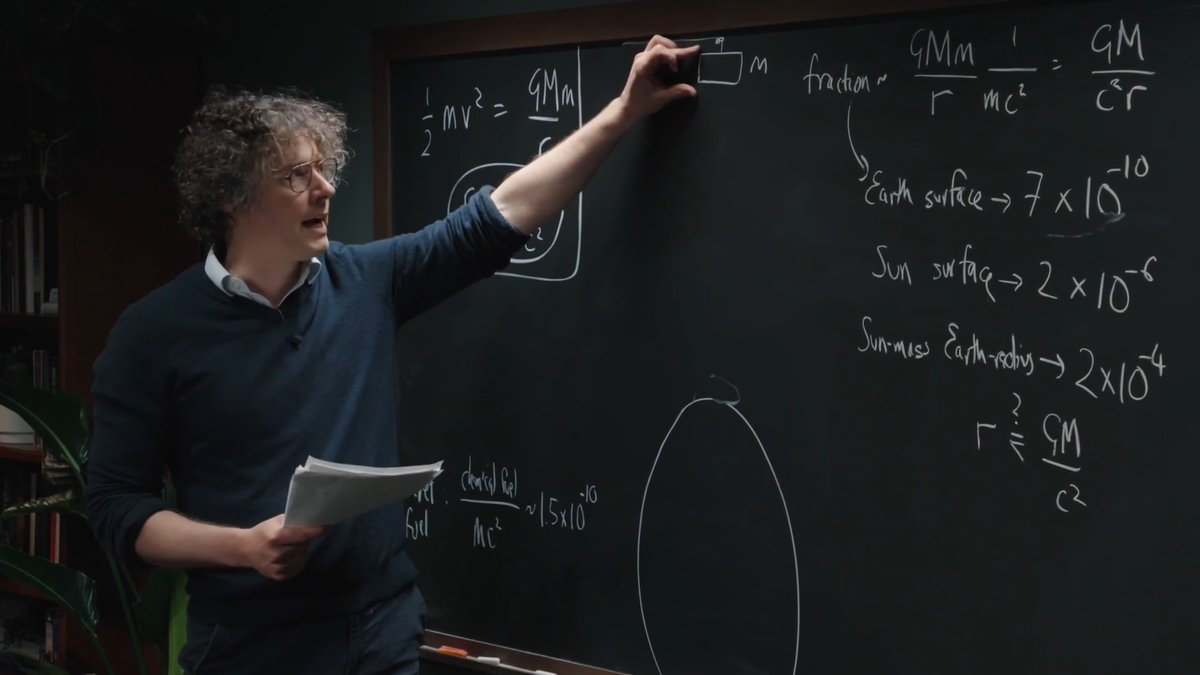
Albert Einstein himself never believed black holes were real when they first appeared in his equations. The actual black hole solution was found by Karl Schwarzschild in 1916, just months after Einstein published general relativity. Schwarzschild solved the equations exactly while serving on the Russian front during World War...

69,310 Aufrufe • vor 3 Monaten •via X (Twitter)

0 Kommentare

Keine Kommentare verfügbar

Kommentare vom Original-Post werden hier angezeigt

Ähnliche Videos

Adam Brown (Adam Brown) is back! General relativity is said to be the most beautiful idea the human mind has ever produced. Most of us will never get to fully appreciate its elegance by taking the 20-lecture graduate course Adam taught on it at Stanford. But in the video below, Adam distills the key idea at its heart so clearly and compellingly that even I could keep up lol. At the core of general relativity, Einstein is trying to figure out the principle behind a particular coincidence: that the mass that resists acceleration and the mass that gravity pulls on just happen to be exactly the same. Adam then leads us through the path of insight which Einstein called his “happiest thought.” Then Adam lectures on black holes. First, by showing how even under special relativity you could create a perpetual motion machine if black holes weren't truly black. And then, by explaining why the observations of an infalling observer and a distant bystander to the black hole would be so radically different Adam leads Blueshift, the team at Google DeepMind cracking science and reasoning. Which gave us the opportunity to discuss at the very end how close we are to AIs that could rediscover general relativity from scratch. Stay till the close for some philosophy of science. 0:00:00 – The coincidence that led Einstein to general relativity 0:16:42 – Gravity is a consequence of curved spacetime, not a force 0:31:46 – Why black holes prevent unlimited energy extraction 0:47:12 – Black holes are the ultimate power plants 1:13:50 – What falling into a black hole would actually feel like 1:18:51 – The three ways we know black holes are real 1:24:21 – The first time we saw gravity bend light 1:29:33 – How far can AI get without experimental evidence? Look up Dwarkesh Podcast on YouTube/Spotify to watch. Enjoy!

Dwarkesh Patel

653,756 Aufrufe • vor 1 Monat

Say hello Datafam to **Einstein Copilot for Tableau**, your trusted AI assistant that helps you go from data to insights quicker than ever before. In this demo, we explore reported wildlife strikes on planes in the U.S., leveraging FAA data to identify patterns, assess financial costs, and even find ways to reduce the impact on wildlife. Einstein Copilot makes exploring data seamless. For example, with just a click of the Einstein icon, you can ask AI-driven questions like "What is the trend of wildlife strikes over the years?" Immediately, Einstein filters and refines the data for you, revealing insightful trends such as a dip during COVID, followed by a record number of reports in recent years. Does that mean flying is more dangerous? Not quite. By adding another layer of analysis, like damage level, Einstein shows that while reports of strikes are increasing, almost all of them report no damage, which means flying remains as safe as ever. But Einstein goes beyond just trends and insights; it helps with complex calculations too. Need to calculate the total cost of these strikes adjusted for inflation? No problem. Einstein can handle the heavy lifting, combining the correct cost fields into one calculation, offering you a deeper understanding of the financial impact. In one standout example, Einstein highlights a $50 million spike in damage from 2009. Curious about the cause? With a simple prompt, Einstein quickly identifies that the outlier was the famous US Airways Flight 1549, known as the “Miracle on the Hudson,” when Captain Sully heroically landed in the Hudson River after a bird strike took out both engines. And just like that, Einstein Copilot for Tableau helps you transform data into actionable insights, empowering you to make smarter, faster decisions.

Marc Benioff

56,410 Aufrufe • vor 2 Jahren

Marc Andreessen says the movie Oppenheimer misunderstands history and morality. "The movie sets up both Oppenheimer and also specifically Albert Einstein as the key moral authorities of the era with respect to the use of nuclear weapons. Both claims of which I believe are deeply incorrect on substance." "My critique is the morality of the movie I think is very badly upside-down. And it's upside-down in a way that flatters our current politics but is very badly upside-down in terms of what actually happened at the time." Its redeeming feature is the first half: "[The first half of the movie is] one of the only recreations on film of what American elite culture and society and American research establishment of the leading experts at the time, in the 1920s and 30s, how thoroughly saturated that world was with Communism." However, the remainder of the movie frames Oppenheimer and Einstein as political heroes and vilifies technology, when in reality Oppenheimer was surrounded by Communists, Einstein was a critic of American democracy, and the hydrogen bomb Oppenheimer refused to build may have prevented World War III. (Marc recommends reading When Reason Goes on Holiday by Neven Sesardić to learn more about Einstein's political views.) "I thought the movie really cheated on the morality of it because it presented this as this slam dunk that the nuke was bad and that these people were bad and the whole thing was bad and that both Einstein and Oppenheimer were moral heroes in some extent trying to line up against this. And I just thought that really cheated the audience." Marc Andreessen 🇺🇸

a16z

328,615 Aufrufe • vor 10 Monaten

BREAKING NEWS: CHINESE SCIENTISTS PROVED EINSTEIN WRONG by performing an “impossible” experiment, a top US science journal reported in its latest issue. Iconic scientist Albert Einstein outlined an experiment on paper a century ago to disprove claims by an up-and-coming Danish physicist named Nils Bohr. But Chinese scientist Pan Jianwei and his team actually managed to do the experiment in real life, said a report in a publication of the American Physical Review. This week, newspaper headlines are saying things like “Chinese physicists prove Einstein wrong and put century-old debate to an end”. But that’s actually not true. And I’ll explain why below. . LASER TWEEZERS But let’s start with what is true – and is pretty amazing, too. The Chinese team managed to measure the physical impact that light has when it hits a surface—and they did it by isolating a single photon of light and shooting it at a single atom, held in place using a pair of “tweezers” made out of tiny laser beams. Why and how did they do this and what were they trying to prove? Full details and diagrams can be found in the video. Why do I say the headline writer got it wrong? This one says the Chinese scientists “put century-old debate to an end”. . NOT ACTUALLY TRUE That’s not true. The debate ended more than half a century ago, by which time, the majority of the world’s physicists had decided that Bohr was right and Einstein was wrong. And this wasn’t just a measure of opinions – many experiments had been done to reinforce this fact. So what the Chinese scientists just did was to create an elegant and precise experimental set-up that reinforces what physicists had already agreed on—and which can be replicated around the world to make further discoveries. So it is a very impressive feat, for sure. Meanwhile, thanks to Einstein, Bohr and Pan for showing the world exactly how photons work. They are very important – and remember, this information is being sent to you right now by a large army of photons!

Nury Vittachi

35,688 Aufrufe • vor 8 Monaten