正在加载视频...

视频加载失败

🇺🇸 America’s debt problem is hitting home, literally Surging Treasury yields are pushing 30-year mortgage rates above 7%, right as buyers are already staring down historically expensive homes. Then comes the vicious cycle: roughly $38 trillion in federal debt means higher yields make Washington’s borrowing more expensive, while costly...

17,438 次观看 • 2 天前 •via X (Twitter)

2 条评论

Conscious Mankind 的头像
Conscious Mankind2 天前

To hell with the u.s. I hope bad economy will force them to let the rest of the world be.

Fantastic Mr. Fox 的头像
Fantastic Mr. Fox2 天前

Like this home seller wasn't already depressed....

相关视频

🚨 THIS IS NOT NORMAL The U.S. 30-year Treasury yield just hit 5.52%. Highest since 2004. And it gets worse every day: The Treasury already TRIPLED one of its long-term bond buybacks to $6 BILLION. And yields are STILL going HIGHER. Something doesn’t add up: WHO IS GOING TO BUY THE NEXT WAVE OF U.S. DEBT? Japan has been one of the largest buyers of U.S. Treasuries for decades. Now Japanese yields are above 3%, and Japanese investors have already sold roughly ¥3 TRILLION of overseas debt this year. China is doing the same thing. Its Treasury holdings fell from roughly $696B to $618B in one year. Meanwhile, hedge funds are becoming increasingly important buyers of U.S. government debt. And that changes the game. Central banks buy Treasuries because they NEED reserves. Hedge funds buy them because the TRADE pays. When the trade stops paying, they leave. That means the marginal buyer is becoming much more PRICE-SENSITIVE. And Fed Governor Christopher Waller just said something almost nobody noticed: The historical “safety premium” on Treasuries is basically gone. Investors want to be PAID to hold U.S. debt for 30 years. If buyers demand 5.5%, Treasury pays 5.5%. If they demand 6%, Treasury pays 6%. The Fed controls the short end. It does NOT control what the market demands for 30-year money. And this can feed on itself: Fewer structural buyers → higher yields → higher interest costs → more borrowing → more Treasury supply → higher yields Treasury buybacks can help LIQUIDITY. They cannot create long-term demand. And if the 30-year keeps moving higher, this doesn’t stay inside bonds. Stocks. Real estate. Bitcoin. Everything gets repriced. Remember, I’ve been trading markets for over 15 years. I’m watching where the biggest money moves BEFORE it reaches stocks and Bitcoin. When I see the next major shift, I’ll post it here like I always do. Turn notifications on. If you’re not following yet, you’ll understand why that was a mistake later.

Alex Mason 👁△

80,817 次观看 • 7 天前

David Friedberg: Higher Interest Rates Are About to Make America’s $40 Trillion Debt Problem Much Worse “The federal government has a problem because over the next 12 months they have to refinance $10 trillion of debt. That debt is coming due. Those bonds are now due. They have to pay the principal back to the bond holders, and they have to go back to the treasury market and sell more treasuries to borrow more money to refinance. So the borrowing cost now is going to climb up, and when that borrowing cost climbs up, the federal government's burn goes up and the fiscal deficit goes up. So my theory and my argument on this is: There is no action that Bessent can take that's actually going to have a meaningful effect on the long end of the curve. We have a fundamental fiscal spending problem with the federal government right now. It is very expensive now to borrow money if you're the US federal government. And the reason is persistent inflation, I would argue because of excess government spending on social programs and other things. And the big problem at this point is the federal government is spending so much that if they were to cut spending aggressively, the argument and the concern is it would hit unemployment and it would cause a recession because the federal government is such an intricate part of the economy now. That's the argument. But it's causing inflation, and it's causing deficit spending. So this year the deficit will be roughly $2 trillion. And as a result, the market is saying, ‘We're worried about the US fiscal solvency over the long run, or there's a higher risk. As a result, we're going to charge you a higher interest, 5.2% on the 30 year.’ What does this mean for the federal government? Well, today, the federal government's average cost of debt is 3.4%. That's what we're paying on interest on average on the $40 trillion of debt that the federal government has outstanding. For every 1% change in the interest rate, the US government has to pay 1.25% of GDP in excess interest each year. 1.25% of GDP in interest each year for that 1% change in the interest rate.”

The All-In Podcast

334,932 次观看 • 1 个月前

🚨 TOMORROW COULD BE THE WORST DAY OF 2026 FOR MARKETS. You need to understand what’s happening before August 24. Japan and China are both reducing exposure to U.S. Treasuries while China keeps accumulating gold. This is much bigger than one bond trade. For decades, near-zero Japanese rates created one of the biggest carry trades in history: Japan and China are forcing capital back into their countries. And the biggest carry trade in history is now starting to unwind. This is NOT normal. For decades, Japan kept interest rates near zero. That turned the yen into the world's cheapest funding currency. Investors borrowed trillions of yen. Then they poured that money into U.S. Treasuries, stocks, real estate, crypto, and markets around the world. That trade is now breaking apart. Japan is facing soaring government debt. A rapidly aging population. Massive pension obligations. And years of pressure from a weak yen. Now policymakers want that capital back home. And now China is adding another layer of pressure to the U.S. Treasury market. China has been steadily reducing its holdings of U.S. Treasuries. Chinese Treasury holdings just fell to $633 BILLION, the lowest level since 2008. At the same time, China continues to build its gold reserves. → U.S. Treasuries get reduced → Gold holdings increase → Demand for U.S. debt weakens → Pressure on Treasury yields increases Japan and China were both among the major sources of the latest decline in foreign Treasury holdings. And when two of the world's biggest holders reduce their exposure at the same time... Someone else has to absorb that supply. That means higher yields are required to attract buyers. And U.S. bond yields are already surging. The 30-year Treasury yield recently pushed above 5.3%, reaching levels not seen since 2007. The U.S. Treasury is now forced to buy back its own debt because no one else wants it. Read that again. This is the part most people are missing. Japan is pulling capital toward Japan. China is reducing Treasury exposure and increasing its strategic gold position. → Foreign Treasury demand weakens → Treasury prices fall → U.S. bond yields rise → Borrowing costs increase → Liquidity tightens This creates another feedback loop. Higher U.S. yields increase the cost of financing the enormous U.S. government debt load. Higher Japanese yields make Japanese assets more attractive. And China's continued diversification adds another structural source of pressure to the Treasury market. Pay attention. Most people won't understand why markets are collapsing until it's already happening. I’ve studied markets for over 12 years and called nearly every major top and bottom. If you want to survive the 2026 cycle, follow and turn notifications on. I warned you before. And I'll warn you again soon. A lot of people will wish they paid attention earlier.

DANNY

187,518 次观看 • 1 个月前

🚨WARNING: MONDAY COULD BE A BLOODBATH Read this before it's too late. Two of the largest holders of U.S. debt are heading for the exit at the same time, and almost nobody understands what that unleashes. → Japan is offloading a massive wave of U.S. Treasuries → China just cut its holdings to $633 billion, the lowest since 2008 And the U.S. just confirmed how serious this is by doubling its bond buybacks to cover the damage. If you own any assets, you need to understand what's happening: the biggest carry trade in history is starting to unwind. For decades, Japan pinned rates near zero, making the yen the cheapest money on Earth. Investors borrowed trillions of it and poured that cash into Treasuries, stocks, real estate, and crypto worldwide. That trade became the plumbing underneath global asset prices. Now it's breaking. Japan is buried under soaring debt, an aging population, and a collapsing yen, so the money is being pulled home. And China is stacking pressure on top. It's been steadily dumping Treasuries and loading up on gold instead. Less demand for U.S. debt, more for hard assets. The message is clear. Here's why it matters: when the two biggest buyers step back at once, someone else has to absorb that supply, and they'll only do it at higher yields. That's exactly what's happening. The 30-year Treasury yield just pushed above 5.3%, the highest since 2007. The Treasury is now forced to buy back its own debt because demand is drying up. That's not strength. That's a desperate move. And it feeds on itself: higher yields make the debt more expensive to finance, which forces more issuance, which pushes yields even higher. Most people won't understand why markets are unraveling until it's already happening. I've studied these cycles for over 12 years and called nearly every major top and bottom. I'm warning you now. If you want to survive the 2026–2027 cycle, follow and turn on notifications. A lot of people are going to wish they'd listened sooner.

Shelpid.WI3M

146,467 次观看 • 1 个月前

🚨 WARNING: TOMORROW WILL BE THE WORST DAY OF 2026!! You MUST read this before September 28. 98% of people will lose everything. For the first time EVER, something just broke in the economy. If you hold any assets today, you MUST prepare for the biggest sell-off of the year: When the markets open on Monday, this won’t be just a ‘normal correction.’ What's happening right now is NOT normal. → Japan is dumping $5.2 TRILLION in U.S. Treasuries → China is dumping $600 BILLION in U.S. Treasuries → Trump just rejected Iran’s ceasefire proposal to reopen the Strait of Hormuz → U.S. Treasury yields are going PARABOLIC These events are NOT separate. They are connected through one massive feedback loop that is now accelerating Iran offered a seven-day roadmap to reopen the Strait of Hormuz and restart negotiations. Trump rejected the proposal. That keeps geopolitical risk elevated, keeps pressure on energy markets. At the same time, the two largest foreign holders of U.S. Treasuries are pulling capital away from American government debt. Japan is dumping U.S. Treasuries. China is dumping U.S. Treasuries. And someone else has to absorb that supply. That means the market demands higher yields to attract buyers. And that is exactly what we are seeing. Treasury yields are exploding higher because the market is repricing the risk of holding long-duration U.S. government debt. This creates a massive feedback loop: → Japan and China reduce Treasury exposure → Treasury supply becomes harder to absorb → Yields rise to attract new buyers → Higher yields increase the cost of financing U.S. government debt → Higher borrowing costs pressure stocks, real estate, crypto, and every asset priced against Treasury yields → Higher energy prices from the Iran crisis add more inflation pressure → Higher inflation pressure pushes yields even higher And now the geopolitical shock is feeding directly into the bond-market shock. The Strait of Hormuz is one of the most important energy chokepoints in the world. Trump rejecting the ceasefire keeps the geopolitical risk alive at exactly the moment Treasury yields are already surging. That means the energy shock feeds the inflation shock. The inflation shock feeds the Treasury selloff. And the Treasury selloff spreads across EVERY major asset market. This is why you cannot look at oil, bonds, stocks, crypto, and geopolitics separately anymore. They are all part of the same chain reaction. Most people will watch stocks waiting for the crash. But the Treasury market is where the warning is already flashing. This is NOT normal. This is the beginning of a much larger repricing of risk. Pay attention now, because by the time everyone understands what is happening, it’ll already be too late. I’ve studied markets for over 12 years and have called nearly every major top and bottom. And I'm warning you today. If you want to survive the 2026–2027 cycle, follow and turn on notifications. A lot of people will wish they had paid attention before it was too late.

0xNobler

523,677 次观看 • 5 天前

🇺🇸🇯🇵 Mohamed El-Erian: Washington is trying to impose outcomes on markets that fundamentals don't support The yen intervention isn't working. The attempt to push down long-term Treasury yields isn't working either. And Mohamed El-Erian thinks both are symptoms of the same problem: Washington increasingly believes government policy can dictate market outcomes. Markets are reminding it otherwise. Japan has already sold roughly $96 billion in foreign securities in a month while defending the yen, putting additional upward pressure on U.S. yields. Yet the yen has weakened again, creating what El-Erian agrees is essentially a vicious loop: defend the yen, sell Treasuries, push U.S. yields higher, make the carry trade more attractive, weaken the yen again. Washington is simultaneously trying its own financial engineering. With mortgage costs hurting voters ahead of the midterms, the administration wants lower long-term yields. But El-Erian says Treasury lacks the “bazooka” required to overpower a market this large. Without fixing the fundamentals, intervention becomes another Band-Aid. And those fundamentals aren't pretty. U.S. debt has crossed $40 trillion, doubled in 10 years, and interest payments are rising roughly 15% annually. Meanwhile, the AI boom is creating another enormous demand for capital, forcing government, companies and households to compete for money and pushing borrowing costs higher. El-Erian's broader warning is about “geo-economics.” Tariffs. Sanctions. Currency intervention. Treasury intervention. Economic tools increasingly look attractive because their costs aren't immediately visible. But the costs don't disappear. They accumulate. And eventually, El-Erian warns, markets will react. Mohamed A. El-Erian

Mario Nawfal

406,840 次观看 • 1 个月前

Housing Affordability Will Return the Hard Way New homes selling for less than existing homes means builders are being forced to respond to the market before homeowners are. Builders carry construction loans, land costs, payroll and unsold inventory. They cannot wait indefinitely, so they cut prices, reduce square footage and offer mortgage rate buydowns. Existing owners with 3% or 4% mortgages can simply refuse to sell. Price discovery is therefore appearing first in new construction while resale prices remain supported by restricted supply. The comparison is not perfectly equal because new homes are increasingly smaller and concentrated in lower-cost regions. Even so, the reversal matters. A market that historically placed a premium on new construction now requires discounts to move inventory. Mortgage Demand Has Collapsed The deeper signal is mortgage activity. The purchase application index is roughly 35% below its long term average and about 70% below its 2005 peak. Application volume has fallen toward levels last seen around 1995 even though the U.S. population is nearly 29% larger. Measured per person, purchase application activity is therefore about 22% lower than it was three decades ago. In practical terms, a much larger country is producing nearly one quarter fewer mortgage applications per capita. This is not a lack of interest in owning a home. It is a failure of affordability. Mortgage rates were around 7.5% to 8% in 1995, but the median new home cost roughly $133,000. Today rates are somewhat lower, yet home prices are more than three times higher. Monthly payments have risen much faster than household incomes, while down payments, taxes and insurance have become larger barriers of their own. Transactions Usually Break Before Prices The historical pattern is that housing volume weakens before home prices fully adjust. That happened during the 2006 to 2008 downturn. Buyers disappeared first, inventory accumulated later, and prices fell more decisively once unemployment rose and forced selling increased. Today the mortgage lock in has delayed that process. Owners with low rates are holding properties off the market, preventing inventory from rising enough to clear prices. Builders do not have that luxury, which is why they are cutting first. Why Lower Rates May Not Be Enough Lower mortgage rates alone could bring sidelined buyers back and place another floor under prices. Real affordability requires both lower financing costs and lower home prices relative to income. That combination usually appears when the economy is weakening. Rising unemployment reduces household formation, forces some owners to sell and breaks the lock in effect. Inventory rises just as demand falls. Mortgage rates decline because growth and inflation are deteriorating, but lending standards tighten and fewer people feel secure enough to buy. That is the cruel part of the housing cycle. Homes become more affordable only after buyers become scarcer. The people who benefit most are those who retain employment, liquidity and access to credit through the downturn. Hormuz Could Accelerate The Reset A sustained Strait of Hormuz disruption would intensify this process with a lag. Higher oil prices raise gasoline, freight, airline, food and production costs. Households lose discretionary income, businesses see margins compressed and hiring slows. At first, the inflation shock could keep long term yields and mortgage rates elevated even as demand weakens. Later, if unemployment continues to rise and consumption deteriorates, rates would fall because the economy is breaking beneath the surface. That is the most likely path back to affordability. Not a painless return to cheap mortgages, but a recessionary reset in which employment weakens, forced supply increases and falling rates arrive too late to protect everyone.

EndGame Macro

251,569 次观看 • 2 个月前

🚨 WARNING: SOMETHING TERRIBLE WILL HAPPEN ON MONDAY!! The Fed just hit the panic button. Next week, they'll inject BILLIONS into the economy to prevent a market collapse. When markets open on Monday, this won't be “just a dip.” If you hold any assets now, you MUST read this: The Fed is no longer choosing between a strong economy and stable inflation. It is choosing which problem to make worse. If the Fed hikes rates, borrowing costs will surge. Long-term Treasury yields will rise. Economic growth will slow. Debt servicing costs will explode. And with $40T in debt, the U.S. financial system will absorb an enormous amount of pressure. But if the Fed pauses or cuts rates, the problem moves somewhere else. Inflation will accelerate. Financial conditions will loosen. Inflation expectations will rise. And the Fed will be forced back into aggressive tightening. This creates a trap with NO clean exit. Higher rates → Higher yields → Slower growth → Bigger debt burden Lower rates → Higher inflation → More tightening → Higher yields This is no longer a normal rate cycle. The Fed is trapped between INFLATION and DEBT. And this is exactly where the Bank of Japan is currently sitting. Now it’s the Fed’s turn. The market can ignore this for as long as liquidity remains abundant. But once long-term yields start breaking higher while economic growth is slowing, the pressure will spread across every major asset class. Stocks will dump. Bonds will dump. Gold and Silver will dump. Bitcoin will dump even harder. Because when liquidity disappears, investors do not sell what they WANT. They sell what they CAN. And that is where the real chain reaction begins. Higher yields → Tighter liquidity → Falling risk assets → Forced selling The Fed will eventually be forced to choose between fighting inflation and protecting the debt market. And whichever path it chooses will create another problem somewhere else. This is the setup most people are completely ignoring. I have spent over 10 years trading markets and studying liquidity, rates, and macro cycles. I warned you before. And I'll warn you again soon. If you want to survive the 2026-2027 cycle, follow and turn notifications on. A lot of people will wish they paid attention earlier.

0xNobler

312,564 次观看 • 6 天前

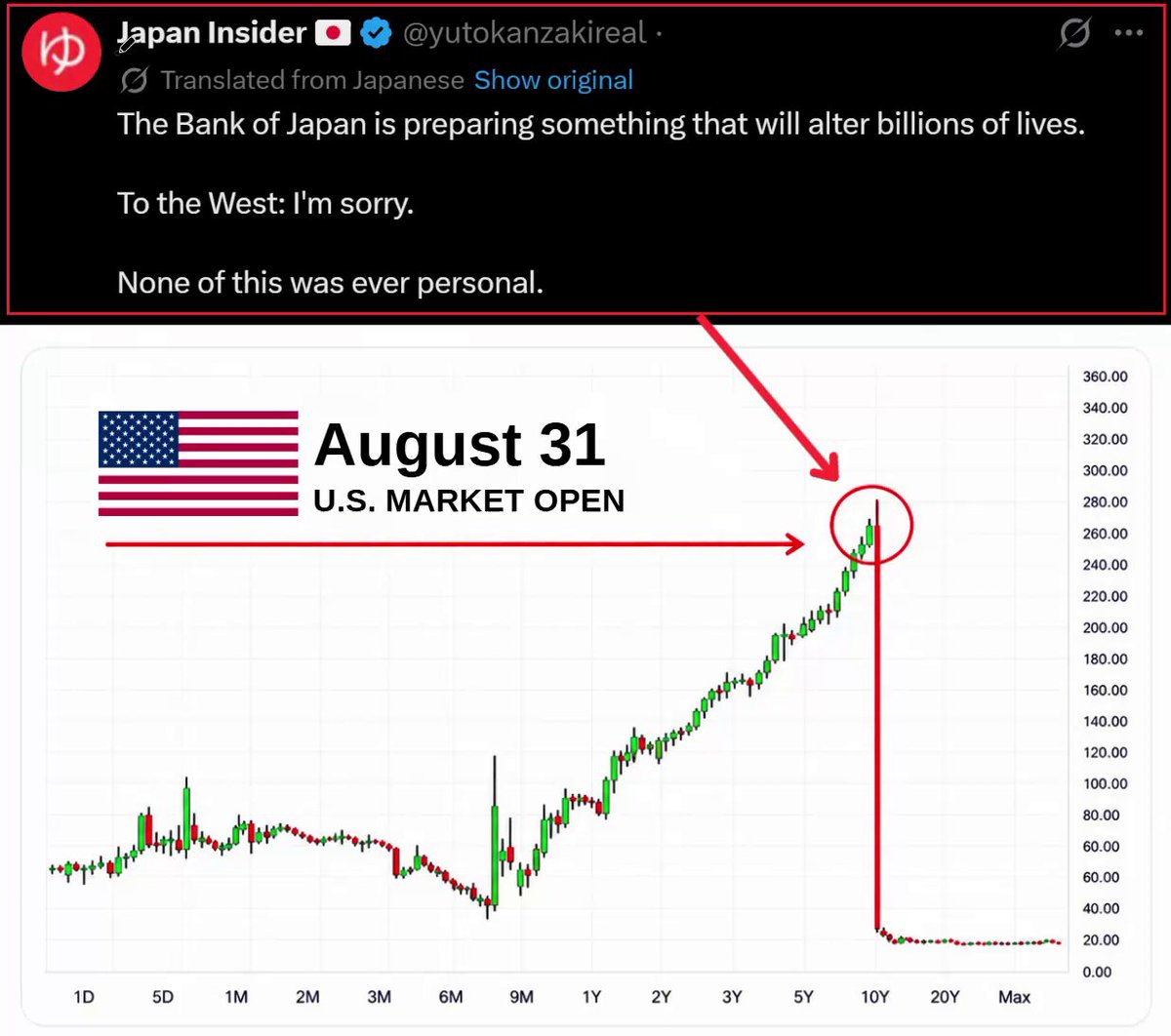
🚨 WARNING: TOMORROW WILL BE THE WORST DAY OF 2026!! 99% of people will lose everything. You MUST read this before August 31. → Japan is dumping $5.25 TRILLION in U.S. Treasuries → China is dumping $600 BILLION in U.S. Treasuries The U.S. just confirmed the crisis is real, and DOUBLED buybacks to cover the damage. If you own any assets today, you need to understand this: Japan and China are forcing capital back into their countries. And the biggest carry trade in history is now starting to unwind, with devastating consequences. This is NOT a normal market correction. For decades, Japan kept interest rates near zero, turning the yen into the world's cheapest funding currency. Investors borrowed trillions of yen and poured that money into U.S. Treasuries, stocks, real estate, crypto, and markets around the world. But now, the Japan trade is breaking apart: → Soaring government debt → Rapidly aging population → Massive pension obligations → Years of pressure from a weak yen And now, China is adding another layer of pressure to the U.S. Treasury market. China has been steadily reducing its holdings of U.S. Treasuries. Chinese Treasury holdings just fell to $633 BILLION, the lowest level since 2008. At the same time, China continues to build its gold reserves in a bold move. The implications are clear: → U.S. Treasury holdings decrease → Gold holdings increase → Demand for U.S. debt weakens → Pressure on Treasury yields increases Japan and China were both among the major sources of the latest decline in foreign Treasury holdings. And when two of the world's biggest holders reduce their exposure at the same time... Someone else has to absorb that supply, which means higher yields are required to attract buyers. The 30-year Treasury yield recently pushed above 5.3%, reaching levels not seen since 2007. The U.S. Treasury is now forced to buy back its own debt because no one else wants it. And that's a desperate move with catastrophic consequences. This creates another feedback loop: → Higher U.S. yields increase the cost of financing the enormous U.S. government debt load → Higher Japanese yields make Japanese assets more attractive → China's diversification adds another structural source of pressure to the Treasury market Pay attention, because most people won't understand why markets are collapsing until it's already happening. I’ve studied markets for over 12 years and have called nearly every major top and bottom. And I'm warning you now. If you want to survive the 2026-2027 cycle, follow and turn on notifications. A lot of people will wish they had paid attention earlier.

0xNobler

482,480 次观看 • 1 个月前

🚨 US TREASURY JUST CONFESSED: THE DEBT CAN’T BE PAID Scott Bessent just said the quiet part out loud: “The only option left is to grow out of it.” America cannot cut or tax its way out of $40 trillion. That is not a strategy. That is a last bet. It means the pile is too big to repay in real terms. So they need GDP to outrun the debt while deficits stay massive. Miss the growth target and the ratio explodes. Hit it only with inflation and the currency takes the hit. They are now selling the AI boom as fiscal policy. Robots, data centers, productivity miracles, anything to make the denominator grow fast enough that $40 trillion looks “manageable.” Then comes the second trick: Stablecoins. Wrap Treasuries as “reserves,” push dollar tokens worldwide, and quietly transfer fiat debt onto a crypto rail so foreigners keep funding the same obligation under a new wrapper. If that fails (and the odds are high), the trap snaps shut. Sticky inflation. Rising long yields. Softening Treasury demand. Record interest payments eating revenue. Multi-trillion deficits forcing more issuance. More bonds, higher rates, a bigger interest bill, still more debt. That loop does not “grow out.” It compounds. There is no soft landing after that. Only a financial depression and a new system. China is already building the alternative: 21 straight months of official gold buying, a Hong Kong vault-and-clearing network to make yuan convertible into metal, and BRICS rails designed to settle trade outside pure dollar clearing. The confession only means one thing: They’re kicking the can as much as they can, but the endgame is a financial depression. This was exactly outlined by the famous City Of London banker Lord Belgrave at the start of the year. Washington will have no choice but to debase the U.S. dollar and weaken its “reserve status” to get out of its debt trap. It’s all planned for Gold.

Stern Drew

978,469 次观看 • 1 个月前

🚨 WARNING: SOMETHING EXTREMELY BAD JUST HAPPENED Japan has started the biggest yen intervention in history. The U.S. is now printing dollars to stop Japan from dumping $1.2 TRILLION in U.S. debt. If the yen crashes again, the entire market will collapse. Stocks will dump. Metals will dump. Bitcoin will dump even harder. And this is NOT normal. Here's what's really happening right now: Japan gives its U.S. Treasury bonds to the Fed. The Fed prints dollars against those bonds. Japan sells those dollars and buys yen. This lets Tokyo defend its currency without dumping its entire $1.2 TRILLION Treasury position into the market. Because if Japan starts selling at that scale, global liquidity disappears. And the pressure is coming from everywhere. Higher Japanese rates are pulling capital back home. A weaker yen is making imports more expensive. Japan's massive government debt makes higher borrowing costs increasingly painful. And Japanese investors are sitting on trillions of dollars in foreign assets. That creates enormous pressure to bring money back into Japan. But here's the insane part: If Japan dumps Treasuries, bond prices fall and yields rise. Higher Treasury yields push global borrowing costs higher. Liquidity tightens. Risk assets come under pressure. And the shock spreads from bonds into stocks, real estate, crypto, and credit markets. So the U.S. is effectively printing dollars to absorb the same U.S. debt Japan wants to sell. Japan dumps the bonds. America prints the money. And the Fed takes the debt onto its own books. The underlying pressure does not disappear. It gets transferred through the financial system. THIS IS HOW THEY ARE TRYING TO HIDE A GLOBAL LIQUIDITY CRISIS. Pay attention. The biggest shifts in global finance are never obvious while they are happening. Then suddenly, everyone realizes the world has changed. I've spent more than a decade watching how these markets move. And I've also called nearly every major market top and bottom. Follow and turn on notifications now. Many people will wish they had started paying attention sooner.

0xNobler

154,245 次观看 • 25 天前

The world's safest bonds are suddenly not acting safe. The 30-year Treasury just hit its highest yield since 2007. Germany, France, and Japan are seeing the same thing. Yet the stock market is partying near record highs... A government bond is a loan you make to a country. The yield is the interest that country pays you. When the yield jumps, it means lenders are nervous. They are demanding more to hold that debt. This is not one country having a bad week. Long-term rates are spiking all over the world. Japan just hit a 30-year high. Germany hit its highest level since 2011. France hit levels not seen since 2008. The United States is leading the pack. The 30-year US yield touched 5.3% this week. The last time it was this high was 2007. Now look at what makes this so strange. The economy has actually been slowing down. Jobs data has cooled off. Retail sales just fell. That should push interest rates lower, not higher. Instead they keep climbing. So why are rates rising anyway? The bond market is scared of something bigger. The US government is drowning in debt. That pile is about to cross $40 trillion. In July alone the deficit hit $432 billion. The government keeps borrowing more every month. So lenders are demanding more to keep lending. Higher rates make that debt even harder to carry. Lending to a government once felt risk-free. That assumption is quietly breaking. Recent debt auctions tell the same story. The latest 30-year sale drew its highest yield since 2001. Buyers are forcing the government to pay up. They want more to lend for thirty long years. Oil is making all of this worse. It just pushed back above $90 a barrel. That feeds straight into inflation fears. And inflation is the enemy of every bond. There is one more warning sign: The biggest lenders are starting to walk away. China, Japan, and the UK all cut their holdings. Someone still has to buy all that new debt. Fewer buyers means even higher rates. Now come back to the stock market. It is still sitting near record highs. Wall Street has a comforting story for this. Strong earnings will power right through it. Maybe they will. But the bond market is not buying that story. Two markets are telling opposite things. Stocks say the party keeps going. Bonds say the ground is shifting underneath. When they disagree this sharply, bonds usually win. The bond market is bigger and harder to fool. It sets the cost of money for everyone. Higher yields quietly make every stock worth less. This is not just a Wall Street problem. These same yields set your mortgage and car loan. A new car loan now runs about 7%. When the government pays more, so do you. Retail watched the stock market. The bond market wrote the real story. That's the whole game. Surmount builds automated strategies that follow the data, not the noise. Start for free and let the signals lead.

Logan Weaver

11,838 次观看 • 1 个月前

🇺🇸 The U.S. Treasury is trying to stop bond yields from rising. But according to David Lin, Washington may be picking a fight with a market it simply doesn't have enough firepower to control. Treasury Secretary Scott Bessent doubled planned bond buybacks from $2 billion to $4 billion per operation, signalling that Washington is prepared to intervene more aggressively. Yields fell for one day. Then they went straight back up. The problem is scale. The Treasury market is measured in tens of trillions of dollars, making $4 billion of intervention little more than a signal. And if yields keep rising, the consequences spread far beyond Wall Street. Mortgages, corporate borrowing and government debt servicing all become more expensive. Lin's bigger concern is what governments do when financial pressure starts limiting their options. Higher debt costs could push governments toward more aggressive tariffs, trade wars and foreign-policy decisions as they try to protect their economies. Meanwhile, the dollar remains the world's dominant safe haven, even as central banks accumulate more gold and countries increasingly look for ways around a dollar-based system. And then there's the Iran war. Lin argues that the conflict has exposed another vulnerability: energy infrastructure is remarkably easy to disrupt with cheap drones. Refineries, pipelines and shipping can all become targets, creating a much bigger problem for an already fragile global economy. So the biggest risk may not be a sudden financial collapse. It may be governments gradually losing room to maneuver, while markets become increasingly unwilling to listen. The Treasury can announce bigger interventions. The bond market can simply decide they aren't big enough. David Lin

Mario Nawfal

300,860 次观看 • 1 个月前

🇺🇸🇯🇵 The U.S may be quietly approaching a “whatever it takes” moment to stop Treasury yields from exploding America recently joined Japan in supporting the yen after the currency plunged toward 40-year lows. At first glance, that's a Japanese problem, but David Lin says Washington had a very American reason to intervene. The yen sits at the heart of one of the biggest trades in global finance. For years, investors have borrowed cheaply in Japan and poured that money into higher-yielding U.S assets. But if Japanese rates keep rising, that enormous carry trade starts to unwind. Investors sell U.S assets, Treasuries get dumped, U.S yields surge, and that's where things get dangerous, because America today cannot tolerate interest rates the way it could 40 years ago. David points out that U.S debt-to-GDP was around 31% in the early 1980s; today it's above 120%. So when people say America survived 15% interest rates in the 1980s, they're missing the point; the U.S had a fraction of today's debt. David warns that if the 10-year Treasury yield were allowed to spiral dramatically higher now, the effects would rip through virtually everything: Mortgages, credit cards, corporate borrowing, housing, equities, and even the enormous AI infrastructure boom, which depends on companies being able to finance staggering amounts of CapEx. And there's another problem making all of this worse: Iran. Japan imports huge quantities of energy through the Strait of Hormuz, which puts more pressure on inflation and the yen, so it may be forced to raise interest rates further. And higher Japanese rates make the carry trade even more vulnerable. So you get a potentially vicious cycle: Hormuz squeezes Japan, it raises rates, the carry trade unwinds, U.S assets get sold, Treasury yields rise, and America's borrowing costs explode. Which helps explain why Washington stepped in. But here's the problem: the U.S intervention barely lasted; the yen began weakening again within days. And David doesn't think the amount Washington deployed was remotely large enough to solve the underlying problem. His theory is that this may have been a teaser. A signal to markets that the gloves are coming off and Washington is prepared to intervene much more aggressively if necessary. And if this doesn't work, the next steps become much bigger. David Lin

Mario Nawfal

297,547 次观看 • 1 个月前