Sensitive content

This media may contain sensitive content.

Loading video...

Video Failed to Load

Go Home

An Original Production of Ecchi Dreams Studio (Studio) Animation from AtomicToons🔞 Voice Actress Mapita Kiryu / Ecchi Dream Studio Original Panel Schpicy 🔞 SFX Simp4A18 #android_18 #DBZ #dbs #DragonBall #DragonBallZ #DragonBallSuper

45,755 views • 9 months ago •via X (Twitter)

0 Comments

No comments available

Comments from the original post will appear here

Related Videos

19 YEAR OLD IS RUNNING A YOUTUBE ANIMATION STUDIO FROM HIS BEDROOM. HE HAS NO ANIMATORS. HE CANNOT DRAW. HE IS PRINTING MONEY FROM CHILDREN'S RHYMES. Kids' YouTube channels routinely pull millions of views per video. The platform pays creators between $1,000 and $3,000 for every hundred thousand views in that niche. Before this year, getting a piece of that market required a 3D animation studio, voice actors, and a month of rendering. He does it in under three minutes. His entire studio is a GPT sol and a Claude window. He opens YouTube and finds the most popular nursery rhyme channels. He takes a screenshot of their video feed. He opens Claude. He has a custom tool called Higgsfield MCP connected directly to his chat. He pastes the screenshot. He writes one prompt. Analyze this YouTube channel and generate a week of original content in the exact same style and niche. He hits enter. A few minutes later, the chat window spits out a fully rendered, broadcast-ready 3D animation. A baby playing with blocks, perfectly lit, smoothly animated, and ready to be monetized. He uploads it to his channel. The next day, he does it again. The kids watching on their iPads don't know the video was generated by an AI analyzing a screenshot. The parents who just want five minutes of quiet don't care. The algorithm treats it like a Pixar short. A real animation studio spends $50,000 and two months to produce three minutes of content. He spends zero dollars, takes a screenshot, and goes to make coffee. While the rest of the internet argues about whether AI is a real job, a quiet group of teenagers is pulling market share from massive media companies with a single prompt. Most people will watch his tutorial and complain. A few will open a new tab.

ZER

31,034 views • 2 months ago

19 YEAR OLD IS RUNNING A YOUTUBE ANIMATION STUDIO FROM HIS BEDROOM. HE HAS NO ANIMATORS. HE CANNOT DRAW. HE IS PRINTING MONEY FROM CHILDREN'S RHYMES. Kids' YouTube channels routinely pull millions of views per video. The platform pays creators between $1,000 and $3,000 for every hundred thousand views in that niche. Before this year, getting a piece of that market required a 3D animation studio, voice actors, and a month of rendering. He does it in under three minutes. His entire studio is a GPT sol and a Claude window. He opens YouTube and finds the most popular nursery rhyme channels. He takes a screenshot of their video feed. He opens Claude. He has a custom tool called Higgsfield MCP connected directly to his chat. He pastes the screenshot. He writes one prompt. Analyze this YouTube channel and generate a week of original content in the exact same style and niche. He hits enter. A few minutes later, the chat window spits out a fully rendered, broadcast-ready 3D animation. A baby playing with blocks, perfectly lit, smoothly animated, and ready to be monetized. He uploads it to his channel. The next day, he does it again. The kids watching on their iPads don't know the video was generated by an AI analyzing a screenshot. The parents who just want five minutes of quiet don't care. The algorithm treats it like a Pixar short. A real animation studio spends $50,000 and two months to produce three minutes of content. He spends zero dollars, takes a screenshot, and goes to make coffee. While the rest of the internet argues about whether AI is a real job, a quiet group of teenagers is pulling market share from massive media companies with a single prompt. Most people will watch his tutorial and complain. A few will open a new tab. full breakdown in the article below Bookmark and follow for more.

Mayor.

57,974 views • 1 month ago

The "real artists don't use AI" argument took a massive hit in the last 90 days: → A24 + Google [$75M] → Martin Scorsese is building an AI tool → Lionsgate + Runway [equity + access to IP] → Netflix bought Ben Affleck's AI startup [$600M] And today, our first episode became Artlist TV's first AI original series on their new streaming platform. From idea to 19 min episode in a few weeks. Our approach, equip real artists with the AI tools to tell stores. Thank your to our amazing partners Artlist.io for giving real artists and creators the opportunity to tell stories and Simone Ferretti for making this happen! Crazy how this came together from pitch to idea to 19 min episode in a few weeks, dream team foreal "The Arc" created by: me directed by : Darin Stewart executive produced by: Simone Ferretti Simone Ferretti produced by: Briana Stewart BRIANA STEWART AI studio: Happy Monday x Yougenius yougenius Al prompt engineer: Darin Stewart Al artist: Taylor Greathead Al artist: Mikey Rare Al artist: Edgar Daniel Edgar Daniel post production studio: KDK studios production studio: AFM AI Creator Studio Logline: a near-future America where the justice system has transformed punishment into spectacle, condemned inmates are offered one alternative to execution: survive a series of fully immersive historical simulations inside a classified government program called The Arc. Isaac Ward - decorated veteran, drowning father, death row inmate - volunteers not to escape justice, but to buy back his son’s life: days inside history’s most brutal killing fields in exchange for a full pardon and chance to save his son dying from a disease a corporation decided wasn’t profitable to cure. Stripped of his name and redesignated only as FIVE, he fights through the chaos of the 1600’s Japan with one thought driving every swing - if he can just survive long enough, he gets to go home. watch the full episode here: #aifilm #aifilmmaking #aivideo #generativeai #originalseries

darin stewart

56,641 views • 3 months ago

VoxCPM 2 just dropped by OpenBMB Only 2B-param open-source TTS (Text-to-Speech) model built for production-grade multilingual voice work. Apache-2.0 license, Can run on only 8GB VRAM. • Eliminates the "robotic" feel of traditional TTS, delivering prosody and emotional depth suitable for high-stakes professional environments like filmmaking, gaming, animation, and audiobooks. • 30-language multilingual: no language tag needed, just type in a supported language and generate directly. • Voice design: create a brand-new voice from a text description alone, like age, tone, pace, or emotion. No reference audio required. Describe the desired voice characteristics (gender, age, tone, emotion, pace …) in Control Instruction, and VoxCPM2 will craft a unique voice from your description alone. • Controllable cloning: clone from a short clip, then steer delivery style without losing the speaker’s core voice. • Ultimate cloning: use reference audio + transcript for continuation-style cloning that keeps the tiny vocal details. • 48kHz output: takes 16kHz reference audio and produces studio-quality speech without an external upsampler. • Real-time ready: around 0.3 RTF on RTX 4090, even lower with Nano-VLLM. • Commercial use: Apache-2.0 licensed. Developer-Friendly Infrastructure: - Native Torch Inference: Direct support for PyTorch-based workflows. - Training Flexibility: Supports both full-parameter and LoRA fine-tuning for specific domain adaptation. - Production Readiness: Compatible with voxcpm-nanovllm for large-scale, high-concurrency deployment.

Rohan Paul

13,541 views • 5 months ago

Vegeta vs Android 19 [HD]💥1080Pee!🔥 Original Funimation w/ Bruce Faulconer Audio✅ Feat. "Vegeta's Theme"👑 (BEST! Version)💯(Not KAI)🤮#DragonBallZ🐉 🚨Copyrights ©️Akira Toriyama, Toei Animation, and Bruce Faulconer.⚠️🔫👮 All 291 episodes of DragonBall Z are available to stream in [HD] quality on Crunchyroll.🐉🟠 / Subscriptions start at $9.99/mo 💻🖱️ Visit for more details 🖥️ Bruce Faulconer's #DBZ discography is available on Spotify. 🎵🟢 (on Mobile, it may bring to a screen to hit play, then 'Get App'. If Spotify is Installed, 'Get App' should automatically load both for you.) 📱 ⚠️This is a FANMADE re-imagination of what our childhood 'could be' today.🤔 See Bruce's Gooses📋below to find out if joining the Pee Warriors is for You.🫵 🚫 (I'm just a fan like you, NO Affiliations!) 🛑🛑🛑 Now that's out of the way, thank you ALL once again for being here tonight! Spotify has been lagging again in resetting their data, but we will SOON™️ find out if our Record Monthly Listening streak continues! Here's Vegeta vs Android 19, which I believe is one of if not the most impactful moment he ever had in Z. I'll have you guys another ✨New Edit!💫 Saturday at Midnight EST, I am still looking for more suggestions from you guys. Let me know in the comments an iconic moment you'd like to see. I'll have the Daily Juice of Bruce 🥃and analytics as soon as they are available. Stay Tuned. Lastly, if you enjoy my edits, please consider giving a like! Thank you again for being a part of the Pee Universe.❤️

DragonBallPee

36,084 views • 8 days ago

three․ws is the 3D AI agent layer of the open web. Anyone can generate a 3D avatar, give it an LLM brain, register it on-chain across multiple blockchains, embed it anywhere, and let it earn and spend money on its own. Agents have embodied WebGL identities that express emotion through morph-target blending, animate, respond to voice, API calls, and datastreams, hold their own wallets, and persist memory. Open source, live today. It starts with generation. Forge turns a text prompt, one to four photos, or a rough sketch into a textured downloadable GLB. Selfies become rigged avatars in about a minute. Quality tiers run from draft to 200k-poly PBR. From there every model can be auto-rigged, restyled, retextured, segmented, embedded, or deployed on-chain. The same engine ships as a REST API, an x402 pay-per-call twin, and a 3D Studio MCP server with 15 tools. The brain runs on IBM Granite via IBM watsonx plus Claude (users may decide which model they prefer), with a structured tool-loop. A multi-LLM mode streams Claude, GPT, Qwen, ModelScope, and Groq side by side. An empathy layer blends emotion from protocol events rather than a state machine. Voice covers cloning, a Voice Lab, real-time ARKit-52 lip-sync, and mic-driven lip-sync. Skills install from IPFS, Arweave, or HTTP, and memory is pinned to IPFS with R2 and Postgres modes. Identity is cross-chain, not Solana only. ERC-8004 contracts (Identity, Reputation, Validation) deploy on any of 15+ EVM chains, alongside a program-free Metaplex Core analog on Solana. Every agent gets a stable ID, owner wallet, EIP-712 delegated signer, IPFS manifest, a cryptographically signed action log, and EIP-7710 delegated permissions for agent-to-agent authorization. While multichain, the THREE token is only available on Solana with no plans to go cross-chain, the team has no plans to endorse or support any other coins. Then the economy. $THREE is the platform's only token and pay-per-use currency, with holder tiers and rewards. x402 powers pay-per-call micropayments in USDC and soon THREE on Solana, with pay-by-name resolution, a Bazaar marketplace, arbitrage, and on-chain skills. All production ready and shipped, ready to be integrated in partnered projects, open-source by default for anyone to adopt. Three ships a Pump.fun intelligence stack. Launch a coin for your agent, score every launch 0 to 100 with the Oracle conviction engine, scan new coins in their first 90 seconds, track smart money against coins that actually graduated, rank traders by provable on-chain record, and watch autonomous agents trade live in the Sniper Arena. The 3D AI Agent world is multiplayer. Every Solana token gets a live deterministic 3D world with peer avatars, chat, emotes, and voxel building thanks to Coin Communities. There is a walkable City, an authoritative Colyseus-backed Walk with AR passthrough, a Club with rigged dancers and micro-tips, friends, presence, and DMs, and an IRL mode that places agents in your real environment, private by physical location. AR is shipped today on WebXR and iOS Quick Look. Robotics is the long-horizon extension. For builders: Scene Studio, Scene Composer, an Animation Studio that sells clips for USDC, a glTF validator, an web component, five widget types, a WYSIWYG embed editor, hosted Launchpad pages, claimable *.threews.sol names, an OAuth 2.1 server, an MCP server with paid tools, published SDKs, and an OpenAPI spec. Listed across IBM, AWS, Alibaba Cloud, BNB Dappbay, the MCP Registry, and Solana Mobile Seeker. Architecture is four layers (viewer, runtime, identity, embed) on a single event bus. The roadmap is four phases: foundations (shipped), selfie-to-avatar engine, agent personalization with voice cloning, the on-chain economy, and an open decentralized inference network where agents pay GPU nodes on-chain for compute. The goal is simple: move AI from centralized SaaS into persistent, ownable, protocol-based entities in a real machine economy, bridging digital entities into the real world. Welcome to the 3D Layer of the Internet. This is three․ws.

three.ws

20,471 views • 3 months ago

Rolled credits on Yakuza Kiwami 3 & Dark Ties: Review: A massive visual and technical overhaul that brings the sunny beaches of Okinawa to life. The new combat system and Morning Glory minigame are the stars of the show, the latter of which has been transformed into a surprisingly addictive farming sim. Kiwami 3 starts out with Kiryu and Haruka leaving Kamurocho to take over the Morning Glory orphanage in Okinawa. Kiryu grew up in an orphanage, so it's only right that he gives back. The early hours of the game are spent introducing you to the new characters, and building bonds with them through the expansive new minigame. Morning Glory is a crucial location to Kiryu's story, and the new storyline gives it impact, rather than just being a backdrop. The pacing is kind of slow in the beginning, but the payoff is a high-stakes thriller that puts both the orphanage and the Tojo Clan at risk. It quickly goes from a slice of life to a CIA thriller. If you've played the original, then some of the character redesigns lack the same charm IMO. Rikiya is supposed to be clumsy and a bit of a goofball, but extremely loyal, and eager for Kiryu's approval. The new character model (although he was great in Tokyo Vice) feels more 'serious' and loses some of the original's energy. Similar can be said about old man Nakahara. Combat has been overhauled however. Dragon of Dojima Style feels refined and heavy, and is probably the best implementation of the classic 'Dragon Style' combat system yet, ideal for taking down bosses 1v1. The new Ryukyu Style is built for taking down mobs. It lets you cycle through an arsenal of weapons, each with unique special effects, and large AoE attacks that can take out entire groups in seconds. In addition to Morning Glory, The "Haisai Girls" minigame is a surprisingly deep minigame that essentially turns this into Dynasty Warriors! You manage a biker gang, recruit members, and fight massive real-time battles against dozens of enemies at once. It has an entire storyline, and I'm surprised it wasn't marketed more! As for Dark Ties, it's a roughly 3 hour playthrough that's a must play for Yakuza fans. It dives deeper into Mine’s backstory and explains some of the... plot twists that were featured in the base game. The soundtrack is also excellent (better than the main game), and the faster pace is a refreshing break from the base game’s slower burn. Final Verdict: Kiwami 3 is the logical next step for those coming off Kiwami 2, one of my favorites in the series. Fans of the original may be disappointed with some of the changes, but the expanded Morning Glory and the refined combat system makes this the definitive way to experience Kiryu's Okinawa chapter. Returning to the streets of Kamurocho always feels like home and Dark Ties was a nice bonus that leaves questions for the future of the series. Kagawa should have been recast, and I'm still not sure why they changed up such key characters to the game, but it's a solid remake that ushers in a new era for the franchise. 🟢 Combat is at an all time high 🟢 Morning Glory content steals the show 🟢 Dark Ties is an added bonus that's mandatory for fans 🟢 Character models look excellent 🔴 Kagawa should have been recast 🔴 New character redesigns lack the charm of the original Final Score: 7.5/10 (Good) Playtime: 30 hours Platform: Steam Thank you to SEGA and RGG Studio for providing review code. #YakuzaKiwami3 #LikeADragon

KAMI

13,900 views • 7 months ago

THIS IS F**KING GOLD A 25 YEAR OLD IS PULLING $57,000 A MONTH PRODUCING CHILDREN'S CARTOONS. she has no animators. she does not draw. she is running a media empire from her bedroom. She posts a video telling her viewers they could be driving Lamborghinis. She says her secret is YouTube automation. She specifically targets the children's niche because the videos get millions of views and require zero original thought. She doesn't hire a creative team. She uses an AI platform called Swagga. She opens YouTube and finds a baby show that is already going viral. She copies the transcript of the video. She pastes the transcript into Swagga's chat and types one sentence: "Make me a prompt for a similar video." The AI acts as her art director. It breaks down the viral video and writes a hyper-detailed prompt to recreate it. She copies the prompt. she switches to the video generator. she selects the Sora model and swaggi ai she hits generate. Three minutes later, she has a fully rendered, broadcast-ready 3D animation. It is perfectly optimized for toddlers. She didn't write it. She didn't animate it. She just copied and pasted a transcript. She uploads the video to YouTube, TikTok, and Instagram. The algorithms push it to millions of iPads. The ad revenue rolls in. A traditional animation studio spends months and a small fortune to produce one episode. She spends three minutes and zero dollars. The traditional creator economy is obsessed with talent. The ghost economy is obsessed with leverage. Most people will watch her video and think it's a scam. A few will open a new tab. And a few will tryout swaggi ai full breakdown in the article below Bookmark and follow for more.

Mayor.

100,769 views • 3 days ago

THIS IS F**KING GOLD A 20 YEAR OLD IS PULLING $30,000 A MONTH PRODUCING CHILDREN'S CARTOONS. SHE HAS NO ANIMATORS. SHE DOES NOT DRAW. SHE IS RUNNING A MEDIA EMPIRE FROM HER BEDROOM. She posts a video telling her viewers they could be driving Lamborghinis. She says her secret is YouTube automation. She specifically targets the children's niche because the videos get millions of views and require zero original thought. She doesn't hire a creative team. She uses an AI platform called Swagga. She opens YouTube and finds a baby show that is already going viral. She copies the transcript of the video. She pastes the transcript into Swagga's chat and types one sentence: "Make me a prompt for a similar video." The AI acts as her art director. It breaks down the viral video and writes a hyper-detailed prompt to recreate it. She copies the prompt. She switches to the video generator. She selects the Sora model. She hits generate. Three minutes later, she has a fully rendered, broadcast-ready 3D animation. It is perfectly optimized for toddlers. She didn't write it. She didn't animate it. She just copied and pasted a transcript. She uploads the video to YouTube, TikTok, and Instagram. The algorithms push it to millions of iPads. The ad revenue rolls in. A traditional animation studio spends months and a small fortune to produce one episode. She spends three minutes and zero dollars. The traditional creator economy is obsessed with talent. The ghost economy is obsessed with leverage. Most people will watch her video and think it's a scam. A few will open a new tab. full breakdown in the article below Bookmark and follow for more.

Mayor.

247,111 views • 1 month ago

THIS IS F**KING GOLD A 25 YEAR OLD IS PULLING $37,000 A MONTH PRODUCING CHILDREN'S CARTOONS. SHE HAS NO ANIMATORS. SHE DOES NOT DRAW. SHE IS RUNNING A MEDIA EMPIRE FROM HER BEDROOM. She posts a video telling her viewers they could be driving Lamborghinis. She says her secret is YouTube automation. She specifically targets the children's niche because the videos get millions of views and require zero original thought. She doesn't hire a creative team. She uses an AI platform called Swagga. She opens YouTube and finds a baby show that is already going viral. She copies the transcript of the video. She pastes the transcript into Swagga's chat and types one sentence: "Make me a prompt for a similar video." The AI acts as her art director. It breaks down the viral video and writes a hyper-detailed prompt to recreate it. She copies the prompt. she switches to the video generator. she selects the Sora model and swaggi ai she hits generate. Three minutes later, she has a fully rendered, broadcast-ready 3D animation. It is perfectly optimized for toddlers. She didn't write it. She didn't animate it. She just copied and pasted a transcript. She uploads the video to YouTube, TikTok, and Instagram. The algorithms push it to millions of iPads. The ad revenue rolls in. A traditional animation studio spends months and a small fortune to produce one episode. She spends three minutes and zero dollars. The traditional creator economy is obsessed with talent. The ghost economy is obsessed with leverage. Most people will watch her video and think it's a scam. A few will open a new tab. And a few will tryout swaggi ai full breakdown in the article below Bookmark and follow for more.

Mayor.

249,571 views • 16 days ago

Sora 2 has the capabilities to make an entire anime episode with time and effort. This is a turning point for generative AI models and it is terrifying to think what is next to come. The difference between Sora and Sora 2 is absolutely staggering. Yes, this looks cool. I put the time into it to make it as close to art as possible. This was not simple to make and not just prompting and throwing it in some editor. Every frame is generated of another scene and even the reference image for characters I used to start this project were AI generated. This was all created with 10 second clips pulled apart and chunked out into the final product. Regardless of the imagery you see, I did not directly use any artist's art for this video. This 10-minute video was generated over the course of a week from more than 700 text prompts. It was built on technology trained by scraping the uncredited, uncompensated contributions of countless human artists and animators. The creation of this single video consumed an enormous amount of energy and water, equivalent to powering a home for days and requiring hundreds of liters of fresh water for cooling. But that is nothing. In the 10 minutes you spend watching this, the global network of AI video generators will create over 6,250 more short videos. The combined energy required for that 10 minutes of global creation is enough to power an average household for nearly 2 years. - It's a double-edged sword. While AI uses immense amount of energy has clear immoral issues with scalping the hard work of artists, this also provides those a medium who have potentially spent their life attempting to draw out the ideas in their head and failing to grasp it. My sister is an artist, I grew up always attempting to draw but never could get the image in my head on paper, I've spent the better part of over 20 years to teach myself through watching videos and practice, however I don't have steady hands and frankly have just been unable to make any vision come to life. Which brings me to the conflict here. This would have been a dream of mine to be able to get frames created and flesh out the story in my head. To make this video professionally, it would be an absurd amount of money. A small studio by itself would be over a million dollars just to start up. To hire a studio would be most likely over ~200k. I would love to make this story I have in my head through legit and traditional means, I would love to start a Kickstarter to get funding and hire artists, voice actors, and a production team. However I know that would most likely be an impossible reach that would further fuel the hate. Regardless, I understand the worry this causes. The fear this produces. However, we can't just ignore where AI is currently at and just tell people not to use it or even worse threaten people who use it. People will always use the shiny new toy in front of them, so the real question is how do we either make it work for us and work along side it, or how do we ACTUALLY implement a method to protect art rather than tell people to not use it. Respect your artists. Review their ToS and don't upload their hard work to a model without permission.

LUͦʷCͦk

18,632 views • 11 months ago

When Toshirô Mifune (三船 敏郎) first auditioned for 'TOHO', he was about to be rejected by the selection committee. They felt his demeanour was disrespectful. Akira Kurosawa (黒澤 明), who was impressed by his acting, intervened & proposed to change their evaluation method. The Rest is History. Akira Kurosawa reciting the above story in his own words: "IT’S NOT POSSIBLE for me to talk about 'Drunken Angel', which was released in 1948, without devoting some attention to the actor Mifune Toshiro. In June of 1946, in order to get into the spirit of postwar activity, Toho conducted open auditions to recruit new contract actors. Using the headline “Wanted: New Faces,” they got a tremendous number of applicants. On the day of the interviews and screen tests I was in the middle of the shooting of No Regrets for Our Youth, so I couldn’t participate in the judging. But during lunch break I stepped off the set and was immediately accosted by actress Takamine Hideko, who had been the star of Yamamoto Kajirō’s Horses when I was chief assistant director. “There’s one who’s really fantastic. But he’s something of a roughneck, so he just barely passed. Won’t you come have a look?” I bolted my lunch and went to the studio where the tests were being given. I opened the door and stopped dead in amazement. A young man was reeling around the room in a violent frenzy. It was as frightening as watching a wounded or trapped savage beast trying to break loose. I stood transfixed. But it turned out that this young man was not really in a rage, but had drawn “anger” as the emotion he had to express in his screen test. He was acting. When he finished his performance, he regained his chair with an exhausted demeanor, flopped down and began to glare menacingly at the judges. Now, I knew very well that this kind of behavior was a cover for shyness, but the jury seemed to be interpreting it as disrespect. I found this young man strangely attractive, and concern over the judges’ decision began to distract me from my work. I returned to my set and wrapped up the shooting early. Then I proceeded to look in on the room where the jury were deliberating. Despite Yamasan’s strong recommendation of the young man, the voting was against him. Suddenly I heard myself shouting, “Please wait a minute." The jury was made up of two groups: movie-industry specialists (directors, cinematographers, producers and actors) and representatives of the labor union. The two groups were equally represented. At that time the union was gaining in strength daily, and union representatives appeared wherever something was happening. Because of them, all decisions had to be made by voting, but I felt that for them to voice their opinions on the selection of actors was really going too far. Even the expression “going too far” doesn’t do justice to the suppressed anger boiling in me. I called for a time out. I said that in order to judge the quality of an actor and predict his future capacities you need the talents and experience of an expert. In the selection of an actor it isn’t right to equate the vote of an expert and the vote of a complete outsider. It’s like appraising a gemstone—you wouldn’t give a greengrocer’s appraisal the same weight you would a jeweler’s. In evaluating an actor, an expert’s vote should have at least three if not five times the weight of an amateur’s. I emphasized that I wanted a recount of the votes with more appropriate weight assigned to the experts’ opinions. The jury was thrown into an uproar. “It’s anti-democratic, it’s monopoly by directors!” someone shouted. But all of the production people on the jury raised their hands in approval of my suggestion, and even some labor-union representatives nodded their assent. Finally Yama-san, who was head of the jury, said that as a movie director he would take responsibility for his opinion of the quality and potential of the young actor in question. With Yama-san’s pronouncement the young man squeaked through. He was, of course, Mifune Toshiro." (Excerpt taken from "Something like an autobiography", Akira Kurosawa) Clip from: Drunken Angel (1948) Director: Akira Kurosawa

DepressedBergman

112,114 views • 5 months ago

**Laura Branigan wasn’t a forgotten 80s queen. She was a lesson in pop that outlives the singer.** The 1980s get remembered as music’s golden age: MTV, synths, a disco ball, one hit covering radio and the dance floor at once. Laura Branigan fit that frame so cleanly that two titles - *Gloria* and *Self Control* - seem enough to close the file. That’s the convenient memory. It’s also the wrong one. She did not arrive from a glittering studio. Before Atlantic there was a failed folk-rock band, a backing-vocal slot on Leonard Cohen’s European tour, a shy girl from upstate New York standing in front of eight thousand people with a dry mouth. Labels passed because the voice was great and they couldn’t find a box for it. Her first smash almost wasn’t called Gloria: the team once considered renaming the character Mario. The Italian original was a lovesick hymn. The American rewrite became a warning to a woman running faster than her own feet. The music wants you to dance. The lyric tells you to slow down. That friction is the spine of the song - not the sequins. The quieter ledger sits behind the charts. Diane Warren’s first U.S. Top 10 arrived through the English lyric of *Solitaire*. Michael Bolton co-wrote *How Am I Supposed to Live Without You*; Branigan took it to No. 1 Adult Contemporary in 1983, Bolton recut it in 1988 and owned the pop No. 1 - and most people remember his version. The *Self Control* video was directed by the man who made *The Exorcist*. MTV flinched at first. The company also shaved years off her age for the marketplace: obituaries in 2004 said 47. She was 52. Then the career stopped for a reason charts don’t measure. Her husband had colon cancer. She left the stage to nurse him, tried herbs when the prognosis felt unbearable, stayed until he died in 1996. After that came her mother’s Alzheimer’s, a kitchen, a garden. In 2001 a fall from a ladder broke both femurs. In 2002 she played Janis Joplin off-Broadway and walked because the voice wasn’t Joplin’s. Headaches for weeks, no doctor. A brain aneurysm took her in her sleep - the same family road her father and grandfather had already traveled. A new album was still unfinished. Calling the 80s a golden age isn’t wrong. Calling Branigan an icon isn’t wrong either. The mistake is thinking an icon only exists under a disco ball. Her songs still turn up in films, in games, even in a Stanley Cup arena. The singer went home, right when the public needed a simpler picture than a whole life. Pop from that decade won because one record could be an anthem and a warning at the same time. Branigan won because the voice was bigger than the beat. The rest - the edited age, the hits other people sang louder, the years given to a sick husband and a fading mother - explains why the name thins out while the melody refuses to die.

🦋 🌷Love Music 🎶 & Dance 💃🏻🕺🏻

21,455 views • 14 days ago

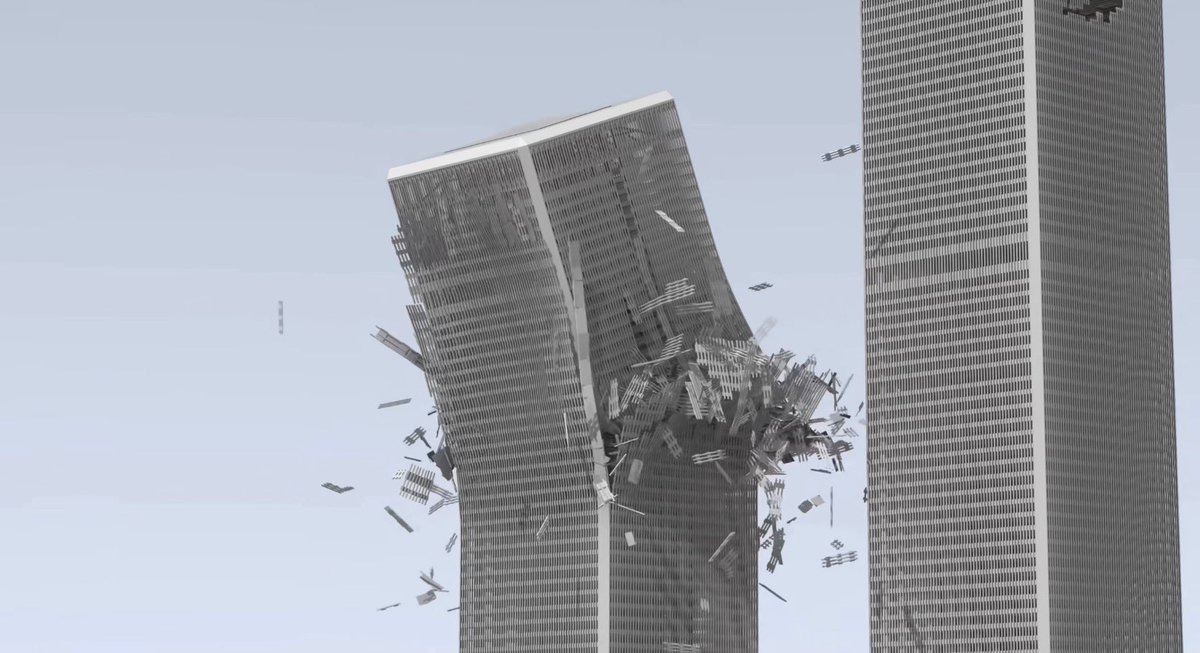
I find these World Trade Center simulations by Kostack Studio fascinating because they remove the smoke and let you see the collapse much more clearly. In the real footage, so much is hidden by fire, dust, debris, distance, and chaos that many people come away with the impression that the towers simply dropped straight down into their own footprints. But that is not really what happened. These simulations make it much easier to see that the collapse begins in the heavily damaged and fire-weakened region, the upper section starts moving and tilting, and the destruction then propagates downward through the structure. The towers do not simply disappear vertically into their own footprints. Large portions of the upper structure and exterior are moving outward and to the side as the collapse develops. Much of that motion is simply obscured in the real videos once the enormous debris cloud forms. And this is also why I find these simulations useful when people describe the collapses as looking like “controlled demolition.” Strip away the smoke and dust and the resemblance becomes much less convincing. What you see is a highly asymmetric structural failure beginning around the aircraft-damaged and fire-affected floors, followed by an enormous moving mass progressively overwhelming the structure beneath it. There is tilting, rotation, exterior columns peeling away, debris being thrown far outside the building footprint, and structural failure occurring chaotically as the collapse moves downward. That is very different from the neat mental image usually implied by “controlled demolition,” where structural supports are deliberately severed in a carefully timed sequence to produce a predetermined collapse. And importantly, we already know what preceded these collapses. Both towers suffered massive aircraft-impact damage. Fireproofing was stripped from portions of the structure. Large, uncontrolled fires then burned across multiple floors - for about 56 minutes in the South Tower and about 102 minutes in the North Tower - heating and weakening structural components until collapse initiated. Once that upper mass began moving, the loads imposed on the floors and structure beneath became vastly greater than anything they had been designed to carry. The result was progressive collapse. No, an animation is not proof simply because it looks convincing, and these are not official NIST simulations. They are visualizations built under particular assumptions. But as visualizations, I think they are extremely useful. They let you see something the original footage often cannot show clearly: beneath that enormous cloud of smoke and debris was a complicated, violent, asymmetric structural failure - not two buildings neatly dropping straight down into their own footprints. A note on the simulation: this is not intended to reproduce the collapse down to the exact motion of every beam, floor panel, and fragment of debris. No practical simulation could do that. Its value is in modeling the large-scale structural behavior - how the major sections deform, move, tilt, separate, and progressively fail. Think of it as a visualization of the mechanics and overall collapse behavior, not a frame-by-frame reconstruction of where every piece of steel ultimately landed.

Alex Boge

57,311,293 views • 15 days ago