Loading video...

Video Failed to Load

Go Home

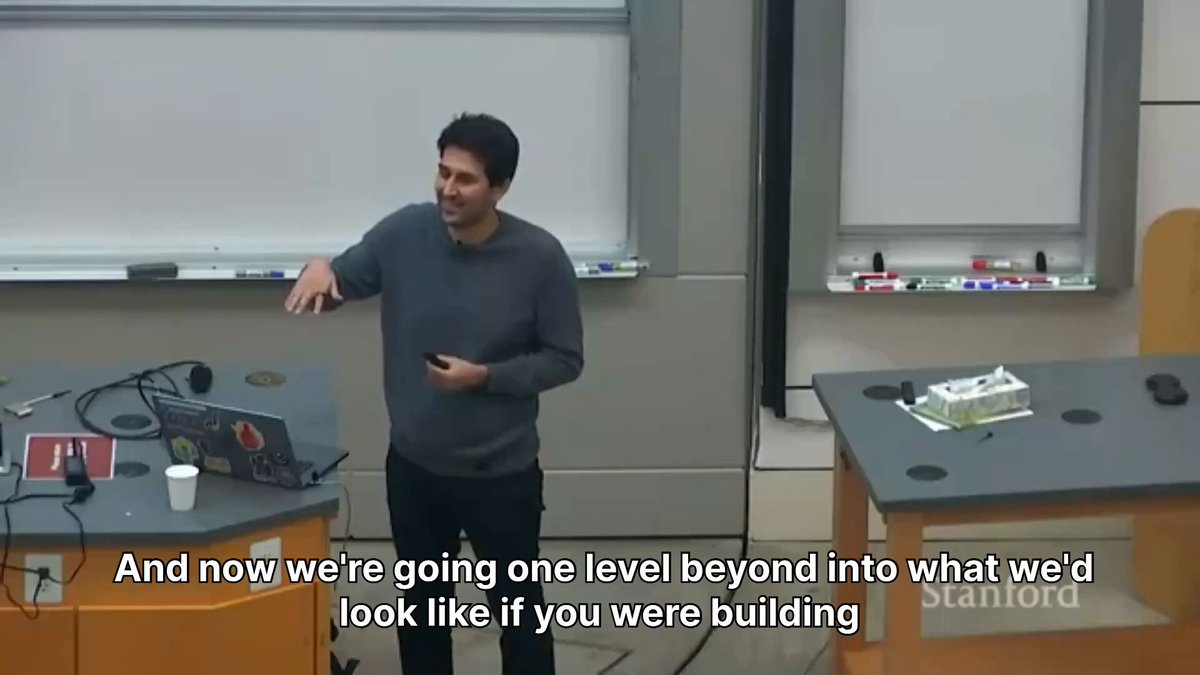
Andrej Karpathy : 10x engineers are normal. real agentic engineers are 100x this guy just shipped the exact AI Agent setup of Fable 5 and GPT 5.6 used by these 100x engineers. 12 builds with exact files. for free. better than $1000 ai agent courses watch & bookmark it...

39,389 views • 1 day ago •via X (Twitter)

0 Comments

No comments available

Comments from the original post will appear here
Related Videos

GPT-5.6 vs GPT-5.5 on my custom spaceship prompt. I gave both models the exact same custom prompt. This is also the same prompt I previously gave to Fable 5. For context, GPT-5.6 Pro worked for 87 minutes, while GPT-5.5 Extra High worked for 34 minutes and 42 seconds. As I’ve said before, based on great authority GPT-5.6 will be an incremental/soldi improvement over GPT-5.5, not a “Fable killer.” My rough expectation has been that it would trade blows with Fable 5 on some benchmarks, maybe win around half depending on the category, but not clearly surpass it overall. And again fable five will have bigger model smell, but this was expected. After testing this coding output, that view feels pretty accurate. GPT-5.6 is clearly better than GPT-5.5 in several visual areas. The lighting, shading, chairs, object details, and exterior of the spaceship looked noticeably stronger. The scene was also easier to test. I do want to give GPT-5.5 credit though. It built out the rooms much much better and the planets looked better than GPT-5.6’s. It was also interesting that both GPT-5.5 and GPT-5.6 produced better-looking planets than Fable 5 in this specific test. The downside with GPT-5.5 was stability. The game was much glitchier and harder to test compared to GPT-5.6. But when it comes to the core of the demo, which is the spaceship itself, Fable 5 still beat both models pretty comfortably. GPT-5.6 is impressive, but from this test, it looks exactly like what I expected which was a meaningful incremental improvement over GPT-5.5, at least for indie game demos, but not something that replaces Fable 5. In collaboration with Chetaslua

Chris

228,126 views • 27 days ago

Before software engineers even begin writing code, they have to set the stage of the entire development process. This process requires engineers to make complex tradeoffs between requirements, system design, and implementations details. Current IDEs that rely on AI features, like chat and inline coding, can help engineers get the job done quickly on small development tasks. Still, engineers spend much more time on larger projects—even after the initial code is generated—by conducting rigorous testing and creating documentation. This is where today’s AI IDEs can do more to accelerate the development lifecycle—and this is why we built Kiro. Kiro is an AI IDE that helps you go from prototype to production with spec-driven development and agent hooks. From simple to complex tasks, Kiro works alongside you to turn prompts into detailed specs, then into working code, docs, and test so what you build is exactly what you want and ready to share with your team. After a developer builds the code with Kiro, Kiro’s agent hooks help engineers solve challenging problems and automate tasks like generating documentation and unit tests. Kiro brings structure and mature engineering practices to AI coding, so you can go from concept to application while being in the driver’s seat every step of the way. Kiro is free during preview, and supports Mac, Windows, and Linux, and most popular programming languages. We're excited for you to try it out and let us know what you think ➡️

Swami Sivasubramanian

154,343 views • 1 year ago

Anthropic's Claude Ai Agents Team just Educated how to build production AI agents in under 30 mins. For Free. From the engineers who built the stack. CANCEL Your Weekend Plans, and Learn to Build AI Agents Today. Bookmark it. Watch it. Build your first production agent this weekend. $5,000/month. $7,000/month. $12,000/month. People are building agents for clients and charging $$$ as Beginners. You're still stuck in the thinking about AI phase. This video fixes that tonight. Follow Himanshu Kumar for more high-signal content that actually moves your AI engineering career forward. ↓ Ivan Nardini runs Developer Relations for AI at Google Cloud. He just gave away the entire production agent stack in 30 minutes. This is the talk that separates people deploying AI agents that actually scale from people whose agents break the moment they leave localhost. Here's everything inside. I break down a production AI video like this every week. Follow Himanshu Kumar. ↓ The 4-part agent stack that actually scales. Most devs are duct-taping frameworks together and calling it an "AI agent." Ivan lays out the real stack: Agent Development Kit (ADK): open-source, code-first framework for building, evaluating, and deploying agents. Supports Claude models through Vertex AI directly. Model Context Protocol (MCP): lets your agent talk to any tool or data source with one standard. Vertex AI Agent Engine: managed platform for deploying, monitoring, and scaling agents in production. No DevOps headaches. Agent-to-Agent Protocol: open protocol so agents built on different frameworks can actually work together. This is the stack replacing every hacky agent setup in production right now. Full MCP + Claude breakdowns drop weekly on Himanshu Kumar. ↓ Building your first real agent. Ivan builds a birthday planner agent live. LLM Agent class. Name it. Define instructions. Pick the model. He uses Claude 3.7 Sonnet. You could use Opus 4.7 for better reasoning. Full agent built in minutes. Not weeks. Watch the build once and you'll never structure an agent the wrong way again. I post agent architectures people pay $500 courses to learn. Himanshu Kumar. ↓ Multi-agent systems without the chaos. Single agents are easy. Multi-agent systems are where 99% of builders fail. Ivan extends the birthday planner by: Adding a calendar service through MCP tools Creating an orchestrator agent to route requests between agents Handling state and context across agent handoffs This is production multi-agent architecture. Clean. Scalable. Debuggable. Most tutorials hand-wave this part. This one shows you every step. Multi-agent orchestration content drops weekly on Himanshu Kumar. ↓ Deployment without the DevOps nightmare. This is where most AI projects die. You build a cool agent locally. It works. You try to deploy it. Everything breaks. Vertex AI Agent Engine fixes this: Minimal code deployment Automatic monitoring of latency, CPU, and memory Built-in observability and logging No infrastructure setup needed You provide config and requirements. The platform handles the rest. This is how agents actually get to production. Deployment guides for Claude agents post every week. Himanshu Kumar. ↓ Agent-to-Agent Protocol: the future nobody's talking about. Most people don't know this exists yet. The A2A Protocol lets agents built in different frameworks communicate seamlessly. Your Claude agent. My LangChain agent. Someone else's CrewAI agent. All talking to each other. All solving parts of the same problem. All without custom integration code. This is the infrastructure layer of the coming AI economy. Getting in early on A2A Protocol is like getting in early on HTTP in 1995. A2A deep dive coming soon. Himanshu Kumar. ↓ 30 minutes from the team shipping this in production. You'll learn more from this than from 6 months of YouTube tutorials made by people who've never deployed an agent past localhost. People who watch this understand production AI agents at the architect level. People who skip it keep hacking together frameworks that break every time an API updates. Save the video. Watch it tonight. Build a real agent this weekend. Follow Himanshu Kumar for more high-signal content that actually moves your AI engineering career forward.

Himanshu Kumar

226,535 views • 2 months ago