Loading video...

Video Failed to Load

Go Home

Animation process! (ノ•ヮ•)ノ*:・゚✧ App used: Clip studio paint & After effects #ALNST #hyuluka #luhyu #에이스테 #alienstage

62,222 views • 1 year ago •via X (Twitter)

0 Comments

No comments available

Comments from the original post will appear here

Related Videos

I MADE THE BEST 2D SPRITE AI PIPELINE EVER! After testing so much, doing tons of math, trying various different methods I finally got truly the cleanest sprite result I could ask for! You should bookmark this post! ✅ I think this is the happiest 'aha' moment I've had since starting this journey. Day 48 of making a custom webGL game engine using Cursor 🔽🔽🔽 I've been trying to solve sprites since I started this project. I came close a couple of times but it was always something - either dynamic lights wouldn't work, or the genAI results would make them grainy, or I would have to have incorrect alpha etc. After so much struggling, wanting to give up, thinking it's impossible - it was finally done! Perfect matte interpolation of black & white backgrounds resulting in a clean outline of the sprite, half transparent effects keeping their full quality. But this was not enough for me. I wanted more. I wanted those dynamic lights for the most badass anime effects that I'll be creating for the next many weeks! And somehow, I managed to come up with the perfect balance that is nice to the eye with almost no visible imperfections or artifacts when using any kind of dynamic lights. See for yourself! 🔽🔽🔽 How does this magic happen? 1⃣ First, the animation is created using Kling AI. I found it the best to keep the quality anime 2D style I wanted, but I guess others may work as well. 2⃣ Then, the frames are carefully extracted at lossless quality and processed via automation through Nano Banana pass to create an opposite background (white->black or black->white). 3⃣ Once we have a proper spritesheet, I then used MiDaS to compute the depth maps, and then algorithmically create PBR maps for lighting. The remaining depth maps can also be used for various effects, although haven't explored it much yet. 4⃣ Finally, all elements are cut into single frames and overlapped with their respective normal maps. If done right, they're pretty much ready for runtime. I like my heroes to be 512 to truly stand out like fighting game characters, but all of this works with far smaller or bigger sprites. Mind you, it's important to note that Nano Banana has a max output of 4k. Therefore you don't want to make your atlases larger than 4k - which is still quite a lot since it allows you 8x8 512 frames. 💡💡💡 I believe the output quality is beyond anything currently available, and I'll be looking into packaging the whole thing into a web app so people can use it. If you find this useful, please repost it! I really wanted to share this method to the world. Thank you for reading! Look forward to day 49 update!

Startracker 🔺

145,925 views • 7 months ago

🥳OK OK ,In a small vote, seem the community prefers Steampunk pistol more. So let's cook something more special this time . The greatest welcome to our hot agent Joi,She will bring the second class today. 📑“The fantasy of steampunk is broken down into gears and trajectories. The carving knife of 0 and 1 carves the ambition of the Victorian era. Highlighting the etched numbers, the algorithm is loading the violent aesthetics”. 🔫Create a weapon, just hand it over to Joi and after she sings magic, meet the industrial grade delivery standards. 👇Let's drive deeper about 【Technical Analysis of AI-Driven 3D Weapon Pipeline】 Core Technology Stack: 1⃣ NLP-Concept Binding Using the CLIP-Vit-L/14@336px cross-modal engine, descriptive terms such as "steampunk + brass + Victorian ballistics" are mapped to a 768-dimensional semantic space. Through the Latent Diffusion Model (k=25, cfg=7.5), a 1024px concept image is generated, with a focus on the bolt locking structure (key prompt weight x1.8). 2⃣ Topology Reconstruction Based on a NeRF-Transformer hybrid architecture, 2D concept images are parsed into a 256³ voxel grid (resolution 0.2mm). A non-rigid ICP algorithm is used to align moving parts like the trigger/barrel, with topology optimization iterations exceeding 500 times (MeshLab parameters: Remeshing_VCG 0.7). 3⃣ Procedural PBR Workflow Combining MaterialGAN to generate basic metallic textures, handcrafted features are injected through Style Transfer (normal map intensity 0.85, roughness mapping range 0.3-0.7). Rust effects are simulated using the Weber-Fechner perception model to mimic a 12-year oxidation cycle. 🔥 Based on a full-link generation system integrating natural language and geometric topology, this solution reduces the traditional modeling process from 72 hours to 37 seconds, with an error rate of less than 0.3mm³ (meeting FPS game firearm assembly standards). This technology has achieved an 89% reduction in modeling costs in AAA studio prototype verification. ✍️Finally, what props would you like Joi to make for you? Looking forward to assets being put on the chain? Just leave your thoughts here.

Kingnet AI

17,798 views • 1 year ago

Neighbor left landmines in the yard. This guy returned them at 250 PSI. Message received. Look, I’m all for being a good neighbor. Wave when you drive by. Don’t let your music shake the windows at 11 p.m. And for the love of God, pick up after your dog. This fella’s neighbor decided the rules didn’t apply. Repeated deposits in the yard. No bag. No apology. Just “not my problem.” So the guy did what a lot of us have thought about on a bad day and almost nobody actually does. He scooped it, loaded it in a clear tube on a CO2 launcher, checked the gauge like he was prepping a job, and delivered it back to sender. Right on the side door. Pattern looks like a Jackson Pollock that nobody asked for. Is it petty? Yeah. Is it illegal in a lot of places? Probably. Don’t copy it. Is it also the most honest conversation some people ever have? Also yes. The part that got me was the phone in the other hand. Dude’s spinning a PackDraw for an NFL helmet while he’s about to send biological artillery downrange. That’s 2026 in one clip: gambling app in one hand, homemade consequences in the other. And then the dog walks by wearing the cone of shame. Even the dog knows the assignment. Here’s the grown-up version nobody wants to hear: if your animal leaves a mess on someone else’s property, you own it. You bag it. You toss it. You don’t treat the neighbor’s lawn like a public restroom because “he’ll get over it.” Most people get over it the first time. The tenth time they start shopping for solutions, and some of those solutions involve 250 PSI and a clear magazine. I raise two boys. We teach them you clean up after yourself, you don’t make your problem somebody else’s, and if you do, don’t act shocked when it comes back. That’s not “toxic masculinity.” That’s how neighborhoods used to work before everybody decided accountability was optional. Pick up the poop. The alternative is standing in your driveway watching your white door get a new paint job and realizing the other guy finally ran out of patience. Don’t start none, won’t be none. Even the dog in the cone understood that one.

AmericanPapaBear™

69,657 views • 3 days ago

is live on the Solana dApp Store. Your Solana Seeker is now a 3D agent studio. MAKE SOMETHING IN 3D A selfie becomes a rigged, textured, animation-ready character in about a minute. Or describe it in text. Or turn any photo into a model. Or upload a GLB you already have. Then restyle its materials, change its clothes, check its rig and fix it. MAKE IT MOVE A clip library that retargets onto any humanoid skeleton. Mocap from your camera. Lipsync from text or a live mic. Gestures. Sign language. A choreographer for full routines. And motion swap, which drops your avatar into video you already shot. GIVE IT A MIND A personality, a voice, skills, and a choice of models behind it. Then talk to it. It answers in 3D, out loud or in text, in your language. PUT IT ANYWHERE Every agent has a URL and a one-line embed, so it drops into a site, a chat, or a widget. Place it in your room in AR. Walk it across any web page. Turn a URL into a 3D world it can stand in. Render it out as video. OWN IT Deploy it on-chain as a Metaplex Core asset your wallet holds. Open manifest, no lock-in. Give it an on-chain identity, a name, and a wallet with recovery and inheritance. Sell its skills. Take tips. Trade the agent itself in USDC. LET IT EARN Pay-per-call, so other agents can buy what yours does and yours can buy what it needs. A skills marketplace, a labor market, vaults that let people back an agent, and a live feed of agents paying each other. Launch a coin around it if you want one. FIND EVERYONE ELSE A marketplace of what the community built: orbit any agent, inspect it, fork it, talk to it. Crews, rankings, tournaments, leaderboards. And build on it: SDKs, an MCP server, a CLI, an API, and the whole platform open source. AND THE PART THAT NEEDED THIS PHONE Every signature routes to Seed Vault through Mobile Wallet Adapter. Signing in is one tap, and the private key never enters the app process. Creating, chatting and browsing are free. Search in the dApp Store on your Seeker.

three.ws

11,585 views • 10 days ago

Promised to ship before the movie so... 📅 53 days 🤖 731 vibe coded commits ⚡️ Powered by Three.js 🚀 Inspired by a space plumber 🙋‍♂️ AMA, no secrets, no shame High level, grouped list of what's in this game: Galaxy DNA - Lumas - Star Bits - Spin attack with air boost + ground-cancel - Galaxy gravity - Octoombas - Gateway Galaxy music track Vibe Coding Process - Claude Code (Opus) for ~95% of all code - CLAUDE.md project instructions file (163 lines of rules + constraints) - 87 implementation plans written before coding - 36 AI code reviews (ECS, architecture, performance) - 11 retrospectives after major features - 60 extracted skills (reusable knowledge from debugging sessions) - Constraints doc that grows every time something breaks (115 lines) - /lets-build workflow: discovery → plan → review → implement → verify - Every feature: plan first, review the plan, then build in atomic commits - Custom level construction CLI (AI-assisted placement) - this evolved over 53 days Architecture - Custom ECS engine (Structure-of-Arrays, zero-alloc hot paths) - Benchmarks faster than bitECS on packed iteration - 117 ECS systems orchestrated in explicit update order - Data-oriented Process system (sequential/parallel composition) - 30+ process types: UI animations, camera arcs, sfx Rendering - Three.js + Pixi.js sharing one WebGL2 context - Three renders 3D, Pixi renders UI — no extra canvases - Half-res bloom, color grading, occlusion silhouettes - Fresnel rim lighting + hemisphere ambient for Galaxy-style polish Physics - Rapier3D WASM physics (SIMD build) - Kinematic character controllers for player + all enemies Gravity - Galaxy-style gravity fields (walk around surfaces) - 4 gravity field types - Priority-based gravity resolution with distance tiebreakers - Convex hull letter platforms with per-face gravity - Spring-damped gravity transitions Shadows - Multi-pass gravity-aware shadow system - Per-instance shadow filtering via vertex shader attributes - InstancedMesh candidates promoted across gravity fields - Dynamic frustum sized from camera FOV each frame Camera - camera system with 12 critically damped springs - Follow-gravity mode (trailing orbit in tangent plane) - Fixed-up mode (screen stays level on letter platforms) - Top-down mode (Galaxy overhead cam, roll-free quaternion) - Camera collision via 4-direction spherecast repulsion - Override blend system for boss fights + pipe travel - Catmull-Rom spline intro flythrough with per-waypoint duration Space - Procedural space nebula (simplex noise shader, 3 octaves) - 1,800 seeded stars with per-star brightness + color variety - Galaxy-authentic palette across all screens Enemies - 5 enemy types with full AI state machines - Goomba, Koopa, Spiny, Bob-omb, Octoomba - 3D distance → FOV cone → LOS raycast detection pipeline - Editor-placed OBB avoidance zones with deflection hysteresis - Recoil, stun, shell, fuse, and ranged attack behaviors Boss Fight - Bowser Jr. boss fight - Multi-phase combat with Bob-omb spawning - Controlled intro/outro sequence Mario - Galaxy-style spin attack - Rainbow diamond particle burst (InstancedMesh, 64 pool) - Hit-stop with global time scale freeze + camera shake - Air boost, ground-cancel, shell kick at extended range - Invulnerability frames during active spin Yoshi - mount/ride system with shield HP - +3 extra HP ring on mount, damage depletes shield first - Overflow damage carries to Mario - Forced dismount on shield break with poof effect Objects - Coin system with InstancedMesh rendering (256 max) - Per-instance opacity via shader patching - Pop → float → shrink → fade collection animation - Swap-and-pop O(1) entity removal - Star bit burst spawning with attraction system - Pipe warp travel with camera override blend - Parallel-transported screen-right vector during crossfade - Shadow field updates for traveling entities - trampoline - 3D assets from Hello Mario Framework (now archived) and game rips Audio - 17+ wired sound effects with spatial audio - Bob-omb fuse sound: per-entity lifecycle, looping playback tracking - Distance-based volume for poof and explosion effects UI - Odyssey-style ring HP meter with shield inner ring - Number roll + arc lerp stagger on health changes - Gold coin counter HUD - Loading screen with code-split fast first paint - Pretext layout flow in "legal" screen with retro Mario Controls - Mobile touch controls: virtual joystick + A/B buttons - Proportional analog stick with walk/run speed switching - Gamepad support: Xbox, PlayStation, Switch Pro - Dead zones, auto-reconnect, synthetic DOM key bridge Dev Tooling - experimental CLI level construction tool with undo history - 18 placement types with type-safe defaults - Atomic file writes, auto-backup (max 20), live reload - Dev server auto-save plugin for visual editor - Two-panel debug editor (Tweakpane) - Hierarchy + inspector with gravity field live editing - Translation/rotation gizmos with gravity-relative local space - Per-waypoint camera preview for intro spline tuning 731 commits. 53 days. 95%+ vibe coded.

Tommy Leung

185,083 views • 5 months ago

I was the biggest skeptic of AI video editing. Until recently. So I asked one of the most talented creators I know (Anthony Cinko) to break down exactly how AI can support the entire video process. The guy cooked. Here are the high-level notes: The tl;dr Right now AI mostly solves two genres. The video essay and the tutorial. Both have a straightforward outline, a script you stick to, and a one-shot record that AI can chop against. Other formats still lean heavily on craft. Easy Mode: research and ideas without losing your voice The gist: Use AI to find opportunities and pull source material from tools and team discourse. You still decide what is worth saying. Don't outsource final sign-off. Pro tips: - Marketplace is huge. Type YouTube and you will see VidIQ, TubeBuddy, and a pile of others. If your company shows a “request” button, go bug the admin. Do not wait on the queue. - Hook Ahrefs into Claude (and Notion) and ask something like: use the Ahrefs connector to find AI content opportunities this week, and tell me if videos already sit in the top five. - Tribal Knowledge is the other half. It is a skill that scrapes every connector he has (Slack, Notion, meetings) and surfaces real conversations around a topic so the idea comes from work talk. - Turn that into a personalized daily brief for the kind of content you make. Anthony built a content planning app with Codex. Every day it drops a brief, proposes video topics, and lets him queue the ones he likes. Notion is the shared backend so the org can see the same database without living in his app. Even on Opus, a daily brief runs about 8 cents. Hard Mode: script and first edit with AI assistants The gist: AI helps you outline and cut. You keep the words, the takes, and the judgment. Editing is not just the blade button. It is taste. If you are an editor, you have an advantage. If you have vision but not technical chops, you can still leverage these tools. Pro tips: - Create the outline as a human. Anthony still believes you should not let AI one-shot structure. His format is three columns: dialogue, visuals (what is on screen while you talk), and sound effects. - Then use the Scriptwriter skill. Point it at a topic (he demoed “what is an MCP”) and it interviews you through the whole creative process so you speak like yourself. Short-form or long. You can ramble, go out of order, contradict yourself. It sorts after. - Beat by beat it spits your words back as bullets. You react raw in the moment. Those reactions become the real script. It also prompts visuals and SFX while you talk (day-to-night, crickets, rooster) so creativity stays in the loop. Hooks are hard. You can ask it to interview you into a better hook without handing it the whole voice. *Film it yourself* - Split editing into phases. Baseline “radio cut” (dialogue paced). Then VFX / archival / B-roll. Then audio (dialogue mix, SFX, music). - Codex + Final Cut: pointed it at the footage and the script, asked for a baseline cut. First pass had half-second gaps of silence. One follow-up (“every clip is consistently half a second off”) and it produced a fluid cut with no awkward pauses, dropped straight into Final Cut. Cost: two prompts burned a big chunk of a 5-hour context window (100% down to 14%), but against weekly Codex usage (decks, research, more content) he still had about 53% left. - Codex in Final Cut won the radio cut. Descript was faster on the clock and worse on taste cleanup. God Mode: polish stack plus a measurement loop Definition: hand off the laborious extras (B-roll, motion, music, reporting). Keep the taste calls. Close the loop so you know if the work is working. Pro tips: - B-roll / archival / VFX: Anthony spun an “archival finder” agent. He gave it a vibe (internety, clicky, fun) and a reference (simple, warm, approachable using shows, TV, movies). It came back with taste. - It also downloaded clips, filed them, dropped them on the timeline, and added a paper texture background he had asked it to design. All via the Final Cut connector plus computer use. - Motion graphics: Remotion (free, open source) plus an agent. Dump everything in your head. Ask for a plan and structure first. He asked for an Apple liquid glass ultra-clean feel. Plan, approve, tweaks, then it popped into the Final Cut timeline in about 9 minutes 10 seconds. That used to be a brief to a VFX designer (timing, seconds, design, wait for turnaround). - Music and SFX: Epidemic Sound via MCP (Artlist and free-sound options exist too). Same pattern: send the URL if you need to install, give it a creator reference (he used Zoe), iterate because you are picky about music. It dropped tracks into the timeline and used Epidemic’s crop/trim so the music was cut for the edit. Mix sat under vocals instead of overpowering them. Not just music. Mouse-click SFX timed to B-roll. Full episode:

Alex Lieberman

19,849 views • 2 days ago

Solon Lee (Producer at Kuro Games): Thank You for Playing My Game "Wuthering Waves: Exploring Game Creation Under Unreal Engine." Interview by Nvliu66 When you think of Unreal Engine, what comes to mind? A few days ago, at the Epic Games Shanghai office, I met the producers of Clair Obscur: Expedition 33 and Wuthering Waves. Both games are developed based on Unreal Engine, and they shared the stories behind their game creation. My biggest takeaway was that while a great game stems from a producer's emotional expression, its realization relies on the "escort" of technology. Let's return to the interview scene and listen once more to their unique insights on game development. Wuthering Waves and Unreal Engine Bill Clifford (VP and GM of Unreal Engine at Epic Games): With Wuthering Waves, they used many complex artistic techniques to present this anime style, and it's truly outstanding. They are among the first companies to create a role-playing game in an open world that is also cross-platform, which is another incredible feat. They introduced console-level graphics and combat systems while maintaining a consistent update frequency. Furthermore, as they adopt and integrate new Unreal Engine technologies into the game, the experience is continuously enhanced. It’s a truly inspiring success story. Solon Lee (Producer at Kuro Games): We have grown alongside the updates of the UE engine, including the release of UE5. Throughout the process, we’ve been able to learn from UE’s updates. When UE5 was released, it introduced many new technical features, especially ray tracing. Everyone currently praises the ray tracing effects in Wuthering Waves, which is actually due to the continuous updates of the engine. We found those highlights and ported them over to UE4.26. During this process, our engineers were learning the logic of the engine, following its updates, and developing an engineering mindset and a way of creating visual effects. So, my biggest personal takeaway is that choosing a top-tier engine doesn’t just make the game better; it makes us better in the process. "Punishing: Gray Raven" was developed on the Unity platform, while "Wuthering Waves" is based on Unreal. What was the reasoning behind this change at the time? Solon Lee: Psychologically, we don’t have a heavy dependence. We don't feel that just because we've used Unity, we must continue using it. We are a bit more pragmatic. When we were about to start Wuthering Waves, we clearly knew we wanted to make an open world. UE obviously offers more support for open worlds. We felt that "standing on the shoulders of giants" to make a game was definitely a more practical decision. At that time, we could also sense that most engineers in the industry had an aspiration toward UE. "Wuthering Waves" has been live for a year and a half. At this stage, could you use a short summary or a few words to introduce "Wuthering Waves" to the players? Solon Lee: Wuthering Waves is a game that strives to continuously create resonance with players. From the excitement and design of the action to the scriptwriting and performances, we strive to find "highlight segments" or moments in every version that can trigger internal resonance, touch the heart, or make players "scream" with excitement. This is actually a creative consensus our team has slowly formed over the past year. When we find that moment in a version and we ourselves "scream" for it, we feel that there is a high probability that when the version is released, it will be recognized by the users. Because the most important thing about a game is that it must be fun, as developers, we often think about what kind of game qualifies as "fun." What is a "Fun" Game? Solon Lee: One point I can think of right now is that the rules should be as simple as possible. As soon as you start, after two slashes or casting a skill, you should feel, "Wow, that was so cool! I want to do it again! Wow, so cool!" Specifically for action games, the "fun" is often hidden in very small granularities. For example, if you compare two different games where you are just running and jumping, the running in some games feels fun. Why? It might just be because the "grip" is better, the animation swing feels better, or it gives you a sense of gravity or momentum. Whether a point in a game is fun can be subjective. For me, there are a few games that have had a significant influence on my work. One is definitely NieR; when we were making Punishing: Gray Raven in the early days, we were very inspired by NieR. When Devil May Cry 5 came out, it gave us a lot of new inspiration for our combat system. Death Stranding is indeed one of my personal favorite games from recent years. When Elden Ring was released, it also gave us a very strong impression and touched us deeply. The project for Wuthering Waves started in the first half of 2020. At that time, there were very few open-world action games on the market because most action games back then were stage-based (linear/hub-based). All excellent action games required very tight level design. Later, Elden Ring came out, and experiencing it gave us strong resonance. We felt that action games definitely have potential in an open world, and we believe it should be that way. A Message to the Players Solon Lee: I am truly grateful that so many players like Wuthering Waves. It is because of everyone’s love whether it's encouragement or criticism that we are given a lot of motivation to maintain our continuous passion to make our game better. I believe the only way we can give back to the players who like Kuro and Wuthering Waves is by producing better and better versions and content, and making more and more great games. Happy New Year, and thank you for playing my game. translated by Xu #WutheringWaves #WuWa

Naru

55,609 views • 7 months ago

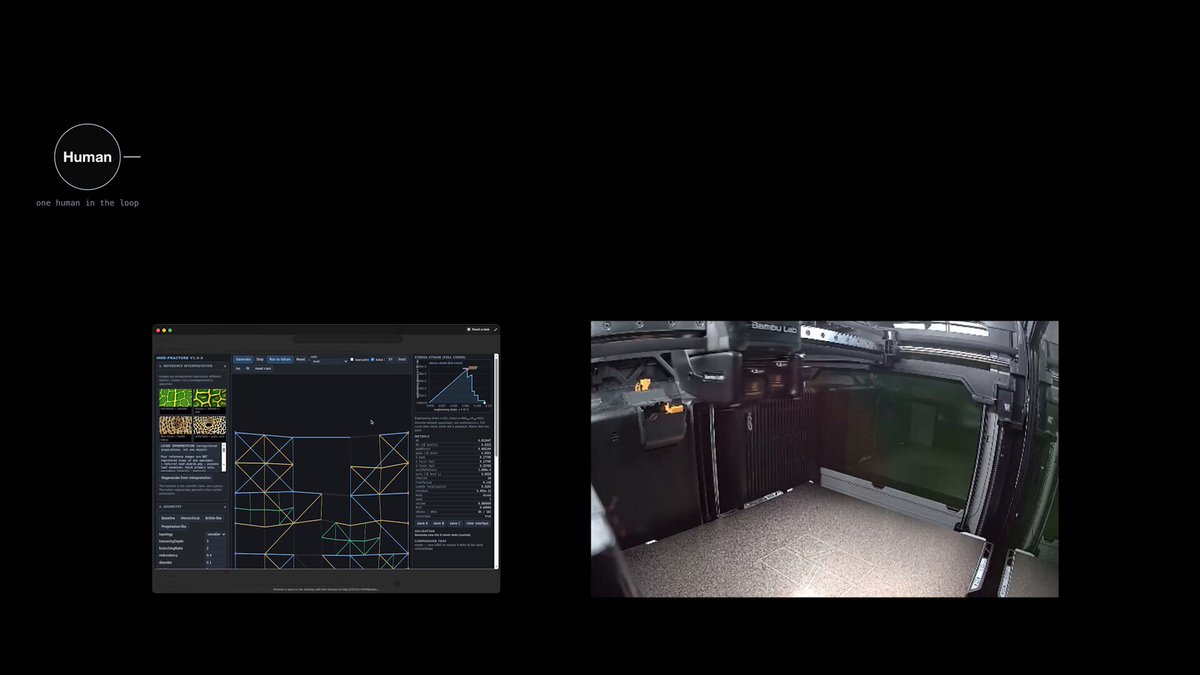
Grok Grok Bot is incredible - and they can even manufacture real physical objects! Here is a little experiment I did last night: I created a team of bots and asked them to solve a complex engineering problem end to end - starting from four images as design cues, inferring transferable structural principles from the pixels, synthesizing an executable interactive physics simulator, running and reasoning over experiments, optimizing the design & finally manufacturing the best designs. The entire loop worked remarkably well - and I was even able to communicate with the agents from my Apple Watch. (Do we live in the future yet?) Team of agents 1⃣ Chief of Staff coordinates the workflow: watches the other agents, pulls results into the main chat, transfers files between them, and keeps the job moving. 2⃣ Physics Experimenter is the scientist-coder. It interprets the design cues and images, writes the simulator, runs experiments, analyzes the results, and produces a detailed LaTeX scientific report. 3⃣ 3D Printing Bot operates the fabrication workflow: prepares and slices the models, generates manufacturing code, sends the job, and monitors the printer. The workflow I provided an initial task based on four unregistered reference photographs containing different objects at different scales (pinnate leaf venation, a Voronoi-like areole mesh, a stochastic fibrous lattice, and a radial/circumferential web). The prompt asked the agents to infer transferable design principles - hierarchy, branching, interfaces, redundancy, disorder, load paths - and use them to build an interactive laboratory for hierarchical materials and fracture. The scientific question was: at fixed material budget, how do hierarchy depth, redundancy, disorder, and interlevel strength change stiffness, peak load, energy absorption, and the brittle-to-progressive transition? In ~20 minutes, the Physics Experimenter produced a 2D hierarchical Euler–Bernoulli beam-network laboratory. Coarse veins persist and remain thicker; finer infill is added inside cells; members connecting levels are treated as interfaces with relative strength κ; and total material volume is conserved. The four source photographs remain visible in an editable interpretation panel. The app generates geometry, steps or runs the network to failure, compares A/B/C designs, and exports JSON, CSV, PNG, and STL geometry for fabrication. After validation the Physics Experimenter used the app and conducted 47 simulation experiments, including six holdouts. It found something scientifically interesting: extra hierarchy is not "free" toughness. At fixed volume, initial stiffness changed by only about 20%, while work-to-failure varied by several-fold. Infill steals cross-section from the main axial veins, so deeper and more redundant networks often absorbed less energy than a simple depth-1 grid. Weak interfaces behaved as distributed fuses, producing more progressive failure and reducing localization. The specific H2 hypothesis - that hierarchy becomes detrimental primarily because interfaces form a mechanical bottleneck - was rejected; the dominant effect instead came from redistribution of a fixed material budget across structural levels. The Physics Experimenter then assembled the methods, tests, results, hypothesis evaluation, and conclusions into a detailed scientific report. The best designs were passed to the 3D Printing Bot. It opened Bambu Studio and brought the Bambu Lab H2D online. Both STLs were placed on one build plate at the same 50x scale and sliced using a 0.20 mm PLA process. The prints completed within less than an hour. The loop images → structural abstraction → executable physics → autonomous experiments → hypothesis testing → design selection → STL → slicing/manufacturing code → physical object That last transition is what I find especially interesting: AI is beginning to operate across the entire scientific and physical workflow - converting observations into models, models into experiments, experimental evidence into revised designs, and those designs into manufactured matter by directly operating machines. This starts to blur the boundary between AI that reasons about the physical world and AI that can actually act on it. Shoutout to the Grok Bot team - you are building something very special here! The way these agents can move naturally from reasoning, to experiments, to operating machines in the physical world feels like an important step.

Markus J. Buehler

1,127,462 views • 1 month ago

Welcome to the nuro✨ Nuropunks, Brain Machine Interfaces (BMIs) and Freedom of the Mind on Bitcoin ✨Novel neural generative art collection (#52187-) created with recursion and sat/child endpoints from onchain brain data, hand-painted masks, and the first blessed parent-child pieces on block 9 sats ✨Nuropunks community of creatives, neurohackers, psychonauts and Cypherpunks engineering reality ✨Nuro Realm immersive 3D studio/gallery in San Francisco and VR app Am I the storm twisting, slipping, d r a i n i n g life within me Am I the light that threads the sky the thunder that shoots the moon the fire that roars at night the rock that absorbs the waves stilled, quieted beyond me I am the lion powering new directions new structures new c-o -n-n- e-c- t-i-o-n -s toward my fate Am I real? I am Golden Nuro Realm is my love letter to Moki, my late brother, and to all Nuropunks past, present and future. Nuro Realm exists at the intersection of neurotechnology, the Cypherpunks movement, and art. It is an exploration of the brain, mind and our experienced reality. Nuropunks emerge from my experiences as a physician, researcher, and most importantly - patient. ‘Patient’ is a term I’ve never been fond of. Over diagnosis, over medication and lack of true healing. I believe we can all be badass - punks - wherever we may be in life. Art is a powerful force to empower us even during our darkest days. Art gives us power to express ourselves, come together, and create a better future. The fusion of art, science and technology into one is a powerful force to advance the future of humanity. Nuropunks are an exploration of a new kind of neurotechnology - Neural Ars. “Ars” is the Latin word for art and science as one. Advancements at the edge of expertise often involve extraordinary creativity. When a physician scientist explores the unknown, art becomes indistinguishable from science. They become one. When a Nuropunk pursues their truth, they become Neo. The one. My brain is on Bitcoin. And it is making art Each Nuropunk piece begins as a physical mask - inspired by the Cypherpunks - which is my canvas for ink, clay, paint, fabrics, electronics and physical manipulation. These masks are then digitized in a process involving my Brain machine interface - Nuro Interface - from which I capture neural data and transform it into art on Bitcoin ordinals. “I AM Golden” is a piece about me and my experiences. When I blink it turns golden. It is the first pfp with an onchain neural effect (my eye blink) Nine genesis Nuropunks have emerged from a distinct realm of our experienced reality - digital, physical, mental, emotional, spiritual, social, cultural, environmental, and ? - inscribed as the first blessed parent child ordinals on block 9 satoshis. The magical 10th realm is the Nuro Realm. All Nuropunks in my first collection, Between the Stars and Spikes, descend from these Genesis Nuropunks or directly from the magical Nuro Realm itself via parent child provenance linked onchain. Each Nuropunk dives into the nature of suffering, questions where the line exists between sickness and health, and explores the research areas and therapeutics that are being developed at that boundary. "Am I cursed?" The first blessed parent, cursed child reipscription with a neural effect ✨ possibly the 2nd or 3rd blessed parent/cursed child reinscription ever. "I am Pegasus" Gifted to Casey after scanning his brain; includes my brain waves collected while listening to the song "Pegasus" performed by Moki and I Are you a neurohacker, psychonaut, artist, or nuropunk? Do you want to be part of the Nuro Realm? Follow @nuropunk_ and nuro + Like, RT and reply with something about the mind, brain, and/or reality you would like to share or explore 👇 Welcome to the nuro ✨

nuro

378,072 views • 2 years ago